eBook - ePub
Differentiating Assessment in Middle and High School English and Social Studies
- 208 pages
- English
- ePUB (mobile friendly)
- Available on iOS & Android
eBook - ePub
Differentiating Assessment in Middle and High School English and Social Studies
About this book
This book by Sheryn Spencer Waterman follows the bestselling Handbook on Differentiated Instruction for Middle and High Schools. With numerous examples and strategies, it is an all-inclusive manual on assessing student readiness, interests, learning and thinking styles. It includes examples of Pre-, Formative and Summative assessments Informal and formal assessments Oral and written assessments Project and performance assessments Highly structured and enrichment assessments for struggling to gifted students Assessment tools and rubrics
Information
1
Differentiated Assessment
Introduction
Assessment is probably the most important aspect of the learning experience. In fact, I suggest generally that the ratio of instruction to assessment should be approximately 1 to 4. For example, for every 10 minutes of instruction, the teacher should consider including approximately 40 minutes of assessment. More than allowing teachers and students to know what students already know and what they are learning or have learned, assessment supports instruction so that learning can take place.
In addition to being critically important to instruction, assessments that address students’ needs are the most useful. Focusing on how teachers might differentiate assessment should greatly improve learning outcomes. This book provides an overview of assessment in conjunction with differentiation, an explanation of general differentiated assessment strategies, three chapters of examples differentiated by readiness for at-risk, average, and gifted or highly advanced students, and a chapter that shows how to put several assessment strategies together in a differentiated unit of study.
Some Concepts to Understand
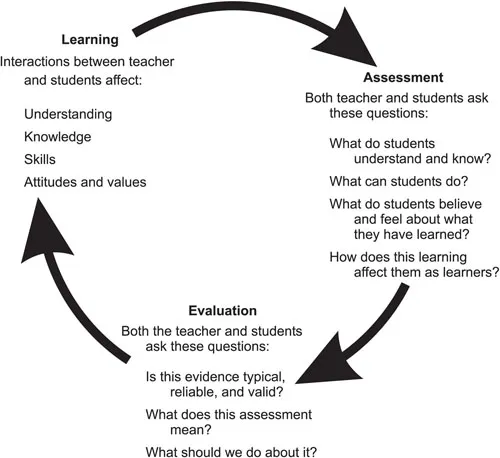
There are many important issues to consider as we explore differentiated assessment. First, we should define the important terms that help us understand how learning, assessment, and evaluation interact. Figure 1.1 is an interesting visual adapted from Trussell-Cullen (1998, p. 7).
Figure 1.1. Learning ➔ Assessment ➔ Evaluation ➔ Loop ➔ Learning, etc.
Defining Differentiated Assessment
Keeping these distinctions in mind, this book will focus on the “assessment” part of these concepts. We define “differentiation” as adjustments teachers make to address the learning needs of all students. (Northey, 2005; Tomlinson, 1995, 1999, 2003; Wormeli, 2006) When we combine assessment with differentiation, we can say that “differentiated assessment” is the process of finding out in a fair way what each individual student knows, understands, and can do (KUD), how they feel about what they have learned, and how they feel about themselves as learners.
Here is a list of criteria for good assessments suggested by Rick Wormeli (2006, pp. 39–41; see his book for a full discussion of each one).
Good assessment
♦ Increases learning rather than merely documenting it
♦ Chooses what is most important for students to learn
♦ Helps inform instruction
♦ Goes on throughout the unit of study and never saved for only “the end”
♦ Addresses knowledge, understanding, and skill development in a meaningful way
♦ Is authentic either to a real-world experience or to the way the information was taught
♦ Shows clear and valid information about what students have actually learned
♦ Is reliable across time and across classes of students
♦ Is timed well to check for learning
♦ Is integrated with other subjects
♦ Requires use of a variety of tools
♦ Helps teachers determine students’ misunderstanding of the what students are learning
♦ Asks for students’ input
♦ Is varied and differentiated
If teachers want to become skilled at implementing differentiated assessment in their classrooms, they might address these six parts of assessment planning as follows in Figure 1.2.
Figure 1.2. Six Parts of Planning Differentiated Assessment
| 1. | Students’ needs: | Who are the students in terms of: (a) readiness, (b) interests, and (c) learning and thinking styles, and what do they already know about the topic? |
| 2. | Curriculum: | What enduring essential knowledge (EEK) (expressed as essential questions [EQ]) do these students need to know, understand, and do (KUD)? Note that the measurable objective(s) is listed separately in Part 3 below but is also included in the curriculum. |
| 3. | Measurable objectives: | How will the teacher measure that learning? |
| 4. | Differentiation: | How should the teacher differentiate the assessment to meet students’ learning needs? |
| 5. | Procedures: | What procedures will the teacher follow to implement the assessment? |
| 6. | Assessment audit: | How will teachers evaluate the alignment of the assessment(s) and procedures so that they have a clear picture of what each student knows, understands, and can do related to the content? |
Students’ Needs
In the first step of this implementation process, the teacher should assess students’ readiness, interests, and learning or thinking styles. The following sections are an overview of how we should think about these factors.
Readiness
Assessment and the Zone of Proximal Development
When teachers plan assessments for students, they need to make certain to align them with students’ readiness to learn. If the assessment is too simple or not sensitive to the students’ level of development, then students may feel less motivated to stretch toward higher levels of learning. Teachers should be aware of what Vygotsky (1978) calls the “zone of proximal development” (ZPD), which is defined as the difference between what a person can do alone and what the person needs help to do. Most teachers know early in the year how well their students read, how well they solve learning problems, and how motivated they are to learn. If the teacher needs specific tools to assess these issues, Northey (2005) has several ideas for assessing reading, interests, and learning styles. Teachers must also at times use materials above or below the readiness level of some or all of their students. Picture books on the lower end and computer-generate...
Table of contents
- Cover
- Title Page
- Copyright Page
- Table of Contents
- Meet the Author
- Free Downloads
- 1 Differentiated Assessment
- 2 Types and Examples of Differentiated Assessments
- 3 Highly Structured English and Social Studies Assessments
- 4 English and Social Studies Assessments with Moderate to No Scaffolding
- 5 Enriched English and Social Studies Assessments
- 6 Putting It All Together
- References
Trusted by 375,005 students
Access to over 1.5 million titles for a fair monthly price.
Study more efficiently using our study tools.
Frequently asked questions
Yes, you can cancel anytime from the Subscription tab in your account settings on the Perlego website. Your subscription will stay active until the end of your current billing period. Learn how to cancel your subscription
No, books cannot be downloaded as external files, such as PDFs, for use outside of Perlego. However, you can download books within the Perlego app for offline reading on mobile or tablet. Learn how to download books offline
Perlego offers two plans: Essential and Complete
- Essential is ideal for learners and professionals who enjoy exploring a wide range of subjects. Access the Essential Library with 800,000+ trusted titles and best-sellers across business, personal growth, and the humanities. Includes unlimited reading time and Standard Read Aloud voice.
- Complete: Perfect for advanced learners and researchers needing full, unrestricted access. Unlock 1.5M+ books across hundreds of subjects, including academic and specialized titles. The Complete Plan also includes advanced features like Premium Read Aloud and Research Assistant.
We are an online textbook subscription service, where you can get access to an entire online library for less than the price of a single book per month. With over 1.5 million books across 990+ topics, we’ve got you covered! Learn about our mission
Look out for the read-aloud symbol on your next book to see if you can listen to it. The read-aloud tool reads text aloud for you, highlighting the text as it is being read. You can pause it, speed it up and slow it down. Learn more about Read Aloud
Yes! You can use the Perlego app on both iOS and Android devices to read anytime, anywhere — even offline. Perfect for commutes or when you’re on the go.
Please note we cannot support devices running on iOS 13 and Android 7 or earlier. Learn more about using the app
Please note we cannot support devices running on iOS 13 and Android 7 or earlier. Learn more about using the app
Yes, you can access Differentiating Assessment in Middle and High School English and Social Studies by Sheryn Spencer-Waterman in PDF and/or ePUB format, as well as other popular books in Education & Education General. We have over 1.5 million books available in our catalogue for you to explore.