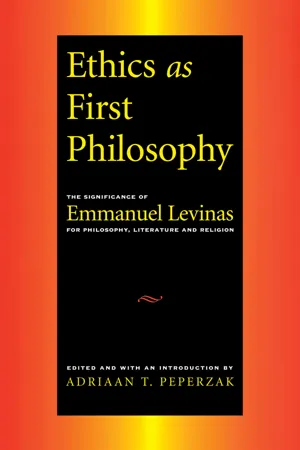
In Ethics as First Philosophy, Adrian P. Peperzak brings together a wide range of essays by leading international scholars to discuss the work of the 20th century French philosopher, Emmanuel Levinas. The first book of its kind, this collection explores the significance of Levinas' texts for the study of philosophy, psychology and religion. Offering a complete account of the most recent research on Levinas, Ethics as First Philosophy is an extraordinary overview of the various approaches which have been adopted in interpreting the work of a revolutionary but difficult contemporary thinker.
eBook - ePub
Ethics as First Philosophy
The Significance of Emmanuel Levinas for Philosophy, Literature and Religion
- 288 pages
- English
- ePUB (mobile friendly)
- Available on iOS & Android
eBook - ePub
Ethics as First Philosophy
The Significance of Emmanuel Levinas for Philosophy, Literature and Religion
About this book
Information
1
The Philosophy of Emmanuel Levinas and the Hebraic Tradition
Emmanuel Levinas started learning the Bible while he was a child in Lithuania, yet he discovered the rabbinic commentaries later on, after the Second World War, after the Catastrophe, while living in Paris. His master was named Chouchani, a mysterious master but also a very renowned one. To this day Levinas does not neglect to quote and praise him. In this paper I shall explain why both the Bible and the rabbinic commentaries—which are absolutely indissociable for a Jew—are essential in order to understand Levinas’s philosophy.
My first aim will be to articulate the significance of the tension between philosophy and Judaism in Levinas’s thinking. In the second part of this paper I shall refer to the ideas of responsibility and freedom in order to elucidate better this significance.
Philosophy and Judaism
One of Levinas’s philosophical aims is to refer to the Greek language of philosophy—a language he asserts to be of universal import—in order to elucidate ideas that come from the Hebrew worldview, from the prophets and from the sages. He wants to give a new insight into Greek categories and concepts, but he refuses to abnegate the philosophical requirements for accuracy. That is why when he refers to biblical verses or to talmudic apologies, or when he makes mention of one sage’s name or another’s, he does not want to prove anything: “The verses of the Bible do not here have as their function to serve as proofs; but they do bear witness to a tradition and an experience” (HAH 96; CP 148).
They bear witness to a tradition of thinking—and not to a faith. According to Levinas, this tradition of thinking is essential to human thought as such. Yet Levinas’s philosophical writings are indeed philosophical because their author does not yield to the temptation of substituting the authority of a certain verse or a certain name for the philosophical requirement of argumentation.
Levinas explains that “the split within the spirit between Jewish wisdom and Greek wisdom,” “the rift in a world which is both attached to its philosophers and to its prophets” (TaI 24), puts its mark on the spiritual and intellectual history of Western culture.
Of course, philosophers have been thinking about Judaism—thus Hegel assigned it a place in his system—but they have not really been anxious to learn something from it since, according to most of them, Judaism has been surpassed by Christianity. None of them could really admit Judaism as a living reality. Philosophers have borrowed some important ideas from the Bible—such as the ideas of transcendence or of creation—but Judaism cannot be reduced to a philosophy. This knowledge remains far away indeed from the lively tradition of reading the Torah, which is what counts in Judaism.
It is also true that Judaism has always been suspicious of philosophy. The rabbis have always looked askance at the ideal of a conceptual mastery of reality and of the autonomy of a reason that does not care to obey Revelation. It is true that Philo of Alexandria and Maimonides, for instance, tried to join together philosophy and Judaism. Philo tried to give an allegorical interpretation of the Bible by using Plato’s philosophy; Maimonides tried to do the same by using Aristotle’s main concepts. But their endeavor is not widespread among Jewish thinkers and it has been, and still is, much criticized. At any rate, Levinas’s project is very different from these earlier ones.
Levinas lives and thinks in a world that is wounded. After the Shoah, how is it possible to think the way people were thinking before this disaster? He thinks he has to explain to the Jews—and, of course, to every one else—that Judaism can give us back the meaning we have lost in this disaster, a meaning that philosophy and Christian culture were unable to protect. He thinks his task—which is very urgent— is impossible, however, without referring to the philosophical way of thinking. One has to use a universal means of communicating, which for Levinas is the logos.
An alliance of Judaism with philosophy is necessary for the Jews who have been living in a Christian world for years without knowing anything about Judaism. It is necessary if we want Judaism to be something besides a mere memory, since a memory does not replace a civilization.
It is also necessary for philosophers to understand better why when a man agrees to be inspired by a prophetic book, it does not mean that he praises irrationality but that he tries to explain why human thinking may not be content with discursive reasoning. According to Levinas the appeal to prophetic inspiration means, instead, that the first word of all language, the Saying—the word to which all the others, the Said, answer—is greater than being and transcends it. The rational way of thinking tries to master such an “extravagance,” such a “delirium,” and to rebel against an original transcendence that breaks the logos. The rational way of thinking requires a consistent discursive reasoning. Yet it recognizes the extravagance against which it fights. In Levinas’s philosophy, such an extravagance is the extravagance of the Infinite or of God, the extravagance of a transcendence that directs all thoughts and all words toward meaning.
After the collapse of Western culture, Levinas wants to explain to his contemporaries what is unique in Judaism, but he wants to remain faithful to the language of philosophy. He thinks that the conflict between, on the one hand, the upholders of inspiration by a prophetic book and, on the other, those who deny that such a book has any value from a philosophical point of view must not be settled by the victory of one camp and the disappearance of the other. We must not avoid the conflict, as it may be, according to Leo Strauss, “the secret of the Occidental vitality.” Now if we try to oppose these two ways of thinking, and deny to one of them the right to exist, we shall see how this vitality—which is first of all the vitality of thinking—will decrease. It is certainly a good thing to condemn the obscurantism of all those who preach a total submission to the Bible and who use it as a means to prevent men from thinking, but do we have to agree that a prophetic book necessarily leads to superstition and fear? Is it indeed antiphilosophical to open the Bible and the rabbinic commentaries as Levinas does?
If we try to bring back in favor, in the philosophical field, the idea of inspiration, and if we want to explain that this has nothing to do with an archaic urge that prevents us from thinking clearly and distinctly, we have to be humble when thinking, which means that we have to look for the essence of thinking in our dedication to the Infinite and in our vow to answer it. Reading Levinas may help us to go forward on that way.
From this point of view I shall try now to explain the importance of freedom and responsibility in Levinas’s philosophy and to point out the links between such ideas and the Hebraic tradition.
Responsibility and Freedom
According to Levinas the terrible suffering of the persecutions must not lead to despair but must rouse one to make new demands of oneself. When suffering, one may yield to the temptation of thinking only of oneself, forgetting the other man’s distress. Yet Levinas argues that the memory of the persecutions and the guilty feeling that is a specific characteristic of the survivors—he says he experiences the latter feeling—must not lead us to despair but, on the contrary, to place new demands on ourselves. He wants to pass on how “the cruelty and the burning sensation of my suffering and the anguish of my death were converted into dread and concern for the life and death of my neighbor” (ADV 18).
Levinas remembers that the Nazi was yelling to the Jew, “You have no right to be.” Yet, according to him, the Jew who remains alive must not try to protect himself by maintaining that he is an innocent being but by asking himself, when facing the weak and the oppressed, whether his life is indeed a just life.
Have I the right to be when facing the other man’s suffering? Such is the human question par excellence in Levinas’s philosophy. This question conveys a meaning of holiness. Levinas prefers this word to the Greek word ‘ethics’ for describing the highest human destiny, holiness meaning a life wholly for the other.
Let us now try to understand how he argues this idea and let us underline the tension between Judaism and philosophy in his argumentation.
The Critics of Autonomy
Most philosophers think freedom is equivalent to autonomy. Man is free when he listens to the voice of reason in himself and when he imposes his own will on himself. According to Kant, for instance, freedom means obedience to the moral law of reason. Consequently, if one man obeys the will of another, he loses his freedom. Heteronomy means alienation and prevents man from being an adult. By contrast, according to Rousseau, “to obey a law one has stipulated for oneself is an act of freedom.”1 A people that stipulates a law for itself is a free people, a people full of self-command and sovereignty. A people that surrenders to a law that is not its own is not free and does not even deserve the title of a people.
From both a moral and a political point of view, therefore, freedom seems to be the highest value. Nevertheless, Levinas does not agree with the traditional argumentation that I have here summed up very concisely. He criticizes this kind of freedom in a chapter of Totality and Infinity entitled “Freedom Called into Question.” Levinas writes that according to this philosophical tradition, “the spontaneity of freedom is not called in question; its limitation alone is held to be tragic and to constitute a scandal. Freedom is called in question only as much as it somehow finds itself imposed upon itself: if I could have freely chosen my own existence everything would be justified” (TaI 83).
It is only because freedom fails that man criticizes it. Man knows it is impossible to live peacefully with another man if both of them do not agree to limit their freedom; he knows laws are necessary to protect himself from the other man’s spontaneity of freedom. To this consciousness of failure, Levinas opposes the consciousness of guilt:
This self-criticism [of freedom] can be understood as a discovery of one’s weakness or a discovery of one’s unworthiness—either as a consciousness of failure or as a consciousness of guilt. In the latter case to justify freedom is not to prove it but to render it just (TaI 83).
Thus, according to him, freedom is not called into question because it fails but because it is neither just nor moral. Morality does not start with freedom: it is aroused in man’s consciousness when he becomes aware of the guilt of such a freedom. The neighbor does not oppose his freedom to my freedom, he does not challenge it and does not compel me to enter into a contract with him so that we shall not destroy each other, but he “calls in question the naïve right of my powers, my glorious spontaneity as a living being.” Levinas concludes: “Morality begins when freedom, instead of being justified by itself, feels itself to be arbitrary and violent” (TaI 84). Contrary to the traditional view of freedom, Levinas thinks morality is rooted in heteronomy; the neighbor is the origin of this heteronomy. Morality does not take root in a reasonable will or a reasonable freedom but in my aptitude to welcome the neighbor in such a way that his life will be more important to me than my own life.
This idea of freedom being subject to an exteriority—the exteriority of God and the exteriority of the neighbor—is also one of the main ideas of the Hebraic tradition. According to that tradition, “the free man is pledged to his neighbor” (HAH 97; CP 149). Such an assertion is a paradoxical one, since, usually, freedom means that I choose to act in a certain way while when I am pledged, I am bound to do something. (The French word is voué, “called to,” here “called to look after one’s neighbor even if one does not want to.”) If we assume that freedom is equivalent to autonomy, this paradox is indeed a complete contradiction.
Yet Levinas does not think that freedom is autonomy. According to him, moral freedom must be constantly oriented by the exteriority of the other. Nevertheless such a heteronomy does not mean alienation or tyranny for two reasons:
1. It helps the self to be conscious of the other man and to be aware of the true meaning of the word “human.” This heteronomy leads to the “difficult freedom” of one who agrees to be a creature, a creature whose existence answers a calling that is prior to it, a calling which is waiting for its answer. We find a similar idea in Franz Rosenzweig’s Star of Redemption, a book that was of extreme importance for Levinas’s thought. According to Rosenzweig, creation is the miracle that enables man to listen to the calling of God asking, “where are you?” (Genesis 3:9). The significance of the self lies in its answering this calling. The uniqueness of the self— which is a prerequisite of freedom—does not rest in its self-asserting but in its answering the calling that appoints it as unique.
2. Heteronomy as defended by Rosenzweig and Levinas is a loving one: “The law is the very badgering of love. Judaism, woven from commandments, attests the renewal of the instants of God’s love for man, without which the commanded love could not have been commanded. The mitzvah, the commandment that holds the Jew in suspense, is not a mere formalism, but the living presence of love” (OS 57).
For these two reasons, heteronomy does not lead to slavery but to goodness, and the paradox I mentioned—that “the free man is pledged to his neighbor”—is not a contradiction. But it also means that the difficult freedom described by Levinas is the freedom of a religious election.
Now, what is the significance of such an election? It entails the obligation to serve the other, the awareness of a responsibility that is prior to freedom, that comes first. Let us try to understand it better.
Freedom as an Answer to a Calling
Generally speaking, to be responsible means to answer for one’s acts and words before other men. Such a responsibility is a limited one. It is founded on freedom and has no value beyond a free choice. From this viewpoint no one can be held responsible for what is beyond his or her freedom.
Levinas’s thought is very different indeed. Levinas disagrees with the priority of freedom over responsibility and asserts responsibility to be infinite. He wants to explain how it is indeed possible “to be responsible over and beyond one’s freedom” (OB 122). He argues that man is invested with responsibility even when he does not want to be. He belongs to responsibility rather than chooses to be responsible. “In spite of his wishes,” he is responsible. In order to describe this responsibility beyond freedom, Levinas quotes Ezekiel 8:3: “And he put forth the form of a hand and took me by a lock of mine head.” It is as if responsibility were a fate rather than a free choice. Passivity lies at the core of it; yet passivity does not mean inertia or apathy but man’s ability to be moved by what happens to his neighbor, to be called by him.
Responsibility is an obsession that comes from a past that man does not remember. It describes the situation of a man facing another man: “Responsibility in obsession is a responsibility of the ego for what the ego has not wished, that is for the others” (OB 114). Man is not only responsible for himself and for his acts before others, he is responsible for others in such a way that he loses his innocence when he looks at them. He becomes really human when he is ready to answer, “Here I am” (“Hinneni”) to the call of the other.
Philosophers who stand up for freedom criticize Levinas’s ideas. They underline their excessive consequences: Do I really have to think that I am responsible for all the sufferings that occur in the world? For all the atrocities? Is it not enough for me to be responsible for the wrong I have done? Levinas’s idea of responsibility seems to them extravagant, and they assert that it leads to a pathological feeling of guilt.
Yet Levinas does not surrender to such criticism. He does not want to be more moderate, even when philosophers say his ideas are not sensible. The Hebraic tradition is not moderate either. Let us understand now the link between Levinas and this tradition as regards this idea of responsibility.
I do not intend to find in an etymological investigation the secret of a strange idea, but it is worth mentioning that in Hebrew, “responsibility” (ahariout) and “other” (aher) are closely linked. Both words share the same root. While this does not prove anything, nevertheless in Hebrew words that share the same root also share a certain kind of meaning. “Responsibility” in Hebrew is also linked to “time” and “faithfulness,” since the Hebrew word for “after” (aharei) shares the same root as well.
Now what does the Torah say about responsibility? When we read the story of Cain and Abel we understand that responsibility does not mean freedom. God asks Cain: “Where is Abel thy brother?” (Genesis 4:8). If God thinks this question is a relevant one, it means that according to him Cain is responsible for his brother’s fate, even if he does not want to be. Levinas quotes this verse and writes, “One is his brother’s keeper, one is in charge of his neighbor” (HAH 14). It is true that the story of Cain and Abel is a story of a real and terrible guilt, but the Torah emphasizes man’s responsibility for the other. The question “Where is Abel thy brother?” is asked of everyone as if each were responsible for all the Abels who are suffering and dying in the world even if he or she personally has not actually killed them or made them suffer.
In the Talmud the Sages also argue in favor of a responsibility beyond freedom. In their commentary on the biblical verse “And they shall fall one upon another” (Leviticus 26:37), they explain: “It means they shall fall because of their brother’s guilt, it teaches us that we all are responsible for one another” (Babylonian Talmud, Tractate Sanhedrin 27b). If a man is not opposed to his brother’s guilt, he is responsible for this guilt. He will have to answer to this charge. According to Rav Papa, “The Princes of the world have to answer to all charges” (Babylonian Talmud, Tractate Shabbat 55a). And it is also worth quoting the famous sentence: “All Jews are responsible one for the other” (Babylonian Talmud, Tractate Shavuoth 39b).
This sentence means no one of the...
Table of contents
- Cover Page
- Half Title page
- Title Page
- Copyright Page
- Table of Contents
- Key to Abbreviations
- Preface
- Part One: Characterizations
- Part Two: Ethics as First Philosophy
- Part Three:Psychism
- Part Four:Art
- Part Five:Religion
- Part Six:Levinas and Benjamin
- Contributors
- Index
Trusted by 375,005 students
Access to over 1.5 million titles for a fair monthly price.
Study more efficiently using our study tools.
Frequently asked questions
Yes, you can cancel anytime from the Subscription tab in your account settings on the Perlego website. Your subscription will stay active until the end of your current billing period. Learn how to cancel your subscription
No, books cannot be downloaded as external files, such as PDFs, for use outside of Perlego. However, you can download books within the Perlego app for offline reading on mobile or tablet. Learn how to download books offline
We are an online textbook subscription service, where you can get access to an entire online library for less than the price of a single book per month. With over 1.5 million books across 990+ topics, we’ve got you covered! Learn about our mission
Look out for the read-aloud symbol on your next book to see if you can listen to it. The read-aloud tool reads text aloud for you, highlighting the text as it is being read. You can pause it, speed it up and slow it down. Learn more about Read Aloud
Yes! You can use the Perlego app on both iOS and Android devices to read anytime, anywhere — even offline. Perfect for commutes or when you’re on the go.
Please note we cannot support devices running on iOS 13 and Android 7 or earlier. Learn more about using the app
Please note we cannot support devices running on iOS 13 and Android 7 or earlier. Learn more about using the app
Yes, you can access Ethics as First Philosophy by Adrian Peperzak in PDF and/or ePUB format, as well as other popular books in Philosophy & Ethics & Moral Philosophy. We have over 1.5 million books available in our catalogue for you to explore.