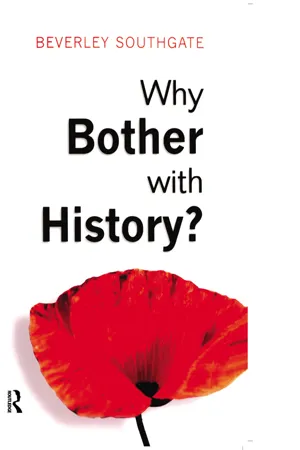
. Why Bother With History?
argues for an increasingly important role for a revitalised historical study. Examining the motivations of past historians, the author rejects the ancient aspiration to a 'history for its own sake' and argues that historians' importance lies in their own adoption of a moral standpoint, from which a story of the past can be told, that facilitates the attainment of a future we desire.
Inevitably controversial, in that it challenges many of the assumptions of modernist history, this is an interdisciplinary book, which draws in particular on psychology and literature.
eBook - ePub
Why Bother with History?
Ancient, Modern and Postmodern Motivations
- 200 pages
- English
- ePUB (mobile friendly)
- Available on iOS & Android
eBook - ePub
About this book
1
History for history’s sake
Introduction
The world-weary character in Aldous Huxley’s novel, quoted above, would presumably have had little difficulty in responding to the central question to be considered in this book, of why we should be bothered with history – bothered, that is, both with the past and with our attempted representations of that past. ‘Why indeed?’ might well have been his rejoinder: ‘in our brave new world, and poised as we are on the threshold of a new millennium, we have no occasion at all for being bothered with it. We should all be focusing firmly on the future, so if the past ever does seem to intrude, we should try even harder and more carefully to avoid being bothered with it.’
Huxley’s unbothered hero would not lack supporters. ‘The future, not the past’ has been described as ‘the favourite mantra’ of Britain’s modernising Prime Minister, who has been reported as having symbolically replaced a historic portrait of William Pitt the Younger in his official residence, with a canary-yellow image of a contemporary ballerina. At the same time, a Battle of Britain pilot, who had been invited to give a school talk, ascertained that the pupils in his audience hadn’t heard of the momentous event in which he was involved in 1940 – and nor had their teacher; and other children, we are told, believe that Winston Churchill’s fame derives from his invention of the compass, and don’t even know who won the Second World War. Even more alarmingly, the organisers of an exhibition in a major museum in Barcelona do claim to know who won the war, and record how Britain capitulated to Nazi Germany in 1939. And meanwhile, on the other side of the Atlantic, history has been recently described as ‘the most despoiled and neglected subject in the curriculum’. As evidence, it is reported inter alia that, by 1994, 59 per cent of fourth-grade students were unable to assign any motive for the Pilgrim Fathers’ transatlantic voyage; the same percentage of the eighth grade remained in ignorance of what conflict ‘Hiroshima’ referred to; and a majority of American schoolchildren don’t know in what century their Civil War was fought. ‘American students’, according to one senior professor, ‘have for a long time displayed an abysmal ignorance of history.’2
Yet on the other hand, plenty of people obviously are still bothered about the subject. Films and television documentaries compete to present alluring accounts of the past; history books not infrequently become best-sellers; popular newspapers report with concern on perceived threats to the history curriculum; museums and heritage centres entice increasing numbers of the general public, to the extent that one historian has written of ‘Western societies … living through an era of self-archaeologising’ – a point confirmed by reports that an English grocer’s shop, which closed in 1973 but was never cleared of its stock, has reopened (in 1999) as a museum.3 And in academia more specifically, the ever-growing mountain of history books is challenged only by the number of books on historiography, discussing the nature of that history, or questioning what (if anything) history actually is.
Whether we see historical study as declining or increasing in importance, and whatever it is that we believe that history is, this book derives from my belief that it’s time to take stock and ask why we should anyway be bothered with it – why we should be bothered with the past, and why we should be bothered with historians’ representations and descriptions and assessments of that past. Unlike Aldous Huxley’s hero, I am bothered with it, as something that’s not only intrinsically interesting but also of enormous practical importance; and what I’m presenting here is itself in part an historical study. The central question I’m asking isn’t by any means new: it doesn’t suddenly appear at the end of the twentieth century, as a result of some heightened humanity or intellectual capacity in which we can take pride. But I believe that it’s now of particular urgency. So before looking in the concluding chapters at some of our contemporary concerns about the purposes of historical study, I want to set the whole issue in a broader historical perspective.
In doing that, I’m conscious of looking back and plundering the past for my own purposes – of seeking to detect those antecedents which, while depriving me of any pretensions to originality, may add ballast to my case. And that already provides clues as to some of the functions history might perform, and as to why we might be bothered with it. By setting me and my opinions on a conveniently constructed trajectory that links the present with the past and future, it may provide some stability to my own identity and add weight to my position – prospective advantages that might be (and often have been) utilised not only on a personal but also on a public (political) level.
Those are points to which we’ll obviously need to return. But it’s also worth noting at the outset that the various purposes that historians have had, have helped to determine the various natures of the histories they’ve produced. Some have believed that their subject’s primary purpose was to train those destined to wield political power and enable them to maintain that power, and they have naturally focused on political and diplomatic history; others, who have been more concerned with prospective military commanders, have sought to draw lessons in leadership and tactics from the history of warfare; some historians of religion have contrived to provide underpinning for theological and moral positions; educators in the fields of arts and sciences have prescribed the histories of their respective disciplines as useful foundations for future practitioners; and social scientists and students of literature have often shown an interest in the contextual material provided by the more colourful aspects of social history. There have been periodic fashions for the history of philosophy and of ideas, fuelled by such motivations as the acquisition of ‘self-knowledge’ and a recognition of intellectual alternatives; and numerous other interest groups, in attempts to establish their own identity and validity, have promoted the specialised histories of previous activities in their own back yards.
Different goals, then, have provoked different sorts of historical study, but pervading them all have been two motivations identified in classical antiquity by the Roman orator and philosopher Cicero: in the first place, history gives pleasure, and secondly it’s actually useful. Those reasons for bothering with the subject are probably the most frequently cited through the following two millennia. During that time there were certainly those who viewed the subject with greater scepticism and even cynicism, and who claimed to detect more sinister objectives for historical study. But it wasn’t until the ‘professionalisation’ of the subject in the later nineteenth century that the whole idea of having any underlying motive at all was explicitly repudiated, and ‘purposelessness’ was prescribed as an ideal.
That ideal may be hard to envisage: it’s surely difficult (if not impossible) to think of history being done without some goal in mind – some ‘end’, some purpose for it all. But that was the goal-less goal authoritatively set for historical study by the great British historian Lord Acton. His aspiration to an ideally ‘purposeless’ history seems to negate the very need for (or desirability of) so much as asking our central question, and might incidentally serve to justify the complaint of his historically aware contemporary, the Russian novelist Leo Tolstoy, when (in an epilogue devoted to that subject) he observes that ‘modern history, like a deaf man, answers questions no one asks’.4 But I’ll argue anyway that even history that purports to be done without any avowed purpose, and entirely ‘for its own sake’, hasn’t actually lacked its raison d’être or its ‘end’, and that in the end the aspiration to such purposelessness is literally meaningless.
That Huxleian-style ideal, though, as expressed by Lord Acton will serve our own purpose as a starting point.
The ideal of history as ‘purposeless’
Our studies ought to be all but purposeless. – Lord Acton5
Lord Acton’s ideal of an ‘all but purposeless’ study will sound ludicrous to many twenty-first-century readers – but for two quite different reasons. In the first place, rampant vocationalism and ubiquitous demands for ‘accountability’, make any aspiration to promote something ‘purposeless’ sound educationally and socially preposterous – a long outdated concept, associated with ‘privilege’ and ‘élitism’, twin horrors of an outgrown time. Historians can no longer afford that sort of decadence: ‘we must’, as Quentin Skinner has insisted, ‘expect to be asked, and must not fail to ask ourselves, what is supposed to be the point of it all.’6 Any vestige of ‘purposelessness’ is now anathema, offensive to our practical and utilitarian age.
There is another objection to it that will be raised by many others: that it is quite simply meaningless. However much we might like to promote ‘art for art’s sake’, or history for history’s, it’s literally impossible. For it implies the enjoyment by artists or historians of a detached and value-free position, from which they are able to express themselves – or act as the medium for some higher power – without any ulterior artistic or historical, political or ideological, psychological or moral ‘purpose’. And we now know that that is impossible: after Freud and Foucault, Lyotard and Hayden White, the prospect of enjoying any such privileged position is denied us.
Historians in the past may have confidently claimed, from some assumed position of Olympian detachment, to reveal the truth about the past, and for no other purpose than that such revelation was inherently good. But we are all more conscious now of those human limitations which prevent us from ever enjoying (or describing) more than a partial view of anything – a partial view derived from our inevitable adoption of a particular perspective which necessarily precludes the simultaneous adoption of alternatives. We remain as frustrated as Archimedes in our efforts to find an external point (an ‘objectivity’) from which we can lever the earth (or past) in its entirety. As things are, we have ourselves to stand somewhere on the earth (or in relation to the past); we can’t ever quite remove ourselves from the work in which we’re engaged. So historians are involved in something from which they can never entirely extricate themselves; and they choose their point of involvement for some reason, for some purpose – even if they themselves are not always conscious of what that purpose is.
Yet the idea and ideal of ‘purposeless’ knowledge ‘for its own sake’ have long historical pedigrees. In his series of lectures entitled ‘On the Scope and Nature of University Education’, delivered on his installation as Rector of the new Irish Catholic University in 1852, Cardinal Newman discoursed on the concept of ‘liberal knowledge’. As distinct from knowledge which is to be applied in a business or professional context, ‘liberal knowledge’ is to be defined as being an end in itself, and is to be pursued entirely ‘for its own sake’. That ideal Newman traces back again to Cicero, who enumerates various ‘heads of moral excellence, [and] lays down the pursuit of Knowledge for its own sake, as the first of them’.7
Cicero here was following Aristotle’s much earlier recognition that it is only after our basic material needs for food and shelter have been met, that we can hope to enjoy the luxury of theoretical speculations. When we have a little surplus time and energy left over from the demands of basic subsistence, we may start to wonder about those subjects – general questions of human life and the universe – that have come to form the essence of philosophical investigation. And those subjects, precisely because they don’t pander to any extraneous needs, are to be esteemed as preferable – as free and ‘pure’ speculations which are intrinsically valuable for their own sake.
Cardinal Newman’s mid-nineteenth-century vision of the ideal university, therefore, can be seen as perpetuating that classical evaluation: a ‘liberal’ education is superior to any more practically orientated training, and it equips the gentleman – the person unconcerned with the basic material necessities for survival – for a fulfilling life. ‘Liberal knowledge … stands on its own pretensions … is independent of sequel, expects no complement, refuses to be informed (as it is called) by any end …’ Unlike ‘mechanical’ knowledge which is focused on particulars, ‘liberal’ knowledge aspires to transcend the ‘particular and practical’ in its quest for the universal; and so it is ‘a knowledge worth possessing for what it is, and not merely for what it does’.8
That aspiration to a knowledge that elevates its recipient above the banal demands of practical everyday experience, has remained as a visionary motivation for some educationists even through the twentieth century. Inspired by philosophical, theological or political ideals, such theorists (and practitioners) have evaluated academic subjects, and attempted to define them, accordingly; and they have been active not least in the field – or minefield – of historical study. Writing on ‘the practice of history’ in the 1960s, Geoffrey Elton sees his subject’s role as ‘to understand the past … in its own right’. By accepting the tenet ‘that the past must be studied for its own sake’ (which involves ‘the deliberate abandonment of the present’), the historian ‘contributes to the complex of non-practical activities which make up the culture of a society’. ‘The search for truth’ about the past, after all, as well as affording intellectual and ‘emotional satisfaction of a high order’, is really its own justification. J. H. Plumb similarly describes the historian’s purpose as ‘to see things as they really were’, and records ‘a growing determination for historians to try and understand what happened, purely in its own terms’. And following more recently (1987) in that same tradition, Alan Beattie once again distances historians from concern with anything as practical as moral judgements, and insists, against challenges that put the subject ‘in peril’, that ‘history is the study of the past for its own sake’.9
Should we, then, be questioning the purpose of our studies anyway? The immortal phrase from Tennyson’s poetic account of the charge of the Light Brigade in 1854 – ‘Their’s not to reason “Why?”’ – seems to answer that question, in expressing an ideal which has been frequently applied in other, less obviously military contexts. ‘Why should I?’ is one of the earliest questions children ask, and the answer is likely to come back pat: ‘Because I told you to!’ Frank McCourt’s account of his schooldays will resonate for many, when he recalls how the questioning pupil was reminded:
That’s none of your business. You’re here to … do what you’re told. You’re not here to be asking questions...
Table of contents
- Cover
- Half Title
- Title Page
- Copyright Page
- Dedication
- Table of Contents
- Preface
- Acknowledgements
- 1 History for history’s sake
- 2 History and historical examples
- 3 History and psychology: identity – memory and forgetting; meaning and purpose
- 4 History, politics and power
- 5 History and religion
- 6 History and education
- 7 Postmodernism, history and values
- 8 Postmodern history and the future
- Bibliography
- Index
Trusted by 375,005 students
Access to over 1.5 million titles for a fair monthly price.
Study more efficiently using our study tools.
Frequently asked questions
Yes, you can cancel anytime from the Subscription tab in your account settings on the Perlego website. Your subscription will stay active until the end of your current billing period. Learn how to cancel your subscription
No, books cannot be downloaded as external files, such as PDFs, for use outside of Perlego. However, you can download books within the Perlego app for offline reading on mobile or tablet. Learn how to download books offline
Perlego offers two plans: Essential and Complete
- Essential is ideal for learners and professionals who enjoy exploring a wide range of subjects. Access the Essential Library with 800,000+ trusted titles and best-sellers across business, personal growth, and the humanities. Includes unlimited reading time and Standard Read Aloud voice.
- Complete: Perfect for advanced learners and researchers needing full, unrestricted access. Unlock 1.5M+ books across hundreds of subjects, including academic and specialized titles. The Complete Plan also includes advanced features like Premium Read Aloud and Research Assistant.
We are an online textbook subscription service, where you can get access to an entire online library for less than the price of a single book per month. With over 1.5 million books across 990+ topics, we’ve got you covered! Learn about our mission
Look out for the read-aloud symbol on your next book to see if you can listen to it. The read-aloud tool reads text aloud for you, highlighting the text as it is being read. You can pause it, speed it up and slow it down. Learn more about Read Aloud
Yes! You can use the Perlego app on both iOS and Android devices to read anytime, anywhere — even offline. Perfect for commutes or when you’re on the go.
Please note we cannot support devices running on iOS 13 and Android 7 or earlier. Learn more about using the app
Please note we cannot support devices running on iOS 13 and Android 7 or earlier. Learn more about using the app
Yes, you can access Why Bother with History? by Beverley C. Southgate in PDF and/or ePUB format, as well as other popular books in History & Historiography. We have over 1.5 million books available in our catalogue for you to explore.