eBook - ePub
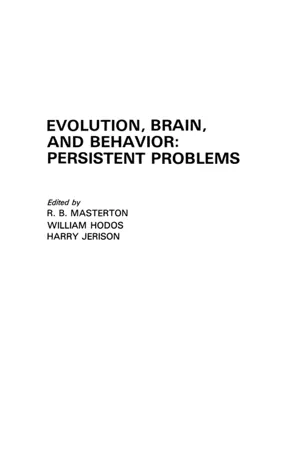
Evolution, Brain, and Behavior
Persistent Problems
- 266 pages
- English
- ePUB (mobile friendly)
- Available on iOS & Android
eBook - ePub
About this book
In this second volume on the evolution of the nervous system and behavior, the discussion turns from conclusions to method, from a desciption of what happened in history to the means of deciidng what happened. First published in 1976.
Information
1
On the Comparative Method of Investigation
Kresge Hearing Research Laboratory
Both scientists and laymen have been comparing animals to one another since at least the time of Aristotle, but it was not until the early nineteenth century that this pursuit was honed into a fine tool for the study of animal structure and function. Georges Cuvier (1769–1832), a French zoologist and paleontologist, analyzed the comparative method, formulated its guiding principles, and put the method systematically to work comparing structures in many vertebrates and invertebrates (see the excellent biography of Cuvier by Coleman, 1964).
His method is still used and is, in fact, so fundamental that it has passed into current thinking without notice. Yet understanding the power of this method can lead to fresh insights; understanding its mechanics can help keep current analyses as clear and orderly as were Cuvier’s own.
Today the method is usually used and understood in evolutionary terms, although Cuvier, whose intellectual accomplishments predate The Origin of Species by 30–60 years, was an antievolutionist. He was a Rationalist above all; he looked at facts first and then devised a theory to fit those facts. Then, as now, many thinkers took the opposite approach, and pre-Darwinian evolutionary theories were inconsistent with the facts of zoology. Cuvier could only oppose the idea that species might change.
At any rate these were peripheral issues. His concern was not with a process of change but with a present reality–animal classification and what would now be called functional morphology. He explored the relationships of structure to function and of both to environment.
These relationships he called “the conditions of existence.” Understanding them would be nearly tantamount to understanding the mind of the Creator. This understanding would be gained by structural and functional studies of many animals to determine how their designs fit them to their environment. He derived two rules to guide these comparative studies and the interpretation of the many facts they would reveal.
The first rule he called “the correlation of parts.” It states that all parts of an organism are so intimately interdependent that they must be correlated not only with their functions but also with one another and with the animal’s environment. Knowledge about one part of an animal therefore necessarily involves considerable knowledge about the whole animal. Some of these correlations have a functional basis: feathers are correlated with wings, presumably because they suit the requirements of flight better than do hair or scales. Other correlations apparently have no function: for instance, a cloven hoof is correlated with horns or antlers. Cuvier regarded the diversity of animals as examples of the Creator’s “experiments,” in which different means were designed to accomplish the same ends: flight, for example, was achieved by one means in birds, by another in bats. General principles of fundamental organization could be determined by comparative studies of how parts and functions are correlated in different groups.
The second rule for understanding the “conditions of existence” he called “the subordination of characters.” It states that some parts of animals are so vital to survival that their possible designs are sharply limited. The common design of these least subordinate parts signals membership in one of a few large natural categories (taxa).
On both empirical and theoretical grounds Cuvier concluded that the nervous system is the least subordinate, most important part of the body, less diverse within a taxon than any other body part. External and skeletal features, however, he considered subordinate to almost every other body part; they could be designed in many different ways and therefore were not to be used to determine large classifications. This disagreed fundamentally with then current taxonomic thought. Although both schools of thought agreed that vertebrates are a natural group, for instance, Cuvier’s contemporaries did so on the basis of their vertebral columns, whereas Cuvier himself pointed to their unique dorsal hollow nervous systems.
Combining these principles of the correlation of parts and the subordination of characters, Cuvier decided that there is no single scala naturae; instead of one basic design, modified to produce all animals, he found four different designs among metazoan animals; not surprisingly, he distinguished these primarily by the morphology of their nervous systems. Each nervous system design was the basis of a major classificatory group, or embranchement. These were:
1. the Vertebrata, characterized primarily by their spinal cord and enlarged anterior brain
2. the Mollusca, characterized by a distinct brain and scattered ganglia with nerves, but no central nerve cord
3. the Articulata, characterized by a very small brain and two distinct ventral nerve cords
4. the Radiata, the nervous system of which was based on a sparse, diffuse, radial group of nerves and ganglia in such animals as echinoderms and completely absent (!) in animals such as coelenterates.
Although he studied other parts of all these animals in order to confirm these natural groupings, Cuvier felt that all other parts were subordinate to the nervous system. This is particularly ironic because in Cuvier’s time, as well as in our own, the nervous system is probably the least understood of all organ systems.
Cuvier’s empirical approach and his principles of the correlation of parts and the subordination of characters were an attempt to bring reason and order into zoology. He felt that, properly used, his two principles could do for zoology what Newton’s law had done for physics. Although this was optimistic, his quest for an overview was not unlike what motivated the Tallahassee conference from which these volumes grew. A group of empirical scientists, working on separate, detailed studies, came together for interdisciplinary communication with the hope that it could lead to a general understanding rather than just specific glimpses of the evolution of the vertebrate brain and behavior. In some way these paleontologists, experimental neuroanatomists, and behaviorists are Cuvier’s intellectual descendents: although in these volumes it is discussed with a different vocabulary and in an evolutionary context, Cuvier’s comparative method and his principles, especially that of the correlation of parts, are still used. This approach is indeed fruitful.
Until the last decade, for instance, the mammalian forebrain has been thought to have evolved quite independently of the forebrain of all other vertebrates (see, for example, Herrick, 1924; Papez, 1929; Ariëns-Kappers, Huber, & Crosby, 1936). Only mammals were thought to have visual, auditory, and somesthetic projections to the dorsal thalamus and thence to the neocortex; these sensory systems were thought to terminate at midbrain levels in nonmammalian vertebrates. The nonmammalian cerebrum was believed to be dominated by the olfactory system; small hippocampal and piriform areas received solely olfactory information; striatal structures, which somehow corresponded to mammalian basal ganglia, coordinated olfactory information and sent it to lower brain centers. Furthermore, it was believed that the nonmammalian cerebrum had only vague, indirect control of bulbar and spinal cord levels and that direct cerebrospinal pathways carrying motor information from the cerebrum to the spinal cord and bulbar nuclei were found only in mammals. These views can still be found in textbooks (e.g., Romer, 1970).
These concepts of the uniqueness of the mammalian forebrain were based on broad comparative studies of the forebrain in many vertebrates. The mammalian cerebrum is structurally unique in its characteristic six-layered neocortex that receives large and specific projections of thalamic fibers. Nonmammalian vertebrates have no six-layered neocortex, and until very recently there have been no data on projections of nonolfactory sensory modalities to their forebrain. It was therefore assumed that the neocortex had no homolog in nonmammals but had evolved de novo in the synapsid-mammal line and that cerebral representation of vision, audition, and touch, correlated in mammals with the neocortex, had evolved at the same time. Experimental neuroanatomy, however, particularly using degeneration techniques, has yielded results that force a reevaluation of the old ideas on the evolution of the vertebrate forebrain. Many of these results have been reported in this volume and its companion.
With these techniques, several hitherto unsuspected projections have been demonstrated in nonmammalian vertebrates. There are direct spinal cord projections to discrete nuclei in the dorsal thalamus of representative sharks, reptiles, and birds, as well as mammals. There are direct retinal projections to the dorsal thalamus in every class of vertebrates. There are auditory projections to the dorsal thalamus in all amniotes (reptiles, birds, and mammals). There are large sensory projections from the dorsal thalamus to the ipsilateral cerebral hemisphere in bony fishes, amphibians, reptiles, and birds, as well as in mammals, and to the contralateral cerebral hemisphere in sharks. The nonmammalian cerebrum is not, after all, dominated by olfactory projections; on the contrary, it has been found that olfactory information projects to only a limited portion of the cerebrum in representative sharks, bony fishes, amphibians, and reptiles, as well as mammals. Moreover, the cerebrum sends large efferent projections to lower brainstem structures not only in mammals but in sharks, teleosts, amphibians, reptiles, and birds as well; in birds, at least, some of these projections extend into the cord. These data are reviewed by Ebner (Volume 1, 1976) and Ebbesson and Northcutt (Volume 1, 1976).
It is apparent, therefore, that multiple sensory projections to the dorsal thalamus and thence to the cerebrum are not necessarily correlated with a six-layered neocortex but must be regarded as a much more general vertebrate characteristic than has previously been thought. Moreover, with the demonstration of these multiple sensory projections to the cerebrum and of motor projections from the cerebrum, the dominance of forebrain structures in the control of behavior, long established for mammals, must be at least suspected in nonmammalian vertebrates as well (Graeber, Ebbesson, & Jane, 1973).
Furthermore, because in nonmammals many specific dorsal thalamic nuclei project to structures previously regarded as striatal, one must at least entertain the idea of homologs with mammalian neocortical areas. Based on projections, for instance, it seems possible that the same fields of telencephalic cells have evolved into the teleost epistriatum, the reptilian dorsal ventricular ridge, the avian neostriatum, hyperstriatum, and ectostriatum, and, during the evolution of synapsid reptiles and mammals, into the six-layered neocortex.
There are certainly class differences in brain structures and connections but what recently emerges as even more significant is the similarity of fiber projections between parts of the brains in living vertebrates. Cuvier, looking at the nervous system in many vertebrates, observed that this system exhibited little variation from group to group, and he therefore concluded that the nervous system is of prime importance in maintaining the life of the individual and that other systems and parts are subordinate to it. Thanks to comparative studies, it is just now beginning to be realized how great is the similarity and how little the variation.
Whereas the comparative method can be fruitfully applied to broad categories, it can be even more confidently used within a restricted, closely related group. In my laboratory, I and my associates have for several years been studying the peripheral and central auditory structures of the rodent family, Heteromyidae, which includes kangaroo rats (Dipodomys), kangaroo mice (Microdipodops), pocket mice (Perognathus), and spiny pocket mice (Heteromys and Liomys). Thanks to the work of several paleontologists (Wood, 1935; Reeder, 1957; Shotwell, 1967) it is possible to outline phylogenies with a reasonable amount of confidence (Figure 1).
The habitats of these five genera–in the western United States through northern South America–range from tropical rain forest (Heteromys) to extremely arid desert (Microdipodops, most species of Dipodomys, and a few species of Perognathus). Heteromys and Liomys, the most tropical of the heteromyid families, have small, normal rodent middle ear cavities and quadrupedal locomotion with little if any elongation of the hindlimbs. In contrast, Dipodomys and Microdipodops, in which most or all species are arid desert dwellers, have extremely large middle ear cavities the combined volume of which exceeds that of the cranial cavity; they also have extremely long back legs, short front legs, and bipedal, ricochetal locomotion. Moreover, these characteristics are also found in African and Asian rodents that live in similar environments but that have evolved quite independently of the strictly new world heteromyids.
A quantitative morphological study of the middle ears of 26 heteromyid species shows several correlations (Webster, 1969). There is a strong relationship between tympanic membrane diameter and middle ear volume (Figure 2); in general, the dryer the habitat, the larger these measurements. The auditory ossicles and tympanic membr...
Table of contents
- Cover
- Half Title
- Title Page
- Copyright Page
- Table of Contents
- Introduction
- 1. On the Comparative Method of Investigation
- 2. Uses of the Comparative Study of Behavior
- 3. Principles of the Evolution of the Brain and Behavior
- 4. Rates of Evolution of the Nervous System and Behavior
- 5. Genetic Considerations in Studies of the Evolution of the Nervous System and Behavior
- 6. What Animals Should We Compare?
- 7. Grades and Clades Revisited
- 8. Interrelationships of the Major Fish Groups with Comments on Specimen Availability
- 9. The Nomenclature of Correspondence: A New Look at “Homology” and “Analogy”
- 10. Morphological Homology and the Nervous System
- 11. The Concept of Homology and the Evolution of Behavior
- 12. Practical Aspects of Homology Recognition
- 13. In Defense of the Analog: A Commentary to N. Hotton
- 14. Homology: Logic, Information, and Efficiency
- 15. Problems in the Comparative Study of Language
- 16. Intelligence: An Invertebrate Perspective
- Author Index
- Subject Index
Trusted by 375,005 students
Access to over 1.5 million titles for a fair monthly price.
Study more efficiently using our study tools.
Frequently asked questions
Yes, you can cancel anytime from the Subscription tab in your account settings on the Perlego website. Your subscription will stay active until the end of your current billing period. Learn how to cancel your subscription
No, books cannot be downloaded as external files, such as PDFs, for use outside of Perlego. However, you can download books within the Perlego app for offline reading on mobile or tablet. Learn how to download books offline
We are an online textbook subscription service, where you can get access to an entire online library for less than the price of a single book per month. With over 1.5 million books across 990+ topics, we’ve got you covered! Learn about our mission
Look out for the read-aloud symbol on your next book to see if you can listen to it. The read-aloud tool reads text aloud for you, highlighting the text as it is being read. You can pause it, speed it up and slow it down. Learn more about Read Aloud
Yes! You can use the Perlego app on both iOS and Android devices to read anytime, anywhere — even offline. Perfect for commutes or when you’re on the go.
Please note we cannot support devices running on iOS 13 and Android 7 or earlier. Learn more about using the app
Please note we cannot support devices running on iOS 13 and Android 7 or earlier. Learn more about using the app
Yes, you can access Evolution, Brain, and Behavior by R. B. Masterton,W. Hodos,H. J. Jerison in PDF and/or ePUB format, as well as other popular books in Psychology & History & Theory in Psychology. We have over 1.5 million books available in our catalogue for you to explore.