eBook - ePub
Differentiating By Readiness
Strategies and Lesson Plans for Tiered Instruction, Grades K-8
- 128 pages
- English
- ePUB (mobile friendly)
- Available on iOS & Android
eBook - ePub
Differentiating By Readiness
Strategies and Lesson Plans for Tiered Instruction, Grades K-8
About this book
Teach your students based on their readiness levels with tiering strategies from Joni Turville, Linda Allen, and LeAnn Nickelsen. You'll offer lessons designed to challenge each student appropriately, and in ways that save time and yield actual progress. In this book, the authors demonstrate how tiering, a standards-based differentiation strategy which uses readiness as a basis for instructional planning, helps teachers introduce the right degree of content complexity for each student. The result? Greater student success and less time spent re-teaching. This book provides a comprehensive introduction to tiering plus step-by-step instructions for using it in your classroom. Also included are 23 ready-to-apply blackline masters, which provide helpful ideas for activities and classroom management.
Information
1
Building the Foundation: What is Tiering in Differentiated Instruction?
When we do the best we can, we never know what miracle is wrought in our life or the life of another.
—Helen Keller
When beginning to build a structure, we must create a solid foundation. Without it, no matter how creative or beautiful the structure is, it will eventually fall apart. When learning to tier instruction, it is important to have a deep understanding of differentiating instruction and how differentiating in this way is just one part of the process.
Differentiating Instruction
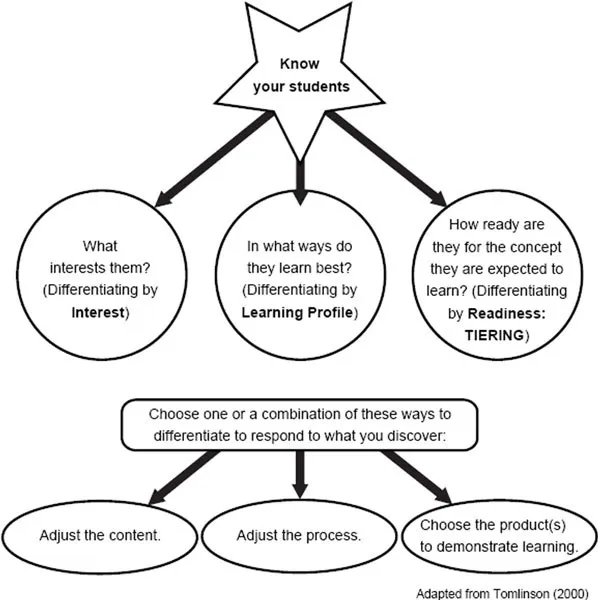
There are many different definitions of differentiated instruction. There doesn’t seem to be one, specific way to describe it, but there are several factors that are important when adjusting instruction (Figure 1.1, page 4). We like the word “doable” to describe how to differentiate.
Differentiating begins with knowing your students. There are three things you can find out about them: what interests them, how they learn best, and how ready they are to learn a particular concept. Once you know these things about your students, you can adjust the content of what they are to learn. This is not to say that we can change the standards, but we can choose the kinds of materials they will use to learn and adjust the kinds of supports they may require to access the content. Next, the process of how they learn can be adjusted. This can incorporate things such as learning styles, multiple intelligences and cooperative learning. Finally, we can adjust the way students will demonstrate their learning by considering what products they will create or how they will show their learning.
Differentiating Content (Adjusting Materials and Supports for Learning Concepts)
♦Resource materials are available at varying readability levels
♦Audio and video clips
♦Peer and adult mentors
♦Keyed concepts and boldface typed vocabulary
♦Ideas presented through a variety of tools (e.g., websites, audio books)
♦Varied manipulatives and tools (e.g., charts, graphic organizers)
♦Charts and models used to convey an idea
♦Concrete objects used to explain abstract ideas
♦Multimedia presentations including PowerPoint presentations
♦Interest centers for additional exploration
♦“I Wonder” statements to foster curiosity about current topics to guide mini-lessons, resources, and connections
♦Events and interests in students’ lives as examples in content areas
♦Multiple intelligences and learning styles in exploring materials, especially considering auditory, visual, and kinesthetic modes
Figure 1.1. Differentiating Instruction
♦“Big picture” concept as well as the “step-by-step” understanding within each unit of study
♦Text-to-speech software
Differentiating Process (Making Sense and Meaning of Content)
♦Leveled questions or question stems (different levels of complexity)
♦Learning centers
♦Personal agendas containing universal class assignments and supplementary or in-depth assignments for particular students
♦Hands-on materials used in a variety of ways to build understanding of concepts
♦Varied pace according to student’s readiness and processing rate
♦Literature circles, discussions, and Socratic seminars as ways to examine topics closely
♦Cooperative learning tasks
♦Choice in strategies for processing
♦Varied working groups (partners, triads, small groups and alone)
♦Use of WebQuests
♦Choices for learning through activity structures such as RAFTs, choice boards, learning contracts, etc.
♦Use of speech-to-text software
Differentiating Products (Showing What Has Been Learned)
♦Varied product choices that have options within the multiple intelligences and the learning styles, and considerations for gender, culture, and interests
♦Technology-based products (e.g., digital photos, podcasts, blogs, wikis, multimedia presentations)
♦Collaboration with art, music, physical education, and drama teachers to assist in the development of the criteria and quality assignments with students on various products for scoring guides and rubrics
♦Use of student-designed rubrics to showcase criteria and levels of knowledge and understanding (with teacher input and guidance)
♦Tiered product activities
Some of these ways to differentiate can be used as the basis for tiered assignments. Many can be used in combination, which further increases the complexity of planning, but may help to better meet student needs. For example, using resource materials at varying readability levels is a great way to help students understand important concepts. They could then be given leveled graphic organizers on which to process what they have read. In this way, both the content as well as the process are differentiated.
Defining Tiering
Tiering is used when there is a large gap between what students currently are able to do and what they are expected to learn. By providing extra support or challenge, students can all be successful in reaching the standard and have a high level of engagement. Tiering has been described in the literature in many ways and can be one of the most difficult parts of differentiated instruction to describe.
Adams and Pierce (2003) describe the tiered lesson structure as having multiple levels so students work in moderately challenging, but developmentally appropriate activities. “A tiered lesson addresses a particular standard, key concept and generalization but allows several pathways for students to arrive at an understanding of these components.” They describe tiering as being qualitatively different, without simply adjusting quantity.
According to Heacox (2002), “Tiered assignments are differentiated learning tasks and projects that you develop based on your diagnosis of students’ needs. When you use tiered assignments with flexible instructional groups, you are prescribing particular assignments to particular groups of students.” She describes tiered lessons as a way to help match instruction to student needs.
Kingore (2005) relates the concept of tiering to having students work in greater depth in their understanding of a concept, as opposed to “treadmilling,” where they are not progressing, but just doing more of the work they are already able to do.
Tomlinson (1999) writes that tiering is important when “students with different learning needs work with the same essential ideas and use the same key skills. The teacher designs activities so students all focus on the same concepts with different levels of complexity, abstractness and open-endedness.” This increases the likelihood that all students learn and are challenged appropriately.
According to Wormeli (2007), tiering is related to a vertical, layered approach as opposed to a horizontal strategy. He combines this notion with Tomlinson’s (1999) idea of the “equalizer,” where these layers can be thought of in terms of things like complexity of thought, open-endedness and abstractness.
How Tiering Is Framed in This Book
In this book, tiering is defined as providing different learning activities when there is such a variance in readiness levels among the learners that students may not be able to learn effectively and be engaged if no adjustments are made. Tiered lessons are created based on the diagnosis of the students’ needs. The goal is for all students to be appropriately challenged so that success occurs with each child. Learning is focused on the standards, and all students are expected to reach them, but with different kinds of support, complexity, and pacing.
Straight Talk on Tiering: What It Is and What It Isn’t
In understanding tiered instruction, it is important to understand not only what it is, but what it is not. Figure 1.2 serves as a brief summary and it can help teachers focus on what they are planning and check whether it falls within the construct of tiering.
Figure 1.2. Is this Tiering?
| yes | No |
| ♦Begins with, and focuses on required standards | ♦May or may not be focused on standards |
♦Focuses on “big ideas” that will endure over time and be transferable to other subjects. All learners reach the same learning destination | ♦Standards are altered or not used. Care is not given to focus on enduring understanding |
♦Uses proactive instructional strategies, based o... |
Table of contents
- Cover
- Title Page
- Copyright Page
- Dedication
- Contents
- About the Authors
- Acknowledgements
- Free Downloads
- Introduction
- 1. Building the Foundation: What is Tiering in Differentiated Instruction?
- 2. The Essential Building Blocks: Getting Ready to Tier
- 3. The Blueprint for Tiering: Designing with the End in Mind
- 4. Pour the Concrete! It’s Time to Tier
- 5. Passing Final Inspection: Assessment of Tiered Products
- 6. Cutting the Tape: Time to Start Tiering!
- Appendix: Blackline Master
- References
Trusted by 375,005 students
Access to over 1.5 million titles for a fair monthly price.
Study more efficiently using our study tools.
Frequently asked questions
Yes, you can cancel anytime from the Subscription tab in your account settings on the Perlego website. Your subscription will stay active until the end of your current billing period. Learn how to cancel your subscription
No, books cannot be downloaded as external files, such as PDFs, for use outside of Perlego. However, you can download books within the Perlego app for offline reading on mobile or tablet. Learn how to download books offline
Perlego offers two plans: Essential and Complete
- Essential is ideal for learners and professionals who enjoy exploring a wide range of subjects. Access the Essential Library with 800,000+ trusted titles and best-sellers across business, personal growth, and the humanities. Includes unlimited reading time and Standard Read Aloud voice.
- Complete: Perfect for advanced learners and researchers needing full, unrestricted access. Unlock 1.5M+ books across hundreds of subjects, including academic and specialized titles. The Complete Plan also includes advanced features like Premium Read Aloud and Research Assistant.
We are an online textbook subscription service, where you can get access to an entire online library for less than the price of a single book per month. With over 1.5 million books across 990+ topics, we’ve got you covered! Learn about our mission
Look out for the read-aloud symbol on your next book to see if you can listen to it. The read-aloud tool reads text aloud for you, highlighting the text as it is being read. You can pause it, speed it up and slow it down. Learn more about Read Aloud
Yes! You can use the Perlego app on both iOS and Android devices to read anytime, anywhere — even offline. Perfect for commutes or when you’re on the go.
Please note we cannot support devices running on iOS 13 and Android 7 or earlier. Learn more about using the app
Please note we cannot support devices running on iOS 13 and Android 7 or earlier. Learn more about using the app
Yes, you can access Differentiating By Readiness by Linda Allen,Joni Turville in PDF and/or ePUB format, as well as other popular books in Education & Education General. We have over 1.5 million books available in our catalogue for you to explore.