eBook - ePub
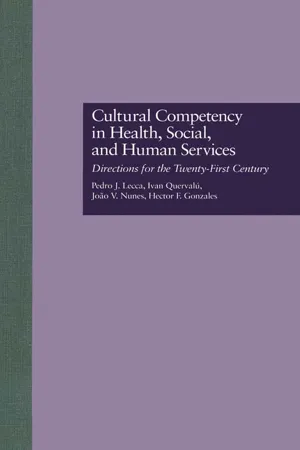
Cultural Competency in Health, Social & Human Services
Directions for the 21st Century
- 320 pages
- English
- ePUB (mobile friendly)
- Available on iOS & Android
eBook - ePub
Cultural Competency in Health, Social & Human Services
Directions for the 21st Century
About this book
Cultural competency is an issue that is becoming increasingly more important as thousands of people come to this country every year. Because of widely different social mores, living conditions, traditions, personal beliefs, and practices of clients, health professionals in all specialties are finding it difficult to communicate effectively with the members of the diverse racial and ethnic groups that come to them for help. To give health and human services professionals the necessary training, material on cultural competency has been mandated in several different curricula, yet appropriate pedagogical material remains relatively rare. This pioneering volume presents the latest information and techniques for improving cultural competency in the delivery of health, social, and human services to ethnic and racial minority groups in the United States. Special attention is paid to the importance of understanding the social and culture backgrounds of clients when assessing diagnosis of policy and economic issues, which are rarely examined in this context. Notable for its combination of theory and practice, which will be invaluable for both professionals and students, this book also includes material on cultural competency within such special populations as the mentally ill, the elderly, children, and families.
Information
PART I
Cultural Competency Framework
CHAPTER 1
Cultural Competency Services for Multicultural Populations
The health, social, and human service practitioners of today are no longer faced with patients of only one culture, but also with patients who are of different cultural backgrounds with different needs. Historically, many practitioners from a wide range of disciplines lack knowledge of the diverse backgrounds of their patients, thus fostering a gap in their ability to assist such a diverse group of patients. Practitioners are finally coming to the realization that they lack the training and knowledge to assist and understand diverse population patients.
The 1990 U.S. Census revealed some major demographic changes. By the year 2000 it is estimated that one third of the population will consist of racial and ethnic minorities. It is also predicted that in some states the minorities will outnumber the “majority” population. Not only is there an apparent shift in demographics, but there is also a shift in paradigms. Some scholars have argued that the assimilation paradigm and the melting pot ideology have not been manifested in American society; instead, one can observe the essence of a cultural pluralistic or bicultural society (Gonzales, 1993; Isaacs & Benjamin, 1991; Sue & Sue, 1990). Some writers define biculturalism as an “ethnic group maintaining the values, beliefs, and customs of their own culture, while adopting some of the traits of the host culture, such as language, dress, and food” (Sue & Sue, 1990, p. 21). Due to the changing demographics and shifting paradigms it is becoming crucial that practitioners, agencies, and institutions become more culturally competent so that they can meet the needs of the increasing minority population.
Cultural competency is defined as “a set of congruent behaviors, attitudes, and policies that come together in a system, agency, or profession that enables that system, agency, or profession to work effectively in cross-cultural situations” (Chung, 1992). To understand the importance of cultural competency one must begin to examine the inherent biases in western mental health practices. Some scholars have pointed out that western psychiatry is drawn from a “white middle-class” perspective (Marsella, 1993; Proctor & Davis, 1994; Robinson, 1993; Solomon, 1992; Sue & Sue, 1990; Torrey, 1972). Since each culture is unique in its ideologies, values, and attitudes, such a strict white middle-class form of treatment would not effectively assist the diverse ethnic populations in America. Torrey (1972) has coined the term “psychiatric imperialism,” which refers to practitioners who impose their cultural mental health services on groups that are culturally different from that of the practitioner.
Furthermore, some scholars believe that psychiatric values are based on “verbal expressiveness,” “openness,” and a certain degree of “psychological mindedness.” In a study by Isaacs and Benjamin (1991) in which they compared the values of Anglo-Americans with those of other ethnocultural groups, they found that other cultures valued stronger familial bonds and more restrained modes of expression, unlike Anglo-Americans who valued openness, directness, and individuality. If practitioners treated such ethnic groups with the same psychiatric values as those of Anglo-Americans, inaccurate diagnosis, assessment, and treatment would be inevitable (Sue & Sue, 1990). Researchers have used the term “culturally encapsulated” when referring to therapists who stereotype ethnic minority groups rather than taking into account their cultural differences (Mokuaa & Matucka, 1992). By culturally encapsulating their patients, therapists tend to categorize any differences they do view during therapy as a form of resistance by the patients. Hence, the patients do not receive adequate counseling from their therapists, and many issues about their own culture and identities are left unresolved.
The results from such therapy on the diverse ethnic minority groups are very evident. Individuals from minority cultures have been more reluctant to seek mental health services than Anglo-Americans (Sue et al., 1977). Additionally, almost half of the minority patients who do seek therapy do not return after their first session. Furthermore, early terminations of therapy by the minority patients are common due to “a series of frustrations, misunderstandings, distortions, and defensive reactions [caused by] language problems, role ambiguities, misinterpretations of behavior, and differences in priorities of treatment” (Dana, 1993, p. 2).
In order to eradicate bias and stereotypes that practitioners may hold in respect to ethnic or racial minorities, Proctor and Davis (1994) state that culturally competent practitioners need to possess three characteristics. First, the practitioner needs to be aware of his or her own beliefs and attitudes about racial and ethnic minorities in order not to impose these feelings on his or her patient. Second, practitioners need to understand and be aware of the world views of the patient without judging them. The practitioner also needs to be aware of how race, culture, and ethnicity affects personality and personal choices, as well as life experiences. Third, the practitioners must be able to use culturally competent skills when interacting with a racially or ethnically minority patient.
Proctor and Davis’s (1994) ideas on how to create a culturally competent therapist is quite similar to those of another author who conducted his study two decades earlier. Felix Biestek (1970) cited seven elements, rather than three, which would enhance the practitioner-patient relationship when cultural diversity plays a factor. The seven elements are individualization, purposeful expression of feelings, controlled emotional involvement, acceptance, nonjudgmental attitude, patient’s self-determination, and confidentiality.
By individualization, Biestek means that the therapist must consider the patient’s unique culture and adjust the therapy to fit the qualities and needs of that culture. Language, for instance, is a huge barrier that therapists must overcome with many of their minority patients. The proper use of translators is one of the most effective methods to overcome such barriers (Marsella, 1993). Furthermore, in some cultures, the family is an important part of an individual’s identity (Sue & Sue, 1990). Therefore, utilizing family therapy as well as individual therapy in many cases is a more effective form of treatment for minority patients (Ross-Sheriff, 1992).
The purposeful expression of feelings is also an important element of therapy. This involves:
… the recognition of the [patient’s] needs to express his feelings freely, especially his negative feelings. The [therapist] listens purposefully, neither discouraging nor condemning the expression of these feelings, sometimes even actively stimulating and encouraging them when therapeutically useful. (Biestek, 1970)
Another example of the use of individualization by a therapist is the evaluation of body language. Because many cultures value discretion of expression rather than openness, nonverbal communication can also be noted by the therapist, as emotions which the patient is sometimes reluctant to express verbally may be evident in the patient’s physical posture and expressions (Marsella, 1993).
Biestek’s third element is that of controlled emotional involvements: that is, the practitioner should understand the minority individual but remain objective during therapy. Understanding the patient means that the communications between therapist and patient are clear and comprehensive: If need be, translators are utilized to ensure comprehensibillty of the communication. Furthermore, therapists must be careful not to stereotype or overgeneralize similarities between minority groups, nor should they overidentify with their patients. Instead, the goal should be to work toward a level in which they can maintain both distance and closeness with the patient (Dean, 1979).
Acceptance is the fourth element in Biestek’s list. The therapist’s approach is one that accepts the patient and welcomes the patient’s values, putting aside any stereotypes he or she may have about the particular patient. Along with this acceptance comes another element, a nonjudgmental attitude. Therapists must be careful not to assign guilt to a patient for his behavior (Dean, 1979). For example, in some cultures faith healers are thought to be very important (McQuaide, 1989). When treating individuals with such beliefs, practitioners need to recognize the importance of the faith healer to that person and try to evaluate the “healer’s” role and meaning in the patient’s life (Dean, 1979).
Patient self-determination is the sixth element in Biestek’s list. Patient self-determination means that therapists respect the rights of the patient and allow him or her the freedom to make some of the decisions in the treatment process. In other words, the establishment of goals and the treatment plan should be performed together; otherwise unnecessary problems may arise. One such way to prevent problems between the patient and therapist is also Biestek’s final element—confidentiality. Mental health professionals need to realize that minority patients may be uncomfortable discussing their problems. Therefore “the sense of betrayal is especially acute [for them] when information privately shared with one professional is known by many” (Dean, 1979). Such a betrayal could destroy the patient’s trust in the therapist and make him reluctant to proceed with treatment.
Regardless of whether therapists follow the Proctor and Davis (1994) characteristics or the elements outlined by Biestek (1970), one thing is clear—practitioners need to build cultural competency within themselves. They need to learn about other cultures and to be able to empathize with their patients. Therapists should not be afraid to ask questions of the patient pertaining to the patient’s own culture. The patient’s own self-identification and self-description are sometimes the most important clinical data for the therapist (McGill, 1992). By asking questions the therapist acknowledges differences between the two cultures and helps to establish a middle ground (McGill, 1983).
Current literature stresses the importance of cultural competency, urging practitioners to utilize skills and knowledge that are cultural...
Table of contents
- Cover
- Half Title
- Title Page
- Copyright Page
- Dedication
- Table of Contents
- Preface
- Acknowledgments
- PART I Cultural Competency Framework
- PART II Organizational Issues
- PART III Policy Imperatives
- Index
- About the Authors
Trusted by 375,005 students
Access to over 1.5 million titles for a fair monthly price.
Study more efficiently using our study tools.
Frequently asked questions
Yes, you can cancel anytime from the Subscription tab in your account settings on the Perlego website. Your subscription will stay active until the end of your current billing period. Learn how to cancel your subscription
No, books cannot be downloaded as external files, such as PDFs, for use outside of Perlego. However, you can download books within the Perlego app for offline reading on mobile or tablet. Learn how to download books offline
Perlego offers two plans: Essential and Complete
- Essential is ideal for learners and professionals who enjoy exploring a wide range of subjects. Access the Essential Library with 800,000+ trusted titles and best-sellers across business, personal growth, and the humanities. Includes unlimited reading time and Standard Read Aloud voice.
- Complete: Perfect for advanced learners and researchers needing full, unrestricted access. Unlock 1.5M+ books across hundreds of subjects, including academic and specialized titles. The Complete Plan also includes advanced features like Premium Read Aloud and Research Assistant.
We are an online textbook subscription service, where you can get access to an entire online library for less than the price of a single book per month. With over 1.5 million books across 990+ topics, we’ve got you covered! Learn about our mission
Look out for the read-aloud symbol on your next book to see if you can listen to it. The read-aloud tool reads text aloud for you, highlighting the text as it is being read. You can pause it, speed it up and slow it down. Learn more about Read Aloud
Yes! You can use the Perlego app on both iOS and Android devices to read anytime, anywhere — even offline. Perfect for commutes or when you’re on the go.
Please note we cannot support devices running on iOS 13 and Android 7 or earlier. Learn more about using the app
Please note we cannot support devices running on iOS 13 and Android 7 or earlier. Learn more about using the app
Yes, you can access Cultural Competency in Health, Social & Human Services by Pedro J. Lecca,Ivan Quervalu,Joao V. Nunes,Hector F. Gonzales in PDF and/or ePUB format, as well as other popular books in Social Sciences & Social Work. We have over 1.5 million books available in our catalogue for you to explore.