- 208 pages
- English
- ePUB (mobile friendly)
- Available on iOS & Android
eBook - ePub
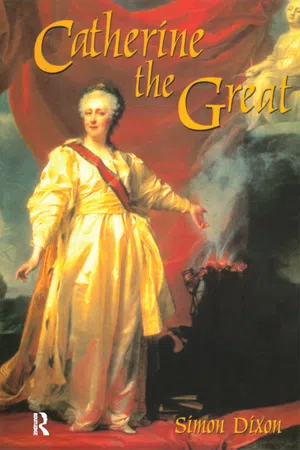
Catherine the Great
About this book
Neither a comprehensive 'life and times' nor a conventional biography, this is an engaging and accessible exploration of rulership and monarchial authority in eighteenth century Russia. Its purpose is to see how Catherine II of Russia conceived of her power and how it was represented to her subjects. Simon Dixon asks essential questions about Catherin'es life and reign, and offers new and stimulating arguments about the Englightenment, the power of the monarch in early modern Europe, and the much-debated role of the "great individual" in history.
Chapter One

The problem of power
The great Question which in all Ages has disturbed Mankind, and brought on them the greatest part of those Mischiefs which have ruin’d Cities, depopulated Countries, and disordered the Peace of the World, has been, Not whether there be Power in the World, nor whence it came, but who should have it.
(Locke1)
Catherine the Great, 1729–96
This book is neither a ‘life and times’ nor a biography. Instead, it offers a study in rulership. Its purpose is to see how Catherine II of Russia conceived of her power and how it was represented to her subjects, what she sought to do with that power and how far she was frustrated by forces beyond her control. To what extent was her rule consensual? How far did it depend on force? Subsequent chapters will approach these questions on a thematic basis. The purpose of this opening chapter is to establish the conceptual framework for what follows by considering rival theories of power and examining some of the ways in which these have been used to interpret the history of monarchy in early-modern Europe. But it is natural to begin with a brief outline of Catherine’s life and reign.
When Catherine II of Russia died in St Petersburg on 6 November 1796, the world sensed the loss of a ruler who had become a legend in her own lifetime. Yet when Princess Sophie of Anhalt-Zerbst was born in Stettin on 21 April 1729, scarcely anyone beyond the walls of that bleak Baltic garrison so much as blinked an eyelid. Few cared about the birth of an obscure German princess: only the advent of a male heir to a ruling house was cause for widespread jubilation.
Sophie’s childhood was divided between Stettin, where her father’s regiment was stationed, and protracted visits to the cosmopolitan court of Brunswick Wolfenbüttel, where she enjoyed the protection of her mother’s benefactress, the dowager Duchess Elisabeth Sophia Maria. It was at Wolfenbüttel that Sophie first met her future husband, Grand Duke Peter, nephew of Empress Elizabeth of Russia. Elizabeth transformed Sophie’s life by making her Peter’s consort in 1744. Baptised into Orthodoxy shortly after her arrival in St Petersburg, the teenage grand duchess was rechristened Ekaterina (Catherine) Alekseevna. Soon deprived of her new husband’s affections, she sought solace in a series of clandestine affairs, beginning in 1752 with Sergei Saltykov. Catherine implied in her memoirs that it was Saltykov who fathered her son Paul, born after two miscarriages on 20 September 1754. Proof in this case is lacking,2 but Catherine certainly produced further children from subsequent illicit relationships. In 1758, she bore the Pole Stanisław Poniatowski a daughter who lived only fifteen months; in April 1762, she gave birth to a son, by Grigorii Orlov, who survived into adulthood (though not emotional maturity) under the pseudonym Count Aleksei Bobrinskoi. At the time of the boy’s birth, however, Catherine’s prospects were again on the point of being revolutionised by a coup orchestrated by Orlov and his four brothers on 28 June 1762. This overthrew her husband, who was subsequently assassinated while under the supervision of Aleksei Orlov, and brought Catherine to the Russian throne.
Consolidation of her illegitimate position was naturally a key preoccupation. Advised by a series of consultative commissions, she embarked on an ambitious programme of legislation. In Russia, as elsewhere in continental Europe, the priority was internal regeneration in the aftermath of the ruinous Seven Years’ War (1756–63). Catherine’s Senate reform of 15 December 1763 signalled a determination to recharge a creaking central administration. Prince A.A. Viazemskii was made procurator general in 1764 and remained a crucial influence in government until the onset of the illness which caused his death in 1792. Economic growth and fiscal recovery were further priorities. Manifestos of 1762 and 1763 encouraged the settlement of foreigners, expert in agriculture, to cultivate Russia’s thinly populated lands. By the end of the century, some 30,000 Germans had been attracted to farm in Saratov province. Following Russia’s annexation of the Crimea in 1783, Potemkin’s energetic settlement policy in New Russia (now Ukraine) brought an even larger influx from Moldavia, Poland, the Balkans and Greece. Meanwhile, on 15 October 1765, Catherine offered her ‘highest protection’ (and a large measure of autonomy) to the Free Economic Society, founded in June of that year to promote agricultural improvement. By then, the property of the Orthodox Church, which owned roughly two-thirds of Russia’s ploughed soil and approximately one million peasants, had been taken into state control on 6 February 1764. Only 161 of 572 monasteries and 67 of 217 convents remained open, all with severely restricted landholdings.
Though fiscal security ranked higher than anti-clericalism among Catherine’s motives for secularising the church lands, the measure was naturally greeted with acclaim by sceptical Enlightened thinkers across Europe. Here was an audience the empress deliberately sought to woo. From 1763, she corresponded with Voltaire and other leading lumières. She read the French translation of Beccaria’s On Crimes and Punishments in 1765, only a year after its publication in Italian, promptly transcribing some of the Milanese jurist’s most radical propositions, alongside more from Montesquieu’s The Spirit of the Laws (1748), into her Instruction (Nakaz) to the Legislative Commission. This 564-delegate assembly, opened in Moscow in July 1767, was charged with devising a new law code to replace the outdated Ulozhenie issued by Aleksei Mikhailovich in 1649. But the Commission’s work was interrupted by the Turkish declaration of war in 1768, and in mid-December Catherine announced an adjournment that ultimately proved terminal for all but a skeleton secretariat. Although fifty-six officials and fifty clerks were still at work in 1796, the great majority of the Commission’s subcommittees had been discontinued in October 1771, and it is unlikely that significant ideas were generated after the last subcommittee was finally suspended in December 1774. By then Catherine had long since turned to other characteristically Enlightened ways of exhorting her subjects, including the satirical journals, many published by N.I. Novikov (1744–1818), to which she herself contributed.
It was not only the Legislative Commission that was sabotaged by the Turks. Their attack from the south simultaneously exposed the fatal flaw in the significantly named ‘northern system’ – an incomplete series of defensive alliances that formed the cornerstone of the pro-Prussian policy of Catherine’s first adviser on foreign affairs, Count N.I. Panin. Though Panin was not to fall from grace until 1781, when the Russo-Prussian alliance of April 1764 was formally replaced as the basis of Russian diplomacy by a secret alliance with Austria, his authority was already damaged in 1768. In the short term, however, the problem of securing an extensive western frontier was obscured by military prowess both on land and at sea. Field Marshal P.A. Rumiantsev crossed the Danube into Moldavia and Wallachia in 1769–70; the Russian fleet scored a famous victory at Chesme, off the Anatolian coast, on 25–26 June 1770. In 1772, Catherine conspired with Frederick the Great of Prussia and Maria Theresa of Austria to partition Poland for the first time. Partition was a mixed blessing for Russia, which had sacrificed indirect domination over the whole of Poland for direct control of only a part of it. But triumphs on the battlefield had finally been matched by diplomatic success for the first time since the Treaty of Nystad (1721) guaranteed Peter the Great’s conquests in the Baltic lands in the Great Northern War against Sweden (1700–21).
At home, however, crisis loomed. In 1771, Moscow was struck by plague. Some 50,000 of the city’s population died; roughly twice as many were killed in the central provinces; the toll in the empire may have reached 120,000. Here was genuine cause for alarm, especially in the mind of an empress already mistakenly convinced (with Montesquieu and other prominent thinkers) that Europe’s population was in serial decline. Two years later, the very foundations of Catherine’s regime seemed threatened by the peasant uprising led by a Cossack, Emel’ian Pugachev, the most important of the sixteen known pretenders to the throne who claimed to be the assassinated Peter III. Pugachev’s rebellion was ultimately confined to the Volga region, where the damage was severe. In St Petersburg, the combined crises of war and internal disruption were intensified by a factional dispute at court and by the failure of the philosophe Diderot’s visit to Russia. Catherine abandoned and sent abroad her unfaithful lover, Grigorii Orlov, and took up instead with the pro-Austrian Grigorii Potemkin, whom she almost certainly married in 1774. Diderot returned home pessimistic about the chances of Enlightened rule; Potemkin, though his period as ‘official’ favourite was brief, was to remain the single most important influence on the empress until his death in 1791. The early 1770s therefore marked an important turning point (though not, as we shall see, a caesura) in Catherine’s reign.
The settlement of the Turkish conflict at the Peace of Kuchuk Kainardzhi (July 1774), followed in January 1775 by the execution of Pugachev, created the peaceful conditions the empress required in order to consolidate Russia’s domestic administration. By showing that central control of the provinces was no more than tenuous, the rebellion had brought Catherine’s long-standing interest in local government to the top of her priorities. In November 1775, she issued a fundamental Statute for the Administration of the Provinces of the Russian Empire (since known as the Provincial Reform). As part of a wider strategy to bring local government closer to the people, this legislation rationalised provincial boundaries, established courts on an elective basis according to social estate, and made provision for boards of social welfare in each provincial capital. A paternalist Police Ordinance followed in 1782, stipulating wide-ranging, though low-level, powers of regulation for the police in towns. In the same year, Catherine established a Commission on National Education that produced Russia’s first Statute of National Schools in August 1786. In January 1783 she decreed the establishment of private printing presses and, on her fifty-sixth birthday in April 1785, proclaimed fundamental charters to the nobility and the towns that confirmed and codified for the first time the rights and privileges of hitherto insecure imperial elites.
A draft charter to the state peasants, never put into effect, is but one example of the further systemic change contemplated by Catherine, still working personally on a revision of Peter the Great’s outdated General Regulation in the month of her death. By August 1787, when the Turks again declared war, she had all but finished her ‘Instruction to the Senate’, the most detailed surviving component of an incomplete, and still unpublished, attempt to codify the laws.3 Plans for domestic reform were then interrupted by the Porte’s delayed response to the Russian annexation of the Crimea in May 1783. As so often in the eighteenth century, Russian forces started badly. The Black Sea fleet was ill prepared; Catherine’s Austrian ally was slow to respond. The empress was genuinely alarmed when Gustav III took advantage of her distraction in the south to launch a Swedish offensive from the north in June 1788. Yet although diplomacy remained difficult, Russian fortunes in the field were about to improve. Potemkin took the strategically significant Turkish fort at Ochakov in December 1788. Field Marshal A.V. Suvorov went on to trounce the Turks at Ismail in December 1790. From 1789, revolution in France once again deprived both Sweden and the Ottoman Empire of thei...
Table of contents
- Cover
- Half Title
- Title Page
- Copyright Page
- Dedication
- Table of Contents
- Preface
- Abbreviations
- CHAPTER 1 • The problem of power
- CHAPTER 2 • Catherine takes power
- CHAPTER 3 • Images of power
- CHAPTER 4 • The power of ideas: Catherine and the philosophes
- CHAPTER 5 • Catherine and Russian political culture
- CHAPTER 6 • Enlightened despotism
- CHAPTER 7 • Power relationships in Russia
- CHAPTER 8 • Russia as a European great power
- CHAPTER 9 • Epilogue: power transferred and transformed
- Further Reading
- Index
Trusted by 375,005 students
Access to over 1.5 million titles for a fair monthly price.
Study more efficiently using our study tools.
Frequently asked questions
Yes, you can cancel anytime from the Subscription tab in your account settings on the Perlego website. Your subscription will stay active until the end of your current billing period. Learn how to cancel your subscription
No, books cannot be downloaded as external files, such as PDFs, for use outside of Perlego. However, you can download books within the Perlego app for offline reading on mobile or tablet. Learn how to download books offline
Perlego offers two plans: Essential and Complete
- Essential is ideal for learners and professionals who enjoy exploring a wide range of subjects. Access the Essential Library with 800,000+ trusted titles and best-sellers across business, personal growth, and the humanities. Includes unlimited reading time and Standard Read Aloud voice.
- Complete: Perfect for advanced learners and researchers needing full, unrestricted access. Unlock 1.5M+ books across hundreds of subjects, including academic and specialized titles. The Complete Plan also includes advanced features like Premium Read Aloud and Research Assistant.
We are an online textbook subscription service, where you can get access to an entire online library for less than the price of a single book per month. With over 1.5 million books across 990+ topics, we’ve got you covered! Learn about our mission
Look out for the read-aloud symbol on your next book to see if you can listen to it. The read-aloud tool reads text aloud for you, highlighting the text as it is being read. You can pause it, speed it up and slow it down. Learn more about Read Aloud
Yes! You can use the Perlego app on both iOS and Android devices to read anytime, anywhere — even offline. Perfect for commutes or when you’re on the go.
Please note we cannot support devices running on iOS 13 and Android 7 or earlier. Learn more about using the app
Please note we cannot support devices running on iOS 13 and Android 7 or earlier. Learn more about using the app
Yes, you can access Catherine the Great by Simon Dixon in PDF and/or ePUB format, as well as other popular books in History & Early Modern History. We have over 1.5 million books available in our catalogue for you to explore.