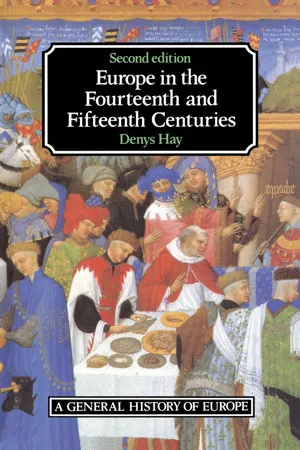
- 496 pages
- English
- ePUB (mobile friendly)
- Available on iOS & Android
eBook - ePub
Europe in the Fourteenth and Fifteenth Centuries
About this book
The second edition of this highly successful textbook analyses the structure of later medieval society in Europe, identifies its main groups and their political programmes, and examines their impact on the political, economic and social history of the major European states. There are many additions and expansions in this new edition, and the important chapter on the Central Monarchies (of Poland, Hungary, Bohemia, Rumania and Lithuania) has been newly contributed by Professor J M Bak of the University of British Columbia.
1
The Sources
A historian depends on the evidence of every kind left by earlier ages. Buildings, tools, clothing, works of art and works of utility are all grist to his mill. His prime source of information is, however, the words of the period with which he is concerned – literary works, including contemporary histories, and administrative records of all sorts, from the official accounts of governments to the ledgers and letters of private persons and corporations. These written records are usually more informative than the silent witness of bricks and paint, and in any brief account of the sources they take pride of place.
In the course of the period here discussed the sources of this type changed very considerably in most regions of Europe. Earlier the bulk of writing had been in Latin; now it was often in the vernacular, a trend which by the late fifteenth century had become dominant, despite a remarkable and important revival of writing in ‘classical’ Latin. Earlier the record keepers had been mainly clergy, the clerks who acted for king and magnate, and whose own records, for church or monastery, have been better preserved than lay documents; now the king’s officials were often laymen, and laymen themselves began to keep more documents, because they were frequently literate, exchanging letters with one another. These were perhaps the most important changes but many others followed on the king’s securing (as we shall see that he did) a greater power in most countries, for this affected the administrative records which are usually our most continuous source of information about public life. We now begin to find secretarial records, for example, and a new type of diplomatic agent with a growing range of reports and detailed negotiations. The very changes in the documentation are thus frequently a valuable guide to what people were doing and what they said they were trying to do, which is what the historian wants to find out.
For the plain narrative of events – the kind of material one can nowadays accumulate by keeping a file of newspapers – one must at this time turn to the historians, the men who were chronicling their own day for themselves and their contemporaries. Here, too, we shall find changes indicative of new needs: the old chronicle, annalistic and largely the product of monasteries, was going out; annals of a quite novel type began to be compiled; and fresh varieties of narrative made their appearance. These developments in narrative sources will first be considered.
Narrative Sources
One has to remember the great number of chronicles composed and ‘continued’ in the twelfth and thirteenth centuries to view in perspective the output of the monastic annalist in the later Middle Ages. At first sight the work of the monastic historian seems considerable. In France the great house of St Denis, north of Paris, maintained its ‘Great Chronicles’ in both Latin and the vernacular, and the Latin narrative of the anonymous monk covering the years 1380–1422 (ed. Bellaguet, 1839-52) is, if the last important contribution to the series, by no means the least impressive. Similarly at St Albans, north of London, the house that had produced the splendid chronicles of Roger of Wendover and Matthew Paris could still muster a Thomas Walsingham, several of whose works and notably the Historia Anglicana 1406-20 (ed. V. H. Galbraith, 1937) are significant sources. But after the early years of the fifteenth century the monastic chronicle dried up, even in France and England; elsewhere it had become parochial long before.
This decline in historical writing by members of religious communities is of interest for the light it throws on the intellectual life of the religious themselves, as well as on the broader topic of what was of interest to other sections of the reading public. There is no overall decline in historical composition; rather the contrary, for several new types of narration appeared to compensate for the failure of the traditional genre. There is, first, a curiously shortlived burst of what must be termed ‘chivalric’ history; secular chronicles begin to be plentiful in towns; and, in Italy, original forms of sustained and mature historical composition were evolved.
A knightly way of life had been the accepted social norm in western Europe for many centuries. This had certain literary consequences (the romance epics, for instance) but it was not until the fourteenth century that historiography was markedly affected. One important reason for the timelag undoubtedly lay in the illiteracy of the laity – or at any rate of the landed laity – who earlier had of necessity to listen to bard or storyteller, but who could now often read for themselves. To them the subject of war was particularly congenial and to them were addressed the chronicles of Jean le Bel and his great successor, Jean Froissart (d. c. 1404). The success of Froissart’s Chronicle, which in its various recensions covers the years 1327–1400, is to be measured by the large number of manuscripts which have survived – so numerous are they that to this day there is no complete and adequate edition. (What will be the best, that published by the Société de l’histoire de France, began to come out in 1869 (ed. Luce) and has not got beyond the year 1388 in the fourteen volumes which have so far appeared.) Froissart’s success was undoubtedly due in part to the way he coincided with a period of Anglo-French rivalry which subsumed the history of Scotland, the Low Countries and Spain: his canvas covered Europe. In part it was due to his brilliance as an author, for it is hard even today to put him down once one has begun to read his stately and colourful prose. But equally important are the long lists of lords, knights and gentlemen who throng his pages; for many readers his story had all the charm which later notables were to find in the Almanack de Gotha or Who’s Who. Le Bel and Froissart were clerks in orders. Their successors in this type of contemporary history were often laymen: Enguerrand de Monstrelet (d. 1453) and Georges Chastellain (d. 1475), who between them cover the first three-quarters of the fifteenth century from a European viewpoint somewhat similar to Froissart’s, were gentlemen in the service of the dukes of Burgundy.
This chivalrous history, concentrating on wars and tournaments, is of the first importance to the historian but, as the authors gathered much of their material from the parties whose actions they were describing, the authority of any single episode as recounted even by Froissart or Chastellain has to be controlled by other sources. There is also the danger that these literary men might have coloured their pages in a way favourable to the patron of the moment: it is this which has led some critics to identify and disparage the so-called ‘Burgundian School’. Yet the greatest literary champion of a prince had a detachment which gives his pages the very highest authority: Philippe Commynes, former servant of Charles the Bold who became adviser and man of affairs to Louis XI of France, wrote in his Mémoires (conveniently edited by Calmette and Durville, 3 vols., Paris, 1924-25 trans. and ed. M. Jones, ‘Penguin Classics’, 1972) an astonishingly cool analysis of the reigns of Louis XI and Charles VIII, when he had been at the centre of political life. But with Commynes we have left the chivalric narrative and entered a world which Froissart would have hardly recognized: the Mémoires have more in common with the new diplomatic despatch than the old chronicle. Jones, op. cit. pp. 27-8 argues that they are largely designed to defend his own devious behaviour.
In these years a new type of chronicle made rapid strides all over Europe. It was composed by townsmen for their fellow townsmen and it is evidence both of the growth of urban importance in society at large and of the literacy of yet another group of men and women. Not surprisingly the town chronicle is found most often in areas where towns were large and politically important: in Italy, in parts of Germany. No collection of Italian town chronicles has ever been made, though a great many are now in print, not least in both the old and the new ‘Muratori’ – the Rerum Italicarum Scriptores published by L. A. Muratori in twenty-eight folio volumes (Milan, 1723-51) which has been slowly appearing, newly edited, since 1900. In Italian civic histories one series stands apart, the chronicle composed by three members of the Villani family of Florence (ed. Magheri, 8 vols., 1923; Cronisti del Trecento, ed. R. Palmarocchi, 1935). Giovanni’s work ran from the creation to 1348; his brother Matteo continued this to 1363; and Matteo’s son Filippo added a further section. For German town chronicles we have the great work, known by the name of its first editor C. Hegel, Die Chroniken der deutschen Städte vom 14 bis ins 16 Jahrhundert: this began to appear in 1862 and vol. 36 was published in 1931. The narrative of events in great cities like Hamburg, Augsburg, Florence or Milan naturally embraced much general history. In France, Castile or England urban chronicles were both rarer and more parochial. London was really the only English town to develop a flourishing tradition; in France even Paris failed to provide a proper civic chronicle, though it had in the so-called ‘Bourgeois’ a diarist whose work is a vital source of French history for the period 1405-49 (ed. Tuetey, 1881), annotated and trans. by Janet Shirley, Oxford, 1968. It should be noted that this urban historiography contributed greatly to more ambitious works of the late fifteenth century – for example Fabyan’s Chronicle in England (London, 1516) and in Germany the Liber Chronicarum of Hartman Schedel (Nuremberg, 1493) which, with its illustrations, was to prove an influential work, although in itself an uncritical compilation. It will be noted that we now moved into the era of print (see below, p. 384); with Schedel we have also moved into a literary tradition where the new historio-graphical methods of Italy are beginning to be influential.
The nature and stages of the ‘Renaissance’ in Italy form the subject of a later section of this book (below, p. 374). One of its characteristic fields was historical composition. The turning point in this was the close identification of literary culture with civic politics in the writings of Leonardo Bruni. Florence had in Bruni a chancellor who aided with his pen the diplomacy of the town and who presented to his fellow citizens a rational picture of Florentine history designed to fortify Florentine sentiments of primacy and independence and to win respect by its polished presentation. Bruni’s Historiarum Florentini Populi libri xii (1415 – 29, best ed. by Santini in the new Rerum Italicarum Scriptores, 1914—26) was soon emulated all over Italy. Even the popes had such a survey of their past in B. Platina’s Lives (ed. Gaida, Rer. Ital. Script., 1912— 32), though this could naturally not be made, as other histories were, to serve the interests of a dynasty. The classical Latin historians were regarded as models and, though the directness and charm of the old civic chronicle was lost and a polemical aim often distorted the facts, much was gained in clarity of exposition, analysis of motive and concentration on significant events. At this stage history became ‘past politics’ and frequently – as in the vernacular writings of Machiavelli and Guicciardini in the early sixteenth century – maintained a function in present politics as well. Another strand in Italian culture was an interest in the past for its own sake. This is best seen in the works of Flavio Biondo, a papal servant who wrote a number of influential works on Roman antiquities and who broke new ground by his description of Italy (Italia Illustrata, 1448-53) and his survey of history, the Decades (1439—50) which cover the period from a.d. 412 to 1442: with him the concept of the ‘Middle Ages’ effectively takes form; the phrase media tempestas is found in 1469.
By the end of the fifteenth century Italian writers were for the most part in the service not of republican towns but of increasingly autocratic princes and this was to facilitate the acceptance of the new Italian styles in northern Europe in the course of the sixteenth century. But even before then some traces of a new interest in antiquity and a new analysis of politics can be discerned north of the Alps. In France one must note the remarkable works of Thomas Basin (1412—91) in Latin, of which C. Samaran published an edition and translation of the Histoire de Charles VII in two volumes, (Paris, 1933-44) and of the Histoire de Louis XI in three volumes, (1963-72); Gaguin’s Compendium came out at Lyons in 1497. In Germany Schedel has been mentioned. To his name we should add the more important writers Johannes Nauclerus who published in 1504 a chronicle in which Italian influences are evident; and Jacob Wimpheling who at about the same date published his Epitome rerum Germanicarum. Yet these men were clerks of an old-fashioned kind and their works are often almost indistinguishable from medieval writings on similar themes. Only in Wimpheling, with his deliberate attempt to bolster German prestige, do we encounter a genuine Italian element and that in its most crude and chauvinistic form. In fact the most sophisticated northern historian was Commynes, writing not in Latin but in the vernacular. But even in Renaissance Italy the vernacular was about to be used for mature historical and political analysis by Machiavelli and Guicciardini.
It will be apparent that, apart from Italy, the new types of narrative history found in the later Middle Ages compensate only in part for the absence of the great church chronicles of an earlier epoch. That the history of the fourteenth and fifteenth centuries can none the less be written with a new richness and precision is due to the much greater bulk of record material and of what may loosely be described as private papers.
Public Records and Private Papers
Government at every level in the Middle Ages depended on written documents. As government became more ambitious and effective in the thirteenth and later centuries this documentation becomes more abundant.
In great kingdoms – in Iberia, France, England – the central machinery was now more prolific than ever before. Acting on instructions from prince or council, the old departments of state issued executive directions. The very deliberations of the intimate councillors were often minuted. Formal charters were issued by the chancery under the great seal of the realm and the chancery also issued a host of directives less solemn (letters patent) or more ad hoc (letters close) as well as even more casual writs and injunctions. Of these copies were carefully registered. Likewise careful records of the prince’s financial rights in his land were kept by the exchequer or treasury which, like the chancery, had an executive side. Equally it had a judicial side, though in all kingdoms there now existed a hierarchy of courts of law operating from the local level with appeals upwards to the centre of political power. Here too litigants demanded and judges imposed the maintenance of full records of proceedings. Finally there were everywhere bodies of a consultative or legislative or legal character – parliament, estates, cortes – whose deliberations and decisions were sometimes enrolled either because this was the wish of the representatives present or because their decisions affected public administration or finance.
To these steadily accumulating ‘public records’ this period was to add new categories. Here again the innovations are first encountered in Italy. The Italian princes and republics began to employ ‘secretaries’: the word itself suggests the familiar and confidential nature of the work. By the mid-fifteenth century we encounter secretaries in the entourage of the prince in Castile, France and England. The office was destined to have a future of importance, for as the prince began to govern more and more personally he found the secretary a more adaptable instrument than the cumbersome chancery; the secretary was his alter ego, his pen, his ear – his master at times, and frequently his scapegoat. Masses of papers came to this influential factotum – notes from his sovereign, reports from underlings, endless requests for favour and intervention from even the greatest in the land. By the end of the fifteenth century we can discern some of the functions of the future ‘secretary of state’.
Another official was likewise born in Italy at this time: the permanent diplomatic agent. This development, and the secretary, will be briefly mentioned later (p. 121). Here must be noted the emergence of his records – formal instructions, formal despatches, and the multiplying papers of his daily inquisitiveness, as he retailed to his government the comings and goings of the court to which he was attached and estimated the significance of gossip and rumoui. Again, by the end of the century, northern princes are falling into line, not least in maintaining agents at the court of the pope.
The curia Romana merits a word to itself in connection with record sources for, as we shall see, the administration of the church qua government was elaborate and up-to-date. Here we find not only the chancery and treasury (the latter called the camera apostolica) and law courts (notably the Rota) all with elaborate registries, but from the fifteenth century, a secretarial staff both numerous and influential. The resulting records, dealing as they do with Christendom at large, are one of the prime sources of European history and as such are being exploited by scholars of every country. French, German and Belgian scholars have over the years made available vast quantities of the papal registers of the fourteenth century; in the Calendars of Papal Letters and Papal Petitions we have volumes throwing light on many aspects of public and ecclesiastical life in the countries of Britain. Admirable surveys of this material have been recently published by Dr Leslie Macfarlane (Archives, vol. iv, 1959), and by Leonard Boyle S. J. (Pontifical Institute of Medieval Studies, Toronto, 1972). Church history also witnesses attempts at conciliar government at Constance (1414—18) and Basle (1431—47). These assemblies resulted in a mountain of documentation which represents every type of historical source – narrative (including the important accounts by Aeneas Sylvius Piccolomini and John of Ragusa), documents of all sorts and diaries, letters, sermons and debates. There have been many collections of this of which the most notable are volumes xxvn-xxxv ofj. D. Mansi, Sacrorum Conciliorum Collectio (1759-98, reprinted 1901 ff.), E. H. von der Hardt, Magnum Oecumenicum Constantiense Concilium (Frankfort 1696–1717), Monumenta Conciliorum generalium saec. XV: scriptores, ed. O. Richter and others (Vienna 1857-95); and the more recent collections by H. Finke, Acta Concilii Constanciensis, 4 vols. (1896–1928) and J. Haller and others, Concilium Basiliense, 7 vols. (1896–1926). Translations by Louise R. Loomis of some of the Constance materials are contained in The Council of Constance, edited by J. H. Mundy and K. M. Woody (1961). Preceding paragraphs have been devoted to the archives of central government. But this is only part of the story. At a regional or local level in great kingdoms the administrative controls were only in part to be found in royal officials: prévôts, sheriffs and other magistrates. Much law and administration was still seignorial – in the hands of the lord of land – or municipal. And there were large areas in Europe, notably in Germany and Italy, where at the start of the period the only government that mattered was seignorial and municipal. In the case of a great lord, whether in France or Italy or Germany or England, the machinery he...
Table of contents
- Cover
- Title
- Copyright
- CONTENTS
- LIST OF GENEALOGICAL TABLES AND MAPS
- PREFACE
- ACKNOWLEDGEMENTS
- 1 THE SOURCES
- 2 EUROPE AT THE BEGINNING OF THE FOURTEENTH CENTURY
- 3 SOCIETY AND ITS STRUCTURE: 1. THE PEASANTS: POPULATION TRENDS
- 4 SOCIETY AND ITS STRUCTURE: 2. CLERGY, NOBILITY, TOWNSMEN
- 5 THE THEORY AND PRACTICE OF GOVERNMENT
- 6 POLITICAL DEVELOPMENT IN WESTERN EUROPE
- 7 ITALIANS AND ITALY
- 8 GERMANY AND HER NORTHERN NEIGHBOURS
- 9 EAST-CENTRAL EUROPE
- 10 EASTERN EUROPE
- 11 THE PAPAL MONARCHY: THE CHURCH AS A STATE
- 12 THE BONDS OF RELIGION
- 13 THE BONDS OF EDUCATION, LITERATURE AND ART
- 14 THE BONDS OF TRADE
- 15 THE FUTURE: EUROPE AND THE WORLD
- BIBLIOGRAPHY
- GENEALOGICAL TABLES
- INDEX
Trusted by 375,005 students
Access to over 1.5 million titles for a fair monthly price.
Study more efficiently using our study tools.
Frequently asked questions
Yes, you can cancel anytime from the Subscription tab in your account settings on the Perlego website. Your subscription will stay active until the end of your current billing period. Learn how to cancel your subscription
No, books cannot be downloaded as external files, such as PDFs, for use outside of Perlego. However, you can download books within the Perlego app for offline reading on mobile or tablet. Learn how to download books offline
Perlego offers two plans: Essential and Complete
- Essential is ideal for learners and professionals who enjoy exploring a wide range of subjects. Access the Essential Library with 800,000+ trusted titles and best-sellers across business, personal growth, and the humanities. Includes unlimited reading time and Standard Read Aloud voice.
- Complete: Perfect for advanced learners and researchers needing full, unrestricted access. Unlock 1.5M+ books across hundreds of subjects, including academic and specialized titles. The Complete Plan also includes advanced features like Premium Read Aloud and Research Assistant.
We are an online textbook subscription service, where you can get access to an entire online library for less than the price of a single book per month. With over 1.5 million books across 990+ topics, we’ve got you covered! Learn about our mission
Look out for the read-aloud symbol on your next book to see if you can listen to it. The read-aloud tool reads text aloud for you, highlighting the text as it is being read. You can pause it, speed it up and slow it down. Learn more about Read Aloud
Yes! You can use the Perlego app on both iOS and Android devices to read anytime, anywhere — even offline. Perfect for commutes or when you’re on the go.
Please note we cannot support devices running on iOS 13 and Android 7 or earlier. Learn more about using the app
Please note we cannot support devices running on iOS 13 and Android 7 or earlier. Learn more about using the app
Yes, you can access Europe in the Fourteenth and Fifteenth Centuries by Denys Hay in PDF and/or ePUB format, as well as other popular books in History & European History. We have over 1.5 million books available in our catalogue for you to explore.