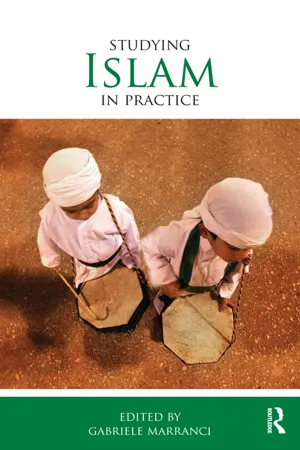
This book presents Islam as a lived religion through observation and discussion of how Muslims from a variety of countries, traditions and views practice their religion. It conveys the experiences of researchers from different disciplinary backgrounds and demonstrates the dynamic and heterogeneous world of Islam. The fascinating case studies range from Turkey, Egypt, Morocco and Lebanon to the UK, USA, Australia and Indonesia, and cover topics such as music, art, education, law, gender and sexuality. Together they will help students understand how research into religious practice is carried out, and what issues and challenges arise.
- 244 pages
- English
- ePUB (mobile friendly)
- Available on iOS & Android
eBook - ePub
Studying Islam in Practice
About this book
Information
Chapter 1
On fasting in Fes
Learning about food, family, and friendship during fieldwork in Morocco
Preamble
Fasting (sawm) is one of the five central pillars of the Islamic faith, along with accepting the oneness of Allah (shahada), performing the five required daily prayers (salat), making a pilgrimage to Mecca (hajj), and alms and charity (zakat). Ramadan is the month of fasting and the holiest month of the Islamic lunar calendar when Muslims fulfil one of the obligations of their faith. Ramadan is a sacred and joyful period, bringing quiet days of fasting from sun-up to sun-down when one tries to remain ‘clean’ in one’s thoughts, speech, and action. Fasting is seen largely as a purification process, and one that restores human beings to a closer state of sinlessness. To not fast during Ramadan is amongst one of the major sins in Islam; and to curse, gossip, or treat another person badly while fasting may void one’s fast. Fasting during Ramadan is to take part in solidarity across the Muslim world, when wealthier Muslims remember the poor and what it would feel like to walk in the shoes of a hungry and desperate person. Acts of charity (sadaqa) in the month of Ramadan are informal with people trying to share and invite guests with more frequency. Charity in the formal sense, zakat, is observed during Ramadan when individuals decide how much they can give in alms. Ramadan nights bring families and friends together around elaborate meals and special television programmes that provide entertainment. Ramadan is also an important time to consider broader cultural conceptualizations of gender within the context of family in Morocco.
Narrative
Despite hours of fasting and long spells of what appears to be virtual inactivity almost everywhere during the day, Ramadan nights become big celebrations where one not only eats, but eats extraordinarily well. It is always good to be a guest in Morocco, and it is especially good to be a guest during Ramadan. Hospitality is one of the central tenets of Islam and it manifests broadly in everyday cultural contexts. One is obligated to show others care and respect through acts of hospitality and charity, and it is believed that Allah rewards those who feed the hungry or those who are fasting. In Morocco everyone fasts and even those who do not show great religiosity during other times of the year observe the fast as well. Cultural expectations of fasting enforce this foundational pillar of faith across all strata of Moroccan society.
My research in Morocco since my first visit in 1997 has been focused on religion in everyday contemporary and urban settings. I have been particularly fascinated by women’s responsibilities around organizing family festivities and how they appear to keep the whole of Moroccan culture woven together. In 2002 and 2003, I was in Fes, Morocco, conducting ethnographic fieldwork on the Fes Festival of World Sacred Music. I had lived with host families in the past and had known what it was like to experience Moroccan hospitality within a home setting, but I was less prepared to experience it this time as I was living with a roommate and volunteering in what seemed more like an office setting than ‘the field’. While I had been adopted into families with whom I had lodged during my earlier stays in Morocco, I was adopted by nearly everyone I met in Fes, and increasingly so during Ramadan. The people I worked with worried that I was living alone in a cold old house in the older part of the city, the medina, away from the comfort of my own home and my husband who had stayed behind during my fieldwork stint. My narrative here focuses on Ramadan as a time devoted to asserting Islamic principles of family and community, and how my Moroccan friends and contacts sought to bring me into a recognizable family framework, a sort of makeshift fictive kinship, for my benefit and for theirs.
First, I should say a word about the Fes Festival of World Sacred Music. It began in 1994 as the result of increasingly negative media images concerning Muslims and Islam following the first Gulf War in Iraq. During the 1990s, when the USA launched its Desert Storm campaign against Sadam Hussein, this period marked a crucial turning point in American foreign policy. As a young person in college during the first Gulf War, for the first time in my life the media began increasingly and consistently to portray the Islamic world as eternally backward and ‘other’. In 1994, a group of Sufi inspired, well-educated Moroccans wanted to turn the ‘Desert Storm’ metaphor on its head with a conference they called ‘Desert Conference’, and they invited participants to take part in discussions where people from the Abrahamic faiths (Judaism, Christianity, and Islam) meditated for a change on their similarities rather than their differences. Under the direction of Dr Faouzi Skali, a Moroccan cultural anthropologist and practicing Sufi, this small endeavour grew into a large international music festival of epic proportions. This festival garnered global attention and acclaim and inspired people to use the arts and music as forms of soft diplomacy to create similar festivals all around the world.
The great grandson of the Prophet Muhammad, Moulay Idris I, settled the city of Fes, considered the spiritual capital of Morocco, in 789 and today Fes welcomes in the world during the Fes Festival of World Sacred Music. This festival brings to life the core Islamic principles of Ahl al-Kitab, or people of the monotheistic traditions. The city abounds with spiritual musical performances in its concert and performance spaces, as well as in the gardens and shared public spaces of the city. I went to Fes to study this festival and how its underlying principles were an example of how progressive Islam reaches out to the rest of the world.
Unlike anthropologists that mostly observed objectively from afar in ethnographies of yesteryear, my presence at the Fes Festival led me to many opportunities to volunteer my time. The people working at the Fes Festival were simply too busy and understaffed to have a perfectly able-bodied person like myself sit around and observe them as they worked at a furious pace, bracing over a period of months to accommodate the thousands of people who would converge on the city for this once-in-a-lifetime yearly event. The annual festival was truly unique in that the line-up of speakers, artists, artwork, and musicians continued to change under new yearly themes and responded to significant current political events. My time in Fes that year marked the second war in Iraq in the wake of 9/11 and marked Morocco’s first suicide bombing in Casablanca, which spurred a march of nearly one million people. The political tremors of what we would later come to call ‘The Arab Spring’ or ‘The Arab Awakening’ were felt the year I was in Morocco.
The festival organizers put me to work at any opportunity they could, and installed me in a small office, informing me that I was to be a translator. I would ‘observe’ as I had hoped and I would also do things to help out, like translate their entire festival programme from French to English. Because I was not really a translator, this job of translating took up much more of my time than I had anticipated and in the interim I managed to make some very good friends while in the office where I did learn a thing or two about Fes and Morocco. While I much appreciated the notion of ‘applied’ and ‘engaged’ anthropology and wanted very much to be useful, the tasks that I was given were not always easy for me to complete. In addition to translating French to English documents rather poorly, I also picked up VIPs from the Fes airport, accompanied our entrepreneurial Berber driver to transport said VIPs while they were in Fes, attended meetings of all sorts, got to know a steel magnolia cast of Fassia women who ran NGOs and organized trips to Mecca, and met a host of musicians, scholars, professors, World Bank execs, and activists of every shade and stripe. I also inadvertently became the subject of documentary films that I would never see. I met an Italian couple that was interested in the fact that I had accidentally rented a room that was really a former stable, and at times I tried interviewing international journalists who tried to interview me as I interviewed them. In other words, conducting fieldwork in this busy thoroughfare was a big adventure.
After surviving my first festival cycle in 2002, I was unlucky enough to be the only English-speaking person left who could help Moroccan vendors file their reimbursement forms for services they had already rendered for the World Bank-sponsored conference that was perhaps ironically named ‘Giving a Soul to Globalization’. Amongst my favourite things I did while doing fieldwork was getting the chance to watch stage architects and sound crews set up performance sites in what were otherwise everyday places and watching the auditory and cultural transformations that would later take place when musicians arrived. This was particularly satisfying for me as a person with longterm interest in the cultural construction of ritual, and Fes was a wonderful place to observe people from different backgrounds, who rarely spoke the same language, come together to build twenty-first century public ritual sites. After the dust of the festival settled, the skeleton crew that made this sprawling festival happen stayed behind to get the whole thing started once again for the following year. It was not the experience I had expected to have, but then again, fieldwork is probably never what we expect it will be.
The office where I worked at the Fes Festival was essentially a part of what used to be a narrow corridor in an abandoned ‘palace’ where a wealthy family had lived in years past. Like many of the old families of Fes, the family who had owned the estate had simply moved to the larger urban areas of Rabat or Casablanca and over time, the site had no formal inhabitants. The French had tried to make Fes work as a colonial capital and had failed miserably. A temporary solution had been to give up on ever turning the honeycombed streets of the medina into a base for their colonial endeavours, so they simply relocated and built a very French looking town off in the distance now called “la ville nouvelle”, or the new town. Now every town in Morocco has a ville nouvelle, and much anthropological ink has been spilled on the topic of the tremendous shift in Moroccan consciousness that occurred when Moroccans gradually abandoned their old towns in favour of something more ‘modern’. The old medina of Fes is either terribly neglected or overly developed for tourists. Much of the medina, whose older portions date back to the middle ages, is currently inhabited by squatters who have taken up in houses whose owners no one can remember and an increasing number of expats hoping to turn Moroccan old world charm into a pretty penny by restoring old homes and opening bed and breakfast lodging for tourists.
Perhaps to save it from complete ruin and abandonment the palace where I worked became a Moroccan version of an NGO, called Fes Saiss, where free courses in reading, writing, and other practical life skills were offered to mostly women living nearby in the medina of Fes. Fes Saiss organized a wide variety of cultural and service events for the city, doing everything from hosting large group weddings for couples who could not afford the customary elaborate ceremonies, to organizing Andalusian music festivals, to collecting secondhand wheelchairs from Europe and dispensing them to the needy in Fes. Electrified with the potential of grassroots development made possible through micro finance projects, Fes Saiss also offered sewing and embroidery courses for women who wanted to launch their own home businesses selling traditional Moroccan hand-sewn clothing. Although Moroccans had rather easily left their medinas, they continued to purchase traditional clothing and cherish the notion of commissioning new pieces each year as styles change, so much so that this was a fundamental part of Ramadan. Although officially non-governmental, the organization’s daily activities could quickly come to a halt if and when important government officials showed up for meetings, and Moroccan high tea would be the main event in the grand salon facing the pomegranate-lined central courtyard. This was after all a non-governmental organization (NGO) in a country that boasts one of the world’s longest royal dynasties and what I came to think of not as a typical NGO, but a MONGO. I would sometimes be called in to meet visiting dignitaries in the elaborately decorated main salon of the palace complex. Our guests might have been dazzled by the antique furnishings and elaborate tile work and hand-carved plaster ceilings, but might have been reluctant to enter had they any idea that the roof above their heads was shouldering significant decay and verging towards foundational collapse. This is in some sense the essence of Fes, grand and evocative of an otherworldly precolonial elegance, yet nearly on the brink of disappearing due to extended periods of benign neglect.
The Fes Festival of World Sacred Music is ultimately a citywide weeklong music and arts festival that draws visitors from all around Morocco, Europe, and the USA, with musicians and speakers attending from all over the world. I had come to study competing notions of hospitality, traditional notions of Islamic hospitality alongside globalizing forces that ushered in the European and American notions of the hospitality industry and service-oriented models. It turned out that my being in Fes Saiss was the perfect place to experience Ramadan as both the Fes Festival itself and Fes Saiss were steeped in Islamic notions of hospitality, welcoming, and giving, and both reached out to the rest of the world through discourses of non-governmental development initiatives resting on older layers of Islamic authority as evidenced in the nearby Qarawiyyin University founded in 859.
My first clue that Ramadan had officially started the year I was in Fes was the sounds from my neighbours in the wee hours of the morning preparing to eat up before the adhan, or the call to prayer that sounds loudly five times daily from the four hundred or so mosque loudspeakers in the medina. They were up eating and drinking their suhur, the meal one eats during Ramadan prior to the morning call to prayer (fajr). Despite the very early hour, I could smell numerous dishes, soup, fresh bread, and smen, a cultured butter used on most breakfast breads. I knew I should get up because it would be impossible to eat at other times during the day. It was unusually cold that year and when my feet touched the cold tile floor, I simply retracted and crawled back under my stack of blankets. The lack of central heating along with my window that was prone to open on its own did make me feel like I was on a permanent camping trip. My room opened onto a courtyard, a riad-style home built around an interior garden and fountain, and to get to the bathroom or shower or to the kitchen I had to walk through a small grove of citrus trees. The house was truly beautiful and had been built as a place to host parties, yet despite its obvious charm it was often unbearably cold.
Later that morning, after I had summoned the courage to face the cold, I walked along virtually empty streets that would have normally been bustling with activity. The medina is famous for its never-ending stream of sounds, and it was a rather surreal experience to walk along the cobblestone path to my palace office corridor hearing only the tip-tap of my own feet. The street was eerily quiet and I felt at first as if I had been the last survivor in this town. I lived about ten minutes walking distance from Fes Saiss and routinely had breakfast on the way to work. Each morning I had grown accustomed to stopping off at a local bakery where I would order qahwa mhersa (broken coffee) and hrsha, a dense cornbread-like food made from semolina. I had grown so used to this food in the morning that I often wondered what I would eat when I returned to Texas as nothing I could think of seemed as fundamentally breakfast worthy as this. Even now, no coffee anywhere tastes as satisfying as qahwa mhersa, called ‘broken coffee’ because the dense milk would ‘break’ the sharpness of the strong Brazilian espresso.
On that first morning of Ramadan everything seemed to be closed or just barely starting to open. The bakery I had come to know and love as the place to catch up on Arabic music videos as I slurped my morning Joe had transformed into a literal mountain of shabakiya, syrupy sweet cookies eaten during Ramadan, and the customary pop music was replaced with Qur’anic recitation from an Egyptian television station. The shabakiya is the iconic reminder that Ramadan has arrived, a more daring cousin of the American funnel cake, with spices like cinnamon and gum Arabic kneaded into the dough, which is twisted into an attractive floral shape, then fried and dipped in honey and rolled around in sesame seeds and doused with a bit of orange blossom water. When Ramadan begins, you see shabakiya everywhere in quantities that suggest Moroccans fearlessly consume carbohydrates as if there is no fear of a diabetic future. After you get used to shabakiya, you tend to forget that in Morocco sweets can often come before the main meal; in fact, dessert can be the first of many long courses in a single meal. For an American like me who was cajoled into eating broccoli as a child to earn the right to have a dessert, shabakiya was a dream come true.
The owner of the café, who welcomed me each morning, cast me a sidelong glance and a solemn nod as if to say, ‘It’s Ramadan, please don’t embarrass yourself by trying to eat here this morning’. I had heard stories about ‘bad foreigners’ who took to eating in McDonald’s during Ramadan in the capital city of Rabat. I kept walking, nodding in return, regretting that I did not get up when I heard the neighbours eating next door. My stomach growled loudly as if in apparent protest as the bakery faded into the background.
I walked into the courtyard of Fes Saiss that morning and found only the daughter of the live-in guard and the stray cats she fed from her family’s table scraps. She said to me ‘Ramadan Mabrouk [Happy Ramadan], and what are you doing here?’ Surprised a bit, I said that I had come to work like any other morning. She replied with more confidence than most six-year olds typically have, ‘Well, don’t you have Ramadan in your country? You should be asleep now, you know’. ‘No, we don’t exactly have Ramadan in my country like in Morocco because we have so many different religions, people celebrate differently’. My response prompted her to shake her head in disbelief. I had found that children were amongst the most useful teachers in Morocco; they had a knack for telling you when you were without a doubt in the cultural wrong and exactly how to return to a culturally perceived kind of normal. They could tell you what you were doing wrong without some of the sting you might feel from adults. Lesson learned, I thought, tomorrow I would eat around 4:00 a.m. in the morning, drink enough water to feel hydrated for the whole day, then go back to sleep like everyone else at fajr, and then sleep in. Then I would show up to work late, very late.
Not sure what else to do with myself, I slipped off into the cocoon of my little office space. I turned on the computer and my stomach growled again. More than food, I wondered with anxiety how I would manage my caffeine needs. Since coming to Morocco, I got used to drinking strong coffee and heavily minted green tea several times a day. I heard some voices in the courtyard and felt relief at not being alone amongst the hungry stray cats that prowled outside my office door. In came my closest work friend Btissam, cheerful as always. Indeed her name actually meant ‘The one who smiles’ and in the year I had known her she seemed to consistently live up to her name.
‘My mom and I were a little worried about you this morning’, she said with a bit of panic in her face. ‘Oh, why is that?’ I said. It turns out they were very bothered by the idea that I would be fasting all alone since fasting is largely done within the context of a family. ‘You’ll just come home with me everyday and eat, OK?’ she said. ‘You mean for thirty days I’ll come to your house?’ I responded with surprise. Btissam and her mother were amongst those overcome with sadness at my being separated from my husband during Ramadan; nothing could be worse than to be on your own during a month when you should be fasting with those you love. The very idea that I would get married and then a couple of months later go to do fieldwork by myself without my husband was really more than they could understand. At that time Btissam was in the process of planning her own engagement and wedding, and she so longed to get married quickly that my own choice of doing research away from my family confounded her at times. The whole thing seemed very esoteric to her, and she would ask me questions like ‘Doesn’t your husband worry for your safety? Are you not thinking of having children? Don’t you worry what your husband will eat during Ramadan?’ I tried to explain that my husband fully supported me and that I had planned my research project befor...
Table of contents
- Cover
- Half Title
- Title Page
- Copyright Page
- Table of Contents
- List of illustrations
- Series preface
- Acknowledgements
- Introduction: studying Islam in practice
- 1 On fasting in Fes: learning about food, family, and friendshipduring fieldwork in Morocco
- 2 Studying the Muslim family law courts in Morocco
- 3 Hymenoplasty and the relationship between doctors and muftisin Egypt
- 4 Studying fatwas: global and local answers to religiousquestions
- 5 The hajj: its meaning for Turkish Muslims
- 6 Studying Islam and the city: the case of Istanbul
- 7 Study of Shi’a Muslim women in Southern California
- 8 Studying Indonesian Muslim masculinities in Indonesia and Australia
- 9 An ethnographer among the Ahmadis: learning Islamin the suburbs
- 10 Gender, sexuality and inclusivity in UK mosques
- 11 Where heaven meets earth: music and Islam in everyday life andencounters
- 12 Muslims and the art of interfaith post-9/11: American Muslim artistsreach out to New Yorkers in the aftermath of September 11
- 13 Global Muslim markets in London
- 14 Researching Muslim converts: Islamic teachings, political contextand the researcher's personality
- 15 Studying Muslims and cyberspace
- 16 Women studying for the afterlife
- 17 Experiencing Islamic education in Indonesia
- Index
Trusted by 375,005 students
Access to over 1.5 million titles for a fair monthly price.
Study more efficiently using our study tools.
Frequently asked questions
Yes, you can cancel anytime from the Subscription tab in your account settings on the Perlego website. Your subscription will stay active until the end of your current billing period. Learn how to cancel your subscription
No, books cannot be downloaded as external files, such as PDFs, for use outside of Perlego. However, you can download books within the Perlego app for offline reading on mobile or tablet. Learn how to download books offline
Perlego offers two plans: Essential and Complete
- Essential is ideal for learners and professionals who enjoy exploring a wide range of subjects. Access the Essential Library with 800,000+ trusted titles and best-sellers across business, personal growth, and the humanities. Includes unlimited reading time and Standard Read Aloud voice.
- Complete: Perfect for advanced learners and researchers needing full, unrestricted access. Unlock 1.5M+ books across hundreds of subjects, including academic and specialized titles. The Complete Plan also includes advanced features like Premium Read Aloud and Research Assistant.
We are an online textbook subscription service, where you can get access to an entire online library for less than the price of a single book per month. With over 1.5 million books across 990+ topics, we’ve got you covered! Learn about our mission
Look out for the read-aloud symbol on your next book to see if you can listen to it. The read-aloud tool reads text aloud for you, highlighting the text as it is being read. You can pause it, speed it up and slow it down. Learn more about Read Aloud
Yes! You can use the Perlego app on both iOS and Android devices to read anytime, anywhere — even offline. Perfect for commutes or when you’re on the go.
Please note we cannot support devices running on iOS 13 and Android 7 or earlier. Learn more about using the app
Please note we cannot support devices running on iOS 13 and Android 7 or earlier. Learn more about using the app
Yes, you can access Studying Islam in Practice by Gabriele Marranci in PDF and/or ePUB format, as well as other popular books in Theology & Religion & Islamic Theology. We have over 1.5 million books available in our catalogue for you to explore.