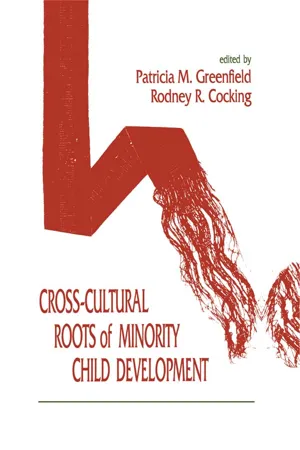
This book constitutes the first time in the field of developmental psychology that cross-cultural roots of minority child development have been studied in their ancestral societies in a systematic way--and by an international group of researchers. Most child development and child psychology texts take cultural diversity in development into account only as an addendum or as a special case--it is not integrated into a comprehensive theory or model of development. The purpose of this text is to redress this situation by enlisting insiders' and outsiders' perspectives on socialization and development in a diverse sampling of the world's cultures, including developing regions that often lack the means to speak for themselves in the arena of international social science.
The unique feature of this text is the paradigm. For the minority groups represented, the questions focused on how development was behaviorally expressed within the culture of origin and in new societal contexts. Thus, developmental issues--such as language and mother-child interactions--for African-American children are considered in the United States as well as in the African culture of origin and in France as a country of immigration. This paradigm is considered for African and Asian cultures and the Americas, including Hispanics from Mexico as well as Native Americans.
Specific questions posed consider the extent to which:
* the development and socialization of minority children can be seen as continuous with their ancestral cultures;
* the cultural and political conditions in the United States, Canada, and France have modified developmental and socialization processes, yielding discontinuities with ancestral cultures;
* the ancestral cultures have changed, yielding cross-generational discontinuities in the development and socialization of immigrants from the very same countries.
* the role of interdependence and independence in developmental scripts can account for historical continuities and discontinuities in development and socialization, both across and within cultures.
These questions not only provide the unifying theme of this unique book but also a model for conceptualizing multi-culturalism within a unified framework for developmental psychology.
eBook - ePub
Cross-cultural Roots of Minority Child Development
- 456 pages
- English
- ePUB (mobile friendly)
- Available on iOS & Android
eBook - ePub
Cross-cultural Roots of Minority Child Development
About this book
Information
Publisher
Psychology PressYear
2014Print ISBN
9780805812244
9780805812237
Edition
1eBook ISBN
9781317781875
CHAPTER
1
INDEPENDENCE AND INTERDEPENDENCE AS DEVELOPMENTAL SCRIPTS: IMPLICATIONS FOR THEORY, RESEARCH, AND PRACTICE
INDEPENDENCE AND INTERDEPENDENCE AS DEVELOPMENTAL SCRIPTS: IMPLICATIONS FOR THEORY, RESEARCH, AND PRACTICE
Patricia M. Greenfield
Developmental psychology, like other branches of psychology, desires to establish a universal science of the person. Yet we are in constant danger of mistaking the particular for the universal. This chapter moves toward the construction of a truly universal theory of development through the empirical and theoretical understanding of cultural diversity. The roles of cultural history and social history are emphasized in this account of development. It is argued that central components of cultural history are value orientations or cultural scripts. These are essential to understand the cultural variability of developmental goals and the acquisition of culture in different societal contexts. However, the study of cultural scripts and their effects on development requires some new methodological assumptions for psychology.
Minority child development provides an important topic that requires all of these conceptual elements for its empirical understanding: cultural history, social history, and new methodological paradigm. In this chapter, I develop each element in turn, drawing on concepts and data from this volume and the workshop that preceded it. As the chapter progresses, it becomes clear that these elements are relevant to the development of all children, not only minority children. The chapter concludes by discussing implications of concepts and data for minority mental health, educational practice, future research, and developmental theory.
IMPACT OF CULTURAL HISTORY ON SOCIALIZATION AND DEVELOPMENT
Minority Child Development and Cultural History
Although recent developmental theory in the Russian tradition has stressed the important role of cultural history in individual development (e.g., Scribner, 1985), proponents of this theory have not applied it to the cultural roots of minority child development. (An important exception to this generalization is Vera John-Steiner.) The present book, in its conception and actualization, makes cultural history a central component of minority child development.
Kim (1991) noted that ethnic groups result from the interaction of the heritage culture and the dominant culture. As Berry (1987) pointed out, minority research up to now has paid too much attention to the “contact culture” and not enough to the culture of origin. A principal aim of this chapter and this book is to redress this balance.
Within ethnic groups, there are variable perspectives on the role of ancestral cultural history. These vary with the time and manner in which a particular ethnic group becomes incorporated into a particular society. At one extreme in the United States are Japanese Americans: They place so much importance on ancestral history that they label every generation since emigration from Japan with a distinctive name. At another extreme are African Americans, among whom the notion of African roots is quite controversial. One view is that the experience of slavery and subsequent discrimination are entirely responsible for a distinctive African-American culture; African culture was wiped out by the slave masters. Yet details of culture, such as African-American handclapping games, are practically identical in West Africa, as Merrill-Mirsky (1991) demonstrated. Sudarkasa (1988) took a sensible position that acknowledges both the historical influence of slavery and the fact that the Africans who adapted to and survived slavery had a culture that must have affected the nature of their adaptation.
Value Orientations: A Key Aspect of Cultural History
Development and socialization in different cultures may originate as adaptations to different ecological/economic conditions (e.g., Berry, 1967, in press; Draper & Cashdan, 1988), the material side of culture. However, the need to create meaning intrinsic to human culture means that these differing adaptations are reflected and rationalized in different value orientations, the symbolic side of culture. Kim (1991) joined these two sides by viewing culture as a collective way to attach meaning to ecological conditions.
The material circumstances of minority children in the United States (or other Western countries) are often very different from those of children growing up in the societies of their ancestral origin. Therefore, it seemed that value orientations, with their attendant goals of development (an aspect of symbolic culture), would be more likely than cultural adaptations to ecological conditions (the material side of culture) to provide evidence of ancestral cultural roots as a source of continuity in the developmental processes of minority children. Although both material and symbolic levels are seen as part and parcel of both culture and human development, the value orientations inherent in cultural scripts were selected as our theoretical starting point.
The key fact about human culture is its intergenerational transmission through the socialization process. Socialization is used in its broadest sense to include informal education in the family as well as formal education. Most important for this chapter and the chapters that follow, value orientations incorporate different goals or endpoints of development, which become the developmental scripts for intergenerational socialization.
Only by viewing behavior and thought processes in relation to people's goals and values is it possible to go beyond the identification of cultural or other group differences and understand the adaptive function and meaning of those differences for the actors. By inserting a value dimension, we are able to go beyond differences to people's own reasons for those differences (Kim & Choi, chapter 11, this volume). In this chapter and this volume, interdependence/independence (often termed collectivism/individualism) is the primary value theme and subsistence survival/schooling is the secondary theme.
Independence/Interdependence: Two Contrasting Developmental Scripts
Psychology as the science of the individual was born and nourished by the philosophical foundations of individualism. We now discover that the independent individual is not a universal fact, but a culture-specific belief system about the development of a person. There is an important alternative belief system that is held by about 70% of the world's population (Triandis, 1989); it is called interdependence or collectivism. Choi (1992) cogently observed that “the socio-cultural themes that came out of the individualistic culture and historical background of the West have the natural bearings of their intellectual heritage, and can never be the alternative view of human beings” (p. 2).
Nonetheless, developmentalists from interdependence-oriented societies can help to balance the ethnocentric picture of individualistic development with an alternative view of interdependent development.
There are increasing voices pointing to a need to derive some intellectual nourishment from the Asian traditions. In the West, the social sciences have been encapsulated by their focus on the individual as the unit of analysis … the Asian contribution would be to refocus the attention on not just the individual, but on relationships. (Ho, 1991, p. 319)
Because every human society must deal with the relationship between person and group, this is a universal developmental issue. To what extent does a culture idealize personhood in terms of individual achievement and autonomy? To what extent does a culture idealize personhood in terms of interdependence with family and community? This choice, with its implications for socialization and development, provides a unifying conceptual framework for considering the relationship between cultural values and developmental pathways. This framework relates closely to the second value dimension, socialization for subsistence/socialization for schooling.
What difference does it make for socialization and development whether the members of a group define the preferred endpoint of human development as independence or interdependence? How does the dialectic (Ho, 1991) between independence and interdependence relate to preferred methods of socialization and education? To answer these questions is a major goal of this chapter and the book that follows.
Independence and Interdependence as Intertwined Phenomena
All human beings are both individuals and members of a social group. Therefore, no one is exclusively independent or interdependent (cf. Turiel, 1994). However, in focusing on values, we are pointing to the ideals of a society. The tension between independence and interdependence generates a continuum of idealized cultural scripts. Although no society can eliminate either the separate individual or the interdependent group, the nature of the ideal has important implications for what is responded to, emphasized, and sanctioned in the socialization process and for the character of social relations. By these means, cultural ideals influence the trajectory of individual development.
Each society strikes a particular balance between individual and group, between independence and interdependence. Every group selects a point on the independence/interdependence continuum as its developmental ideal. The major mode of one society is the minor mode of another. The balance is never perfect; each emphasis, whether it be independence or interdependence, has its own psychological cost (Kim, 1987). Kim noted that, in socially oriented societies, the cost of interdependence is experienced as suppression of individual development, whereas in individualistically oriented cultures, the cost of independence is experienced as alienation. In extreme cases, these costs can become cultural pathologies on either an individual or group level. It is because no society has found the perfect balance between the individual and the group that this theme has such universal fascination.
Intellectual History of Independence/Interdependence
The origins of the independence/interdependence (or individualism/collectivism) dimension lie in the observations of colonialized people who were educated in Western ways and noticed a profound difference in world view. For example, Aimé Cesaire, a subject of French colonization, developed the concept of negritude. In contrast to individualism, a key value of Western civilization, negritude involves “solidarity, born of the cohesion of the primitive clan” (Kesteloof, 1962, p. 84). Individuals as well as physical objects were subordinated to a social collectivity in the world view of sub-Saharan Africa (Greenfield, 1966).
Soon, anthropologists who immersed themselves in African cultures experienced the dichotomous world views. As Lewis (1975) pointed out, an interesting example is the anthropologist Robin Horton (1967):
Horton describes his childhood when he felt most at ease, not with his family or friends, but with his Bunsen burners and chemicals: “Potassium hydroxide and nitric acid were my friends; sodium phosphate and calcium chloride my brothers and sisters.” He continues: “… the image of the man happier with things than with people is common enough in modern Western literature (and) shows that what I am talking about here is the sickness of the times” (Horton, 1967, p. 64).Horton tried to explain to a group of Nigerian students how life in an urban industrial West differed from life in the students' own traditional communities by telling them of his childhood ease with objects and sense of alienation from people. He writes: “What I was saying about a life in which things might seem a welcome haven from people was just so totally foreign to their experience that they could not begin to take it in. They just stared. Rarely have I felt more of an alien than in that discussion.” (Lewis, 1975, p. 231)
The first psychologist to recognize this profound dimension of cultural difference was Mundy-Castle (1968, 1974), who formulated the distinction between social and technological intelligence. This formulation was based on observations concerning the relative importance of people and things in Africa compared with the Western world. Whereas people and social skills seemed more important in Africa, things and technology seemed more important in countries such as the United States, with corresponding differences in strategies of socialization.
Following in the path of researchers such as Wober (1974), Dasen (1984) and Serpell (1993) gave this idea a firm empirical foundation with their investigations of Baoulé intelligence in Ivory Coast and Chewa intelligence in Zambia. Dasen found that what is valued in the Baoulé's indigenous conception of intelligence are social skills such as helpfulness, obedience, respect, and familial responsibility. “More technological skills, such as a sense of observation, quick learning, memory, or manual dexterity are also valued, but only if they are put into the service of the social group” (Dasen, 1984, p. 130). Hence, one can see that it is not a question of social intelligence instead of technological intelligence, but rather an integration of technological intelligence as a means to social ends, not an end in itself. In contrast, in Western society, technological intelligence is generally considered as an end in itself.
In Mundy-Castle's (1968, 1974) original formulations, literacy, with its abstractions removed from a social context, was considered a key to the primacy of technological intelligence. Wober (1967) in turn found a connection between print literacy and the independent individual in Nigeria. There, some workers rejected traditional African housing, with its dense, noisy social environment, in favor of quiet European-style housing, with houses separated by yards, because they wanted to be alone...
Table of contents
- Cover Page
- Half Title Page
- Title Page
- Copyright Page
- Contents
- Preface
- 1 Independence and Interdependence as Developmental Scripts: Implications for Theory, Research, and Practice
- I American Roots
- II African Roots
- III Asian Roots
- IV Concluding Perspectives
- Author Index
- Subject Index
Trusted by 375,005 students
Access to over 1.5 million titles for a fair monthly price.
Study more efficiently using our study tools.
Frequently asked questions
Yes, you can cancel anytime from the Subscription tab in your account settings on the Perlego website. Your subscription will stay active until the end of your current billing period. Learn how to cancel your subscription
No, books cannot be downloaded as external files, such as PDFs, for use outside of Perlego. However, you can download books within the Perlego app for offline reading on mobile or tablet. Learn how to download books offline
Perlego offers two plans: Essential and Complete
- Essential is ideal for learners and professionals who enjoy exploring a wide range of subjects. Access the Essential Library with 800,000+ trusted titles and best-sellers across business, personal growth, and the humanities. Includes unlimited reading time and Standard Read Aloud voice.
- Complete: Perfect for advanced learners and researchers needing full, unrestricted access. Unlock 1.5M+ books across hundreds of subjects, including academic and specialized titles. The Complete Plan also includes advanced features like Premium Read Aloud and Research Assistant.
We are an online textbook subscription service, where you can get access to an entire online library for less than the price of a single book per month. With over 1.5 million books across 990+ topics, we’ve got you covered! Learn about our mission
Look out for the read-aloud symbol on your next book to see if you can listen to it. The read-aloud tool reads text aloud for you, highlighting the text as it is being read. You can pause it, speed it up and slow it down. Learn more about Read Aloud
Yes! You can use the Perlego app on both iOS and Android devices to read anytime, anywhere — even offline. Perfect for commutes or when you’re on the go.
Please note we cannot support devices running on iOS 13 and Android 7 or earlier. Learn more about using the app
Please note we cannot support devices running on iOS 13 and Android 7 or earlier. Learn more about using the app
Yes, you can access Cross-cultural Roots of Minority Child Development by Patricia M. Greenfield,Rodney R. Cocking in PDF and/or ePUB format, as well as other popular books in Psychology & Developmental Psychology. We have over 1.5 million books available in our catalogue for you to explore.