eBook - ePub
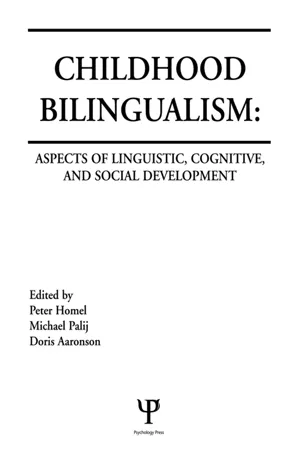
Childhood Bilingualism
Aspects of Linguistic, Cognitive, and Social Development
- 328 pages
- English
- ePUB (mobile friendly)
- Available on iOS & Android
eBook - ePub
Childhood Bilingualism
Aspects of Linguistic, Cognitive, and Social Development
About this book
First published in 1987. This volume is based primarily on a conference on childhood bilingualism held at New York University on June 25 and 26, 1982 with an interest in exploring the nature of bilingual cognition and the effect of bilingualism on psychological development.
Information
I
INTRODUCTION
1
Childhood Bilingualism: Introduction and Overview
In 1962, Peal and Lambert published the results of a study comparing bilingual and monolingual children on various measures of intelligence and achievement. Their findings were surprising, at least in light of certain assumptions that had been prevalent in child psychology up to that time. They found no evidence to indicate any sort of intellectual deficiency in bilingual children. The performance of bilinguals on all measures was either equivalent or superior to that of their monolingual comparison group. These results were in clear contradiction to a belief that had come to be accepted as truism by psychologists and laymen alike, especially in North America: The acquisition of two languages in childhood impairs intellectual development—it leads to mental confusion or difficulties in coordinating language and thought in children. The results obtained by Peal and Lambert suggested that there are no detrimental effects of bilingualism, and there may even be some cognitive advantages.
Peal and Lambert’s study had a major impact on at least two aspects of childhood bilingualism. First, it sparked a renewed interest in the study of childhood bilingualism among psychologists and educators. Second (and perhaps even more important), it provided one of the major justifications for the establishment of bilingual education programs during the late 1960s and early 1970s, especially in Canada and the United States.
The number of studies dealing with childhood bilingualism increased dramatically throughout the rest of the 1960s and 1970s. Most of this research concentrated on cognitive development, basically replicating the results of Peal and Lambert either with different measures of cognitive performance or with different samples of bilingual children. A few studies looked at the social and personal aspects of growing up with two languages. Yet another set of studies considered the social phenomena closely related to bilingualism—biculturalism and bidialectism—and the role they play in the development of the child.
By 1982, research into childhood bilingualism had proliferated to such an extent that a major effort was necessary to bring together the available data on childhood bilingualism and provide some theoretical framework within which to understand them. On June 21–22, 1982, a study group was held at New York University entitled “Childhood Bilingualism: Aspects of Cognitive, Social, and Emotional Development.” Sponsored under the auspices of the Society for Research in Child Development and organized by Peter Homel and Michael Palij with the help of Doris Aaronson, the aims of this study group were (a) to summarize the current work on bilingualism and make it accessible to mainstream developmental psychologists; and (b) to provide researchers in both the bilingual and the monolingual research areas an opportunity to develop an integrated model of the developmental processes operating in the bilingual child.
The structure of the study group was specifically designed to achieve these ends. Researchers in bilingualism from a number of disciplines, including psychology, education, and linguistics, were invited to deliver papers reviewing specific aspects of childhood bilingualism. The papers were organized into sections covering the following areas of interest: language acquisition, cognitive development, social and emotional development, and the relationship of biculturalism and bidialectism to bilingualism. Each section also included a “monolingual” discussant—a researcher in the particular area (e.g., language acquisition) whose own work had been done primarily with monolingual children. This structure encouraged discussion and dialogue not only among scientists from various areas of bilingual research, but also between bilingual and monolingual researchers looking at similar aspects of child development.
It was not the purpose of the conference to evaluate existing governmental policies about bilingual education nor to make recommendations for changing such policies. Rather, the conference was intended to provide an impartial summary and synthesis of the research in childhood bilingualism and bilingualism’s effect on development. Ultimately, however, it was hoped that providing such a compilation of information about childhood bilingualism would prove to be of benefit to those involved making policy decisions concerning bilingualism and bilingual education.
The present volume is the end result of the SRCD study group on childhood bilingualism. It is intended as something more than a record of the proceedings of papers and presentations given during the two days during which the study group met. In preparing their manuscripts for this book, the original participants in the study group were encouraged to revise their original presentations in light of comments or discussions that arose during the course of the study group, as well as to address points of convergence or divergence they saw between their own presentations and those of the others. The result is a far greater degree of integration among the various papers than would have been possible in a proceedings-type volume.
The book is divided into several topic areas: (a) language acquisition and processing; (b) cognitive functioning, style, and development; (c) social and emotional development; and (d) bidialectism and bilingualism. Following the structure of the conference (at which most of these papers were originally presented), each topic area has two or three chapters written by researchers in bilingualism and a discussion chapter by a researcher whose main work has been in a monolingual context. The following is a brief overview of these chapters.
INTRODUCTION
The accompanying chapter in the Introductory section is by Peter Homel and Michael Palij and it provides a social and historical description of bilingualism and language policy in four countries: Canada, the Soviet Union, the United States and the People’s Republic of China. In their concluding section, Homel and Palij discuss the future of bilingualism and linguistic diversity in each country, as well as some of the possible psychological relationships between childhood bilingualism and the social context in which it occurs.
LANGUAGE ACQUISITION AND PROCESSING
The first chapter in this section by Kenji Hakuta focuses on the processes involved in the acquisition of a second language and how these processes contrast with those involved in first language acquisition. Hakuta examines these processes and how they are affected by such factors as cognitive maturity, similarity in linguistic structure of the first and second language, transfer from the first language to the second, and age effects. He concludes by arguing that the best way to guide future research in first and second language acquisition is to adopt a conceptual framework that identifies language universals and typologies (i.e., categorical membership features that identify how one language systematically differs from another). Within this framework, research on second language acquisition is seen to be complementary to research on first language acquisition instead of being separate from or tangential to it.
Next, James Cummins examines the interrelationships among bilingualism, linguistic proficiency, and metalinguistic awareness. According to Cummins, it is easy to misperceive these factors as being categorical (saying, for example, that a child is either bilingual or not), thereby glossing over the fact that these factors constitute continua—that the performance of individual children may vary considerably along any one of these factors. Cummins provides a two-dimensional scheme for understanding the interrelationship among these three factors: one dimension reflects the degree to which there is “contextual” support for understanding a communication (by context Cummins means the sociocultural setting in which the communication is being made); the second dimension reflects the degree of cognitive involvement for the task to be performed.
The first dimension ranges from one extreme, which can be referred to as context-embedded—where a communication is embedded in an appropriate situation, a context in which to understand the communication—to the other extreme of being context-reduced, where there are very few contextual aids in interpreting the communication. The dimension of cognitive involvement ranges from those tasks that require little cognitive processing to those that are very demanding in processing demands. This model allows Cummins to characterize a number of different studies on bilingual proficiency and metalinguistic awareness.
The chapter by Aaronson and Ferres examines some of the differences they have found in English language processing by native English speakers and Chinese-English bilinguals. Striking differences between the two groups seem to be directly attributable to differences in the structures of the English and Chinese languages. One of the most intriguing conclusions drawn from these results is that traditional grammatical categories found in English may not have exact counterparts in Chinese. Differences in linguistic performance appear to be related to the bilingual’s knowledge and experience with the differences in both languages, especially when the languages derive from different language families.
Martin Braine provides a discussion of these three chapters focusing on the implications of each for theory building and future research by monolingual researchers in language acquisition and processing.
BILINGUALISM AND COGNITIVE DEVELOPMENT
Palij and Homel examine the question of how bilingualism affects cognitive development in Chapter 7. This chapter is divided into three subsections: (a) a historical review of studies relating cognitive development and processing to bilingualism, (b) theoretical issues involved in directing research in this area, and (c) methodoligical problems with past and present studies and the use of contemporary statistical techniques in constructing more comprehensive and valid models.
The next chapter by Edward DeAvila examines how intelligence and cognitive style, interest and motivation, and educational opportunity and access all interact to influence school behaviors. DeAvila argues that the poor academic performance seen in many school situations is not directly related to students being bilingual, or even directly related to other factors that are related to being bilingual. Instead, it is the interaction of the three previously stated factors that gives rise to the poor academic performance. For school performance to improve, these factors must be faced and effectively dealt with. DeAvila reviews a study that clearly identifies these factors and suggests one means of improving students’ school performance.
Joseph Glick concludes this section with a discussion of the chapters by Palij and Homel, and DeAvila. He raises issues regarding the role of traditional goals in education and how the methods for implementing them often overlook the specific needs of students. This becomes particularly important in the consideration of classroom goals and performance of students from different sociocultural backgrounds and ethnolinguistic groups.
BILINGUALISM AND SOCIAL DEVELOPMENT
In this section, Chapter 10 by Donald Taylor focuses on social psychological factors that promote or inhibit the acquisition of a second language. Taylor stresses the importance of intergroup relations, the sociocultural goals of each group, and how these factors influence the acquisition of second language by children from different groups. He describes a possible model for depicting such intergroup situations: a 2 x 2 classification scheme where one dimension reflects either positive or negative relations among groups, and the other dimension reflects whether a group desires to maintain its own culture and language. Taylor details the social and psychological consequences that follow from each of these possible conditions within this scheme and provides examples from contemporary society.
Wallace Lambert’s chapter is concerned with how experiences in bilingual and bicultural settings affect the attitudes and perspectives of the developing child. He goes on to show how these attitudes and perspectives then influence language learning and the development of bilingualism. Lambert presents examples of some of the historical forces that have affected both social attitudes and research in Canada. He also reviews the findings of the Canadian language-immersion programs and how attitudes and language learning were affected within them.
E. Tory Higgins provides the discussion for this section. He ties together the threads common to the several chapters and indicates how new research on the role of social cognition may provide additional insights into the relationship between social reality and cognitive functioning.
BIDIALECTISM
Although the distinction between what constitutes linguistic variation and what constitutes dialectal variation may be contestable, bilingualism itself may be described as language variation at the interlanguage level and bidialectism as the study of language variation at the intralanguage level. Dialects represent systematic and coherent linguistic systems that operate within a larger monolingual framework. For example, Black English has specific features that identify it as a bona fide language svstem that also uses many Standard English grammatical forms and words.
William Hall and William Nagy examine how differences in communication patterns between black and white children can be attributed to differences in the children’s cultural background. Hall and Nagy report that black children use state words like “think,” “know,” “happen,” “see,” and “want” much less often in their classrooms than they do at home, where the level of usage of such words is comparable to the home-usage level by white children. Apparently black children experience some sort of discontinuity between their home and school environments that results in reduced usage of state words in school. This finding contradicts the notion that black children come from linguistically deprived backgrounds and indicates that the problems that black children encounter in school may be due to factors that are far more subtle than has been previous considered.
Next, John Roy, in his chapter, reviews the development of Black English and contrasts its development with that of bilingualism by immigrant groups who had not forcibly been brought to American shores. He begins with the development of Black Creole and discusses how various social processes caused it to give rise to the more familiar Black English of contemporary times. He points out that this pattern of development apparently differs from that of other dialects, particularly regional dialects. Black English represents a convergence toward Standard English from Black Creole, whereas other dialects usually represent a divergence from Standard English to their present form. Roy concludes by examining the factors that make it important for teachers of English to be sensitive to the dialectal background of their students.
William Stewart provides the discussion chapter for this last section and describes some of the linguistic and psychological implications of cross-dialectal communication.
CONCLUDING REMARKS
This volume is intended to serve a dual function. On one hand, for those unfamiliar with bilingual research, it provides a comprehensive summary of past work in this area. We feel that there are many aspects of bilingual research that can cast light on research done in other areas of developmental psychology, and vice versa. For those familiar with bilingual research, this book should serve a heuristic function, providing a source of ideas for future investigation. Many of the chapters presented here highlight the need to take into account the mediating role of social and cultural factors; others describe possible research designs and statistical procedures that might be used to handle such multivariate situations....
Table of contents
- Cover Page
- Half Title page
- Title Page
- Copyright Page
- Contents
- Preface
- Half Title
- I Introduction
- II Language Acquisition and Processing
- III Bilingualism and Cognitive Development
- IV Bilingualism and Social Development
- V Bidlalectism
- Author Index
- Subject Index
Trusted by 375,005 students
Access to over 1.5 million titles for a fair monthly price.
Study more efficiently using our study tools.
Frequently asked questions
Yes, you can cancel anytime from the Subscription tab in your account settings on the Perlego website. Your subscription will stay active until the end of your current billing period. Learn how to cancel your subscription
No, books cannot be downloaded as external files, such as PDFs, for use outside of Perlego. However, you can download books within the Perlego app for offline reading on mobile or tablet. Learn how to download books offline
Perlego offers two plans: Essential and Complete
- Essential is ideal for learners and professionals who enjoy exploring a wide range of subjects. Access the Essential Library with 800,000+ trusted titles and best-sellers across business, personal growth, and the humanities. Includes unlimited reading time and Standard Read Aloud voice.
- Complete: Perfect for advanced learners and researchers needing full, unrestricted access. Unlock 1.5M+ books across hundreds of subjects, including academic and specialized titles. The Complete Plan also includes advanced features like Premium Read Aloud and Research Assistant.
We are an online textbook subscription service, where you can get access to an entire online library for less than the price of a single book per month. With over 1.5 million books across 990+ topics, we’ve got you covered! Learn about our mission
Look out for the read-aloud symbol on your next book to see if you can listen to it. The read-aloud tool reads text aloud for you, highlighting the text as it is being read. You can pause it, speed it up and slow it down. Learn more about Read Aloud
Yes! You can use the Perlego app on both iOS and Android devices to read anytime, anywhere — even offline. Perfect for commutes or when you’re on the go.
Please note we cannot support devices running on iOS 13 and Android 7 or earlier. Learn more about using the app
Please note we cannot support devices running on iOS 13 and Android 7 or earlier. Learn more about using the app
Yes, you can access Childhood Bilingualism by Peter Homel,Michael Palij,Doris Aaronson in PDF and/or ePUB format, as well as other popular books in Personal Development & History & Theory in Psychology. We have over 1.5 million books available in our catalogue for you to explore.