- 250 pages
- English
- ePUB (mobile friendly)
- Available on iOS & Android
eBook - ePub
About this book
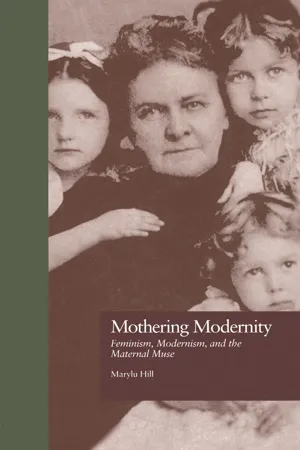
This study examines the transformative relationship between Victorian mothers and their modern daughters in the works of six early British modernists (E. M. Forster, Dorothy Richardson, D.H. Lawrence, May Sinclair, Radclyffe Hall, and Virginia Woolf). The emphasis upon a female hero is a significant and largely unremarked similarity in some of the most significant works of these authors. In these novels, the female hero, in order to attain her full potential as an agent of social and artistic changes, must undergo a maturation process that leads from the father's world of language and public action to a new appreciation of the mother's unrecognized, alternative virtues. Exploring the emergence of the young, modern woman as the hero in the works of these formative authors, Hill traces the gendered development of notions of modernity and the negotiation of new forms of mother-daughter relationship at the birth of modernity and modernist art, providing a more richly nuanced understand of the issue of gender in modernism.
Information
1
Introduction: From New Women to Modernists
In or about December 1910,1 a new type of woman emerged from the bustling thickets of Edwardian fiction. The novel in which she first appeared was E.M. Forster’s Howards End, the character was Margaret Schlegel—intelligent, feisty, intuitive (though not particularly beautiful), and by the end of the novel, successful in shaping the life she wants, on her own terms. The late Victorians had already met the older sister of this kind of woman character in the figure of the “New Woman” of the 1890s, but the span of twenty years permitted a marked difference. The New Woman was angiy and frustrated more often than not; she was also crushingly forced again and again into compromise or into outright failure in her attempts to attain her goals of independence. But the woman of 1910—in fiction, at least—underwent a transformation in which independence no longer meant death or defeat but instead offered interesting and positive alternatives. In addition, this portrait of the modern woman, joined as it would be shortly by the female protagonists from such works as Pilgrimage, The Voyage Out, The Rainbow, Mary Olivier, The Well of Loneliness, To the Lighthouse, and Orlando, heralded a transition in literature that soon would be recognized as modernist. As I will argue here, the young modem women in the novels listed above become the ideal locus of modernist themes and techniques. Unlike her male counterparts in these novels (and in the more aggressively male posturings of Wyndham Lewis, Ezra Pound, T.S. Eliot, and James Joyce),2 the modem woman offers the potential for a remarkable new vision, fostered in each of the above texts, by her ability to synthesize and transform the dual legacies of her paternal and maternal antecedents. Each of the young women characters I will discuss demonstrates a maturation process that leads from the father’s world of language and public action and back into a new appreciation of the mother’s hitherto unrecognized virtues which include alternative concepts of time, space, and perception. By rejecting neither legacy but selecting instead a powerful combination of parental qualities, the modem women in these novels are armed with an ability to critique modem civilization—and even to rescue the modem world from the brink of apocalypse. An optimistic vision thus emerges in which these young women “mother” modernity both in terms of artistic creation and cultural critique. When viewed as an ensemble, these texts and these characters elucidate the origins of modernist voices and serve as a further reminder that the gender of modernism is not strictly or preferably male.
Feminisms and Modernisms
The question of defining modernism has shifted over the past decade from “what is modernism?” to “whose modernism”3 and “when was modernism?” In particular, the rediscovery of works long deemed uncanonical—the New Woman novels of the 1890s, Gertrude Stein’s Three Lives (1909), Charlotte Perkins Gilman’s “The Yellow Wallpaper” (1892) among many others—challenges both the traditional date and place when and where modernism was supposed to have originated. The concept of modernism has always been somewhat loosely defined; however, recent critical studies like Marianne DeKoven’s Rich and Strange: Gender, History, Modernism (1991), Michael Levinson’s A Genealogy of Modernism (1984), Bonnie Kime Scott’s anthology The Gender of Modernism (1990), Gillian Hanscombe’s Writing for Their Lives: The Modernist Women 1910–1940 (1987), Shari Benstock’s Women of the Left Bank, Paris 1900–1940 (1986), and Sandra Gilbert and Susan Gubar’s three-volume No Man’s Land (1988-1994) all rethink the traditional view of High Modernism as predominantly the self-contained product of a select group of men (and one token and secondary female in the person of Virginia WoolÇ. Instead, these studies offer new understandings of the development of modernist forms and themes, in particular by examining women’s writing which was contemporary with, and sometimes preceded, the writings of Joyce, Eliot, Pound, and Lewis. These critiques further challenge the assumption of modernism’s impersonal and purely artistic stance, divorced from the “political radicalism” of the late nineteenth and early twentieth centuiy (DeKoven 4). As DeKoven argues, “modernist form evolved precisely as an adequate means of representing [the] terrifying appeal [of] late nineteenth and early twentieth century feminism and socialism” (4). Finally, in the light of rediscovered avant-garde writing by women in the first decades of this century, combined with recent French theories of écriture féminine, these studies argue persuasively that modernist writing is suspiciously similar to female subversions of hegemonic realist discourse of the nineteenth century, visible in works as early as Gilman’s “The Yellow Wallpaper,” Kate Chopin’s The Awakening (1899), Stein’s Three Lives, Dorothy Richardson’s Pilgrimage (first volume, Pointed Roofs, published in 1914), and Woolf’s The Voyage Out (1915). As Rachel Blau DuPlessis has noted in her essay “For the Etruscans,” “literature by women, in its ethical and moral position, resembles the equally non-hegemonic modernism in its subversive critique of culture” (286).
Despite the caveat that modernism as a definition has been loosely constructed, I would like to offer a short list of the prime characteristics that continue to be highlighted by any serious student of modernism as a genre. In addition, I offer this list as a backdrop for my own theoretical understanding of modernist method and, particularly, how it appears in the texts I have chosen to explore. The characteristics which I would argue are most significant are: a privileging of the subjective over the objective; an emphasis on non-traditional narrative, open-ended plots, and time-frames that are circular rather than linear; a breakdown of language to adequately express one’s sensations; a sense of alienation and fragmentation that is reflected in narrative and language; subversive content and techniques that undermine hegemonic structures; perception that resists dualisms and insists on a multiplicity of viewpoints; a sense of fluidity and flux in describing time, mind, and language rather than a static image; an awareness of the chaotic unconscious lurking under the rational surface; and an effort to create or re-create one’s own private vision of the world.4 Some classic definitions which remain useful choose to emphasize certain elements over the rest; Lionel Trilling, for example, cites as the key element the “shockingly personal” aspect of modem literature (64), while Irving Howe notes that modernism is a revolt against the official order of things: “The modem must be defined in terms of what it is not: the embodiment of a tacit polemic, an inclusive negative” (13). Richard Ellmann in The Modem Tradition gives perhaps the most succinct yet comprehensive definition of the modem:
[modernism elevates] individual existence over social man, unconscious feeling over self-conscious perception, passion and will over intellection and systematic morals, dynamic vision over the static image, dense actuality over practical reality. (vi)
In this study, I intend to argue that the characteristics of modernism listed above—both traditional and more recent configurations—emerge early in the modernist era in the remarkable and consistent trope of the young modem woman. In such novels as E.M. Forster’s Howards End, Dorothy Richardson’s Pilgrimage, D.H. Lawrence’s The Rainbow, May Sinclair’s Mary Olivier, Radclyffe Hall’s The Well of Loneliness, and Virginia Woolf’s The Voyage Out, To the Lighthouse, and Orlando, the female perspective betokens a method by which a society defined by a techno-progressive mind set (associated in all the above novels with stereotypical masculine attributes) can be critiqued and ultimately redeemed. What is particularly significant is that both critique and redemption stem from a perception of the young woman as capable of achieving a new sort of synthesis between the hitherto polarized codes of femininity and masculinity. The young women who are central to these novels embody a hopeful vision of “personhood” rising out of the decayed hulks of Victorian gender codes. However, and most important for this study, these women do not reject the legacy of their Victorian mothers as did their New Woman counterparts of the 1890s. Instead, the young women in these novels all participate in a marked pattern of maturation which leads them from an early male identification, symbolized by an affinity with a father figure and his command of language and learning, to a later reconciliation with a mother figure who represents an alternative sense of knowledge, perception, and language. Armed with 狂 double legacy, instead of burdened by ritual rejections of either mother or father, the emerging modernist woman is ready to enact what Alice Jardine defines as “gynesis”—a prime motivator of modernity which entails
the putting into discourse of “woman” as that process diagnosed in France as intrinsic to the condition of modernity; indeed, the valorization of the feminine, woman, and her obligatory, that is, historical connotations, as somehow intrinsic to new and necessary modes of thinking, writing, speaking. (25)
All the novels I will discuss here address this sense of a new language; what is more, these novels clearly suggest that this language results from a reappropriation of the father tongue, so to speak, that is used to recover the heretofore-silenced mother. According to Jardine, the revelation of a new female discourse was made possible by several developments in the late nineteenth century. Modernity, says Jardine, is characterized by “loss”—the loss or failure of patriarchal history, of male selfhood, and of traditional knowledge—caused by various changes or disruptions in science, psychology, technology, and philosophy (Jardine 33, 67–68).5 In particular the women’s movement of the mid-to late-nineteenth centuiy played a key role in this disruption of male control and selfhood, as women passed from “a zone of near silence or total inwardness in respect of sexual language” to an ability and willingness to speak for themselves (Steiner 80). “Modem” literature, which for Jardine equals the “post-modem” in British and American literature, becomes the meeting point of a tottering patriarchal histoiy and the emerging female voice. The modern impulse thus explores a newly discovered space that is marked by a double awareness and otherness that is most often coded as feminine:
[W]hen the structures based in these dichotomies [of Western philosophy] began to vacillate, there also began, necessarily, an intensive exploration of those terms not attributable to Man.. the space of the en-soi, Other, without histoiy—the feminine. Most important, through those explorations, the male philosophers found that those spaces have a certain force that might be useful to Man if they were to be given a new language. Here we are at the heart of gynesis. To give a new language to these other spaces is a project filled with both promise and fear, however, for these spaces have hitherto remained unknown, terrifying, monstrous: they are mad, unconscious, improper, unclean, non-sensical, oriental, profane. If philosophy is truly to question those spaces, it must move away from all that has defined them, held them in place: Man, the Subject, History, Meaning. (Jardine 72–73)
And, as I will argue, the crumbling of traditional dichotomies allows for—and even demands—a vision that is either fragmented, as exemplified by the modernism of Joyce, Eliot, and Pound, or synthetic as demonstrated by the young women found in Forster, Richardson, Lawrence, Sinclair, and Woolf. Thus, although Jardine locates gynesis in the post-modern, I believe that gynesis is part of the modernist project as well; indeed, as DeKoven and others have argued, it provides a key impetus to modernist form and practice.
Howards End, Pilgrimage, The Rainbow, Mary Olivier, To the Lighthouse, and Orlando privilege the voice of the young modem woman as she critiques and ultimately rejects the male world of history and public action. But in none of these novels does the young woman emerge as simply a “little man” or a creature less than female yet still not male. Instead, through the initial mentorship of a father figure and then (more importantly) a mother figure, the young woman discovers within herself an alternative space for exploration. This space in turn leads potentially to rejuvenation for civilization itself. These young women assert themselves through the previously male function of language, yet they also strive to understand and finally articulate the mother’s silence. In this way, each novel depicts a radical and important attempt to literally “remake” the mother—to bring the female past into a new connection with the present.
Backgrounds
Before going further, it is imperative to consider briefly the historical background which made these novels and these women characters possible, particularly since there is a crucial distinction between these characters and their New Woman counterparts of the 1890s—a distinction which makes the leap into modernity possible. By 1910, when Howards End was written, much had changed in terms of the status and prospects of women. The years 1910–1914 represented the height of the suffrage movement, but many changes had occurred earlier in the late nineteenth century. Thanks to the opening of Girton (1869) and Newnham (1871) Colleges, Cambridge, and Bedford College, London (1878) among others, women’s education was no longer an impossibility; by 1897, “women were largely a part of the world of higher education, albeit a peripheral and minor part” (Vicinus 127). The middle-class work force, once the sole province of men (at least in Victorian times) underwent a steady infiltration throughout the 1880s and 1890s by women, as education and clerical work became more socially acceptable for women of “good” background.6
Increased opportunity alone, however, did not occasion all the changes apparent by 1910. New possibilities for education and work were joined in the 1890s by a growing feminist challenge to societal attitudes—the advent of the New Woman.7 In tandem with the era’s rejection of Victorian mores, the New Woman sought a fresh definition of woman’s role. As David Rubenstein notes, her demands, by today’s standards, were essentially modest:
They centred on the right of the unmarried girl to be considered “an individual as well as a daughter.” She should be able to make her own errors, travel freely, visit music halls—with her brother—and enjoy better education. Boys were ungrudgingly prepared for a variety of professional careers, while many girls were confined to the prospect of a single career, marriage. The daughter who asked for a fraction of the expenditure laid out on her brother, and who was refused on the ground that a woman should remain in the parental home until called from it by a husband, had real cause to protest her lot. (13)8
What startled the public the most, however, were her audacious and daring bids to seize male power; among these symbolic actions were smoking, bicycling,9 possessing a latch key, and assuming “rational dress,” i.e., divided skirts or knickerbockers and going without corsets.10 Dorothy Richardson in Pilgrimage chronicles her female hero’s experiments with each of the above, discovering the delirium of freedom each act represented.
The popular conception of the New Woman thus centered on a woman who no longer looked “womanly” in the Victorian sense. As Patricia Marks comments, the New Woman’s actions redefined her:
She cavorted through the pages of Life, Puck, Punch, and Truth perched on bicycles and smoking cigarettes; she looked learned in judges’ wigs and academic gowns and athletic in riding pants and football helmets. All of her uncomplimentary poses served to shape a new myth; no longer an Iphigenia, the modem Minerva, a stranger in a strange land, aped the customs of the “manly” natives in an effort to find herself. (2)
A key epithet for her was “the manly woman” or “the mannish girl”; so...
Table of contents
- Cover
- Half Title
- Title Page
- Copyright Page
- Series Preface
- Dedication
- Table of Contents
- Acknowledgements
- 1 Introduction: From New Women to Modernists
- 2 “Only Connect”: Mothers, Daughters, and Houses in Howards End
- 3 Getting Back to the Garden: Miriam’s Journey in Pilgrimage
- 4 Redeeming Modernity, Feminizing History: The Regenerative Daughter in The Rainbow
- 5 Honorable Schoolboys, or the New Woman Revisited: Mary Olivier and The Well of Loneliness
- 6 The Mother Lost and Regained: The Voyage Out and To the Lighthouse
- 7 Morphing Mothers and Moderns: The Synchronicity of Orlando
- Notes
- Select Bibliography
- Index
Trusted by 375,005 students
Access to over 1.5 million titles for a fair monthly price.
Study more efficiently using our study tools.
Frequently asked questions
Yes, you can cancel anytime from the Subscription tab in your account settings on the Perlego website. Your subscription will stay active until the end of your current billing period. Learn how to cancel your subscription
No, books cannot be downloaded as external files, such as PDFs, for use outside of Perlego. However, you can download books within the Perlego app for offline reading on mobile or tablet. Learn how to download books offline
Perlego offers two plans: Essential and Complete
- Essential is ideal for learners and professionals who enjoy exploring a wide range of subjects. Access the Essential Library with 800,000+ trusted titles and best-sellers across business, personal growth, and the humanities. Includes unlimited reading time and Standard Read Aloud voice.
- Complete: Perfect for advanced learners and researchers needing full, unrestricted access. Unlock 1.5M+ books across hundreds of subjects, including academic and specialized titles. The Complete Plan also includes advanced features like Premium Read Aloud and Research Assistant.
We are an online textbook subscription service, where you can get access to an entire online library for less than the price of a single book per month. With over 1.5 million books across 990+ topics, we’ve got you covered! Learn about our mission
Look out for the read-aloud symbol on your next book to see if you can listen to it. The read-aloud tool reads text aloud for you, highlighting the text as it is being read. You can pause it, speed it up and slow it down. Learn more about Read Aloud
Yes! You can use the Perlego app on both iOS and Android devices to read anytime, anywhere — even offline. Perfect for commutes or when you’re on the go.
Please note we cannot support devices running on iOS 13 and Android 7 or earlier. Learn more about using the app
Please note we cannot support devices running on iOS 13 and Android 7 or earlier. Learn more about using the app
Yes, you can access Mothering Modernity by Marylu Hill in PDF and/or ePUB format, as well as other popular books in Literature & Feminist Literary Criticism. We have over 1.5 million books available in our catalogue for you to explore.