- 194 pages
- English
- ePUB (mobile friendly)
- Available on iOS & Android
eBook - ePub
American Abolitionists
About this book
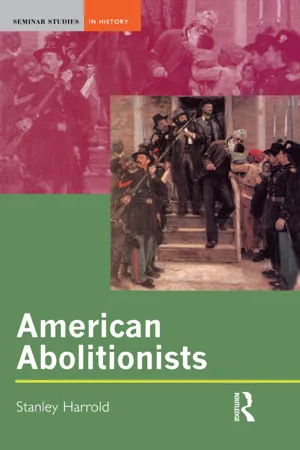
This book, the latest in the Seminar Studies in History series, examines the movement to abolish slavery in the US, from the origins of the movement in the eighteenth century through to the Civil War and the abolition of slavery in 1865. Books in this Seminar Studies in History series bridge the gap between textbook and specialist survey and consists of a brief "Introduction" and/or "Background" to the subject, valuable in bringing the reader up-to-speed on the area being examined, followed by a substantial and authoritative section of "Analysis" focusing on the main themes and issues. There is a succinct "Assessment" of the subject, a generous selection of "Documents" and a detailed bibliography. Stanley Harrold provides an accessible introduction to the subject, synthesizing the enormous amount of literature on the topic. American Abolitionists explores "the roles of slaves and free blacks in the movement, the importance of empathy among antislavery whites for the suffering slaves, and the impact of abolitionism upon the sectional struggle between the North and the South". Within a basic chronological framework the author also considers more general themes such as black abolitionists, feminism, and anti-slavery violence. For readers interested in American history.
| Chapter One |
The Abolitionists in American History
American abolitionists were people - black and white, female and male -who during the eighteenth and nineteenth centuries sought to end slavery and secure racial justice. They were part of a broader struggle within the Atlantic World against the enslavement of Africans and people of African descent. As a result of this straggle, a system of unfree labor that in 1750 existed throughout the British, Dutch, French, Portuguese, and Spanish empires in the New World had disappeared by 1888.
In the United States, which declared its independence from Great Britain in 1776, the antislavery effort faced especially determined opposition. Years of conflict between antislavery forces, located mainly in the North, and pro-slavery forces, centered in the South, preceded the emancipation of all American slaves. The unwillingness of African Americans to remain in bondage, profound economic and ideological change associated with the industrial revolution, and major evangelical revivals shaped a powerful antislavery impulse. Bet strong economic, cultural, and racial interests made American slavery a resilient phenomenon. Even after the formal abolition of slavery in 1865, these interests prevented African Americans from enjoying the same legal rights and economic opportunities as white Americans [59, 60, 91].
Nevertheless, abolitionism is one of the great reform movements in American history. It rivals the struggles for prohibition, women’s rights, labor organization, and black civil rights in terms of longevity and impact. Like other reformers, abolitionists were controversial during their time and have remained so ever since. They were self-righteous, suspicious of compromise, often harsh in their language, capable of violence, and prone to factionalism.
The abolitionists’ opposition to slavery led them to demand fundamental change in America’s racial, economic, social, and political structure. Some of them espoused Christian anarchy and denounced the United States Constitution as proslavery, others insisted that the Constitution must be interpreted so as to abolish slavery. They challenged prevailing concepts of masculinity, while insisting that black men were as capable as white in such traditional masculine endeavors as fighting, wage-earning, and politics. The abolitionists’ encouragement of women to participate in antislavery organizations led some of them to become feminists in a society that had long denied women a role in the public arena.
This book provides a brief but comprehensive history of these contentious, dedicated, often inconsistent, and intensely interesting reformers. Like other books in the Seminar Studies in History series, it reflects recent scholarly interpretations, while striving to maintain an accessible narrative. The emphasis is on the biracial character of the abolitionist movement, the impact of slaves on its development, and the increasingly aggressive tactics employed by abolitionists against slavery in the South. Subsidiary themes include the ties between abolitionism and women’s rights, the interaction between peaceful and violent reform tactics, and the relationship between abolitionism and the coming of the Civil War.
Who Were the Abolitionists?
When historian Betty Fladeland asked this question in 1964 she was concerned with the psychological orientation of those abolitionists active between 1830 and 1865 [208]. But the question of abolitionist identity has wider significance. Prior to the 1960s historians did not adequately differentiate between those who, during the antebellum decades, were abolitionists and those northern politicians and journalists who merely wanted to prevent the extension of slavery. This made it difficult to understand who the abolitionists were and what they stood for. The abolitionists, of course, had been aware of the differences between themselves and nonextensionists. But they also disagreed among themselves over what the proper definition of abolitionist should be.
In response to these difficulties, historians developed a precise characterization of abolitionists as individuals who, on the basis of moral principle, advocated immediate emancipation of the slaves and equal rights for African Americans without colonizing them beyond the borders of the United States. Active membership in antislavery societies, religious denominations, and radical political organizations pledged to these goals has become the chief means of identifying such people [102].
This precise distinction between immediate abolitionists and other antislavery groups, such as nonextentionists and those who urged the colonization of former slaves, has been extremely helpful in understanding abolitionism as it existed prior to the Civil War. But this definition’s narrowness makes it misleading in several respects. It excludes those who sought gradually to abolish slavery and promote racial justice prior to the rise of immediatism during the late 1820s. It also excludes those antislavery politicians who - despite their strong abolitionist connections - were bound to honor conventional interpretations of the United States Constitution that recognized slavery as a legal institution under state control. Most important, as historian Douglas R. Egerton has recently pointed out, it excludes slave rebels and other black southerners who were practical abolitionists [126]. Therefore this book defines abolitionism more broadly. In stressing the biracial and intersectional character of abolitionism, it relies heavily on Egerton’s insight and Merton L. Dillon’s 1990 book Slavery Attacked, which portrays a growing alliance between southern slaves and northern abolitionists [66].
Changing Interpretations
Few groups have been more intensely studied than the immediate abolitionists of the 1830s and 1840s. Historians have approached them in a variety of ways, and as twentieth-century events altered perspectives, differing interpretations of their motivation, character, and impact emerged. Over the years paradigms have shifted and new insights have contradicted older ones. Each layer of interpretation has contributed to a more sophisticated understanding of the movement.
In their memoirs and historical writings, former immediatists distinguished themselves from the gradual abolitionists who preceded them, described themselves as committed Christians, and maintained that they were the catalyst for the sectional struggle that led to general emancipation in 1865. The nationally oriented American historians of the late-nineteenth and early-twentieth centuries agreed. The abolitionists, in their estimation, were moral heroes who brought about the termination of human bondage in the United States [205].
Between the 1920s and the 1960s this image changed dramatically as ‘revisionist’ historians described immediate abolitionists more negatively [209 p. 4]. Several factors caused this reversal, but especially important was Ulrich B. Phillips’s revival of the antebellum southern portrayal of slavery as a benevolent institution gradually civilizing people of African descent. Phillips suggested that white southerners would have peacefully ended slavery during the course of the nineteenth century had not abolitionists forced emancipation on them during the Civil War [102]. Rather than heroes, the abolitionists in this perspective were fanatics who pushed the country into a needless war.
This interpretation remained dominant into the 1950s as historians who emphasized agreement rather than conflict in American history argued that the Civil War was an avoidable tragedy. Avery O. Craven, James G. Randall, and others contended that northern abolitionists, and their political allies raised irrational fears that undermined a bisectional agreement that would have allowed white southerners to deal on their own with the problem of slavery [147]. If, as Phillips argued, black people were content in slavery and paternalistic masters rarely mistreated them, why did abolitionists after 1830 insist that the institution be immediately abolished at the risk of sectional discord? If it were not the evil of slavery that motivated abolitionists, what led them to make such strident demands[205]?
For decades historians searched for answers to these questions. The search produced many insightful studies of northern social, economic, cultural, and psychological forces involved in shaping the immediatists. Of especial significance is Gilbert H. Barnes’s 1933 portrayal of the role of evangelical revivalism in the North during the early decades of the nineteenth century [42]. John L. Thomas’s 1963 attribution of the abolitionist impulse to New England culture and its westward expansion has also been extremely influential [177]. More directly in line with the revisionists was David Donald’s dismissal in 1955 of the abolitionists as a displaced and neurotic New England social elite. According to Donald, these Yankees exploited the slavery issue merely to re-establish ‘the traditional values of their class at home’ or to assuage irrational feelings of guilt [67 p. 36].
During the 1960s, the Civil Rights movement encouraged a resurgence in positive assessments of the abolitionists. Supporting this tendency was Kenneth M. Stampp’s The Peculiar Institution, published in 1956, which successfully challenged Phillips’s portrayal of slavery as a benevolent institution and instead stressed its brutality [169]. ‘Neo-abolitionist’ historians began portraying abolitionists as psychologically healthy, middle-class liberals, who pioneered the struggle for black equality [116 p. 236]. Rather than constituting a displaced social elite, it now appeared that the abolitionists represented a rising northern entrepreneurial class, embodying modernizing values associated with industrialization. Their commitment to wage labor, social mobility, individualism, and education clearly conflicted with the traditional values associated with the South’s rural culture and slave-labor economy [146, 169, 205].
Since the 1960s few historians have persisted in portraying the abolitionists as irresponsible fanatics fomenting a needless war over slavery. Instead, historians have focused on the degree of commitment among white abolitionists to racial justice, the respective roles of radicalism and conservatism in the movement, and the relevance of abolitionism to the sectional conflict that led to the Civil War. In pathbreaking articles and books published during the 1960s and 1970s, Leon F. Litwack and Jane H. Pease and William H. Pease contend that white abolitionists were unable to overcome the racial prejudices of their time. As a result they alienated black abolitionists and undermined their own efforts [221, 226, 144]. This view remains an important part of our understanding of the antislavery movement.
The issue of the abolitionists’ identity as either conservative reformers or radicals is equally controversial. It has shaped historians’ interpretations of the entire movement and their assessments of its impact. Barnes maintained that the moral absolutism and harsh rhetoric of social radicals such as William Lloyd Garrison and his New England associates destroyed their effectiveness. He contended that a larger and more moderate group of evangelical or church-oriented abolitionists led by Theodore D. Weld and Arthur and Lewis Tappan was more representative of the movement and more successful in spreading antislavery sentiment. In contrast, during the late 1960s, Aileen S. Kraditor and James Brewer Stewart maintained that it was the Garrisonians’ radical critique of American society and their sophisticated methods of agitation that shaped abolitionism and accounted for its influence [115, 229].
The most important tendency in abolitionist studies during the period lasting from the 1960s through much of the 1980s, however, was to disengage the abolitionists from the sectional conflict over slavery. In 1961, Larry Gara argued persuasively that pervasive white abolitionist involvement in underground railroad efforts to help slaves reach freedom in the North and Canada was a deliberately fabricated myth. During the 1970s Merton L. Dillon and James Brewer Stewart wrote brilliant comprehensive studies, which documented the growing influence of abolitionism while concluding that the movement did not lead directly to emancipation [88, 65, 176].
Others went further, describing abolitionism solely in terms of northern culture in which the South and slavery had only symbolic value. Increasingly, studies of the abolitionists turned inward, seeking to understand what it meant to be part of the movement rather than how the movement affected broader events. Scholars described abolitionism as a surrogate religion, as part of community development, as a movement that used southerners as a negative reference group in a campaign for social control in the North. Increasingly it seemed abolitionists were simply seeking to absolve themselves from a morally corrupting proslavery culture rather than to force that culture to change [218, 231].
In historical literature abolitionists had gone from being charged with fomenting a needless war to being irrelevant. ‘Sectional conflict, Civil W...
Table of contents
- Cover Page
- Half Title page
- Title Page
- Copyright Page
- Dedication
- Contents
- Introduction to the Series
- Note on Referencing System
- List of Abbreviations
- Publisher's Acknowledgements
- Author's Acknowledgements
- Part One Introduction
- Part Two Analysis
- Part Three Assessment
- Part Four Documents
- Chronology
- Glossary
- Who’s Who
- Bibliography
- Index
Trusted by 375,005 students
Access to over 1.5 million titles for a fair monthly price.
Study more efficiently using our study tools.
Frequently asked questions
Yes, you can cancel anytime from the Subscription tab in your account settings on the Perlego website. Your subscription will stay active until the end of your current billing period. Learn how to cancel your subscription
No, books cannot be downloaded as external files, such as PDFs, for use outside of Perlego. However, you can download books within the Perlego app for offline reading on mobile or tablet. Learn how to download books offline
Perlego offers two plans: Essential and Complete
- Essential is ideal for learners and professionals who enjoy exploring a wide range of subjects. Access the Essential Library with 800,000+ trusted titles and best-sellers across business, personal growth, and the humanities. Includes unlimited reading time and Standard Read Aloud voice.
- Complete: Perfect for advanced learners and researchers needing full, unrestricted access. Unlock 1.5M+ books across hundreds of subjects, including academic and specialized titles. The Complete Plan also includes advanced features like Premium Read Aloud and Research Assistant.
We are an online textbook subscription service, where you can get access to an entire online library for less than the price of a single book per month. With over 1.5 million books across 990+ topics, we’ve got you covered! Learn about our mission
Look out for the read-aloud symbol on your next book to see if you can listen to it. The read-aloud tool reads text aloud for you, highlighting the text as it is being read. You can pause it, speed it up and slow it down. Learn more about Read Aloud
Yes! You can use the Perlego app on both iOS and Android devices to read anytime, anywhere — even offline. Perfect for commutes or when you’re on the go.
Please note we cannot support devices running on iOS 13 and Android 7 or earlier. Learn more about using the app
Please note we cannot support devices running on iOS 13 and Android 7 or earlier. Learn more about using the app
Yes, you can access American Abolitionists by Stanley Harrold in PDF and/or ePUB format, as well as other popular books in History & North American History. We have over 1.5 million books available in our catalogue for you to explore.