This book addresses the complications and implications of parental involvement as a policy, through an exploratory theoretical approach, including historical and sociological accounts and personal reflection. This approach represents the author's effort to understand the origins, meanings, and effects of parental involvement as a prerequisite of schooling and particularly as a policy 'solution' for low achievement and even inequity in the American educational system.
Most of the policy and research discourse on school-family relations exalts the partnership ideal, taking for granted its desirability and viability, the perspective of parents on specific involvement in instruction, and the conditions of diverse families in fulfilling their appointed role in the partnership. De Carvalho takes a distinct stance. She argues that the partnership-parental ideal neglects several major factors: It proclaims parental involvement as a means to enhance (and perhaps equalize) school outcomes, but disregards how family material and cultural conditions, and feelings about schooling, differ according to social class; thus, the partnership-parental involvement ideal is more likely to be a projection of the model of upper-middle class, suburban community schooling than an open invitation for diverse families to recreate schooling. Although it appeals to the image of the traditional community school, the pressure for more family educational accountability really overlooks history as well as present social conditions. Finally, family-school relations are relations of power, but most families are powerless. De Carvalho makes the case that two linked effects of this policy are the gravest: the imposition of a particular parenting style and intrusion into family life, and the escalation of educational inequality.
Rethinking Family-School Relations: A Critique of Parental Involvement in Schooling--a carefully researched and persuasively argued work--is essential reading for all school professionals, parents, and individuals concerned with public schooling and educational equality.
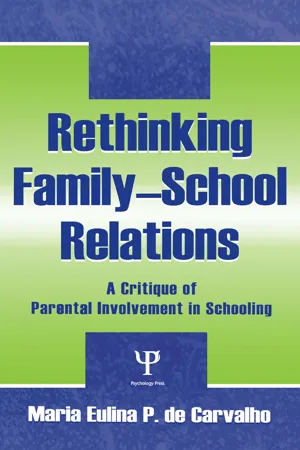
eBook - ePub
Rethinking Family-school Relations
A Critique of Parental involvement in Schooling
- 176 pages
- English
- ePUB (mobile friendly)
- Available on iOS & Android
eBook - ePub
Rethinking Family-school Relations
A Critique of Parental involvement in Schooling
About this book
Information
1
The Articulation of Family and School in Educational Policy
What makes a teacher spend precious time after class telephoning parents about her students' poor performance and urging parents to help her instructional efforts, instead of dealing somehow directly with those at-risk students? What are the limits of good teaching, and what—and how effectively—can parents contribute to classroom instruction?
The call for more parental participation in schooling basically acknowledges an undesirable and harmful distance between family and school, and launches an array of policy efforts to make this relationship closer. It finds ground on commonsense knowledge of a continuity of educational roles, values, and experiences between family and school, as well as on schools and teachers' expectations regarding certain learning preconditions developed in the home, and the incentives certain parents place on educational achievement.
This volume explores rationales and implications of family-school relations as defined under the current call for parental involvement, family-school partnerships, more homework, and parental education in U.S. schools. Specifically, I analyze how the educative roles of family and school, the meanings of a public school, the role and scope of educational policy toward the family, and their implications (for parents, teachers, students, and educational goals and outcomes) are framed by policy discourses and grounded by related theoretical and empirical literature.
As a framework for literary and documentary analysis, I draw on Bourdieu and Passeron's (1977) concepts of symbolic (particularly cultural) capital, and education as symbolic violence (or cultural imposition). Cultural capital, a type of embodied knowledge that functions as power within specific institutional settings, is the medium of family-school relations, and an implicit element of educational policy. As the outcome of family and class socialization, it is the (variable) medium of educational achievement, which may be exchanged for (or merely confirm previous) social and economic positions. However, cultural capital is not uniformly distributed, accessible, or produced in society.
Parental involvement, as family educational input, has been explicitly pointed out and called on as a resource for school success in recent research and policy literature in the United States (Coleman, 1991; Henderson & Berla, 1994). Conceived as a cultural role (Hoover-Dempsey & Sandler, 1997), derived from the successful model of schooling of the middle classes based on cultural continuity between home and school (that is, on family aspirations of upward social mobility via education, and on a complementary school pedagogy that requires the contribution of the family via homework), it is unquestionably seen as necessary and beneficial. The diversity of family material and cultural resources and the way specific instructional practices capitalize on them, however, have not been acknowledged except in compensatory, short-range policies. Along this line, I pose educational policy—specifically drawing on the family as a resource subordinated to the school curriculum and practices—as an important set of structures (discourses and practices) for the play of cultural capital, and hence for the exercise of symbolic violence, with contradictor effects.
Once the role of educational policy, in relation to cultural capital, is acknowledged as an instrument of symbolic violence and social (re)production, a clearer picture of the educational responsibilities, ranges, possibilities, limits, and specific articulations of school and family may be drawn. A clearer picture is needed for understanding and redefining the social purposes and possibilities of the public school, delimiting the contribution of the family in a more equitable way, and reassessing the role and implications of educational policy.
The Family as an Object of Educational Policy
Traditionally, schools and teachers have depended on and requested family or parental collaboration. However, what has not been so evident is that family-school affinities and partnerships have had a middle-class character and a social mobility accent. Moreover, they appeared as an organic expression of the community school and of a particular stage and context of social development in which school played a central integrative role.
To be sure, families, schools, and communities have changed and grown in diversity and complexity, and so has grown the role of educational policy— grounded in research knowledge—in attempting to address the complexities and crises in school and society. In this way, parental involvement in schooling has been explicitly pointed out as a main factor of educational achievement, and policy has turned previously informal and limited parental involvement into a mandate, aiming at generalizing it.
Interestingly, parental involvement is educational policy properly, that is, not just school policy, insofar as it articulates school and family as spaces of education. Nevertheless, in spite of its parent empowerment and democratic participation possibility, it represents a totalitarian movement in educational policy. First, it equates education with schooling. Second, by prescribing family education or aligning home education to the prevailing school curriculum, it penetrates the private realm and formalizes family educative practices. Because the obligation of parents to actively support academic learning is taken for granted, homework becomes a specific means of school (i.e., state) cultural imposition over the family and diverse ethnic groups. From this perspective, there is less space and time for other types of education, including informal and nonformal education related to various popular cultures.
Thus, educational policy enforcing parental involvement generalizes one model of family-school and school-community relations, consequently ignoring family and community social and cultural diversity. On the one hand, it assumes that it is the responsibility of the family to help with instruction and curricular goals because of the value it must place on education. On the other hand, if parental support is found wanting, it assigns as a task of the school and teachers to guide disadvantaged families or negligent parents, and to build or eventually transform the community (Cibulka & Kritek, 1996).
Historical and Cultural Background
The colonial era image of the common school initiated by parents who hired (then male) teachers in order to teach their children within rural communities seems to be the distant cultural origin of the current appeal to the family (Church & Sedlak, 1976; Guest & Tolnay, 1985; Kaestle, 1983). In contrast, at the end of the 19th century, when school became compulsory for children of urban industrial workers, mostly poor immigrants, a parallel movement of parent education emerged (Cravens, 1993; Grubb & Lazerson, 1982).
According to the puritan ethos that praises hard work, and to the liberal-meritocratic rhetoric that attributes socioeconomic success to school success, reinforced by the upward mobility of certain groups of immigrants who took advantage of educational and economic opportunities, the middle classes practiced a constant involvement with their children's education throughout the 20th century. The expansion of school enrollments at secondary and tertiary levels is seen as a result of the social mobility impetus (Labaree, 1997). However, when the critique of the social exclusion and school segregation of African-Americans, as well as the low performance of other minorities, emerged in the context of the 1960s civil rights movement, the educational solutions that followed (such as parent education within compensatory education programs) predominantly took the model of middle-class family-school relations as a norm.
In 1966, the renowned Coleman Report (Coleman, Campbell, Hobson, McPartland, Mood, Weinfeld, & York, 1966) stressed the importance of family background characteristics (the economic and educational resources of the home) for the differentiated school achievements of Native, Mexican, Puerto Rican, African, Asian, and White Americans, downplaying the weight of schools' physical and economic resources. At the same time in which it recognized that the sources of inequality of educational opportunities were "first in the home," it also pointed out "schools' ineffectiveness to free achievement from the impact of the home" (Coleman, 1966, p. 74).
Since then, educational research and policy have partly invested in "effective schools" (curricular and instructional reforms, teacher preparation, and professional development), but also in family child care and socialization processes that precede, support, or "cause" educational achievement, informing and legitimating educational interventions in the realm of the family in order to correct the "cultural deficit" and prevent the school failure of minority and disadvantaged groups.
Cultural deficit theory was strongly supported by research in cognitive psychology. According to Scott-Jones (1993), most of the literature on family influence on school achievement focused specifically on teaching strategies and language in the context of mother-child interactions: "American researchers concluded that the poor school achievement of low-income children was due to the impoverished language environment in their homes" (p. 247). Low-income mothers were less effective teachers than middle-class mothers due to such factors as "less praise, less asking questions, less orienting the child to the task, and more nonverbal communication" (p. 247).
The cultural deficit view of minority families and children led to a series of intervention programs, funded under Chapter 1 of the Elementary and Secondary Education Act, during the 1960s and 1970s. Head Start, for instance,
... provided not only parent-training activities but also a center-based educational component for preschool children and parent involvement in the governance of the program. Involvement in governance was intended to empower the low-income and minority parents who received Head Start services; in practice, however, Head Start came to concentrate on training parenting skills, as did other intervention programs.
(Scott-Jones, 1993, p. 248)
The Contribution of Educational Research to Validate Parental Involvement
Legitimated by research in its importance and efficacy, parental involvement in schooling has been rhetorically constructed as both the problem and the solution for increasing school productivity and the academic performance of socially disadvantaged groups (Chavkin, 1993a, 1993b; Cibulka & Kritek, 1996; U.S. Department of Education, 1987; Henderson & Berla, 1994). As evidence of its importance as a research problem, since 1982, the American Educational Research Association (AERA) created a Special Interest Group named Families as Educators. Its mission is "to promote the study and dissemination of information on family social processes and home-school relationships that support children's education and development" —focusing, in short, on family education for school achievement (Families as Educators Special Interest Group, 1996, p. 1). According to Henderson and Berla (1994), "by 1987... the subject had come into its own as a special topic of research Now, in 1994, the field has become a growth industry" (p. ix).
Henderson and Berla's (1994) report, The Family is Crucial to Student Achievement, published by the National Committee for Citizens in Education (NCCE) —whose mission is defined as "putting the public back in the public schools" (p. x) —provides a useful annotated bibliography of 66 titles (research reports, reviews, articles, and books), ranging from 1969 to 1993, Because they focused on family empowerment, student achievement, and effective schooling as a result of parental involvement, Henderson and Berla offered a particularly positive and conclusive reading of this research: "To those who ask whether involving parents will really make a difference, we can safely say that the case is closed" (p. x). In this context, Epstein (1996) expressed the present research agenda grounded on the concurrent implementation of partnership programs in the following terms: "We have moved from the question, Are families important for student success in school? to if families are important for children's development and school success, how can schools help all families conduct the activities that will benefit their children?" (p. 213).
An alternative critical reading of the research that supports parental involvement as valid policy may be offered as well, stressing the ideological basis of both interpretation of (necessarily limited) research findings and policy prescriptions drawn from them. 1 focus on three trends of research, based on Henderson and Berla's annotated bibliography: (a) evaluation of early intervention compensatory programs which incorporated a parental education component, including 33 studies of experimental and longitudinal design; (b) investigation of family background influence on student achievement, totaling 29 studies using both quantitative and qualitative approaches; and (c) critical studies of family-school cultural mismatch, represented by 4 titles only.
(a) The evaluation research that followed compensatory education programs basically intended to correlate increased parental (i.e., maternal) involvement with significant gains in academic achievement as measured by IQ and other academic performance tests (e.g., Goodson & Hess, 1975; Guinagh & Gordon, 1976; Irvine, 1979; Mowry, 1972; Olmsted & Rubin, 1982; Radin, 1972; cited in Henderson & Berla, 1994). Becher (1984, cited in Henderson & Berla, 1994), for instance, highlighted several key family process variables related to student achievement in elementary school: parents' high expectations for children, frequent interactions with them, modeling of learning and achievement, and actions as teachers of their children, using complex language and problem-solving strategies, and reinforcing what they learned in school. The policy rationale derived from this kind of research is that if "programs designed with extensive parental involvement can boost low income students' achievement to levels expected for middle-class students" (Henderson & Berla, 1994, p. 7), then parental involvement and training is a solution to inequity.
However, as pointed out by Lazar and Darlington (1978, cited in Henderson & Beria, 1994), parental involvement cannot be easily isolated and measured as a variable, though it is part of a cluster of factors considered necessary for program effectiveness. More recently, White, Taylor and Moss (1992, cited in Henderson & Berla, 1994) offered a comprehensive methodological critique, according to rigorous standards of reliability and validity, based on a review of 193 studies:
Thus, it would be inappropriate to conclude, based on this data, that parent involvement in early intervention is not beneficial. Just as important, however, is the fact that no information exists in this admittedly indirect type of evidence to argue that parent involvement in early intervention will lead to any of the benefits that are often claimed.
(p. 109)
Moreover, from a practical and dynamical point of view, experimental programs tend to create unique situations and, if successful, ideal models. Thus, there is no guarantee that the conditions and incentives fostered by a particular program, in a particular context, will be successfully reproduced elsewhere, let alone everywhere.
(b) Another significant trend of research focused on the influence of family processes (the home environment that encourages school learning) and family interactions with schools (mothers' active participation in school activities) on students' development, grades, test scores, high school graduation rates, and enrollment in higher education. The crucial point here is to establish "the extent to which family socioeconomic status (SES) determines the quality of student performance" (Henderson & Berla, 1994, p. 7). Some studies established the relative autonomy of educational and cultural factors (the role of parents' effort) in front of unfavorable socioeconomic conjunctures (e.g., Baker & Stevenson, 1986; Eagle, 1989; Kellaghan, Sloane, Alvarez, & Bloom, 1993; Stevenson & Baker, 1987; cited in Henderson & Berla, 1994), consequently suggesting that "family practices can have an effect independent of SES" (Henderson & Berla, 1994, p. 8). Other studies indicated that family practices (reading to children, guiding TV watching, and providing stimulating experiences) can be positively shaped by involvement with schools (e.g., Sattes, 1985; cited in Henderson & Berla, 1994), and that "the school can be a powerful force for building parent capacity and thereby buffer the negative consequences of low-income" (e.g., Cochran & Henderson, 1986; cited in Henderson & Berla, 1994, p. 46), thus altering the attitudes of powerless and excluded groups (e.g.,, Ziegler, 1987; cited in Henderson & Berla, 1994). Such research tends to corroborate an exaggerated belief in the power of individuals to overcome material limitations, as well as in the power of school policy to change home culture (where it is perceived as inadequate) in order to enhance school success and minimize educational inequalities.
The studies that focused specifically on families as learning environments basically compared parenting styles, strategies for teaching children at home, and expectations for academic performance associated with high-achieving and low-achieving students (e.g., Clark, 1983; Dornbusch, Ritter, Leiderman, Roberts, & Fraleigh, 1987; Scott-Jones, 1984,1987; cited in Henderson&Berla, 1994). Their implicit premise is that families must provide the dispositions (Bourdieu & Passeron's habitus) toward school learning and success. Rumberger, Ghatak, Poulos, Ritter, and Dornbusch (1990, cited in Henderson & Berla, 1994), for instance, found that dropouts wer...
Table of contents
- Cover
- Half Title
- Title
- Copyright
- Contents
- Prologue
- 1. The Articulation of Family and School in Educational Policy
- 2. Family-School Interactions: Lessons From Personal Experience
- 3. Education and Social Reproduction: The Quest for Equity Within Family-School Relations
- 4. The Obscure Side of Homework
- Epilogue
- References
- Author Index
- Subject Index
Trusted by 375,005 students
Access to over 1.5 million titles for a fair monthly price.
Study more efficiently using our study tools.
Frequently asked questions
Yes, you can cancel anytime from the Subscription tab in your account settings on the Perlego website. Your subscription will stay active until the end of your current billing period. Learn how to cancel your subscription
No, books cannot be downloaded as external files, such as PDFs, for use outside of Perlego. However, you can download books within the Perlego app for offline reading on mobile or tablet. Learn how to download books offline
Perlego offers two plans: Essential and Complete
- Essential is ideal for learners and professionals who enjoy exploring a wide range of subjects. Access the Essential Library with 800,000+ trusted titles and best-sellers across business, personal growth, and the humanities. Includes unlimited reading time and Standard Read Aloud voice.
- Complete: Perfect for advanced learners and researchers needing full, unrestricted access. Unlock 1.5M+ books across hundreds of subjects, including academic and specialized titles. The Complete Plan also includes advanced features like Premium Read Aloud and Research Assistant.
We are an online textbook subscription service, where you can get access to an entire online library for less than the price of a single book per month. With over 1.5 million books across 990+ topics, we’ve got you covered! Learn about our mission
Look out for the read-aloud symbol on your next book to see if you can listen to it. The read-aloud tool reads text aloud for you, highlighting the text as it is being read. You can pause it, speed it up and slow it down. Learn more about Read Aloud
Yes! You can use the Perlego app on both iOS and Android devices to read anytime, anywhere — even offline. Perfect for commutes or when you’re on the go.
Please note we cannot support devices running on iOS 13 and Android 7 or earlier. Learn more about using the app
Please note we cannot support devices running on iOS 13 and Android 7 or earlier. Learn more about using the app
Yes, you can access Rethinking Family-school Relations by Maria Eulina de Carvalho in PDF and/or ePUB format, as well as other popular books in Education & Education General. We have over 1.5 million books available in our catalogue for you to explore.