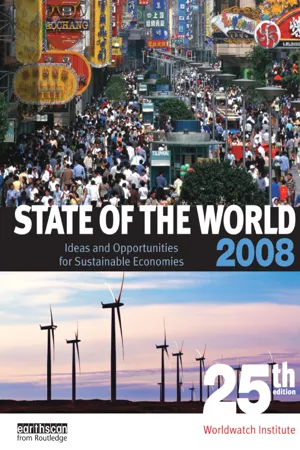
The environmentalist's bible' Times Higher Education Supplement. 'Essential reading' The Good Book Guide. 'The most comprehensive, up-to-date, and accessible summaries ... on the global environment' E. O. Wilson, Pulitzer Prize winner. Celebrating its 25th year of publication, State of the World 2008 suggests that something huge and even revolutionary is struggling to be born as policymakers, business leaders and others around the globe create the architecture of sustainable economies. Featuring chapters on renewable energy, innovations in clean production, commons resources, trade policy, finance for sustainability, new economic yardsticks, and many other topics, State of the World 2008 is the first global-level publication to showcase a wide range of diverse innovations and to demonstrate their near-term potential to put whole societies on a sustainable path. Published annually in 28 languages, State of the World is relied upon by national governments, UN agencies, development workers and law-makers for its authoritative and up-to-the-minute analysis and information. It is essential for anyone concerned with building a positive, global future.
eBook - ePub
State of the World 2008
Ideas and Opportunities for Sustainable Economies
- 288 pages
- English
- ePUB (mobile friendly)
- Available on iOS & Android
eBook - ePub
CHAPTER 1
Seeding the Sustainable Economy
To critique the dominant economic system of the twentieth century would seem a fool’s errand, given the unprecedented comfort, convenience, and opportunity delivered by the world economy over the past 100 years. Global economic output surged some 18-fold between 1900 and 2000 (and reached $66 trillion in 2006). Life expectancy leaped ahead—in the United States, from 47 to nearly 76 years—as killer diseases such as pneumonia and tuberculosis were largely tamed. And labor-saving machines from tractors to backhoes virtually eliminated toil in wealthy countries, while cars, aircraft, computers, and cell phones opened up stimulating work and lifestyle options. The wonders of the system appear self-evident.1
Yet for all its successes, other signals suggest that the conventional economic system is in serious trouble and in need of transformation. Consider the following side effects of modern economic activity that made headlines in the past 18 months:
• Atmospheric carbon dioxide levels are at their highest level in 650,000 years, the average temperature of Earth is “heading for levels not experienced for millions of years,” and the Arctic Ocean could be ice-free during the summer as early as 2020.
• Nearly one in six species of European mammals is threatened with extinction, and all currently fished marine species could collapse by 2050.
• The number of oxygen-depleted dead zones in the world’s oceans has increased from 149 to 200 in the past two years, threatening fish stocks.
• Urban air pollution causes 2 million premature deaths each year, mostly in developing countries.
• The decline of bees, bats, and other vital pollinators across North America is jeopardizing agricultural crops and ecosystems.
• The notion of an approaching peak in the world’s production of oil, the most important primary source of energy, has gone from an alarming speculation to essentially conventional wisdom; the mainstream World Energy Council recently predicted that the peak would arrive within 15 years.2
These and other environmental consequences of the push for economic growth threaten the stability of the global economy. Add to this list the social impacts of modern economic life—2.5 billion people living on $2 a day or less and, among the wealthy, the rapid advance of obesity and related diseases—and the need to rethink the purpose and functioning of modern economies is clear.3
Even in business circles the sense that something is wrong with modern economies is palpable. An annual assessment of the most significant risks to the world’s economies commissioned by the business-sponsored World Economic Forum found that many of the 23 diverse risks were nonexistent at the global level a quarter-century ago. These include environmental risks such as climate change and the strain on freshwater supplies; social risks, including the spread of new infectious diseases in developing countries and chronic diseases in industrial nations; and risks associated with innovations like nanotechnology. Beyond being new and serious, what is most striking is that half of the 23 are economic in nature or driven by the activities of modern economies. In other words, national economies, and the global economy of which they are a part, are becoming their own worst enemies.4
But if economies built according to the conventional model are increasingly selfdestructive, a new kind of economy—a sustainable economy—is struggling to be born. Where the conventional economy depends largely on fossil fuels, is built around useand-dispose materials practices, and tolerates extreme poverty even amid stunning wealth, the evolving sustainable economy seeks to operate within environmental boundaries and serve poor and rich alike.
The emergence of the sustainable economy is visible in a burst of creative experimentation involving design for remanufacture, “zerowaste” cities, environmental taxes, cap-andtrade carbon markets, car-sharing companies, maturing markets for solar and wind power, microfinance, socially responsible investment, land tenure rights for women, product takeback laws, and other innovations discussed in this book. Scaled up and replicated across the world, these and other experiments could form the basis of economies that meet the needs of all people at the least cost to the natural environment.
An Outdated Economic Blueprint
The world is very different, physically and philosophically, from the one that Adam Smith, David Ricardo, and other early economists knew—different in ways that make key features of conventional economics dysfunctional for the twenty-first century. Humanity’s relationship to the natural world, the understanding of the sources of wealth and the purpose of economies, and the evolution of markets, governments, and individuals as economic actors—all these dimensions of economic activity have changed so much over the last 200 years that they signal the close of one economic era and the need for a new economic beginning.
In Smith and Ricardo’s time, nature was perceived as a huge and seemingly inexhaustible resource: global population was roughly 1 billion—one seventh the size of today’s—and extractive and production technologies were far less powerful and environmentally invasive. A society’s environmental impact was relatively small and local, and resources like oceans, forests, and the atmosphere appeared to be essentially infinite.5
At the same time, humanity’s perception of itself was changing, at least in the West. The discoveries of Enlightenment-era scientists suggested that the universe operated according to an unchanging set of physical laws whose unmasking could help humans understand and take control of the physical world. Once the Swiss mathematician Daniel Bernoulli, for example, worked out key ideas of the physics of flight in 1738, it was only a matter of time before humans claimed the air for themselves. After eons of helpless suffering from the effects of plagues, famines, storms, and other wildcards of nature, this growing sense of human prowess—along with a seemingly inexhaustible resource endowment—encouraged the conviction that humanity’s story could now be written largely independent of nature.6
This radically new worldview became entrenched within economics, and even late in the twentieth century most economic textbooks gave little attention to nature’s capacity to absorb wastes or to the valuable economic role of “nature’s services”—natural functions from crop pollination to climate regulation. One Nobel economist in the 1970s made the claim (since recanted) that “the world can, in effect, get along without natural resources.” Even as growth in population and technological power in the last century raised concerns about resource scarcity, economists predicted confidently that price signals from free markets would prompt more-efficient production and consumption or that human effort would produce or discover substitutes. Nature would not be a roadblock to human progress.7
But the assumed independence of economic activity from nature, always illusory, is simply no longer credible. Global population has expanded more than sixfold since 1800 and the gross world product more than 58-fold since 1820 (the first year for which nineteenth-century data are available). As a result, humanity’s impact on the planet—its “ecological footprint”—exceeds Earth’s capacity to support the human race sustainably, according to the Global Footprint Network. (See Chapter 2.) For rich countries, the overshoot is especially high. Industrial economies today survive by dipping ever more deeply into reserves of forests, groundwater, atmospheric space, and other natural resources—practices that cannot continue indefinitely.8
The assumed independence of economic activity from nature, always illusory, is simply no longer credible.
These changing circumstances demand the upending of some fundamental economic notions. With the Industrial Revolution, for instance, factories, machines, financing, and other forms of created capital replaced land as the principal drivers of wealth production. Factories and funding remain important today, but resource scarcity has made “natural capital” an increasingly vital consideration in economic advance. Declines in oceanic fish catch, for example, are often caused by the growing scarcity of fish stocks (natural capital) rather than by a lack of fishing boats (created capital). (See Chapter 5.) Modern fishing practices now overpower nature’s fish endowment: a 2006 study showed that the populations of 29 percent of oceanic species fished in 2003 had collapsed (meaning that catch had fallen to 10 percent or less of their peak abundance). Similar losses of natural capital are found at the regional level for forests, water, and other key resources.9
A second outdated tenet is that growth ought to be the primary goal of an economy. This remains the central operating assumption in finance ministries, stock markets, and shopping malls worldwide despite the clear threat to natural capital, because rapidly growing populations and the creation of consumer-driven economies have made growth seem indispensable. But growth (making an economy bigger) is not always consistent with development (making it better): the nearly fivefold expansion of global economic output per person between 1900 and 2000 caused the greatest environmental degradation in human history and coincided with the stubborn persistence of mass poverty.10
A third shaky axiom of conventional economic thinking is that markets are always superior to government spending and policies as economic tools. Markets are adept at generating vast quantities of private goods, but some of these—such as the dozens of redundant breakfast cereal choices—are of dubious social value. At the same time, markets do little to provide public goods such as parks and mass transportation. And although they help to allocate scarce resources “efficiently” across different products and modes of production, according to Tufts University economist Neva Goodwin, “the very definition of efficiency contains an acceptance of inequality.” In economics, efficiency means allocating every resource to its highest value use, where value is defined mainly by purchasing power, so “a market works efficiently when the rich get a lot of what they want and the poor get just as much as they can pay for.” Markets thus do little to ensure a just distribution of goods: those with the greatest wealth get the most, no matter that 40 percent of the global population lives in wrenching poverty.11
Markets do little to provide public goods such as parks and mass transportation.
Finally, humans themselves differ sharply from the model of “economic man” held by early economists. The celebrated insight of Adam Smith was that the “invisible hand” leads self-interested individual actions to positive collective outcomes. This is a powerful idea, but it has overshadowed the equally important communitarian dimension of human societies—a dimension with deep roots in evolutionary history. People are motivated not only by self-interest but also by the desire to participate in a larger community, as with volunteer work or in response to local or national disasters. Recognizing the strong communitarian impulse of human beings, as sustainable economics does, offers a fuller and more realistic understanding of humans as economic actors.
Ballooning Liabilities
Conventional economies in the twentieth century churned out cornucopian prosperity and opportunity for people in dozens of countries. But as the century wore on, troubling numbers began to appear in environmental and societal balance sheets, suggesting that what is called “economic growth” entails significant losses—of species, healthy ecosystems, and a stable climate, for instance. Today, the alarming liabilities of modern economies threaten to undermine economic stability worldwide. Three issues—climate change, ecosystem degradation, and wealth inequality—illustrate the self-subversion of economies and economic activity today.
Climate change The hidden story behind the headline-grabbing drama of climate change—melting glaciers, rising sea levels, and hundred-year storms—is the costs inflicted by global warming. The Intergovernmental Panel on Climate Change, the international scientific body charged with assessing the issue, reported in 2007 that the cost of curbing climate change through reductions in greenhouse gas emissions would run about 0.1 percent of gross world product annually. An independent review in 2006 conducted by Nicholas Stern, head of the Government Economic Service in the United Kingdom, came to a more sobering conclusion: the cost of mitigation would be around 1 percent of gross world product. One percent in 2007 would have represented $650 billion, equivalent to the cost of the Viet Nam War (in 2007 dollars). This cost is steep, but it would be spread over many countries each year.12
Whatever the cost of action, it is a bargain compared with the cost of doing nothing. The Stern Report concluded that inaction on climate change could dampen global economic output by anywhere from 5 to 20 percent every year over the course of this century, the upper limit likely being closer to the final tally. It noted that heat waves like the one in 2003 in Europe, which killed 35,000 people and caused agricultural losses of $15 billion, will be commonplace in a few decades. And hurricane wind speeds in the United States, which are projected to increase 5–10 percent because of rising sea temperatures, would double annual hurricane damage costs. The report’s low estimate reflects estimated market costs, while the 20 percent estimate sums market costs, nonmarket health and environmental costs, and an equity weighting factor that accounts for the fact that poor countries will bear a disproportionate burden of the total.13
The Stern Report’s findings were largely echoed in a survey of climate research by the Global Development and Environment Institute (GDAE) at Tufts University, which noted that two major modeling efforts estimated annual climate damages by the end of this century at 8 percent or more of world output. Business as usual would lead to declining agricultural yields later in this century, as well as more immediate damage to water supplies, human health, and essential natural ecosystems. The Stern and GDAE assessments suggest that early preventive action is a prudent investment necessary to address what the Stern report calls “the greatest and widest-ranging market failure ever seen.”14
Ecosystem degradation In 2005, a comprehensive report entitled the Millennium Ecosystem Assessment documented the extent of global ecosystem destruction in the last half of the twentieth century. It concluded th...
Table of contents
- Cover
- Halftitle
- Title
- Copyright
- Contents
- Acknowledgments
- List of Boxes, Tables and Figures
- Foreword
- Preface
- State of the World: A Year in Review
- 1 Seeding the Sustainable Economy
- 2 A New Bottom Line for Progress
- 3 Rethinking Production
- 4 The Challenge of Sustainable Lifestyles
- 5 Meat and Seafood: The Global Diet’s Most Costly Ingredients
- 6 Building a Low-Carbon Economy
- Special Section: Paying for Nature’s Services
- Notes
- Index
Trusted by 375,005 students
Access to over 1.5 million titles for a fair monthly price.
Study more efficiently using our study tools.
Frequently asked questions
Yes, you can cancel anytime from the Subscription tab in your account settings on the Perlego website. Your subscription will stay active until the end of your current billing period. Learn how to cancel your subscription
No, books cannot be downloaded as external files, such as PDFs, for use outside of Perlego. However, you can download books within the Perlego app for offline reading on mobile or tablet. Learn how to download books offline
Perlego offers two plans: Essential and Complete
- Essential is ideal for learners and professionals who enjoy exploring a wide range of subjects. Access the Essential Library with 800,000+ trusted titles and best-sellers across business, personal growth, and the humanities. Includes unlimited reading time and Standard Read Aloud voice.
- Complete: Perfect for advanced learners and researchers needing full, unrestricted access. Unlock 1.5M+ books across hundreds of subjects, including academic and specialized titles. The Complete Plan also includes advanced features like Premium Read Aloud and Research Assistant.
We are an online textbook subscription service, where you can get access to an entire online library for less than the price of a single book per month. With over 1.5 million books across 990+ topics, we’ve got you covered! Learn about our mission
Look out for the read-aloud symbol on your next book to see if you can listen to it. The read-aloud tool reads text aloud for you, highlighting the text as it is being read. You can pause it, speed it up and slow it down. Learn more about Read Aloud
Yes! You can use the Perlego app on both iOS and Android devices to read anytime, anywhere — even offline. Perfect for commutes or when you’re on the go.
Please note we cannot support devices running on iOS 13 and Android 7 or earlier. Learn more about using the app
Please note we cannot support devices running on iOS 13 and Android 7 or earlier. Learn more about using the app
Yes, you can access State of the World 2008 by Worldwatch Institute in PDF and/or ePUB format, as well as other popular books in Economics & Environmental Economics. We have over 1.5 million books available in our catalogue for you to explore.