Crop wild relatives (CWR) are plant species which are more or less closely related to crops. They are a vital resource by providing a pool of genetic variation that can be used in breeding new and better adapted varieties of crops that are resistant to stress, disease, drought and other factors. They will be increasingly important in allowing crops to adapt to the impacts of climate, thus safeguarding future agricultural production. Until recently, the main conservation strategy adopted for CWR has been ex situ - through the maintenance of samples as seed or vegetative material in various kinds of genebank or other facilities. Now the need to conserve CWR in their natural surroundings (in situ) is increasingly recognized.
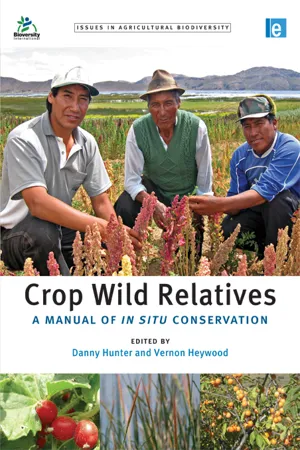
Recent research co-ordinated by Bioversity International has produced a wealth of information on good practices and lessons learned for their effective conservation. This book captures the important practical experiences of countries participating in this work and describes them for the wider conservation community. It includes case studies and examples from Armenia, Bolivia, Madagascar, Sri Lanka and Uzbekistan, which are important centres of diversity for crop wild relatives, and covers four geographical regions - the Caucasus, South America, Africa and the Asia-Pacific Region. It provides practical, relevant information and guidance for the scaling-up of actions targeting CWR conservation around the world.
- 440 pages
- English
- ePUB (mobile friendly)
- Available on iOS & Android
eBook - ePub
About this book
Information
Part I
Introduction
This part sets the scene for Crop Wild Relative (CWR) in situ conservation. It outlines the different approaches to defining CWR, describes the importance of these species, makes a case for their conservation in the wild and illustrates the challenges involved in setting up actions to target their preservation.
Chapter 1
Introductory and Background Material
Without continued genetic enhancement using diverse germplasm from both wild and modified sources, the gains in crop yields obtained over the past seven decades are not sustainable, and yields might eventually grow more slowly or even decline. Agricultural production increasingly relies on ‘temporal diversity,’ changing varieties more frequently to maintain resistance to pests and diseases (Rubenstein et al, 2005).
Introduction: Crop wild relatives (CWR)
Crop wild relatives (CWR) collectively constitute an enormous reservoir of genetic variation that can be used in plant breeding and are a vital resource in meeting the challenge of providing food security, enhancing agricultural production and sustaining productivity in the context of a rapidly growing world population and accelerated climate change. They occur in a wide range of habitats but as numerous assessments testify, habitats continue to be lost or degraded across the world, putting many of these species at risk. It is therefore essential that urgent steps are taken to conserve them both in the wild (in situ) and in genebanks (ex situ) while the genetic diversity they contain is still available.
What are genetic resources?
Genetic resources were traditionally defined as genetic material (alleles) of known value used in plant or animal improvement, but the meaning has been widened by the Convention on Biological Diversity (CBD) to mean any material of plant, animal, microbial or other origin containing functional units of heredity, of actual or potential value. It thus covers both living (e.g. seeds) and preserved material (e.g. herbarium or museum specimens). The International Treaty on Plant Genetic Resources for Food and Agriculture (ITPGRFA) adopts a similar definition. Crop Wild Relatives are a key component of plant genetic resources for food and agriculture.1
What is a crop wild relative?
In general terms, a crop wild relative (CWR) may be defined as a wild plant species that is more or less closely related to a particular crop and to which it may contribute genetic material, but unlike the crop species has not been domesticated (Heywood et al, 2007). It is difficult to give a more precise definition, yet we need one if we are to be able to assess how many CWR exist both nationally and globally. Being a CWR is a matter of degree – some are more closely related than others to the crop. Two ways of describing this relationship have been employed – genecological – based on the extent to which they can exchange genes with the crop – and taxonomic – based on their taxonomic relationship with the crop (see Table 1.1). The genecological approach often uses the Harlan and de Wet (1971) gene pool concept to define the degree of relatedness, based on the relative ease with which genes can be transferred from them to the crop. In the complete or partial absence of genetic data or information on crossability, use of the taxon group concept has been proposed by Maxted et al (2008), which relies on the likelihood of the existing taxonomic classification reflecting a degree of genetic relationship or crossability.
For the purposes of the United Nations Environment Programme (UNEP)/Global Environment Facility (GEF) CWR Project described in this manual (see p 19), a CWR was defined as any species belonging to the same genus as the crop, based on the argument that species judged to be sufficiently similar to belong to the same genus are likely to be related genetically. A similar approach has been proposed by Meilleur and Hodgkin (2004) who suggest as a definition ‘CWRs should include the wild congeners or closely related species of a domesticated crop or plant species, including relatives of species cultivated for medicinal, forestry, forage, or ornamental reasons’. A number of other recent major CWR projects follow this approach. Such a broad definition leads to large numbers of species being considered CWR. For example, Kell et al (2008) found that around 83 per cent of the Euro-Mediterranean flora comprises crop and CWR species. Faced with handling such large numbers of CWR, a priority determining mechanism needs to be used to select which species will be the subject of particular conservation actions (see Chapter 7). CWR are a very diverse group of plants and occur in a wide variety of habitats. They range from forest trees and shrubs to climbers, perennials, biennials and annuals. Some of them are widespread and may even occur as weeds while others have scattered or restricted distributions and some of them are rare and endangered.
Table 1.1 Taxonomic and genecological definitions of CWR
Gene pool concept of CWR
Primary gene pool (GPI)
Contains close relatives that readily intercross with the crop
Secondary gene pool (GP2)
Contains all the biological species that can be crossed with the crop but where hybrids are usually sterile
Tertiary gene pool (GP3)
Comprises those species that can be crossed with the crop only with difficulty and where gene transfer is usually only possible with radical techniques
Taxon group concept of CWR
Taxon Group 1 a – crop
Taxon Group 1 b – same species as crop
Taxon Group 2 – same series or section as crop
Taxon Group 3 – same subgenus as crop
Taxon Group 4 – same genus as crop
Taxon Group 5 – different genus to the crop
Landmark events – a bit of history
Although genes from CWR have almost certainly been used in the development of crops from early times, recorded use of CWR in commercial plant breeding dates back to the end of the 19th century (Hodgkin and Hajjar, 2008) and the potential significance of CWR in plant breeding and crop improvement was recognized by Vavilov and other pioneers2 of the genetic resources movement. Wider recognition of the value of genes from CWR in conferring desirable characteristics in crop cultivars developed in the 1940s and 1950s (see Hajjar and Hodgkin, 2007, for a summary of the early uses of CWR). It was not, however, until the 1960s that active steps were made to undertake coordinated conservation of the genetic diversity represented by landraces, local ecotypes and wild relatives of crops. The recommendations made by the Food and Agriculture Organization of the United Nations (FAO) Technical Meeting in Rome in 1961 represented a key development (Bennett, 1965). It recognized ‘the great importance to this and future generations of preserving the gene pool of genetic variability which now occurs in the major gene-centres of the world, but which is threatened with destruction’. The FAO recommended the establishment of International Crop Centres within the gene-centres to be charged with the task of fully exploring the genetic potential of their respective regions on the basis of detailed local knowledge, of assessing and maintaining basic collections of crops and local races and of wild forms, and of setting up areas in genetic conservation to be managed in such a way as to preserve the evolutionary potential of local population–environment complexes (Bennett, 1965). The International Institute in Izmir (the Izmir Centre), Turkey, was established in 1964 with such terms of reference (Sencer, 1975).
In the 1970s and 1980s, there was increasing recognition of CWR as a significant component of plant genetic resources. In tune with the times, the main focus was on the collection and ex situ conservation of samples of genetic diversity, activities which accelerated in the mid-1980s, probably as a consequence of the introduction of ecogeographic surveying. It was only in the 1980s that a small number of agricultural and forestry scientists began to actively target CWR for in situ conservation, probably due to a growing awareness of habitat and species decline, followed by calls for the conservation of CWR by prominent international and conservation organizations. Although some time and resources began to be allocated to studying the possibilities of in situ CWR conservation, the necessary cross-sectoral approach was often lacking. A number of scientific meetings and publications followed, dealing with various aspects of in situ CWR conservation during the 1980s.
The entry into force of the Convention on Biological Diversity (CBD) in 1993, the endorsement of the Global Plan of Action for the Conservation and Sustainable Use of Plant Genetic Resources for Food and Agriculture (GPA) in 1996 and the International Treaty on Plant Genetic Resources (ITPGRFA) in 2001, whereby signatory countries adopted in situ CWR conservation as a national priority, and a series of books on in situ CWR conservation theory and methods, as well as some on-the-ground field projects, provided added impetus to our appreciation and understanding of the importance of CWR (Meilleur and Hodgkin, 2004).
Landmark publications on CWR
One of the first publications to draw attention to the importance of conserving CWR was the booklet Conserving the Wild Relatives of Crops by Erich Hoyt, published by the International Union for Conservation of Nature (IUCN), IBPGR [later to become IPGRI and today Bioversity International] and the World Wide Fund for Nature (WWF) in 1988.3 Much of what it says is still valid and Hoyt’s statement, ‘The conservation of crop genetic resources – the plants that feed us and their wild relatives – is one of the most important issues for humankind today’, remains true to this day. A major review of the use of CWR was published by Prescott-Allen and Prescott-Allen (1988).
A significant, although frequently overlooked, publication is the booklet Plant Genetic Resources:Their Conservation in situ for Human Use (FAO, 1989), which arose out of a decision taken during the first meeting of the ad hoc working group on in situ conservation of the Ecosystems Conservation Group in 1986, including members from FAO, the United Nations Educational, Scientific and Cultural Organization (UNESCO), UNEP, the IUCN and the International Board for Plant Genetic Resources (IBPGR). This included a series of cases studies from around the world, illustrating action planned or underway in in situ conservation of plant genetic resources.
Other important resources are the proceedings of the workshops initiated by the Council of Europe on ‘Conservation of the Wild Relatives of European Cultivated Plants’ (Valdés et al, 1997), which were held in Faro (Portugal), Neuchâtel (Switzerland) and Gibilmanna-Palermo (Sicily, Italy), and addressed a wide range of issues concerning the genetics, demography, ecology, conservation, management and protection of genetic variability through a series of case studies.
A further valuable resource is the global survey of in situ conservation of wild plant species (Heywood and Dulloo, 2005) that arose out of another UNEP/GEF-supported project ‘Design, Testing and Evaluation of Best Practices for In Situ Conservation of Economically Important Wild Species’.
An additional landmark publication is Crop Wild Relative Conservation and Use (Maxted et al, 2008) which arose out of the first international conference on CWR, organized within the framework of the European Commission (EC)-funded Plant Genetic Resources (PGR) Forum project and held in Agrigento, Sicily, Italy in September 2005.4
The second report on the State of the World’s Plant Genetic Resources for Food and Agriculture5 was endorsed at the 12th Session of the Commission on Genetic Resources for Food and Agriculture (Rome, 18–23 October 2009). It updates the first report with the best data and information available, through ...
Table of contents
- Cover
- Halftitle
- Title
- Copyright
- Contents
- Acknowledgements and contributors
- Foreword
- Preface
- List of acronyms and abbreviations
- Part I: Introduction
- Part II: Conservation Planning
- Part III: Conservation Actions
- Part IV: Other Major Issues
- Annexes
- Index of organisms
- General index
Trusted by 375,005 students
Access to over 1.5 million titles for a fair monthly price.
Study more efficiently using our study tools.
Frequently asked questions
Yes, you can cancel anytime from the Subscription tab in your account settings on the Perlego website. Your subscription will stay active until the end of your current billing period. Learn how to cancel your subscription
No, books cannot be downloaded as external files, such as PDFs, for use outside of Perlego. However, you can download books within the Perlego app for offline reading on mobile or tablet. Learn how to download books offline
Perlego offers two plans: Essential and Complete
- Essential is ideal for learners and professionals who enjoy exploring a wide range of subjects. Access the Essential Library with 800,000+ trusted titles and best-sellers across business, personal growth, and the humanities. Includes unlimited reading time and Standard Read Aloud voice.
- Complete: Perfect for advanced learners and researchers needing full, unrestricted access. Unlock 1.5M+ books across hundreds of subjects, including academic and specialized titles. The Complete Plan also includes advanced features like Premium Read Aloud and Research Assistant.
We are an online textbook subscription service, where you can get access to an entire online library for less than the price of a single book per month. With over 1.5 million books across 990+ topics, we’ve got you covered! Learn about our mission
Look out for the read-aloud symbol on your next book to see if you can listen to it. The read-aloud tool reads text aloud for you, highlighting the text as it is being read. You can pause it, speed it up and slow it down. Learn more about Read Aloud
Yes! You can use the Perlego app on both iOS and Android devices to read anytime, anywhere — even offline. Perfect for commutes or when you’re on the go.
Please note we cannot support devices running on iOS 13 and Android 7 or earlier. Learn more about using the app
Please note we cannot support devices running on iOS 13 and Android 7 or earlier. Learn more about using the app
Yes, you can access Crop Wild Relatives by Danny Hunter,Vernon Heywood in PDF and/or ePUB format, as well as other popular books in Biological Sciences & Ecology. We have over 1.5 million books available in our catalogue for you to explore.