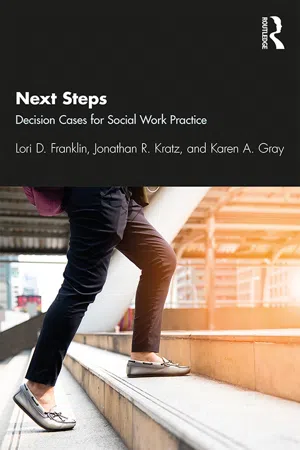
Social work students consistently struggle to apply theory to practice, or use the knowledge of textbooks and classrooms in the field. Vignettes and scenarios represented in textbooks are often simplistic, too tidy to be realistic, and with clean resolutions. Next Steps: Decision Cases for Social Work Practice highlights the complex, messy nature of social work practice in a way that is engaging to students, allowing them to step into the role of a practicing social worker. This book is a collection of decision cases from multiple areas of social work practice, designed to enhance the quality and depth of classroom case discussion and analysis. These realistic, compelling cases present dilemmas about which even experienced practitioners may disagree. This allows rich classroom discussion that enhances critical thinking, provides real-life application, and creates numerous opportunities to apply content and knowledge acquired throughout a social work education experience.
eBook - ePub
Next Steps
Decision Cases for Social Work Practice
- 140 pages
- English
- ePUB (mobile friendly)
- Available on iOS & Android
eBook - ePub
Next Steps
Decision Cases for Social Work Practice
About this book
Information
Part I
Bachelor of Social Work Graduates
1 Bonnie’s Boys
Bonnie Tsosie had to admit that the powwow outing had gone better than she could have ever imagined. Dozens of men in bright grass-dance regalia quickly paced around the field in perfect sync to the thunderous pulse of tribal drums that would make any rock concert seem derivative. The sunset cast a golden glow across the field, creating long shadows that amplified the dramatic expression of the dancers.
“Can we please stay a little longer?” Bruce pleaded, dropping to his knees dramatically, “It’s not over yet! I want to stay until the end!”
“I’m sorry, but we really need to get back to our unit by 8 PM and I think the rest of the group is ready to go,” Bonnie responded, “and you really need to get back so you can take your nighttime meds and get to bed.”
“This is boring,” one of the other boys interjected.
“Shut up! Don’t you ruin this!” Bruce took several steps towards the boy, fists clenched. Here we go, Bonnie thought as she stepped between Bruce and the rest of the group from Children’s Hope Residential Treatment (CHRT). Maybe this was a bad idea after all. Bruce is like a walking time-bomb. I never know what will set him off.
Bonnie Tsosie
Bonnie had regularly attended powwows since she was a young girl. “I’m half Indian, half hillbilly!” she would joke to anyone who asked about her heritage. Although powwows played a central role in her cultural development, they had a side benefit of giving her a reprieve from problems at home. She had been exposed to years of domestic violence as a child, first with her biological father and later with a step-father. Bonnie frequently ran away to her grandmother’s home in the Winnebago Reservation to escape the abuse, but her mother would eventually come and bring her back to Omaha.
At the age of 15, Bonnie began to keep a gun under her pillow to keep her stepdad away from her at night. Her grades dropped in school, she joined a gang, and she was often expelled for fighting other students. After being held back to repeat her sophomore year, it seemed likely that Bonnie would drop out of high school.
“Junior ROTC saved my life,” Bonnie would often say. She joined at the urging of a school counselor in her junior year. The JROTC sergeant took an interest in making sure that Bonnie stayed on track.
“Get your ass up! You’re too smart to miss school!” he would yell as he banged on her front door when she overslept. Bonnie found comfort in the structure and consistency of JROTC and she soon began to seek out other programs like it by joining Color Guard and the rifle team, and dreaming of joining the Marines.
It took Bonnie an extra year to finish high school and nearly three years to earn her Associates degree at Metropolitan Community College (MCC) in Omaha. By the time she earned her Associates degree, Bonnie had two children and mostly put her dreams of joining the Marines on hold.
“You need to get your Bachelor of Science in Social Work (BSSW) from the University of Nebraska at Omaha,” her advisor at MCC insisted. At the time Bonnie had been working at a crisis center for youth and had realized that she really enjoyed working with teenagers. As her advisor described the opportunities a BSSW would afford her in that field, she decided to go for it and became one of the first people from her family to earn a college degree.
Starting Work at Children’s Hope Residential Treatment (CHRT)
Bonnie was hired as a Mental Health Technician (MHT) at CHRT within weeks of graduating with her BSSW. As an MHT, she enjoyed leading rehab groups and working on life skills with the residents. Bonnie felt a special connection to many of her clients as she would learn of their traumatic childhoods. I know they can escape the cycle, because I’m living proof that it’s possible! By far, MHTs spent more time with the residents than any of the other professionals at CHRT.
Although Bonnie felt a strong sense of empathy for her clients, she was disciplined in maintaining strict boundaries. Orientation for new staff at CHRT featured hilariously outdated training videos from the 70s on the importance of professional boundaries in residential treatment facilities. Although the training videos provided fodder for inside jokes among CHRT staff, Bonnie was increasingly aware of the importance of clear boundaries with her clients the longer she worked at CHRT. She had witnessed the subtle way in which small boundary issues grew into major controversies within the agency. In fact, Bonnie guessed that boundary violations represented a very large percentage of employee terminations at CHRT.
Boundaries were especially problematic when CHRT hired MHTs who were only a few years older than many of the residents in the program. One afternoon Bonnie noticed a resident tapping Cristal, a newly hired MHT, on her foot under a table. She immediately pulled Cristal aside and confronted her, “What’s going on out here?”
“Oh nothin’, just colorin’ pages with the residents,” Cristal replied.
“Did you not feel him tappin’ your foot?” Bonnie asked as her gaze intensified.
“Um, yeah, well I told him to quit,” Cristal replied nervously.
“Right, well nobody else knows you told him to quit. You need to start removing yourself from that situation. That type of boundary violation won’t do you any favors in this agency.”
Bonnie’s natural leadership skills cemented her reputation as an invaluable member of the CHRT staff. In fact, the administrative staff often treated Bonnie more like a supervisor than an MHT, even to the point that she was often included in weekly administrative staff meetings. Bonnie was never afraid to speak her mind, and this was a source of both strength and tension in the administrative group. She was often confronted for being “too abrasive and sassy.”
Clinical Director Dennis Kodak would verbally interpret her statements in his typical Mr. Rogers fashion, saying, “What I think Bonnie is trying to say is….” You don’t have to be my buffer, I can take care of myself, Bonnie would think whenever Dennis tried to diplomatically reframe a confrontational statement. Yet Bonnie rarely confronted him on this tendency. He’s such a sweet man and, honestly, he’s just trying to keep the peace.
“Don’t you talk to me like that!”
CEO Alexander Ludwig was someone that Bonnie attempted to spend as little time with as possible. Although Alexander’s role in the system was largely related to finances, he had started as an MHT decades earlier and often made a habit of walking through the units and critiquing staff.
“You need to get your shit together!” Alexander told Bonnie in front of several residents one afternoon. Bonnie had been struggling with some personal matters and was visibly upset when Alexander had walked through the room and confronted her.
“Don’t you talk to me like that in front of these kids!” Bonnie yelled at Alexander in the hallway outside the unit.
“Who do you think you are to tell me what to do?” Alexander responded, “This is my hospital!”
Later that day in Dennis’s office, Bonnie unloaded her frustrations. “He’s always harder on me. I’m not going to let him talk to me like that, especially in front of the residents.”
Dennis sat calmly behind his desk and listened attentively to Bonnie, then suggested, “You know, I think you might remind Alexander of his sister…”, Dennis stopped mid-sentence in response to the extreme irritation on Bonnie’s face. Of course, he’s going to psychoanalyze the CEO instead of doing something about this hostile work environment.
“You know, I think Alexander is trying to say that he cares about you and that he wants you to succeed,” Dennis continued.
“This is bullshit,” Bonnie couldn’t contain her irritation, “Alexander is an ass.”
“I’m an ass?” Alexander interjected, surprising Bonnie who had not noticed him in the doorway behind her, “why don’t you say that to my face?”
“You’re an ass!” Bonnie exclaimed as she stood mere inches from Alexander, her five-foot, four-inch frame only an inch taller than his.
Bonnie fully expected to be terminated from the agency, yet her name continued to be listed on the hospital schedule. Maybe Dennis talked Alexander into giving me a second chance? Bonnie thought as she arrived on the unit later that same week. Shouldn’t we at least have a meeting to debrief about the argument? Are they really going to just ignore that I called the CEO an ass to his face? Several days passed and neither Dennis nor Alexander seemed interested in discussing the incident with Bonnie.
A Special Resident
Alexander barely spoke to Bonnie in the months that followed. In fact, Alexander had become significantly less visible throughout the facility. He rarely walked through the residential units and minimally participated in weekly administrative meetings. Given this new normal in the agency, Bonnie was surprised when Alexander spoke during a meeting in early March 2015.
“We have a new resident who is transferring to us from the acute unit at CHI Immanuel,” Alexander shared, appearing to direct his statement at Bonnie. “He’s a 13-year-old Omaha male and he’s being discharged after a suicide attempt. He’s been in custody for over seven years and has been diagnosed with Reactive Attachment Disorder and Major Depression. His Department of Health and Human Services (DHHS) and Indian Child Welfare Act (ICWA) workers are at a loss about where to place him. He’s gone AWOL from nearly every residential facility in the state.”
Here we go again, Bonnie thought, he’s going to ask me to take the lead because I’m Native American.
Bonnie’s instinct was immediately validated as Alexander continued, “I really want Bonnie to work with this kid and develop a relationship with him.” Alexander looked directly at Bonnie, “I think you will have a lot in common.” Although Bonnie was annoyed by previous suggestions that she lead a Native American rehab group, she wondered if this was Alexander’s way of apologizing for his role in their argument months prior.
Bruce
This kid is going to knock someone out, Bonnie thought as Bruce, a stout 13-year-old boy, walked onto the unit for the first time. Bonnie noticed him scanning the room and sizing up the other residents. So sad to see the jailhouse mentality in such young kids, Bonnie thought as Bruce approached her.
“Hi there, let’s get you settled in,” Bonnie introduced herself. Most residents would bring a small bag of permitted personal items when admitted to CHRT, but Bruce had nothing but the clothing he was wearing and a few books.
“This is Marcus,” Bonnie introduced Bruce to the male MHT on duty, “he will help you get settled into your room.”
Marcus was one of the most experienced MHTs at CHRT. An African American man in his late 40s, his calm yet firm style seemed to put residents at ease. In fact, Bonnie had noticed that there were significantly fewer behavioral problems on the unit when Marcus was on duty.
“What’s up little man?” Marcus shook Bruce’s hand, adding, “nice to have another Native brotha’ to hang with Ms. B on this unit.”
Bruce looked at Bonnie with a confused look on his face, “Native?”
“Don’t listen to him, it’s nothing,” Bonnie responded.
“No, I’m serious,” Marcus interrupted, “Ms. B here is Indian too.”
Bonnie felt uncomfortable as Bruce looked her up and down and said, “No way. You a white girl.”
“Don’t let these blond highlights fool you,” Bonnie said playfully. “It’s okay if you don’t believe me—I get that all the time.”
“I’m Omaha. What tribe are you? Winnebago?” Bruce guessed correctly.
“Oh yeah, everybody’s Winnebago around here, right?” Bonnie responded sarcastically. Maybe this won’t be so bad, she thought as Marcus walked Bruce to his room. I hate to admit it, but Alexander might have been right about me working with this kid.
Settling In
Bonnie had always made a point of treating all of the residents at CHRT as equally as possible, yet it was clear that Bruce preferred her to the other staff. Bonnie wasn’t the only one who noticed Bruce’s affinity for her. Within a few weeks most of the staff had begun to call Bruce “Ms. B’s Boy.” Bonnie was irritated by this and often confronted staff members about the inappropriateness of the nickname.
As Bruce entered his fourth week at CHRT, Bonnie had begun to really connect with him on a cultural level. I can’t tell if he’s really interested in tribal stuff or if he’s pretending because he knows that it interests me, Bonnie wondered. What 13-year-old boy likes traditional beadwork? Her doubts about the authenticity of his stated interest rapidly faded as he spent hours devouring books on traditional beadwork that Bonnie brought to CHRT.
“You can’t do beadwork while you’re here, but maybe it’s something you can look into after you leave,” Bonnie had told Bruce when she first gave him the books. “Please be careful with them—they technically belong to my grandmother,” she warned.
“Well, when I get out I’m going to make you this one,” Bruce said pointing at a photo of a particularly elaborate beaded headband.
“You know that I can’t take gifts from you,” Bonnie reminded Bruce. “You should make it for yourself, or maybe you could make some money by selling it.”
Mom
“This is how my mom should’ve been,” Bruce said out of the blue one afternoon as he played UNO with Bonnie in the dayroom. Bonnie didn’t respond right away. I feel so bad for him. Despite everything he’s been through, he’s just an innocent kid who was dealt a bad hand. Bonnie’s thoughts drifted to her own childhood. Maybe Bruce can overcome these obstacles and find happiness like I did. I wonder if he’s ever experienced a relationship as stable as the one we’ve developed? Bonnie thought before finally replying to Bruce’s statement, “Yeah, I’m sorry she hasn’t been able to be there for you.”
Bruce’s behavior when Bonnie was on the unit was dramatically different compared to when she wasn’t. “Reflection” was the lowest behavioral level given to clients in the program, and Bruce had just levelled up after spending t...
Table of contents
- Cover
- Half Title
- Title Page
- Copyright Page
- Table of Contents
- About the Authors
- Acknowledgments
- Introduction
- PART I Bachelor of Social Work Graduates
- PART II Master of Social Work Practicum Students
- PART III New MSW Graduates
- PART IV Experienced MSW Practitioners
Trusted by 375,005 students
Access to over 1.5 million titles for a fair monthly price.
Study more efficiently using our study tools.
Frequently asked questions
Yes, you can cancel anytime from the Subscription tab in your account settings on the Perlego website. Your subscription will stay active until the end of your current billing period. Learn how to cancel your subscription
No, books cannot be downloaded as external files, such as PDFs, for use outside of Perlego. However, you can download books within the Perlego app for offline reading on mobile or tablet. Learn how to download books offline
Perlego offers two plans: Essential and Complete
- Essential is ideal for learners and professionals who enjoy exploring a wide range of subjects. Access the Essential Library with 800,000+ trusted titles and best-sellers across business, personal growth, and the humanities. Includes unlimited reading time and Standard Read Aloud voice.
- Complete: Perfect for advanced learners and researchers needing full, unrestricted access. Unlock 1.5M+ books across hundreds of subjects, including academic and specialized titles. The Complete Plan also includes advanced features like Premium Read Aloud and Research Assistant.
We are an online textbook subscription service, where you can get access to an entire online library for less than the price of a single book per month. With over 1.5 million books across 990+ topics, we’ve got you covered! Learn about our mission
Look out for the read-aloud symbol on your next book to see if you can listen to it. The read-aloud tool reads text aloud for you, highlighting the text as it is being read. You can pause it, speed it up and slow it down. Learn more about Read Aloud
Yes! You can use the Perlego app on both iOS and Android devices to read anytime, anywhere — even offline. Perfect for commutes or when you’re on the go.
Please note we cannot support devices running on iOS 13 and Android 7 or earlier. Learn more about using the app
Please note we cannot support devices running on iOS 13 and Android 7 or earlier. Learn more about using the app
Yes, you can access Next Steps by Lori D. Franklin,Jonathan R. Kratz,Karen A. Gray,Lori Franklin,Jonathan Kratz,Karen Gray in PDF and/or ePUB format, as well as other popular books in Social Sciences & Social Work. We have over 1.5 million books available in our catalogue for you to explore.