This volume provides an excellent overview of the field of discourse processes, capturing both its breadth and its depth. World-renowned researchers present the latest theoretical developments and thought-provoking empirical data. In doing so, they cover a broad range of communicative activities, including text comprehension, conversational communication, argumentation, television or media viewing, and more.
A central theme across all chapters concerns the notion that coherence determines the interpretation of the communication. The various chapters illustrate the many forms that coherence can take, and explore its role in different communicative settings.
eBook - ePub
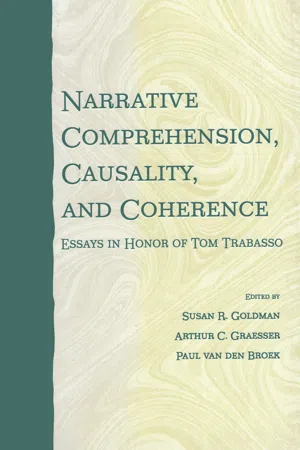
Narrative Comprehension, Causality, and Coherence
Essays in Honor of Tom Trabasso
- 328 pages
- English
- ePUB (mobile friendly)
- Available on iOS & Android
eBook - ePub
Narrative Comprehension, Causality, and Coherence
Essays in Honor of Tom Trabasso
About this book
Information
1
Essays in Honor of Tom Trabasso
Tom Trabasso is one of the founders of the field of discourse psychology. To many of us who are active in discourse psychology, it is Tom who had the intellectual vision and genuine passion that was needed to launch the field. That vision was needed to sell our ideas to experimental psychologists, cognitive scientists, and to members of the various disciplines that contribute to discourse analysis. The passion was needed for everyone to stay motivated during the confused, unsettled stage when the field was discovering and inventing itself.
Tom Trabasso’s role in launching discourse psychology is a matter of public record. He was the obvious choice to be the first president of the Society for Text and Discourse (ST&D) in 1991. It was Tom who made ST&D a legal entity, while Bruce Britton prepared the bylaws and Art Graesser arranged for Discourse Processes to be the official journal of the Society. The first meeting of the annual ST&D conference was held within a few miles of Tom’s laboratory at the University of Chicago. Tom was an associate editor of Discourse Processes during those formative years, sharing the duties with Roy Freedle (founding editor), Art Graesser (current editor), and Deborah Tannen. Tom Trabasso was a central figure at the meetings of the annual Winter Text Conference, held every January in Jackson Hole, Wyoming. The Winter Text conference was organized by Bruce Britton as a forum to focus on issues of text processing, modeled after a conference held at the same location by George Sperling in the area of cognitive psychology. So every January for the past 10 years, a group of folks interested in various aspects of discourse psychology, cognition, and winter sports hold a conference in Jackson Hole. At the apex stands Tom Trabasso, along with Walter Kintsch and Chuck Perfetti, ready for a rapid, dangerous, invigorating run. The intellectual debates and provocative data are indeed as stimulating as the slopes.
Those of us who have been mentored by Tom decided to write a collection of papers to celebrate his contributions to discourse psychology. Some of us are officially his students. Some are collaborators. And some are neither, but have been deeply influenced by his ideas. The ideas in this edited volume provide a representative snapshot of research on narrative comprehension, coherence, and causality during the 1990s.
Before we describe the body of work that we have assembled in recognition of Tom’s impact on discourse psychology we need to point out that this body of work represents only one of the research hats Tom has worn. Before arriving at the University of Chicago, Tom participated in the academic life of some prestigious institutions and psychology departments. Tom’s formal career in psychology began at Michigan State University under the tutelage of Frank Restle, a leading figure in mathematical learning theory. Tom was awarded the PhD from Michigan in 1961 whereupon he began a National Institute of Mental Health postdoctoral fellowship at Stanford University. At Stanford, Tom worked with a budding cognitive psychologist by the name of Gordon Bower. This collaboration resulted in a lifelong friendship and sharing of intellectual ideas. At Stanford, Tom continued to pursue his research on conceptual learning and memory, interests that dated from his Master’s and Doctoral theses.
Tom first joined the professorial ranks at the University of California, Los Angeles in 1963. After just 4 years, he was promoted to associate professor. He moved to Princeton University in 1969 as professor of psychology. During his time at Princeton, Tom took on the editorship of the journal Cognitive Psychology, becoming its second editor. Tom’s research interests at Princeton eventually shifted from conceptual learning and attentional control to language processing, reasoning, and inference generation. His work examined adult performance and the development of reasoning in children. From 1976 to 1979 Tom was professor of child development at the University of Minnesota where he pursued his interests in cognitive development. While at Minnesota, Tom began collaborating with Nancy Stein. Her work on the role of story schema in narrative comprehension and memory had a substantial impact on Tom’s later research on the role of causality in discourse comprehension. In 1979, Tom moved to his current home at the University of Chicago. He was instrumental in forming the department of psychology at Chicago and served as department chair for 3 years. In 1990, Tom was named the Irving B.Harris Professor of Psychology.
In addition to the variety of institutions at which Tom has held professorial positions, he has spent time in different parts of the United States and England in various visiting professor positions. Tom’s mobility contributed to his impact on a broad range of scholars, as does his presence at professional meetings such as Psychonomics and Society for Research on Child Development. For various reasons, the contributors to this volume are only a small subset of all the people on whom Tom has had an impact, including some of his colleagues at the University of Chicago. Nevertheless, the volume represents the breadth and depth of Tom’s influence on discourse psychology.
TOM TRABASSO’S MAJOR INTELLECTUAL CONTRIBUTIONS TO THE THEMES IN THIS FESTSCHRIFT
Although Tom’s intellectual career contributes to a variety of important topics in psychology, this book focuses on his work in discourse psychology. He was instrumental in moving the area of story comprehension from an emphasis on grammatical structures to the semantic and conceptual elements that underlie those structures. Tom developed a highly influential model of the causal structure of goal-based stories (Trabasso & van den Broek, 1985). The causal network model has had a profound impact on the way researchers approach narrative understanding, as will be evident in a number of the chapters in this volume. As Tom pursued an indepth understanding of causal explanation for narrative events, his explorations evolved naturally to a consideration of inferential reasoning during comprehension. This path led to a collaboration with Graesser and Singer on a Psychological Review paper that proposed a constructionist theory of inferences and explanation-based reasoning in narrative comprehension (Graesser, Singer, & Trabasso, 1994). According to this constructionist theory, comprehenders seek to establish explanatory coherence for narrative information. Thus, even if there are explicit local connections between narrative events, comprehenders have a natural inclination to make inferences that serve explanations at deeper levels, both local and global. For example, the following segment of a story is locally coherent.
Jimmy saw Tom’s new bike. Jimmy ran home and counted his money. He called the bike store. Then he went to the local grocery store and asked for a job. He worked hard at the grocery store for several weeks. Then he had enough money.
Each of the sentences in this story segment is locally coherent. For each pair of sentences, there are at least one or two concepts that are repeated. Even though there is this local coherence, comprehenders readily make inferences about the causal or explanatory connections from sentence to sentence and across the whole segment. For example, readers will readily infer that Jimmy counted his money because he wanted a new bike like Tom’s. Similarly, they infer that he went to the grocery store because he did not have enough money to buy the bike. A particularly robust finding is the propensity for readers to infer the goals that explain protagonists’ actions.
The constructionist position is often contrasted with a more automatic, less strategic view of inference making in comprehension. According to this view, readers make inferences when necessary to establish coherence. Almost all of the papers in this volume address questions of what inferences are made, when inferences are made, and what representations and processing mechanisms account for these inferences.
In his most recent work, Tom has been particularly interested in the personal narratives that individuals construct and in how these narratives are diagnostic of mental health. In particular, an analysis of goal structures has been found to play a prominent role in a person’s evaluations of their own experiences, emotions, attitudes, and prospects for well being. Tom has had a continuing interest, throughout his career, in the developmental course of psychological representations and skills. Consequently, some of the chapters in this volume take up the developmental theme.
OVERVIEW OF THE VOLUME
This volume begins with a short reflection (chap. 2) by two individuals whose work in discourse psychology has been powerfully influenced by Tom: Paul van den Broek and Joe Magliano. They provide some insight into the personal side of Tom. The remainder of the volume is organized into three sections. The first section deals with larger theoretical perspectives on models of discourse processing. The second section is more heavily concentrated on empirical tests and extensions of Tom’s work on goal structures, causality, and coherence in narratives. The final section addresses Tom’s current focal area, the use of narrative in the context of evaluative and emotional experiences.
The five chapters in the first section highlight the influence that Tom’s work on causal structures has had on investigations of narrative representation and comprehension. The section begins with van den Broek and Gustafson reviewing trends in research on reading over the past 25 years (chap. 3). They reflect on the changes that have occurred in the dominant paradigms and questions driving research. Tom’s work on the importance of explanation-based reasoning in constructing meaning has helped shaped the direction of this evolution. Van den Broek and Gustafson point out that theories of reading comprehension have shifted from a product to a process orientation, and more recently to an orientation that emphasizes an integrated view of process and product (van den Broek, Young, Tzeng, & Linderholm, 1999). Central to this theoretical evolution lie the challenges of dissecting the representations that readers construct and the process of constructing these representations.
The construction of meaningful narrative representations is substantially facilitated when it is easy for the reader to establish local coherence from sentence to sentence in a text. No one would quibble with this. However, when the text is locally coherent, models of comprehension differ with respect to assumptions about how much processing readers do beyond that, as discussed above. O’Brien and Myers (chap. 4) discuss and present evidence for a resonance model of memory-based processing. According to this view, concepts are activated through a fast-acting, passive, resonance process and are available for connection with other information currently being processed. They argue that this view may lead to a blending of two other theoretical positions, the minimalist hypothesis (McKoon & Ratcliff, 1992) and the constructionist theory (Graesser et al., 1994). Relevant to the minimalist view is the memory-based processing definition of what it means for information to be “readily available.” With respect to the constructionist view, the resonance model provides a mechanism for the bottom-up, passive generation of inferences. O’Brien and Myers are particularly concerned with reactivation of concepts during reading. Empirical studies of concept reactivation provide a rich testbed for incisive contrasts between theoretical position
Chapter 5 takes a broad view on inferences in comprehension. Magliano discusses some of the theoretical and methodological issues associated with investigating inferences. Along with colleagues Trabasso and Graesser (Magliano & Graesser, 1991; Trabasso & Magliano, 1996), Magliano has argued for the importance of examining inference processes through converging methods. In this chapter, Magliano takes up three topics, corresponding to his “three-pronged method.” First, he describes work that used the causal network model (Trabasso, van den Broek, & Suh, 1989) to generate theoretical predictions about where inferences ought to be made. He then presents evidence from inference elicitation methods (e.g., think-aloud protocols and question answering) of the kinds of inferences that people should make online. Finally, he provides ...
Table of contents
- Contents
- 1 Essays in Honor of Tom Trabasso
- 2 Reflections on a Mentor, Colleague, and Friend
- 3 Comprehension and Memory for Texts: Three Generations of Reading Research
- 4 Text Comprehension: A View From the Bottom Up
- 5 Revealing Inference Processes During Text Comprehension
- 6 Situation Models and Concepts in Story Comprehension
- 7 Five Dimensions of Narrative Comprehension: The Event-Indexing Model
- 8 Goals as Generators of Activation in Narrative Understanding
- 9 Children’s Understanding of Complex Stories: Issues of Representation and Assessment
- 10 On Narrative Reading-Writing Relationships: How Young Writers Construe the Reader’s Need for Inferences
- 11 Detecting Causal Inconsistencies in Scientific Text
- 12 Comprehension of Mathematical Proofs
- 13 Content Integration and Source Separation in Learning From Multiple Texts
- 14 On the Use of Narrative as Argument
- 15 The Dandelion War
- 16 Predicting Psychological Well-Being From Beliefs and Goal-Appraisal Processes During the Experience of Emotional Events
- Author Index
- Subject Index
Trusted by 375,005 students
Access to over 1.5 million titles for a fair monthly price.
Study more efficiently using our study tools.
Frequently asked questions
Yes, you can cancel anytime from the Subscription tab in your account settings on the Perlego website. Your subscription will stay active until the end of your current billing period. Learn how to cancel your subscription
No, books cannot be downloaded as external files, such as PDFs, for use outside of Perlego. However, you can download books within the Perlego app for offline reading on mobile or tablet. Learn how to download books offline
We are an online textbook subscription service, where you can get access to an entire online library for less than the price of a single book per month. With over 1.5 million books across 990+ topics, we’ve got you covered! Learn about our mission
Look out for the read-aloud symbol on your next book to see if you can listen to it. The read-aloud tool reads text aloud for you, highlighting the text as it is being read. You can pause it, speed it up and slow it down. Learn more about Read Aloud
Yes! You can use the Perlego app on both iOS and Android devices to read anytime, anywhere — even offline. Perfect for commutes or when you’re on the go.
Please note we cannot support devices running on iOS 13 and Android 7 or earlier. Learn more about using the app
Please note we cannot support devices running on iOS 13 and Android 7 or earlier. Learn more about using the app
Yes, you can access Narrative Comprehension, Causality, and Coherence by Susan R. Goldman, Arthur C. Graesser, Paul van den Broek, Susan R. Goldman,Arthur C. Graesser,Paul van den Broek in PDF and/or ePUB format, as well as other popular books in Psychology & Cognitive Psychology & Cognition. We have over 1.5 million books available in our catalogue for you to explore.