Succeeding at Your Interview: A Practical Guide for Teachers uses an effective interactive format to present core information about interviewing for a teaching job, document a wide variety of interview processes, guide teacher candidates in developing strategies for interviewing, and increase their confidence in communicating their professional knowledge. In a spiral process, readers are asked to consider scenarios, respond to questions, contemplate the perspective offered by the authors, and modify their responses. The goal is to help teacher candidates develop and articulate a clear idea of their own professional knowledge and of the culture of the schools at which they are interviewing.
Special features:
*Eleven detailed chapters and five interview scenarios engage the reader in continuous reflective practice in the multifaceted activities integral to interviewing--beginning with organizing the job search and proceeding through the entire interview process.
*The scenarios implicitly develop knowledge and the chapters explicitly detail the information.
*Specific interview situations engage readers in articulating their professional knowledge, linking theory and practice.
*"Keep in Mind" comments, Margin Notes, and Decision Trees provide opportunities to reflect on the issues and develop personal responses.
*Sample documents, formats, questions, and responses enhance understanding of evaluation processes.
*Graphic organizers at the beginning and end of each chapter provide visual representations of the concepts and concerns addressed in each chapter, assisting the reader in identifying chapters relevant to their current needs in the job search and in synthesizing, organizing, and reviewing the information contained in the chapter.
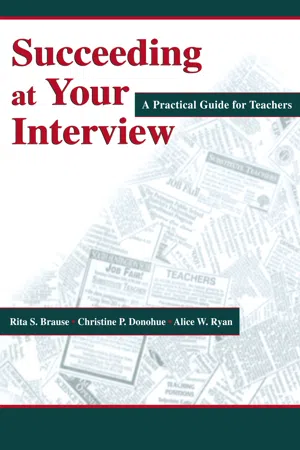
eBook - ePub
Succeeding at Your Interview
A Practical Guide for Teachers
- 248 pages
- English
- ePUB (mobile friendly)
- Available on iOS & Android
eBook - ePub
Succeeding at Your Interview
A Practical Guide for Teachers
About this book
Information
Topic
EducationSubtopic
Counseling in Career DevelopmentPART A
STARTING YOUR SEARCH
The first step in starting your search is gathering information that is essential in deciding where to apply. Part A provides information in two contexts—Steve’s Scenario and Chapters 1 and 2. As you eavesdrop on Steve’s interview you will understand some of his job search techniques. Taking the “fly on the wall” view in the principal’s office, you will get a sense of the content and rhythm of Steve’s interview, a representative sample of many such interactions.
You might ask, “Where in the world do I begin?” Chapter 1 will broaden your understanding of the formal and informal ways to obtain information about schools and help you to pinpoint the places where you are likely to find job openings.
After searching advertisements and visiting job sites and Web sites, you are ready to consider your many options. Will you relocate? Do you want to work with young children or are older students more aligned with your preparation? Will you seek a position as a specialist or a generalist? Your answers to these questions will help you narrow your search as you decide where to apply.
| Scenario: | Steve Border An Initial, School-Based, One-to-One Interview |
| Chapter 1 | Gathering Information |
| Chapter 2 | Deciding Where to Apply |
SCENARIO
An Initial, School-Based, One-to-One Interview
| Candidate: | Steve Border | |
| Interviewer: | Mr. Erickson | Principal |
A graduate of large public schools, Steve is committed to working with students attending public schools in a large city. Enrolled in a graduate teacher education program in a major U.S. city, Steve is student teaching in a public elementary school cited for its innovative academic program and parental involvement. Although he has no hopes of landing a job in this setting, he expects to draw on his experiences here to find a good placement nearby.
Steve thought long and hard about where he could make the greatest contribution and where he would feel most comfortable. When choosing between public or private schools, Steve knew he wanted to work with students who attend public schools, specifically marginalized students. He also heard there were some schools with strong leadership, and then there were schools that no one seems to want to be in. Steve wants to teach in a school with a visionary leader. These early decisions in some ways narrowed the field for Steve as he pursued his teaching credential.
HOW DID STEVE GET AN INTERVIEW?
Steve has observed, volunteered, and student taught in a wide range of the schools available to residents in this city, which we call Newer City. As Steve participated in his teacher education program, he inquired about the criteria for including specific schools in the program, seeking to obtain a clearer understanding of the range of options available in the local schools. Steve wanted to get an accurate picture of the schooling situation, particularly the commitment to public education in Newer City, as he now sought to teach there. Won over by the students and faculty he worked with, as well as the wide array of low-cost resources available, Steve found living in Newer City was an attractive option.
Midway through his student teaching at the Performance School, he inquired about the possibility of a teaching position for the fall. Although neither his cooperating teacher nor the principal had any expectations of changes in the faculty or additional faculty lines, the principal, Ms. Taffel, indicated that she would see if she could find another school that might need a good new teacher. Steve impressed the principal with his resourcefulness and his dedication. Because she had informally observed him numerous times, she was in a position to recommend him to another principal. As luck would have it, Ms. Taffel located a possible school, the J. F. Kennedy School, and gave Steve the principal’s name, Mr. Erickson, and the phone number.
At lunch that day, Steve called the J. F. Kennedy School with hopes of arranging an interview. Mr. Erickson was not available so Steve left a message including both his home phone number, and the fact that Ms. Taffel had suggested he call. Later that day, there was a message on Steve’s voice mail from Mr. Erickson.
Steve returned the call the next morning at 7:30 a.m., hoping to make this contact before leaving for his student teaching responsibilities. To Steve’s surprise, Mr. Erickson answered the phone himself but indicated this was a difficult time to talk and suggested that he visit the school next Thursday. Steve was particularly pleased with this appointment, considering he had sent out 20 letters and received no response.
HOW DID STEVE PREPARE FOR THE INTERVIEW?
Excited at having an interview scheduled, Steve asked his cooperating teacher, Ms. Norita, what he might be asked. Ms. Norita indicated that at her own interview, the principal, Ms. Taffel, had asked about her philosophy of teaching and particularly focused on her approaches to teaching reading and spelling. “And clearly I gave good answers,” she said, “or I wouldn’t be here now.”
“How did you know what to say?” Steve asked.
“I think you need to answer from your heart. You can try to psych out the situation and figure out what the principal wants to hear. You want to be in a school where your philosophy is consistent with the principal’s, or a place where the principal will allow you to do your own thing. I don’t believe in playing a game to get a job because then you’ll never know who you really are. As you know, I take my job seriously, and I think you do, too. So, I’d suggest that you want to be assigned to a school where your beliefs are respected and supported and where you will continue to learn. You clearly cannot learn everything in student teaching or in your teacher education program. I know that I’m constantly learning and loving it. You know that Ms. Taffel is so supportive of our looking at new programs and new ideas and she encourages us to try new ways to do things so that we can be even more effective than we are right now. I find those important qualities of my job. Perhaps you will want to co...
Table of contents
- CONTENTS
- PREFACE
- ACKNOWLEDGMENTS
- LIST OF TABLES
- LIST OF FIGURES
- PART A STARTING YOUR SEARCH
- PART B GETTING READY TO APPLY
- PART C KNOWING THE PROCESS
- PART D PREPARING YOURSELF
- PART E REFLECTING ON YOUR JOURNEY
- EPILOGUE
- SUGGESTED READINGS
- REFERENCES
- Index
Trusted by 375,005 students
Access to over 1.5 million titles for a fair monthly price.
Study more efficiently using our study tools.
Frequently asked questions
Yes, you can cancel anytime from the Subscription tab in your account settings on the Perlego website. Your subscription will stay active until the end of your current billing period. Learn how to cancel your subscription
No, books cannot be downloaded as external files, such as PDFs, for use outside of Perlego. However, you can download books within the Perlego app for offline reading on mobile or tablet. Learn how to download books offline
Perlego offers two plans: Essential and Complete
- Essential is ideal for learners and professionals who enjoy exploring a wide range of subjects. Access the Essential Library with 800,000+ trusted titles and best-sellers across business, personal growth, and the humanities. Includes unlimited reading time and Standard Read Aloud voice.
- Complete: Perfect for advanced learners and researchers needing full, unrestricted access. Unlock 1.5M+ books across hundreds of subjects, including academic and specialized titles. The Complete Plan also includes advanced features like Premium Read Aloud and Research Assistant.
We are an online textbook subscription service, where you can get access to an entire online library for less than the price of a single book per month. With over 1.5 million books across 990+ topics, we’ve got you covered! Learn about our mission
Look out for the read-aloud symbol on your next book to see if you can listen to it. The read-aloud tool reads text aloud for you, highlighting the text as it is being read. You can pause it, speed it up and slow it down. Learn more about Read Aloud
Yes! You can use the Perlego app on both iOS and Android devices to read anytime, anywhere — even offline. Perfect for commutes or when you’re on the go.
Please note we cannot support devices running on iOS 13 and Android 7 or earlier. Learn more about using the app
Please note we cannot support devices running on iOS 13 and Android 7 or earlier. Learn more about using the app
Yes, you can access Succeeding at Your Interview by Rita S. Brause,Christine P. Donohue,Alice W. Ryan in PDF and/or ePUB format, as well as other popular books in Education & Counseling in Career Development. We have over 1.5 million books available in our catalogue for you to explore.