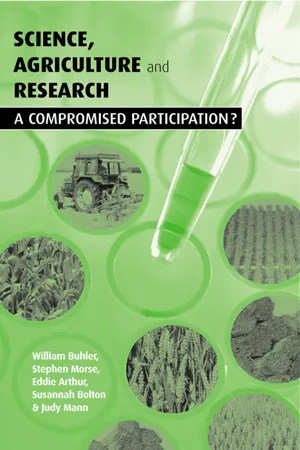
eBook - ePub
Science Agriculture and Research
A Compromised Participation
- 176 pages
- English
- ePUB (mobile friendly)
- Available on iOS & Android
eBook - ePub
Science Agriculture and Research
A Compromised Participation
About this book
Research is never free of pressures and constraints and to understand its results properly these have to be assessed and analyzed. In agriculture, research into biotechnology and GMOs, as well as pesticides and herbicides, is big business - agribusiness. This book looks at the crucial roles of funding and the political context on the research agenda and its results in agricultural development. It provides a critical evaluation of the participatory methods now widely used and explores the ways in which research into biotechnology have reflected the interests of the various parties involved.
Information
Chapter 1
What Drives Agricultural Research?
THE RESEARCH PROCESS AND POLICY – HOW DOES IT ALL WORK?
Having set the book in context in the Introduction, we would now like to explore the various factors that affect and influence agricultural research, from the political environment through to what motivates individuals carrying out the work. We can explore this with some very simple questions:
Why is agricultural research carried out? Is it to provide information to solve a problem, to develop new ideas or to expand on existing ones? Is it to ‘move things forward’, to provide opportunities for wealth creation, to ‘keep ahead of the game’?
What drives agricultural research? Is it a need generated within the industry? And if so, at what level? Is the research self-motivating through the personal ambition and motivation of the researchers? Or is it politically motivated, either through national or international collaboration, or some technological need or support for industry? Or is it simply profit driven?
Who determines what drives agricultural research? Is it ‘technology push’ seeking to employ research through the development of techniques and materials looking for applications, or ‘market pull’ in which the need is identified by industry which then seeks a solution through research?
How closely is the research matched to the need? Who decides and how are the two brought together? Who monitors this decision and the provision of solutions through research?
Who ensures effective use of funds, time, labour and facilities, and who monitors this? Is there any accountability involved?
How are the objectives for the research set and who sets them? Who sets the objectives for the funding agencies and are the objectives based on requirements in the real world, perhaps in industry, or to serve a pressing need and, as such, recognized as being essential? Are the objectives influenced by the needs, aspirations or requirements of the scientist? Or are they politically driven, perhaps to satisfy a demand from the public, to gain parliamentary popularity, or for so called political correctness? They may even be strongly influenced by what is thought to be popular or trendy.
We will attempt to address some of these questions in this chapter, but first let us consider some contrasting scenarios to set the questions in context – an exercise which also helps to justify them.
Let’s start with a popular perception of what research is about: the ‘scientist-driven’ agenda. This entails a scientist, wearing a white lab coat, slightly (or even very) eccentric, single minded and driven by an over-riding search for truth that keeps him working, usually alone, all hours of the day and night. Mostly, the nature of the problem is irrelevant – it is the image that counts and that has been used (and abused) all too frequently to advertise anything from mashed potato to cars, from toilet paper to cosmetics, providing an image of the high tech nature of the product, giving it respectability and making it appeal to the ‘discerning’ buyer who likes to ‘keep abreast of the times’ and who likes to be seen to respond to and embrace advances in technology. Matters of funding, career structure, teamwork, applicability and justification, and the list of questions posed earlier, do not enter into the situation at all – it’s unreal, just for the media – and it can be very misleading if, as is often the case, this is the only portrayal of a scientific researcher some people ever see. Add to this the word ‘agriculture’ and we’re usually in the world of talking animals, animated cows and pigs all striving to provide us with our daily food. Fortunately, agricultural research is rarely portrayed as such, other than through the production of food, so at least we are spared the vision of eccentric, white-lab-coated boffins with their wellies on!
But there is an important message here – that scientists are often perceived by the general public and especially by television audiences, as boffins, isolated from the real world and deeply engrossed in their all-consuming passion – research. By the same token, such research is usually seen as ‘blue skies’ or esoteric, detached from reality and carried out in isolation. For most research this could not be further from the truth.
So, let’s get a bit more real. Consider another scenario with a research scientist working in a research environment, highly motivated and committed to a certain thesis, a particular idea he wants to check out within the sphere of interest in which he is working. He feels strongly committed to the idea that answering this particular question will provide valuable information and move the work along significantly. But he needs funding to carry out the work, so he looks around to see what is available and evolves a compromise to fit what he wants to do with the available funding, targeted at certain topics and research areas to satisfy the funding agency’s requirements. Having obtained the funding, he may be free to pursue his own agenda, follow his own ideas and provide some innovative research, the outcome of which will be difficult to foresee, or he may be required to work to a strict plan with predetermined milestones and deliverables, based on agreed objectives set by the funding agency.
In contrast to this, consider a situation in which a crisis arises, such as a disease epidemic or catastrophic crop failure due to some phenomenon, or perhaps a long-term problem which has reached crisis point. The consequences of the problem may be far reaching, prompting government and/or relevant parties in industry to take responsibility for doing something about it. A strategy is formulated, funds are made available and a call for research proposals to provide information and solutions to the problem is put out inviting researchers to participate. In this situation the funding is provided for research which is strictly managed and carefully targeted to addressing the problem and the motivation is in finding a solution.
Another example can be envisaged in which a scientist proposes some good quality science targeted at a particular applied goal. The ideas are sound, the approach is both feasible and sensible, the costs are reasonable, and the project addresses the problem thoroughly with a high likelihood of a successful outcome. In reality, this is a very common situation and usually results in success all round. But the application for funding can fail at the evaluation stage due to competition from other ‘high science’ proposals which are considered by those in judgement to be ‘better science’. This is all too familiar to researchers in the more strategic areas who are attempting to address particular questions in the real world. This is a topic we shall return to in the sections on funding and the funding agencies.
These examples illustrate the central and crucial dilemma in how research is funded. Should it be strictly managed, targeted to specific well-defined projects designed to answer specific predetermined problems in a highly controlled and managed way, or should it be left to the researchers themselves, as individuals or groups, specialized or multi-disciplinary, to determine their own targets.
In truth, of course, we end up with a mixture of these, resulting in varying degrees of control and freedom in what research is carried out and how, with most being somewhere in between the extremes of ‘blue skies’ and applied. But there remains the question of how it all works to the good of society and mankind and, in the case of agricultural research, for the good of the agricultural industry, from the breeders who provide improved varieties and strains right through the chain of producers and processors to the consumers and end-users.
We will explore this in a little more detail, but first let us compare the process, at least in the broadest terms, in developed and developing countries. In developing countries in the last 20 or 30 years there has been a strong tendency for research to be geared towards the needs of farmers – the farmer-first and participatory principles (to be discussed more fully in Chapter 5). Here, research is directed towards answering questions or solving problems encountered by farmers in a very applied, directed approach. In many ways, and perhaps ironically, this has come to contrast with the situation in the developed world where there is much more freedom, and indeed encouragement from various sources, to pursue more fundamental, innovative research – but perhaps this has lost its way in getting to the point where it often overlooks the needs of those in the agricultural industry, concentrating instead on, or being influenced by, more politically and publicly sensitive issues, determined by forces outside the industry itself. One of the fundamental differences between developing country and developed country research is that, in general, the latter is much more concerned with industry, since agriculture is industrialized on a large scale with few individuals managing large agribusinesses rather than by many individuals, each on a relatively small scale.
Take the situation in much of China or India, where ‘farms’ are usually no more than a few hectares with fields often the size of small plots, and where the agriculture is heavily dependent on labour input. Contrast this with some farms in Western Europe in excess of 500 hectares and individual fields in excess of 50 hectares – indeed, it is estimated that the minimum economically viable farm size in East Anglia in the UK, mostly down to arable crops, is now around 400–500 hectares. Such farms are often managed in groups of two or more and run very much as large businesses – and a far cry from the situation that prevailed as little as 50 years ago.
So the research requirements of the developed and developing countries are likely to be different, given this huge contrast in form and function – or are they? Let us return to exploring the research process. How do the policy-makers and funding agencies see research? Who do they think is in control? Who determines the objectives? Above all, and in relation to our concerns here, is the question of whether the process is responsive and, if so, to what or to whom, and if not, what does determine the objectives?
These statements relate to the questions of how policy-makers and funding agencies see research; what processes come into play in determining objectives and how they convince industry that it is worth investing in particular research areas. There may be some semblance of order in this, with procedures through which the process passes to arrive at the conclusion that this or that area should be targeted. There must also be some way to ensure fair play and good practice to avoid corruption.
The principles of how objectives for responsive research are determined are likely to be similar in both developed and developing countries, but the various factors influencing the process will be determined by the differences in the nature of how things are done and where and what the driving forces are. In the developed countries, these are likely to be industry and politics whereas in developing countries they are more likely to be farmer-driven.
Ideally, the process should be driven by information being made available on the nature of agricultural problems and what likely options are available to address them. To attract funding from industry or at least the attention of industry, industry must be convinced that the research is worth doing – it may not have to be immediately relevant or directly applicable, but it should have a high degree of relevance to its essentially commercial interests. Indeed, many researchers in industry can play a vital role in perceiving applications for more fundamental research. This is referred to later (Chapter 4) when considering the role of UK Foresight and exploiting the science base. But this is a ‘ding-dong’ process in which the different players strive to achieve their own particular objectives. It would be reassuring to think that they all had some common goal in mind other than furthering their own ends – something more idealistic and altruistic – but this seems unlikely, despite all the policy and mission statements about utilization and furthering the common good for example.
The policy-makers and funding agencies will have procedures in place, by which they determine where the funding goes and what areas require targeting. They will have access to information on what is required in practical terms, on the sensitivity of political and public attitudes and concerns, and they will attempt to ensure maximum benefit for the investment in research. But, of course, this may be flawed! It may be essentially naive or overly bureaucratic and full of misplaced motivations and commitment. And ‘benefit’ will almost certainly mean different things to different players in this game. The altruistic interpretation – for the benefit of mankind and the good of all – is almost certainly naive in practice, despite what many ‘mission statements’ would have us believe. It is far more likely that ‘benefit’ refers more to gain in some more worldly, materialistic and financial sense.
Similarly, consideration of what we mean by ‘flawed’ will also depend on perspectives, be they commercial, personal or academic. A decision which favours one party over another will be considered favourable to the beneficiaries but very likely considered flawed by the losers.
So the factors influencing agricultural research are many and varied, and certainly complex. The ‘drivers’ of research are difficult to define, determined as they are by the complexities.
THE IMPORTANCE OF FUNDING IN RESEARCH
One, if not the most important, determining factor in guiding research is funding. In this section, we will discuss sources of funding and how funding is determined, distributed and applied. Funding agencies usually identify amounts of their budgets which are to be made available for research (or research and development). These are sometimes under predetermined headings for specific areas or topics, and sometimes, though probably more rarely, made available for more speculative research. Research is usually expensive in terms of time, labour, equipment and facilities, and consumables.
As examples, we can consider two sources – industry-sponsored research and government-sponsored research. Industry-sponsored research can range from being very applied and directly relevant to industry’s needs, to much more fundamental and speculative research (often called esoteric or ‘blue skies’), which is not immediately relevant to the needs of industry but which explores areas thought to have potential, or is allied to current interests, or pursued simply through a fascination with ‘how things work’. Industry-sponsored research can be carried out within the industry, using its own facilities and expertise, or, as is often the case currently, it can be carried out in specialized research institutes, either by providing funds as a grant for the work to be done, or on a strict contractor/customer basis. This decision may be on the basis of cost, quality of the work needed, access to appropriate facilities and expertise and the likely speed of progress for example. The work is usually highly targeted with clearly set objectives and time scales and is monitored throughout by frequent review meetings and progress reports; industry is understandably keen to get value for money and to see returns for its research and development (R&D) investments.
Government-sponsored research can be fundamental, applied or industry-driven, and much of the current government funding for agricultural research is often supplemented by input from industry in collaborative joint ventures (eg Link Programmes – see Chapter 4). Indeed, for some types of work, especially the more applied projects in which industry can be expected to have a major interest and play a major role, these collaborative projects are a most effective and successful way forward.
So where does the money come from to support expensive agricultural research? For government-sponsored research in the UK the main sources of funding are provided through the research councils (eg the Biotechnology and Biological Sciences Research Council (BBSRC – formerly the Agriculture and Food Research Council (AFRC), and before that the Agricultural Research Council (ARC)) and government departments, such as the Department of Trade and Industry (DTI) and the Department for Environment, Food and Rural Affairs (DEFRA – formerly the Ministry of Agriculture, Fisheries and Food (MAFF)); from industry it can be provided directly, on a customer/contractor basis or indirectly through government departments as in collaborative joint funding. A third and most important provider of funds for agricultural and related research, is that from private sources. These include philanthropic individuals, organizations or foundations, including non-governmental organizations (NGOs). Many of our now world famous research institutions were founded on money provided by such means and continue to receive at least some of their support from the foundations established at the time.
Most research these days is formalized, with procedures to be followed and applications to be submitted when applying for funds to enable the work to be carried out. But this was not always the case; indeed, formalized funding is a relatively recent phenomenon coinciding with the setting up of institutions specifically to carry out the research, such as those of the BBSRC. Prior to 1994, there were three times the number of research establishments, each specializing in particular areas of agricultural research and supported in the main by the umbrella research council. Most of these were established between the two world wars to cope with the needs of agriculture at that time and to exploit new techniques, methodology and technology, on the basis of both philanthropic inputs and government funds. But before this, agricultural research was usually supported by private individuals, who were often land owners seeking improvements in farming techniques and methodology (see Chapter 2).
Funding in some form or other is essential for research – it is the lifeline, for without it there can be no research. But how it is made available can have important consequences for the type of research, how, where and by whom it is carried out, and for the time scales and outcomes. Funding can be freely given, with no ties or expectations, thus allowing the research to follow its own path and the researchers to indulge in their own committed interests and speculations. But these days this is rare, although it is often the most common public perception of how research operates. This lack of accountability rests at the heart of the...
Table of contents
- Cover
- Halftitle
- Title
- Copyright
- Contents
- Tables and Figures
- List of Acronyms and Abbreviations
- Introduction
- 1 What Drives Agricultural Research?
- 2 From Jethro Tull to Grain Mountains: The Origins and Development of Agricultural Research Systems
- 3 Agriculture and the Empire: Transferring Technocracies
- 4 Modern Times: Agribusiness and Biotechnology
- 5 The Rise (and Further Rise?) of Participation
- 6 A Compromised Participation?
- References
- Index
Trusted by 375,005 students
Access to over 1.5 million titles for a fair monthly price.
Study more efficiently using our study tools.
Frequently asked questions
Yes, you can cancel anytime from the Subscription tab in your account settings on the Perlego website. Your subscription will stay active until the end of your current billing period. Learn how to cancel your subscription
No, books cannot be downloaded as external files, such as PDFs, for use outside of Perlego. However, you can download books within the Perlego app for offline reading on mobile or tablet. Learn how to download books offline
Perlego offers two plans: Essential and Complete
- Essential is ideal for learners and professionals who enjoy exploring a wide range of subjects. Access the Essential Library with 800,000+ trusted titles and best-sellers across business, personal growth, and the humanities. Includes unlimited reading time and Standard Read Aloud voice.
- Complete: Perfect for advanced learners and researchers needing full, unrestricted access. Unlock 1.5M+ books across hundreds of subjects, including academic and specialized titles. The Complete Plan also includes advanced features like Premium Read Aloud and Research Assistant.
We are an online textbook subscription service, where you can get access to an entire online library for less than the price of a single book per month. With over 1.5 million books across 990+ topics, we’ve got you covered! Learn about our mission
Look out for the read-aloud symbol on your next book to see if you can listen to it. The read-aloud tool reads text aloud for you, highlighting the text as it is being read. You can pause it, speed it up and slow it down. Learn more about Read Aloud
Yes! You can use the Perlego app on both iOS and Android devices to read anytime, anywhere — even offline. Perfect for commutes or when you’re on the go.
Please note we cannot support devices running on iOS 13 and Android 7 or earlier. Learn more about using the app
Please note we cannot support devices running on iOS 13 and Android 7 or earlier. Learn more about using the app
Yes, you can access Science Agriculture and Research by Susannah Bolton,Eddie Arthur,William Buhler,Stephen Morse,Judy Mann in PDF and/or ePUB format, as well as other popular books in Politics & International Relations & Agribusiness. We have over 1.5 million books available in our catalogue for you to explore.