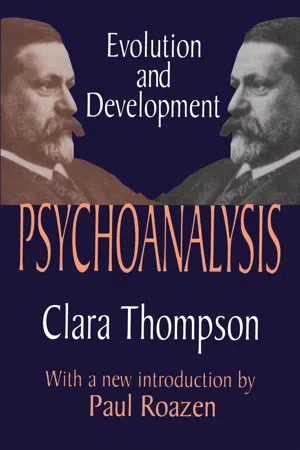
Psychoanalysis
eBook - ePub

Psychoanalysis

Evolution and Development

  1. 252 pages
  2. English
  3. ePUB (mobile friendly)
  4. Available on iOS & Android
eBook - ePub

Psychoanalysis

Evolution and Development

About this book

Clara Thompson was a leading representative of the cultural interpersonal school of psychoanalysis, sometimes known as the "neo-Freudians," which included Karen Horney, Erich Fromm, and Harry Stack Sullivan. "Classical analysts" once viewed neo-Freudians with the greatest suspicion and mistrust, yet today they can be seen for the innovative group of thinkers they were. Thompson's Psychoanalysis: Evolution and Development, first published in 1950, remains an enormously fair-minded discussion of the history of psychoanalytic theory and therapy.

Psychoanalysis has always been a theory of personality as well as a technique of therapy. Since Freud was born in 1856, and was an outstanding representative of the culture of old Vienna, Thompson thought there was plenty of room for revising classical analytic thinking in light of later developments. Such revisionism, she believed, need not lose the essential appreciation of the dynamic unconscious within classical analysis. However, Thompson felt Freud's biological outlook needed to be supplemented by a culturally more sophisticated orientation, and she was among those who tried to put Freud's concepts of libido into historical perspective. Instead of psychoanalysis having as its objective the release of tensions, Thompson proposed that the goal of analysis ought to be the growth of the total personality. Her revisionism also meant that the scope of psychoanalytic treatment could be broadened well beyond the neuroses Freud sought to explain. Thompson well understood the impact of the social environment on character formation.

The psychology of women needed to be rethought; differences between men and women could be partly explained by the social expectations that traditional Western culture had imposed on them. Thompson believed the whole analyst-patient relationship needed to be rethought; the real personality of the therapist has to be acknowledged, and the full human interplay between patient and analyst required examination.

In the current positivistic therapeutic climate based on technological advances in psychopharmacology, the ethical and humanistic dimension may be lost. Reflecting on the work of Clara Thompson and the neo-Freudian school can remind us of earlier efforts to challenge therapeutic authority and their distinct relevance to our problems today.

Frequently asked questions

Yes, you can cancel anytime from the Subscription tab in your account settings on the Perlego website. Your subscription will stay active until the end of your current billing period. Learn how to cancel your subscription.
No, books cannot be downloaded as external files, such as PDFs, for use outside of Perlego. However, you can download books within the Perlego app for offline reading on mobile or tablet. Learn more here.
Perlego offers two plans: Essential and Complete
  • Essential is ideal for learners and professionals who enjoy exploring a wide range of subjects. Access the Essential Library with 800,000+ trusted titles and best-sellers across business, personal growth, and the humanities. Includes unlimited reading time and Standard Read Aloud voice.
  • Complete: Perfect for advanced learners and researchers needing full, unrestricted access. Unlock 1.4M+ books across hundreds of subjects, including academic and specialized titles. The Complete Plan also includes advanced features like Premium Read Aloud and Research Assistant.
Both plans are available with monthly, semester, or annual billing cycles.
We are an online textbook subscription service, where you can get access to an entire online library for less than the price of a single book per month. With over 1 million books across 1000+ topics, we’ve got you covered! Learn more here.
Look out for the read-aloud symbol on your next book to see if you can listen to it. The read-aloud tool reads text aloud for you, highlighting the text as it is being read. You can pause it, speed it up and slow it down. Learn more here.
Yes! You can use the Perlego app on both iOS or Android devices to read anytime, anywhere — even offline. Perfect for commutes or when you’re on the go.
Please note we cannot support devices running on iOS 13 and Android 7 or earlier. Learn more about using the app.
Yes, you can access Psychoanalysis by Clara Thompson in PDF and/or ePUB format, as well as other popular books in Psychology & History & Theory in Psychology. We have over one million books available in our catalogue for you to explore.

Information

Index

Abraham, Karl, io, 30, 47, 67, 68, 69, 70, 71, 72, 74
Abreaction, 83, 183
Adler, Alfred, 4, 11, 12, 13, 59, 153, 154, 155, l56, 157, 158, 159, l60, l6l, 172, 176, 177, 197, 199
Adolescence, 218, 219
Affect, 18, 19, 20, 25, 98, 108, 230
Aggression, 5, 13, 43, 46, 47, 48, 49, 50, 51, 52, 53, 54, 58, 59, 61, 77, 86, 122, 136, 139, 140, 141, 142, 151, 153, 154, 173, 180, 206
Alexander, Franz, 71, 222
Anal character, 66, 67, 68, 70, 72, 73, 105, 224
Anal libido, 47, 54, 65, 66, 67, 73
Anal stage of libido, 33, 36, 37, 41, 47, 53, 70
Anima, 167
Animus, 167
Anxiety, 4, 8, 13, 21, 22, 23, 24, 36, 38, 75, 97, 112, 113, 114, 115, 116, 117, 118, 119, 120, 121, 122, 123, 124, 125, 126, 127, 128, 129, 130, 149, 150, 159, 173, 174, 175, 190, 199, 200, 201, 212, 213, 214, 215, 223, 236, 238, 242
Anxiety neurosis, 21, 22, 23, 24
Authoritarianism, 208
Autistic thinking, 169
Autoerotism, 32, 38, 41
Automaton conformity, 207, 208
Benedict, Ruth, 143, 196
Bleuler, Eug...

Table of contents

  1. Cover
  2. Half Title
  3. Title Page
  4. Copyright Page
  5. Dedication Page
  6. Contents
  7. Introduction To The Transaction Edition
  8. Preface
  9. one Introductory Survey
  10. Two Evaluation Of Freud’s Biological Orientation
  11. Three The Ego and Character Structure
  12. Four Unconscious Processes and Repression
  13. Five Resistance And Transference
  14. Six Theories About Anxiety
  15. Seven Freud’s Cultural Orientation Compared With Modern Ideas of Culture
  16. Eight Deviants Around 1912. Adler and Jung
  17. Nine Deviations and new Developments in the 1920’s
  18. Ten Recent Developments
  19. Eleven Therapy
  20. Bibliography
  21. Index