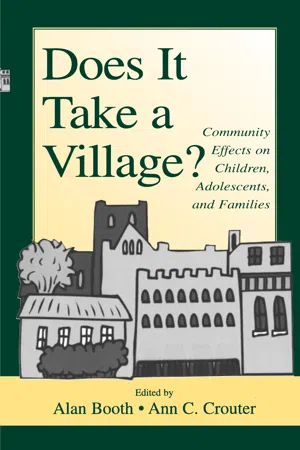
Does It Take a Village? focuses on the mechanisms that link community characteristics to the functioning of the families and individuals within them--community norms, economic opportunities, reference groups for assessing relative deprivation, and social support networks. Contributors underscore those features of communities that represent risk factors for children, adolescents, and their families, as well as those characteristics that underlie resilience and thus undergird individual and family functioning.
As a society we have heavy investments both in research and in programs based on the idea that communities affect families and children, yet important questions have arisen about the validity of the link between communities, children, and families. This book answers the question of whether--and how--it takes a village to raise a child and what we can do to help communities achieve this essential task more effectively.
eBook - ePub
Does It Take A Village?
Community Effects on Children, Adolescents, and Families
- 280 pages
- English
- ePUB (mobile friendly)
- Available on iOS & Android
eBook - ePub
Does It Take A Village?
Community Effects on Children, Adolescents, and Families
About this book
Information
Publisher
Psychology PressYear
2001Print ISBN
9780805832433
9780805832426
Edition
1eBook ISBN
9781135669140
III
How do Neighborhoods Affect the Development of Adolescent Problem Behavior?
8
Neighborhoods and Adolescent Development: How Can We Determine the Links?
Despite ample theoretical reasons to suspect that neighborhood conditions influence adolescent development and behavior, the task of securing precise, robust, and unbiased estimates of neighborhood effects has proved remarkably difficult. This chapter provides an assessment of the conceptual and, especially, methodological issues involved, as well as guidance on the most promising research designs for obtaining an unbiased understanding of the nature of neighborhood effects.
Key methodological issues include (a) obtaining neighborhood-level measures that approximate the theoretical constructs of interest; (b) allowing for the possibility of simultaneous influences between youth and their contexts; (c) avoiding bias from unobservable characteristics of parents that influence both choice of neighborhood and child outcomes; (d) consideration of ways in which families mediate and moderate neighborhood influences; and (e) using samples with sufficient variability in neighborhood conditions.
We argue that (a) studies that draw their samples from only a handful of different neighborhoods have little chance of distinguishing among the many theoretical ways in which neighborhoods may influence youth; (b) neighborhood-effects estimates from studies that measure neighborhood characteristics from youth or parental self-reports or by aggregating responses of youth or their parents are likely to be biased, especially when the youth outcomes themselves are based on youth or parent reports; (c) neighborhood data drawn from independent samples of residents or by more economical systematic social observation methods are more promising for addressing some of the hypotheses of interest; (d) a simple but informative method of estimating upper bounds on the scope of potential neighborhood effects is to estimate outcome correlations for pairs of youth who live close to one another; and (e) quasi- and random-assignment experimental studies represent our best hope for discovering the scope, if not nature, of neighborhood influences.
WHY NEIGHBORHOOD CONDITIONS MIGHT MATTER
Why might extrafamilial contexts—neighborhoods, communities, schools, and peers—affect an adolescent’s behavior? The literature is filled with answers to this question, some but not all of which argue that higher socioeconomic status (SES) environments are better for children. Because this literature is reviewed more completely in other chapters in this volume, we provide in this section an exceedingly brief and selective review of theories of contextual—especially neighborhood—effects, with an eye toward motivating our methodological discussion.
Jencks and Mayer (1990) developed a taxonomy of theoretical ways in which neighborhoods may affect child development. They distinguished:
• epidemic theories, based primarily on the power of peer influences to spread problem behavior;
• theories of collective socialization, in which neighborhood role models and monitoring are important ingredients in a child’s socialization;
• institutional models, in which the neighborhood’s institutions (e.g., schools, police protection) rather than neighbors per se make the difference;
• competition models, in which neighbors (including classmates) compete for scarce neighborhood resources; and
• models of relative deprivation, in which individuals evaluate their situation or relative standing vis-à-vis their neighbors (or classmates).
The first three of these explanations predict that “better” environments promote positive development. The last two predict that some youth may be negatively affected by exposure to higher SES environments.
Because adolescents typically spend a good deal of time away from their homes, explanations of neighborhood influences based on peers, role models, schools, and other neighborhood-based resources would appear to be more relevant for them than for younger children. However, it is possible that neighborhood influences begin long before adolescence. A substantial minority of 3- and 4-year-olds are enrolled in center-based daycare or preschool (Hofferth & Chaplin, 1994). Physically dangerous neighborhoods may force mothers to be isolated in their homes and thus restrict opportunities for their children’s interactions with peers and adults (Furstenberg, 1993). Parks, libraries, and children’s programs provide more enriching opportunities in relatively affluent neighborhoods than are available in resource-poor neighborhoods. Parents of high socioeconomic status may be observed to resort less frequently to corporal punishment and to engage more frequently in learning-related play. Thus, there are many ways in which neighborhood conditions might affect both children and adolescents (Chase-Lansdale, Gordon, Brooks-Gunn, & Klebanov, 1997).
Social disorganization theory identifies key elements of collective socialization and institutional forces likely to influence child and adolescent development. Following Shaw and McKay (1942), Sampson and his colleagues argued that a high degree of ethnic heterogeneity and residential instability leads to an erosion of adult friendship networks and undermines a values consensus in the neighborhood (Sampson & Lauritsen, 1994), which in turn means that problem behavior among young people is not controlled as effectively as in more socially organized neighborhoods.
Sampson, Raudenbush, and Earls(1997) argued for the importance of the concept of collective efficacy, which combines social cohesion (the extent to which neighbors trust each other and share common values) with informal social control (the extent to which neighbors can count on each other to monitor and supervise youth and protect public order). Thus it represents the capacity for collective action by neighbors. Sampson et al. (1997) found that collective efficacy so defined relates strongly to neighborhood levels of violence, personal victimization, and homicide in Chicago, after controlling for prior crime and for social composition as measured by census variables.
Wilson’s (1987) explanation of inner city poverty in Chicago relied on a more complicated model in which massive changes in the economic structure, when combined with residential mobility among more advantaged Blacks, results in homogeneously impoverished neighborhoods that provide neither resources nor positive role models for their children and adolescents.
Furstenberg (1993) and Furstenberg, Cook, Eccles, Elder, and Sameroff (1998) argued for the importance of family-management practices in understanding neighborhood effects. Basing their work on both ethnographic and survey-based studies, they pointed out that families formulate different strategies for raising children in high-risk neighborhoods, ranging from extreme protection and insulation to an active role in developing community-based social capital networks that can help children at key points in their academic or labor-market careers. This work highlights the need to consider family-neighbor interaction effects in neighborhood research.
METHODOLOGICAL CHALLENGES TO “GETTING CONTEXT RIGHT”
Distinguishing empirically among these complementary and, in some cases, competing theories is not an easy task. Collectively, the theories suggest many possible mechanisms, most of which are not easily measured. However, measurement issues are only part of a collection of conceptual problems that await the aspiring neighborhood-effects researcher.
Building on Manski (1993), Moffitt’s very useful review paper (1998) distinguishes among (a) the simultaneity problem; (b) the omitted-context-variables problem; and (c) the endogenous membership problem. To this list we would add (d) consideration of ways in which families mediate and moderate neighborhood influences, and (e) the more practical problem of selecting samples with sufficient contextual variability.
To frame the methodological issues, consider a model in which adolescent i’s achievement or problem behavior (y) is an additive function of i’s family (FAM) and extra-familial contextual (CON) influences:
| yi=A’ FAMi+B’ CONi+ei | (1) |
For the moment, we assume one child per family. Our interest is in obtaining unbiased estimates of B’, the effect of context on the youth outcome. Interactions between FAM and CON (i.e., the possibility that the effect of CON on y depends on FAM conditions) are considered next and do not invalidate our discussion based on equation 1.1
The Simultaneity Problem
A first possible problem is that of simultaneous causation—that contextual conditions themselves may be caused by y’s behavior. In this case, we have a twoequation system:
| yi=A’ FAMi+B’ CONi+ei | (2) |
| CONi=C’ yi+D’ Z+wi | (3) |
where Z is a vector of other determinants of contextual conditions that might include the behavior of other individuals who are part of the context, as well as structural and political factors.
The idea that children are not only shaped by, but also shape, their family environments is a familiar one to developmentalists and a key element of transactional models of development (Sameroff & Chandler, 1975). That two-way transactions may play a role in extrafamilial contexts is best seen in the case of best friends or peer groups. In the case of best friends, CONi might be the behavior of i’s best friend. Equation 2 then reflects the assumption that i’s behavior is causally linked to the behavior of his or her best friend, but Equation 3 then reflects the assumption that i’s best friend’s behavior is also causally dependent on i’s own behavior. Identification of the Bs and Cs in a two-equation system such as 2 and 3 is a difficult task.
Less obvious but not implausible are simultaneity problems involving adolescents and their neighborhood-based contexts. Suppose, as did Sampson et al. (1997), that the collective efficacy of the adults in a neighborhood is a forceful deterrent to the problem behavior of the neighborhood’s youth. It is possible that a neighborhood’s collective sense of efficacy is itself determined by youth behavior, and that misbehavior of even one youth, if sufficiently serious, could affect the context (in this case the collective efficacy in the neighborhood) of that youth.
Addressing the simultaneity problem for peer contexts is particularly difficult because it is virtually impossible to find Z-type determinan...
Table of contents
- Contents
- Preface
- Acknowledgments
- List of Contributors
- I How do Communities Undergird or Undermine Human Development? What are the Relevant Contexts and What Mechanisms are at Work?
- II How do Neighborhoods Enhance or Interfere with Families’ Abilities to Raise Children?
- III How do Neighborhoods Affect the Development of Adolescent Problem Behavior?
- IV What Policies can Strengthen Neighborhoods as Contexts for Child and Adolescent Well-being?
- AUTHOR INDEX
- SUBJECT INDEX
Trusted by 375,005 students
Access to over 1.5 million titles for a fair monthly price.
Study more efficiently using our study tools.
Frequently asked questions
Yes, you can cancel anytime from the Subscription tab in your account settings on the Perlego website. Your subscription will stay active until the end of your current billing period. Learn how to cancel your subscription
No, books cannot be downloaded as external files, such as PDFs, for use outside of Perlego. However, you can download books within the Perlego app for offline reading on mobile or tablet. Learn how to download books offline
Perlego offers two plans: Essential and Complete
- Essential is ideal for learners and professionals who enjoy exploring a wide range of subjects. Access the Essential Library with 800,000+ trusted titles and best-sellers across business, personal growth, and the humanities. Includes unlimited reading time and Standard Read Aloud voice.
- Complete: Perfect for advanced learners and researchers needing full, unrestricted access. Unlock 1.5M+ books across hundreds of subjects, including academic and specialized titles. The Complete Plan also includes advanced features like Premium Read Aloud and Research Assistant.
We are an online textbook subscription service, where you can get access to an entire online library for less than the price of a single book per month. With over 1.5 million books across 990+ topics, we’ve got you covered! Learn about our mission
Look out for the read-aloud symbol on your next book to see if you can listen to it. The read-aloud tool reads text aloud for you, highlighting the text as it is being read. You can pause it, speed it up and slow it down. Learn more about Read Aloud
Yes! You can use the Perlego app on both iOS and Android devices to read anytime, anywhere — even offline. Perfect for commutes or when you’re on the go.
Please note we cannot support devices running on iOS 13 and Android 7 or earlier. Learn more about using the app
Please note we cannot support devices running on iOS 13 and Android 7 or earlier. Learn more about using the app
Yes, you can access Does It Take A Village? by Alan Booth,Ann C. Crouter in PDF and/or ePUB format, as well as other popular books in Psychology & Developmental Psychology. We have over 1.5 million books available in our catalogue for you to explore.