eBook - ePub
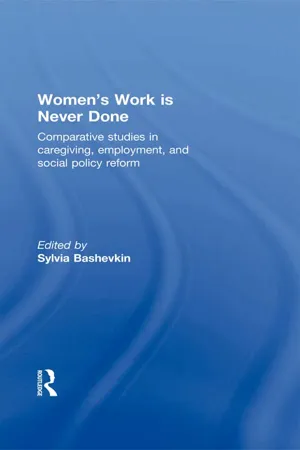
Women's Work is Never Done
Comparative Studies in Care-Giving, Employment, and Social Policy Reform
- 216 pages
- English
- ePUB (mobile friendly)
- Available on iOS & Android
eBook - ePub
Women's Work is Never Done
Comparative Studies in Care-Giving, Employment, and Social Policy Reform
About this book
First published in 2002. Social critics, policy makers, and the public in general frequently overlook the crucial status of women as the main recipients of welfare and as providers of paid and unpaid care. The eight original essays in this collection remedy this situation. By comparing welfare policy in advanced industrial countries and the welfare experiences of different populations of women--black or white, young and old--with that of the male experience, Sylvia Bashevkin and her contributors challenge the Moynihan report; the conservative fatherhood movement; and neoliberal philosophy, politics and practice. Women's Work is Never Done adds a new dimension to the important public discussion of women's status as citizens, disparities in welfare reform, and poverty in a globalized world.
Information
Part I
Conceptual Issues
1.
Normative Concepts in Dutch Policies on Work and Care
Introduction
Since 1995, the Dutch government has been engaged in developing an innovative policy program on work and care. That year, a special advisory committee proposed using a “combination scenario” as the goal for government policies. By acknowledging that caring labor had generally fallen on the shoulders of women, this proposal aimed to promote two forms of balance: first, a balance between men and women in paid work and care; and second, a balance between the use of paid and unpaid care. The combination approach was noteworthy because it moderated the exclusive focus on the integration of women in paid labor that had dominated older equal opportunity policies.
This chapter presents a normative analysis of the Dutch government report on the combination scenario and related policy documents, using the ethic of care as a lens for analysis and evaluation.1 The combination scenario has created space in public policymaking for a more thorough appraisal of care and offers opportunities for developing new forms of policy-making in this field. At the same time, however, a full appraisal of care is hampered by the terms of the distributive policy paradigm that created this space, in which care is overwhelmingly conceptualized as unpaid work. By thinking in terms of a dichotomy between work and care and by positioning care in a separate life sphere, this paradigm not only tends to reproduce the public/private divide, but also overlooks the moral complexities of caring practices and the transformational potential of care as a political concept. It is my contention that a feminist ethic of care can help to bypass these problems, particularly if we conceptualize care as a citizenship concept.
In order to introduce my argument, I first present a normative analysis of some of the main policy documents. What are the goals of the proposed policies? How is care conceptualized in them? What are the leading normative concepts? The conceptual problems associated with the policy framework can then be identified. In the second section, I elaborate on some of the characteristics of care ethics that together provide alternative starting points for thinking about the place of care in the proposed policies. In the third section, I propose a reformulation of the normative concepts for work and care policies.
The Power of the Distributive Paradigm
The conceptual parameters of the current policy discussion were established during the 1980s, when the Dutch government drafted a new plan on emancipation calling for equal opportunity policies.2 The plan maintained that the institutionalization of sexual difference was one of society’s organizing principles, so that women not only systematically confronted barriers in their development, but also were held back in public and private life. According to this report, unequal power relations between men and women were revealed not only in the prevailing division of human labor, but also in the normalization of intimate relations and sexuality. Creating more independence for women could alleviate their dependency on men, so that women would be guaranteed realistic possibilities for free choice.
Following on this problem definition, the 1985 policy plan stated that “every adult must have the opportunity to provide for and take care of themselves.”3 The emancipation policy’s official goal was, then, formulated as follows: “Transforming current society, in which sexual difference is strongly institutionalized, to a pluriform society, where everybody, regardless of sex or civil status, has the possibility of achieving an independent existence, and in which women and men can realize equal rights, opportunities, liberties, and responsibilities.”4 The plan considered sharing the responsibility for domestic labor and the upbringing of children between men and women as important. At the same time, however, domestic arrangements were defined as a private responsibility; according to the report, the state ought to refrain from “prescribing to people how to live their lives.” How the division of labor and care was organized would be determined by “individual choices for the arrangements of one’s existence,” choices that the report’s authors believed government ought to respect.
This conceptual approach was maintained in subsequent years. At the same time, policy makers increasingly acknowledged the claim made by women’s organizations that something needed to be done about the division of work in the home. In 1992, the Dutch coalition government formed by the Social Democrats and Christian Democrats decided to adopt three new so-called lines of action, one of which was the redistribution of unpaid work between men and women, so as to extend men’s caring responsibility. The official policy goal remained, however, untouched. Emphasis continued to be placed on the integration of women in the labor market. A fairer division of household chores was introduced as a precondition for this to be achieved. The next government, a coalition between the Social Democrats and Liberals, retained a labor market approach to emancipation, since it fit with that regime’s view that paid labor was the crucial means of achieving social integration.
The government committee on the division of unpaid work, which began its work in 1994, extended the redistributive approach to care/work.5 Its task was to elaborate four possible future scenarios for the division of unpaid care versus paid work between men and women, and for the ratio of paid to unpaid care-work, and to select the best scenario from among them. The committee employed a macroeconomic approach to the issue of care, using large-scale studies of hours spent on various tasks by the Dutch population in the two preceding decades as its main source of empirical data. The goal was to explore the possible consequences of the four scenarios in terms of different forms of policy, in order to “influence the public and policy agenda.”6
The report selected the so-called combination scenario. In this model, the total volume of paid care would increase until it equaled that of unpaid care. In the sphere of unpaid care, an equal division between men and women would be the goal, with the proviso that they must have the possibility to determine for themselves what they want to emphasize in different stages of their lives.7 The concrete measures proposed by members of the committee, including the legal right to part-time labor, legal regulations for flexible working hours, enhanced child-care facilities, and different forms of caring leave, as well as a further individualization of social security and the fiscal system, all corresponded with their macroeconomic perspective.
This same outlook was revealed in the committee’s view that the two-earner household can best be encouraged by such financial measures as abolishing the tax bonus for breadwinners. The tax bonus abolition argument is based on a neoclassical stimulusresponse model that assumes individuals are mainly motivated by financial considerations in their life choices. Overall, the normative framework of the report can be characterized as a mixture of neoclassical economic assumptions about human nature and social life, with a liberal political framework about the ideal relationship between the state and its citizens. Together, these elements can be said to form the basis of the so-called distributive paradigm.8
In spite of the fact that care was its primary focus, the report translated all aspects of care into the terminology of unpaid and paid work, time spending, citizens’ preferences, and choice. However, throughout the text there appeared elements of an alternative appraisal of care. In its overview of then-current government policies, for example, the committee stated that the growing political attention devoted to caring labor should be seen as “an overture for future policy in which care would have to acquire an independent place, regardless of work.”9 Furthermore, in the concluding chapter, the committee noted that its qualitative judgment about the different scenarios was grounded in a view that the preferred scenario should be in keeping with the “culture concerning the care of children and the aged.” Without further reference or qualification, it proposed that “for reasons of quality of care and upbringing, the Dutch prefer to partially care for themselves.”10
The Search for a Definition of Care
In 1996, the Dutch Emancipation Council recommended to the government a new concept in social security law, to guide future policies. The idea of “care independence,” which resembles the English concept of self-reliance, suggested “that everybody should be responsible and independent in three spheres of life: that of care, that of labor and income, and that of leisure and social life. Women and men can only attain independence in these different spheres when responsibilities are shared in a new way.”11
In this statement, care is once again confined to a separate sphere. Independence remains the hegemonic norm and care is simply tagged onto it. This same approach can also be seen in the normative framework proposed by the Emancipation Council for the life sphere of care: “Care independence and responsibility in the life sphere of care: every adult individual has the opportunity of caring for themselves, for their own life context and for care dependents (those who are not or no longer capable of caring for themselves).”12 Again, “self-care” is taken as the norm. This “self-caring” individual becomes the prototypical representation of the normal citizen in all of the Council’s policy texts. This normative citizen apparently does not need to be cared for by others. Carereceivers are represented as a separate group; they figure as the objects of care by the “care independents.” Independence and selfsufficiency are thus preserved as the core values of emancipated citizenship.
In 1996, the Dutch government also introduced a new white paper to guide future emancipation policies. This document reflected on whether the new policies remained consistent with the official goals of 1985 and their three normative principles: pluriformity, independence, and equal rights. According to the 1996 document, pluriformity accorded with an emphasis on social diversity, but could be at odds with the norm of equality if the latter were treated as equality of results or outcomes. Conversely, if equality were defined as equality of opportunity or starting positions, then it could be combined with pluriformity. Equality, therefore, can best be regarded as a precondition for independence and pluriformity.
Once again, independence figured as the single overarching norm of the 1996 document. This was revealed in the government’s subsequent reaction to critics who claimed that independence was too narrowly confined to economic independence and that “other forms like care independence have been made subservient to this.”13 According to government rebuttals, this one-sidedness can be overcome by adopting a distinction among three life spheres as proposed by the Emancipation Council and by regarding all three as equal in value, each with its own independence norm. The personal life sphere should be guided by care independence, the labor and income sphere by economic independence, and the socio-political sphere by independent judgment and social self-reliance. These ideas also permitted the government to introduce arguments about responsibility in its discourse, which stated that independence and responsibility were unevenly shared between men and women. Women bore greater responsibility for caring, while men viewed their primary responsibility as a financial one.14
In a passage explicitly about care, the white paper employed several different definitions. At one point, it argued that the representation and appraisal of care should be improved for new policies to be successful. This concerned not only the care of children, but also the care of family members and “other relations” so that men would regard it as self-evident that they needed to participate in care. The paper also introduced a broader concept of care, in arguing that notions like equality and independence were usually linked with the individual. Yet individualized ideas should change, since “regarding modern emancipated relationships, society pays more attention to social relations and to the question of mutual care and responsibility.”15 Social responsibility thus stretches beyond the relationships in the nuclear family. It includes voluntary labor and informal care for relatives outside the direct family. The conclusion is that the government will, alongside equality and independence, also pay attention to social responsibility and “care in a wider sense.”16
A subsequent government white paper titled “Towards a New Balance between Work and Care,” published in 1999, opened by stating its preference for a broad and somewhat vaguely defined concept of care:
it is not only the combination of paid labor with caring for the family or others, but also adequate time for one’s own development, education or other social activities. Men and women should have the opportunity of choosing paid labor in combination with other responsibilities, without it leading to an unacceptable work pressure or an over organized existence.17
Once again, an economic vocabulary set the tone of the discussion, since stress and burnout were presented as dangers that justified the proposed policies. Furthermore, care itself was not elaborated upon, since nowhere was the activity of caring actually defined. Just as significant was the white paper’s presentation of care solely from the perspective of the caregivers, the persons with the double load, and caring was confined to looking after family members. The relational perspective on care, as announced in the 1996 document, was not elaborated on. This is not surprising, since by 1999, the government had decided to preserve the individualistic goals of the 1985 emancipation policies, rather than to embrace the more collectivist orientation of earlier initiatives.
Problems with the Distributive Paradigm
The distributive paradigm is permeated with interlocking dualisms, the most conspicuous of which are independence and dependence, caregiving and care-receiving, and public and private. Caring for others is continually perceived as a barrier to independence, while dependence has negative connotations, in that it is perceived as an impediment to independent citizenship. A discursive opposition is thus produced between independ...
Table of contents
- Cover
- Half Title
- Title Page
- Copyright Page
- Contents
- Acknowledgments
- Introduction
- Part I Conceptual Issues
- Part II Confronting Women’s Diversity
- Part III Anglo-American Welfare Reform
- Part IV Policy Alternatives
- Contributors
- Index
Trusted by 375,005 students
Access to over 1.5 million titles for a fair monthly price.
Study more efficiently using our study tools.
Frequently asked questions
Yes, you can cancel anytime from the Subscription tab in your account settings on the Perlego website. Your subscription will stay active until the end of your current billing period. Learn how to cancel your subscription
No, books cannot be downloaded as external files, such as PDFs, for use outside of Perlego. However, you can download books within the Perlego app for offline reading on mobile or tablet. Learn how to download books offline
Perlego offers two plans: Essential and Complete
- Essential is ideal for learners and professionals who enjoy exploring a wide range of subjects. Access the Essential Library with 800,000+ trusted titles and best-sellers across business, personal growth, and the humanities. Includes unlimited reading time and Standard Read Aloud voice.
- Complete: Perfect for advanced learners and researchers needing full, unrestricted access. Unlock 1.5M+ books across hundreds of subjects, including academic and specialized titles. The Complete Plan also includes advanced features like Premium Read Aloud and Research Assistant.
We are an online textbook subscription service, where you can get access to an entire online library for less than the price of a single book per month. With over 1.5 million books across 990+ topics, we’ve got you covered! Learn about our mission
Look out for the read-aloud symbol on your next book to see if you can listen to it. The read-aloud tool reads text aloud for you, highlighting the text as it is being read. You can pause it, speed it up and slow it down. Learn more about Read Aloud
Yes! You can use the Perlego app on both iOS and Android devices to read anytime, anywhere — even offline. Perfect for commutes or when you’re on the go.
Please note we cannot support devices running on iOS 13 and Android 7 or earlier. Learn more about using the app
Please note we cannot support devices running on iOS 13 and Android 7 or earlier. Learn more about using the app
Yes, you can access Women's Work is Never Done by Sylvia Bashevkin in PDF and/or ePUB format, as well as other popular books in Politics & International Relations & Social Policy. We have over 1.5 million books available in our catalogue for you to explore.