- 272 pages
- English
- ePUB (mobile friendly)
- Available on iOS & Android
eBook - ePub
About this book
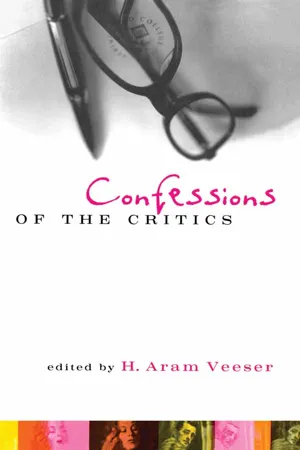
The Confessions of the Critics shatters a certain silence. Autobiographical criticism has until now skated relatively free from the challenges that usually assail a new literary critical method. It has had this immunity from critique largely because feminists and third-world liberation fighters--such as Alice Walker, Adrienne Rich and Jane Gallop--ushered it to the North American academic stage. Other women and men, including Rigoberta Menchu, Nawal al-Sadawi, Mahasweta Devi and Malcolm X, wrote in the tradition and genre of testimonio . These and other unimpeachably militant backgrounds gave confessional criticism a certain cache among the largely liberal community of literary scholars. We have hesitated to express misgivings about a form that seemed intrinsically tied to the most vital, powerful strivings. Telling stories about one's own past is probably our culture's richest way of characterizing the effects of social injustice and developing what it takes to resist various kinds of victimage, writes contributor Charles Altieri. Confessions of the Critics provides a revealing look into the thoughts and experiences of some of the most influential and important critics of the 20th century. The writers included avoid pretention and gross self-misrepresentation, giving way to raw, sometimes embarrassing, always wholly believable emotion. Describing cumulative literary shocks and episodes of self-recognition, contributors offer insights to their ruling passions and works. Powerful sensations, emotions, recognitions and revelations make up the heart of Confessions of the Critics. It is a book that none will put aside or easily forget. Contributors: Charles Altieri, William Andrews, Michael F. Berube, Timothy Brennan, Gillian Brown, Cathy Davidson, Elizabeth Fox-Genovese, Diane Freedman, Marjorie Garber, Gerald Graff, Stephen J. Greenblatt, Michael Hill, Marianne Hirsch, Alice Yeager Kaplan, Amitava Kumar, Candace Lang, Louis Menand, Judith Lowder Newton, Linda Orr, Vincent Pecora, David Simpson, Gayatri Chakravorty Spivak, Madelon Sprengnether, Jane Tompkins, Marianna Torgovnick, H. Aram Veeser, Jeffrey Williams, Elizabeth Young-Bruehl.
Information
I
Is It Okay to Read Subjectively?
1
Autobiographical Literary Criticism as the New Belletrism
Personal Experience

The primary relation most academics have to academic discourse is a sense of duty.—Peter Elbow, “Problematics of Academic Discourse”Personal criticism and the inscription of authorial subjectivity are a means of hijacking discourse by insisting upon a specificity that disrupts the abstractions of the canon. In self-consciously asserting one's location in the text, the personal can disrupt not only the transcendental male critic who privileges his art over his context, but also the subjectivity of the critic herself.—Victoria Howell, reviewing Jane Gallop's Around 1981
Autobiographical literary criticism is a subset of “The New Belletrism” explored in a recent M L A session and in print and of what is here deemed “confessions of the critics.”1 In general, the New Belletrism refers, I think, to the increasing presence of the literary essay of personal meditation in bookstores, book reviews, and the academy—including in cross-disciplinary scholarship and in the writing asked of students as well as what they read. Especially in literature departments, autobiographical criticism may, on the one hand, also go by such names as personal criticism, narrative criticism, autocritography, public criticism, and personalist or experimental critical writing, and on the other, as the personal essay, writings “ on location,” or simply the essay.2 Other contributors to this collection will use additional terms as well to describe both public and academic or quasi-academic versions of the writing in this movement—or moment. “It is engaged,” my co-editor Frances Zauhar wrote in her contribution to our own collection, The Intimate Critique: Autobiographical Literary Criticism. It is accessible, as likely to be published by trade presses as university presses.
Journalist Scott Heller suggests that “the new subjectivity” is a politically and emotionally engaged, often belletristic mode that “freely mixes personal elements with research expertise” (A7). Before settling on “autobiographical criticism” I myself have also previously described it (in An Alchemy of Genres: Cross-Genre Writing by American Feminist Poet-Critics) as cross-genre writing (writing incorporating critical theory, textual exegesis, autobiography, poetry, manifesto), alchemical writing, border-crossing writing, hybrid writing, embodied writing, or a quilt, collage, or patchwork of genres—all metaphors invoked or suggested in the examples of hybrid writing on which I focused in that book: Gloria Anzaldúa's Borderlands/La Frontera, Cherrýe Moraga's Loving in the War Years, Adrienne Rich's “Split at the Root: An Essay in Jewish Identity,” Alice Walker's “In Search of Our Mothers' Gardens,” Susan Griffin's Made from this Earth, Marge Piercy's Parti-Colored Blocks for a Quilt, Tess Gallagher's A Concert of Tenses, Jane Gallop's Thinking Through the Body, Maxine Hong Kingston's The Woman Warrior and China Men, Nancy Mairs's Remembering the Bone House, Jane Tompkins's “Me and M y Shadow,” and others. Together, these kinds of texts represent a paradigm shift in academic writing, a shift that, although (as I'll explain in a moment) it has roots in a range of discursive traditions, may be said to have begun in earnest in the late 1980s.
A short list of other belletristic scholars in fields outside literature might include Anthony Appiah (philosophy/Africana Studies), Ruth Behar (anthropology), Norma Field (Asian studies), Eunice Lipton (art history), Sara Ruddick (philosophy), Patricia Williams (law), and Carolyn Steedman (sociology/psychoanalysis). Fuller bibliographies of autobiographical literary critics and autobiographical scholars across the disciplines may be found in The Intimate Critique and in Nexus, respectively, and the work of some important practitioners is well represented in this volume.
Liberty Bell-etrism
Ann Rosalind Jones has pointed out the “phonocentric emphasis” of much of the writing associated with the feminist movement (think of Gilligan's In a Different Voice, and Frey's “Beyond Critical Darwinism: Women's Voices and Critical Discourse”), something I find resounding in the New Belletrism. I had considered for my “New Belletrism” talk many different terms and tropes for the personal criticism I read and write and was intrigued by the genre-naming that Jane Tompkins, Marianna Torgovnick, Alice Kaplan, and Cathy Davidson attempt in their interview reprinted in this volume.3 I returned to some of the terms that, as I have mentioned, I had previously adopted: cross-genre writing (ungainly), autobiographical criticism (not evocative of the full range of genres used or of disciplines whose term for academic work is not “criticism”), and alchemical writing (because of its association with change, and even because of its association with the failure to transmute base metal to gold. I was interested in evoking the idea of process, not product).
Each time I began to write about the New Belletrism, I kept thinking of the Liberty Bell.
The Liberty Bell embodies its (supposedly failed) process; its makers were unable to meld several metals into a stable amalgam. Hung i n 1753, “it was inscribed ‘Proclaim Liberty throughout the Land unto all the inhabitants Thereof’ (Lev. 25.10) [and] it was rung in July, 1776 to Proclaim the Declaration of Independence It was cracked i n 1835 and again in 1846 and it now rests on its original timbers as an exhibit” instead of being hung and rung (Columbia Encyclopedia). Comprised of three different metals—silver, copper, gold?—its amalgam didn't hold. Nor should it have—the melting pot metaphor that was earlier a supposed American ideal was flawed. It is appropriate that the bell of freedom and independence at once holds together as symbol and yet symbolizes the limits of assimilation, of holding together (as our nation failed to hold itself together in the late 1800s). In fact, the bell probably “functions” better as a relic accessible for ready view than as something lifted high and away, functions better as a reminder of the several peoples and cultures that make up our United States than as a permanently harmonious blend.
In the Duke group interview, Jane Tompkins goes on to say that she wants a term for personal writing “permitting fragmentation, or permitting lots of different selves, or different aspects of the self.” A l l of which makes me want to say that the new belletrism is somehow deeply U.S. American (though practiced elsewhere, of course—most especially in Great Britain, France, and Canada, and by U.S. Latino/as, at the moment).
Multiple Origins
The kind of writing I'm excited to hear about these days produces liberatory feelings and audible music while retaining visual evidence of its multiple and conflicted origins. In fact, Philip Lopate, in his new, nearly eight-hun-dred-page collection, The Art of the Personal Essay, speaks of multiculturalism as one reason for the turn toward the personal. Given “the growing awareness that the United States is a pluralistic, multicultural society,” he writes,
and that we need to listen carefully to the intellectual voices of minorities and immigrants The personal essay turns out to be one of the most useful instruments with which outsiders can reach the dominant culture quickly and forcefully and testify to the precise ambiguities of their situation as individuals and group members. It can also be, as Adrienne Rich's essay shows, a vehicle to analyze how often we are “split at the root” when it comes to our chosen and inherited identities, (li)
In An Alchemy of Genres, I also argued for the efficacy of the hybrid essay for creative writers split at the root or in the “shadows” personally and professionally— Rich, Anzaldúa, Moraga, Kingston, Audre Lorde. I would add Carol Taylor, a scholar of folklore, who finds herself “standing in the shadows” of institutional “plantations” (”Dividing Fences”); lawyer Patricia Williams, who writes in her book The Alchemy of Race and Rights that she slipped “ i n and out of shadow, as [she] became nonblack for purposes of inclusion and black for purposes of exclusion”; and anthropologist Ruth Behar, who was “non-Latina for purposes of inclusion and Latina for purposes of exclusion” and then the reverse (at the hands of her institution).
Autobiographical literary criticism, the most common and widely published form of autobiographical criticism, owes something, in addition, to the increasing presence of poets in the academy, the proliferation of creativewriting programs, and the historically hybrid nature of poets' prose and of English departments housing poets and novelists along with composition teachers, journalists, textual critics, and literary and cultural theorists. Autobiographical criticism shares, for example, composition theory's emphasis on writing as process, not product; reader-response theory's attention to the reactions of readers; and some French theorists' penchant for “crossing over genre lines, cross-pollinating autobiography, fiction and theory, and challenging traditional dividing lines between subject and object, self and others” (Flieger, 265). Autobiographical criticism may also be indebted to such first-person political-aesthetic (and oral) traditions as the Latin American testimonio and the African-American slave narrative. Perhaps China and Japan, two cultures with a strong tradition of “I” writing, as Lopate reminds us, will be the next prodigious producers of and influences upon autobiographical criticism.
The “I” implicated here is very precise, yet more than half unspeakable. Its descriptors are not mere political trading chips. They are vectors, interlocked with energy, joy, imbalance, determination, depression—themselves not free-floating emotions, but situated and socially formed.—Rachel Blau DuPlessis, “Reader, I Married Me: A Polygynous Memoir”
My location or situation as a poet, long before I ever became a critic, and as a woman writer of mixed religious and class identity, mixed up about faith, makes me, I think, privilege belletristic writing, the self-consciously meditative and musical essay, and books and essays by persons with (and whose subject is) hybrid genealogies and social histories. In my writing, editing, and teaching, I lean towards autobiographical criticism that depicts what An Alchemy of Genres and the texts studied therein did—an “identity [that] oscillates among sometimes fogged-in points of reference, multiple angles of vision—and confusion” (Alchemyy 33).
Marianna Torgovnick, in “Experimental Critical Writing,” insists that the critic must work as “a writer, not just a critic When writers want to be read they have to be more flexible and take more chances than the standard scholarly style allows: often, they have to be more direct and more personal.” To her, “writerly writing is personal writing, whether or not it is autobiographical. Even if it offers no facts from the writer's life, or offers just a hint of them here or there, it make the reader know some things about the writer— a fundamental condition, it seems to me, in any real act of communication. … “ (26–27). Surveying some early attempts at the genre while making a case for “essayistic” writing, Douglas Atkins makes clear that in personal criticism, if “the text is not… illuminated for another reader, the resultant writing surely doesn't deserve to be called literary criticism” (97). He continues, “if, on the other hand, the experiencing, responding critic is not interestingly and effectively represented, I don't know why anyone else would want to read h im or her or should be expected to do so.” So, the writer has vectors needing voice(s), and the criticism has vectors needing inclusion (literariness, illumination of literature and culture, illumination of the textual and critical personalities involved. A gyrating X marks the spot.)
Further, most autobiographical criticism, I would argue, is personal in tone (though it needn't be), self-disclosing (though it needn't be), emotional, full of concrete particulars, but it is also theoretically and historically engaged, confronting many of the reigning academic and social debates and problems today (social constructionism, essentialism, identity politics, social construction of gender, alcoholism, child abuse, pornography, sexism, classism, racial discrimination). “This balancing act—to speak from the place of personal experience and to scrutinize the assumptions of the universality of that experience— has produced a particularly persistent tension within the feminism of the past two decades,” writes Bonnie Zimmerman (”In Academia and Out: The Experience of a Lesbian Feminist Literary Critic,” 116). Beyond literature departments, scholars in one discipline after another are taking a fresh approach to their subject matter and writing style as well as to their readers. As frequently unacknowledged connections between a critics's life experiences and his or her research assumptions, methodologies, and conclusions are revealed, academic prose begins to seem more intimate and honest, more inviting—and also more literary. It has become more accessible and exciting to the general public and to general-education students.
Informing Traditions
Although autobiographical criticism represents a radical shift in academic writing, its variants owe something to the essay tradition, with its writerly freedom, and much to the second-wave feminist tenet that the personal is the political; to a female psychology that allegedly favors “connected” over “separate” knowing (Gilligan; Belenky et al.), and to a feminist epistemology that sees social location (the nexus of one's racial, religious, gender, class, geographic, sexual, familial, and institutional histories) as necessarily implicated (and thus needing to be articulated) in one's research (Rich, “Notes Towards a Politics of Location”; Harding). As Leslie Rabine reminds us (quoting Gayle Greene and Coppelia Kahn's assumption for their coedited volume, Changing Subjects), ”a major strength of feminist scholarship is the vital connection between lived experience and theory” (211). The New Belletrism is not a passe throwback, however: although “the 'authority of experience' was basic to feminist inquiry from the start, most academic feminists have also used a depersonalized, academic style, ...
Table of contents
- Cover
- Half Title
- Title Page
- Copyright Page
- Table of Contents
- Acknowledgments
- Introduction: The Case for Confessional Criticism
- I. Is It Okay to Read Subjectively?
- II. How Can a Critic Create a Self?
- III. Just Do It!
- Contributors
Trusted by 375,005 students
Access to over 1.5 million titles for a fair monthly price.
Study more efficiently using our study tools.
Frequently asked questions
Yes, you can cancel anytime from the Subscription tab in your account settings on the Perlego website. Your subscription will stay active until the end of your current billing period. Learn how to cancel your subscription
No, books cannot be downloaded as external files, such as PDFs, for use outside of Perlego. However, you can download books within the Perlego app for offline reading on mobile or tablet. Learn how to download books offline
Perlego offers two plans: Essential and Complete
- Essential is ideal for learners and professionals who enjoy exploring a wide range of subjects. Access the Essential Library with 800,000+ trusted titles and best-sellers across business, personal growth, and the humanities. Includes unlimited reading time and Standard Read Aloud voice.
- Complete: Perfect for advanced learners and researchers needing full, unrestricted access. Unlock 1.5M+ books across hundreds of subjects, including academic and specialized titles. The Complete Plan also includes advanced features like Premium Read Aloud and Research Assistant.
We are an online textbook subscription service, where you can get access to an entire online library for less than the price of a single book per month. With over 1.5 million books across 990+ topics, we’ve got you covered! Learn about our mission
Look out for the read-aloud symbol on your next book to see if you can listen to it. The read-aloud tool reads text aloud for you, highlighting the text as it is being read. You can pause it, speed it up and slow it down. Learn more about Read Aloud
Yes! You can use the Perlego app on both iOS and Android devices to read anytime, anywhere — even offline. Perfect for commutes or when you’re on the go.
Please note we cannot support devices running on iOS 13 and Android 7 or earlier. Learn more about using the app
Please note we cannot support devices running on iOS 13 and Android 7 or earlier. Learn more about using the app
Yes, you can access Confessions of the Critics by H. Aram Veeser in PDF and/or ePUB format, as well as other popular books in Literature & Social Science Biographies. We have over 1.5 million books available in our catalogue for you to explore.