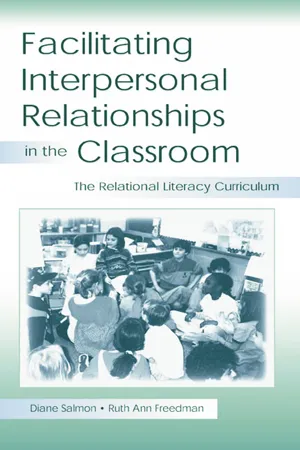
This volume is a guide to using the Relational Literacy Curriculum with children in grades 2-5. Based on developmental and social constructivist principles, this curriculum presents a conceptual framework and a method for enhancing children's understanding of interpersonal relationships in the classroom. The Relational Literacy Curriculum:
*offers a powerful method for children to reflect on challenging interpersonal episodes and to discern constructive patterns of relating through discussion and role play;
*provides a process that can serve as both a prevention tool and a vehicle for managing immediate conflict;
*gives teachers a strong theoretical framework from which they can make principled decisions, and a flexible format for implementing it that they can adapt to meet the particular social needs of their classroom context; and
*promotes teacher reflection and learning through the use of various observational tools.
This book addresses the question of why it is important to study relationships in the elementary classroom; reviews the research and literature that inform the relational literacy curriculum; lays out the process of the curriculum; explains how the curriculum can be used to address real conflicts within the classroom community; and provides guiding principles for practice. It is a useful resource for classroom teachers, school psychologists, school counselors and social workers, and a valuable text for a range of courses, including classroom management, psycho-social interventions, child development, and early childhood education.
eBook - ePub
Facilitating interpersonal Relationships in the Classroom
The Relational Literacy Curriculum
- 200 pages
- English
- ePUB (mobile friendly)
- Available on iOS & Android
eBook - ePub
Facilitating interpersonal Relationships in the Classroom
The Relational Literacy Curriculum
About this book
Information
Topic
EducationSubtopic
Early Childhood Education1
Relationships:
Why Study Them in the
Elementary Classroom?
MARK’S STORY: ONE CHILD’S SOCIAL CONFLICT
Mark is having trouble with one of his friends. Mark is confused. He doesn’t know what to do. He steals all of Mark’s food at lunch, and by the time Mark gets it back there is hardly enough time for Mark to eat his lunch. He even gets Mark’s other friends to go along with him, except Don. Telling him to lay off and quit picking on Mark doesn’t work. He is pushing Mark to the limit. Mark has reasoned with him, talked to him, and now he even punched Mark in the chest very hard six or seven times. Now Mark wants to get revenge on his friend. Mark wants his friend to be transferred to another class. Mark wants to hurt his friend’s feelings the same way, as Mark’s feelings have been hurt. (Child-authored story of class episode)
Mark’s mother, Jackie, a working parent, arrives in her son’s classroom just before school begins, feeling an important need to share the story of her son’s difficult experience in school the previous day. In Mark’s second-third-grade classroom, where peer relationships and social interactions are valued, such parent-teacher occurrences are not unusual. Conversations like this occur on a daily or weekly basis with concerned parents. Mark’s teacher understands and values the idea that schooling is a partnership between home and the larger school community. In this particular instance, it is clear to the teacher from observing the mother’s demeanor and expression that as a parent she is particularly troubled by the interactions that have occurred between her son and the other boys. Jackie has been attempting to provide support at home for her son to help him resolve this dilemma. She has spoken with her son, supported his feelings and tried to follow the normal guidelines.
Mark is a third-grade boy with healthy, normal, fluid relationships within his multi-age classroom. He is a child who is well-liked by his peers and interacts socially and academically with a wide range of other children. Over the two-year period Mark has been a student in this same classroom, this is the first social issue about which his mother has come to speak with the teacher. As an involved and committed parent, she is appropriately concerned because her son has been bothered by this set of particularly troubling social interactions within the classroom community for a week and she can no longer provide answers for him. These relational issues have evolved into a very complex dynamic and Mark is now unmotivated to come to school and appears not to be able to focus on academic tasks. Mark’s emotional response about his social relationships have become so acute that it is all he can focus on when he discusses school with his mother. Mark’s mother is seeking advice and guidance from the teacher about this dilemma. Jackie is aware that in the classroom relational issues are valued in the same manner academic issues are. She needs support for her child and believes the classroom teacher possesses an expertise to facilitate solutions for this issue. Jackie arrives at school on this particular day ready to collaborate with the teacher to resolve this problem.
Although Mark’s mother has been effective in supporting and mediating other social conflicts, this problem has reached a level of complexity that demands more. It demands a process that includes all the involved children in a constructive way. A process that doesn’t seek to punish, but instead offers opportunities for learning. A process that doesn’t focus on blaming, but instead invites reflection on personality characteristics and their implications for relating. A process that doesn’t give children the right answer, but instead encourages them to construct their own language and build a framework for organizing their actions and reactions within complex dynamic social events. As is the typical procedure in this classroom when complex social conflicts arise, the teacher suggests that Mark and his mother co-construct a story about the problem he is experiencing. Jackie feels good about the fact that the classroom problem-solving process will be utilized to work through her son’s problem, and leaves prepared to facilitate the writing of a story with her son.
Mark returns to school the following day with his carefully written story ready to present it to the other boys involved in the conflict. He is feeling better about returning to school because he knows a process to resolve the social conflict is underway.
The Relational Literacy Curriculum (RLC), a curriculum that addresses conflict through discussion and role play, is this process. In taking this approach, the teacher has given control of the situation to Mark and the other students and thus Mark feels more secure about the outcome. The teacher has not solved the problem for Mark or the other children, but rather provided a forum for the problem to be explored. Even the students in the class are aware of the process available in the classroom to resolve this conflict.
| Teacher: | Mark came to me on Monday with a big problem. So who thinks that they know what I might have done and said to Mark. |
| Child: | Get us and tell us to come at 1:30 p.m. today. |
| Teacher: | And what did he do? |
| Child: | He wrote a story. |
Mark invites all of the children he feels are directly and indirectly involved in the story to work through the social problem-solving discussion process. In sharing his story, Mark states that “he steals all of Mark’s food and even gets others to go along.” In the problem-solving discussion that ensues, the boys work through the dilemma by exploring the nature of the problem, who is involved, why they think it is happening, and how they will resolve it.
| Teacher: | What’s the problem? |
| Child: | That somebody is hurting Mark. |
| Child: | Very badly. |
| Teacher: | Okay, Mark is being hurt. Is he being hurt both physically and emotionally? |
| Child: | Yes. |
| Teacher: | Okay, you know the difference between those, right? |
| Children: | Yes. |
| Teacher: | Is it equally valid to be hurt? Is it equally painful to be physically hit as being emotionally hurt? |
| Children: | Yes. |
| Child: | Depends on which one, you could get like, matters how bad. |
| Child: | Well, it depends on which one is worse, you could get like really bad hurt feelings like Mark. |
| Child: | Or paralyzed legs or something. |
As the children examine the story through discussion, they simultaneously explore some important issues about human experience and the nature of relationships. In this exploration, they gain mental and emotional distance from the episode in which they were involved, which may free them to see new avenues for action. Through constructive group dialogue on social issues, a greater sense of community is also fostered. The dialogue provides an opportunity for the group to evolve a shared language for referencing relational dynamics.
A central goal of this volume is to share the curriculum process that we have used to aid children’s understanding of social relationships and relational tensions. Mark and his peers in the incident described previously would not have been as prepared to explore their real dilemma had they not been participating in an ongoing curriculum involving the exploration of hypothetical problems. Through this curriculum, the children create shared resources to aid their development of relationships within the classroom community. In sharing our curriculum process, we also describe the nature of these resources that include not only individual knowledge and skills, but also the less tangible language processes involved in creating classroom cultures. We turn now to hear the teacher’s side of the story.
A TEACHER’S STORY: ONE TEACHER’S RESPONSE TO SOCIAL CONFLICT
All elementary classroom teachers to some extent engage in conversations such as the one with Mark’s mother and the small group of boys. Through the appearance of real, concrete and difficult social conflicts within classrooms, teachers are requested by children and parents to meet the social-emotional needs of children and to facilitate and mediate social-peer relationships within our classroom communities. The social conflicts are presented in such a manner that teachers, who genuinely care about children, cannot avoid them. They are usually presented at the crisis point, when teachers must provide some assistance for resolving the issue. The reality of classroom life, more than 20 young children residing in a small classroom, requires this assistance. The immediate needs of the children in classrooms demand that teachers mediate relationships in some way or another.
Ruth, Mark’s teacher, responded to the dilemma that Mark and his mother presented by using a curricular tool designed to help children learn through and resolve their own social problems. In the past, Ruth may have felt pressured to find a quick fix to the dilemma, to smooth over the issues between the boys, and get back to the business of teaching and learning. Instead, she viewed the incident as an opportunity to learn like many others within her classroom, only instead of math, science, or reading, this one involved the domain of human relationships. In spending time on this as she did, Ruth validated the importance of the children’s experiences with their peers and helped them to learn from them.
Ruth holds high expectations for all her students. She believes that each has his or her own strengths and areas of expertise, and strives to support and validate these within the classroom. In particular, she believes that each child brings a wealth of experience with social relationships and that they are capable of offering important insights into relating through well-structured questioning and discussion. In the following dialogue excerpt, the boys continue their discussion of Mark’s story by exploring why the problem has been happening.
| Teacher: | Okay, I think it is important though for Joe to put that one on here, which is ‘Joe is encouraged to do this to Mark.’ |
| Child: | But that doesn’t mean he should do it. |
| Joe: | It is hard, I don’t want to get in a, I don’t want my friends to, if I don’t do it my friends are going to be like, “Oh you wimp or some.” I’m afraid. |
| Teacher: | Does anyone know what that is called? |
| Child: | Are you saying that? |
| Teacher: | Does anyone know what that is called? |
| Child: | That has happened to me. |
| Child: | Well people have told me when he goes that way, you go get this. And when, if I say no, they will say, like you little wimp, I’m not going to be friends with you anymore. |
| Teacher: | Okay, does anybody know what that is called when your friends— |
| Child: | It is kind of like pushing them, like … |
| Teacher: | Pushing. |
| Child: | Like sitting in your … like cigarette pushers. You know. They think it is not addictive but you can stop when you want to. |
In this interaction, we see Ruth validating a child’s explanation and eliciting others’ thoughts on it. The teacher here assumes that children bring a level of expertise in relating, upon which she can draw and help them to make new connections. This conversation becomes an occasion to scaffold the...
Table of contents
- Cover
- Half Title
- Title Page
- Copyright Page
- Dedication
- Table of Contents
- Preface
- List of Tables
- List of Figures
- 1 Relationships: Why Study Them in the Elementary Classroom?
- 2 A Conceptual Framework for the Relational Literacy Curriculum
- 3 The Relational Literacy Curriculum Discussion Process: Exploring How It Works
- 4 Role Playing in the Relational Literacy CurriculumChristopher J. Fogartaigh
- 5 Shifting Responsibility Within the Relational Literacy Curriculum: Making Conceptual Connections
- 6 Working With Children’s Real Conflicts
- 7 Making It Your Own: Professional Development and the Relational Literacy Curriculum
- References
- Table of Contents for Appendixes
- Appendix A:—Timeline
- Appendix B:—The Discussion Process
- Appendix C:—The Role Play Process
- Appendix D:—Reflections and Connections
- Appendix E:—Real Conflict
- Author Index
- Subject Index
Trusted by 375,005 students
Access to over 1.5 million titles for a fair monthly price.
Study more efficiently using our study tools.
Frequently asked questions
Yes, you can cancel anytime from the Subscription tab in your account settings on the Perlego website. Your subscription will stay active until the end of your current billing period. Learn how to cancel your subscription
No, books cannot be downloaded as external files, such as PDFs, for use outside of Perlego. However, you can download books within the Perlego app for offline reading on mobile or tablet. Learn how to download books offline
Perlego offers two plans: Essential and Complete
- Essential is ideal for learners and professionals who enjoy exploring a wide range of subjects. Access the Essential Library with 800,000+ trusted titles and best-sellers across business, personal growth, and the humanities. Includes unlimited reading time and Standard Read Aloud voice.
- Complete: Perfect for advanced learners and researchers needing full, unrestricted access. Unlock 1.5M+ books across hundreds of subjects, including academic and specialized titles. The Complete Plan also includes advanced features like Premium Read Aloud and Research Assistant.
We are an online textbook subscription service, where you can get access to an entire online library for less than the price of a single book per month. With over 1.5 million books across 990+ topics, we’ve got you covered! Learn about our mission
Look out for the read-aloud symbol on your next book to see if you can listen to it. The read-aloud tool reads text aloud for you, highlighting the text as it is being read. You can pause it, speed it up and slow it down. Learn more about Read Aloud
Yes! You can use the Perlego app on both iOS and Android devices to read anytime, anywhere — even offline. Perfect for commutes or when you’re on the go.
Please note we cannot support devices running on iOS 13 and Android 7 or earlier. Learn more about using the app
Please note we cannot support devices running on iOS 13 and Android 7 or earlier. Learn more about using the app
Yes, you can access Facilitating interpersonal Relationships in the Classroom by Diane Salmon,Ruth Ann Freedman in PDF and/or ePUB format, as well as other popular books in Education & Early Childhood Education. We have over 1.5 million books available in our catalogue for you to explore.