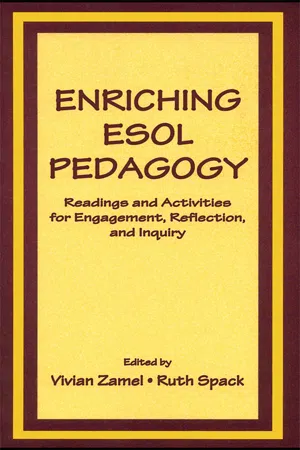
Enriching ESOL Pedagogy: Readings and Activities for Engagement, Reflection, and Inquiry is a collection of thought-provoking articles and activities designed to engage practicing and prospective ESOL teachers in an ongoing process of reflecting on, critically examining, and investigating theory and practice. Its twofold purpose is to provide a theoretical perspective and to offer ways for making the teaching of English to speakers of other languages (ESOL) meaningful for both teachers and learners. Underlying the activities and the readings themselves is the assumption that teachers need to play a role in exploring, shaping, and theorizing the work they do.
The readings included represent a range of genres. They are informed by a common philosophical perspective about language acquisition and treat language teaching and learning holistically. The book is organized into five integrated units that:
* raise questions about conventional notions of methods;
* take into account the complicated nature of real classrooms;
* provide theoretical principles for teaching that promotes language acquisition;
* include rich descriptions of actual classroom experiences; and
* question assumptions about language and literacy.
Each set of readings begin with a "Before Reading" section and is followed by "Reflecting on the Readings," "Reading for Further Reflection," and "Suggested Projects for Inquiry" sections.
This volume is a valuable resource for practicing and prospective teachers in the field of TESOL who work with diverse student populations--at all levels--in both mainstream and ESL/bilingual settings.
eBook - ePub
Enriching Esol Pedagogy
Readings and Activities for Engagement, Reflection, and Inquiry
- 472 pages
- English
- ePUB (mobile friendly)
- Available on iOS & Android
eBook - ePub
Enriching Esol Pedagogy
Readings and Activities for Engagement, Reflection, and Inquiry
About this book
Information
Topic
EducationSubtopic
Education GeneralUnit II: SEEING THE CLASSROOM
BEFORE READING
Respond to one or more of the following:
- If you have ever been observed and evaluated as a learner or teacher (for example while making a presentation or teaching), what was the experience like? What kind of feedback did you receive? How did it make you feel? What did you learn from it?
- If you have ever observed a classroom, what process did you use? How did you prepare for the observation, what did you do in the classroom itself, and what did you do with the information you gathered in your observation? What did you learn from it?
- From your perspective as a learner or teacher, describe a classroom experience in which the teacher either failed to recognize a student’s potential, intelligence, or talent or misinterpreted a student’s behavior or performance.
Chapter 5: “Let’s See”: Contrasting Conversations About Teaching
John F.Fanselow
Two common aims of supervision and observation are to evaluate and to help. Supervisors and observers with these aims provide products to those they visit: “helpful” prescriptions for improvement or a rating of the observed performances. The aims of supervision and observation presented in this article are to explore, to see teaching differently, not to evaluate or help; the emphasis is on a process—visited and visiting teachers sharing ways of looking to discover self. This process includes taping and transcribing excerpts from classes, grouping parts of the excerpts, arriving at a common language to discuss them, and making multiple interpretations about them, based not only on preconceived notions but also on a range of contrasting beliefs and goals. In short, this article tries to provide ways of looking so each of us can see our own teaching differently through observing others, reminding us all that we “are capable of acting on the world, and that these actions can transform the world” (Mehan, 1979, p. 207).
AIMS OF SUPERVISION AND OBSERVATION
When I used to ask teachers to write down comments they recalled from conversations with supervisors or fellow teachers who had visited their classes or had watched videotapes of their teaching, the comments and exchanges between different supervisors/observing teachers and the observed teachers seemed very different from each other. Others have found this too. Gebhard (1984), in a review of different models of supervision— different ways of making comments or of having conversations about lessons between supervisors and teachers—uses these labels: directive, alternative, collaborative, nondirective, creative.
Although the conversations I asked teachers to recall often indicated an overall tendency to be, say, more collaborative than directive, or more directive than nondirective, I consistently saw elements of many distinct models in the same sets of comments or conversations. I also began to notice that all the distinct models had the same aim: to provide a means for a more experienced person to help or evaluate a less experienced person. Two articles on supervision in second language teaching use the following words and phrases to characterize the purposes of the supervision models they describe: functions as an arbitrator, commenting, evaluating, helping, provides (Freeman, 1982, p. 21); to direct or guide, to offer suggestions, to model teaching, to advise teachers, to evaluate (Gebhard, 1984, p. 501). All of these words indicate that the person doing the visiting, no matter whether that person is following a collaborative model, creative model, or any other, is there mainly to help or evaluate the practice teacher, fellow teacher, or inservice teacher in training.
On first thinking about it, what could be more reasonable than designing models of supervision that provide ways for experienced people to help or evaluate inexperienced people? But thinking about the idea of help in other contexts provides a different perspective. Haven’t you heard children shout to parents or teachers words like “Let me do it—don’t show me,” or “Don’t give me the answer”? When referring to the need of children to be allowed to do things on their own, Montessori (1967, p. 309) made the plea, Let them fill their own buckets. As Alinsky (1971) reminded us:
It is a human characteristic that someone who asks for help and gets it reacts not only with gratitude but with a subconscious hostility toward the one who helped him. It is a sort of psychic “original sin” because he feels that the one who helped him is always aware that if it hadn’t been for his help, he would still be a defeated nothing. (p. 93)
The type of resentment Alinsky mentions is not necessarily universal. Some people seem to like to be helped and expect to be told what to do as well. For them, evaluations containing prescriptions of what to do are welcome. In discussing the appropriateness of different models for teachers at various stages, Freeman (1982) highlights the value of help and evaluation by pointing out that beginning teachers, for example, seem to prefer models and direction to collaboration. But even while pleading for help from the cooperating teacher or supervisor, many practice teachers assert, “The most valuable part of practice teaching was seeing other teachers teach!” Seeing other teachers teach is not the same as being told what to do by an evaluator, nor is it being helped by someone.
As a result of this keen interest that practice teachers and many inservice teachers have in seeing others teach, my fear that helping people can lead to resentment toward the one providing the help, and the fact that prescriptions from supervisor’s evaluations can be demeaning and decrease the teacher’s authority and responsibility, I see the need for an aim of supervision and observation different from the ones frequently practiced and described in the literature. Whereas the usual aim of observation and supervision is to help or evaluate the person being seen, the aim I propose is self-exploration—seeing one’s own teaching differently. Observing others or ourselves to see teaching differently is not the same as being told what to do by others. Observing to explore is a process; observing to help or to evaluate is providing a product.
Besides leading to resentment, help can also lead to “learned helplessness” (Abramson, Seligman, & Teasdale, 1978). Helpful prescriptions can stop exploration, since the receiver, as someone in an inferior position being given orders by someone in a superior position, may easily develop the “ours is not to wonder why” syndrome.
A conversation reflecting the aims of the usual models might go like this: “Here I am with my lens to look at you and your actions and tell you or discover with you what is right and what is wrong and needs to be improved; I will then prescribe better activities or collaborate so we or you alone can discover better activities.” A conversation reflecting the aim of observation I am suggesting might go like this: “Here I am with my lens to look at you and your actions. But as I look at you with my lens, I consider you a mirror, I hope to see myself in you and through your teaching. When I see myself, I find it hard to get distance from my teaching. I hear my voice, I see my face and clothes and fail to see my teaching. Seeing you allows me to see myself differently and to explore variables we both use.” Although supervisors may consider their roles so set that empowering teachers to make decisions seems impossible, such redefinition is possible in any field. The role of managers in relationship to workers, for example, is presently undergoing change in many companies.
Although observing others does not automatically lead to seeing oneself differently, mainly because the aim of seeing others to help them is so usual, over time an increase occurs in comments like these: “That teacher said ‘Ok, now’ to mark changes in activity just as I do”; “How little each of us walks around”; “That teacher spoke to students at eye level some of the time; I do so only during breaks.”
The model I am describing grows out of a range of sources, not only my examination of many transcripts of teacher-supervisor conferences. For example, Jarvis (1972) argued that in order for teacher preparation programs to be truly responsive, they need to shift “the responsibility for the decision-making to the classroom teacher…. It is perhaps time to train the teacher to analyze his situation and make his own decision for his situation”. As Freire (1970) points out, learning “consists of acts of cognition, not transferrals of information”. Each of us needs to construct, reconstruct, and revise our own teaching. He reminds us that for learning to take place we need to resolve the “teacher-student contradiction”.
When we observe others to gain self-knowledge and self-insight and when we generate our own alternatives based on what we see others do, we construct our own knowledge and engage in the type of learning Freire has advocated. In a discussion of education, Abbs (1986) has this to say: “Authentic education is to be found in that act of intelligent exploration …the first priority of teachers should be to secure the necessary condition for the autonomy of teaching and for the freedom to learn”. Using the word supervisor —a person with super vision—hardly supports our autonomy. When I observe and when I invite others to observe me, I refer to all of us as visiting teachers to avoid the use of the word supervisor.
PRACTICES
I and others have used various combinations of the following practices in pre- and inservice MA and adult education programs. Anyone genuinely interested in exploring, in seeing teaching differently, and anyone who believes that we can learn about our own teaching by seeing others can use the practices.
In my experience, trying to observe and supervise with the aim of exploring practices and of gaining insight into one’s own teaching does not in itself enable us to stop treating observation and supervision as a means of helping and evaluating others. For people to begin to learn that they can see their own teaching differently by observing others, I and others have found the following practices for collecting, describing, and interpreting observations useful:
- Short amounts of time have to be set aside for observation and discussion.
- Segments from observed lessons need to be collected by note taking, taping, or transcribing.
- The exchanges and activities in the segments need to be grouped in a range of ways.
- Finally, what was done, as reflected in notes, tapes, and transcripts, needs to be related to notions, beliefs, and goals. Coupling this data collection and analysis with discussions of freedom and the need for each of us to construct our own knowledge helps many visiting teachers to decrease their suggestions to others, to increase their descriptive and analytical comments about the lessons observed, and to relate their insights to their own lessons.
Although allowing time for discussions of observations as part of a teacher’s load is a policy I advocate, this policy is rare. Even in teacher preparation programs, there are not always long periods of time for discussions. Rather than putting off observations and discussions until sufficient time is available, thereby virtually ensuring that they will never take place, I recommend limiting observations and discussions to as little as 5 minutes.
Obviously, seeing 5 minutes of a lesson prevents us from seeing lesson development. But look how much we notice in 1-minute commercials. In many classes, 30 questions are asked in a minute (Hoetker, 1968). A dozen instances of feedback—both the treatment of errors and communications made after acceptable student moves—can be seen in a minute as well (Fanselow, 1977). In a 30-minute period, hundreds of communications are made, each in split seconds (Jackson, 1968).
Though short segments provide much data, short discussions force a limit to the number of communications that can be considered and the number of alternatives that can be generated. Since one or two communications often affect what is done and since many of our communications are unconscious, we can only hope to see and later try out one or two alternative communications per class period. Short time segments do not of themselves lead to fewer evaluative or helping comments or more exploration, however, and that is why the following activities are used.
Collecting and Describing Data
Transcribing and Note Taking. The first step in our observations, no matter how long, is to capture as many of the specific communications as possible by audioor videotaping, by taking notes, and by drawing sketches or even taking photographs as communications are observed. Later, tapes can be transcribed to reveal details missed in notes and sketches.
Observers can take notes, sketch, and transcribe as they wish. Many put exchanges in dialogue form in their notes. But now and then, one will put teacher communications in the left-hand column of a page and student communications in the right-hand column to highlight them. Many write one line and pause, forgetting that the purpose of looking is to collect data, not to judge the teacher or think of ways to help the teacher. Some prefer sketches to notes, noting the position of teachers and students, their location, or expressions on faces of teacher or students. Others note what is done rather than what is said—movements, objects used, writing on the board.
Except for the instruction that observers are to write down only what happens, not comments about what happens, no directions are given about what observers are to note. Different observers often note different communications, reflecting differences in the values of the observers. Some observers write down things they are interested in seeing in their own classes that they cannot see while they are teaching. Though two observers are likely to capture some of the same spoken exchanges, they are not likely to have the same account of how the exchanges were said or what other communications were made. Discussing what took place and listening to tapes will make clear a central lesson of observation: What we see is not what takes place but what we value as important to see; observing is selecting.
While transcribing exchanges, drawing sketches, or otherwise noting or capturing specific communications, we cannot write comments such as these: “To make the class lively, this teacher needs more activities”; “This teacher should follow the responses with clearer feedback.” When not taking notes or transcribing, we tend to revert to our usual pattern of thinking of ways to help or evaluate another. This is a sure way to miss seeing anything differently, a sure way to limit our observations by trying to relate them to our preconceived notions of good and bad teaching.
Grouping Activities. As data are collected, the observers, and in many cases the teacher observed, begin to group the communications. For example, if the teacher asks the students to give synonyms for some words and to draw sketches to show the meanings of other words, the two types of tasks are grouped. One possible grouping that emerges has to do with the fact that one task requires the students to speak and the other one requires drawing and silence.
A range of groupings of tasks and activities, rather than just one, is aimed for. Looking at the same exchanges again, we can group the questions on the basis of who was asked the question. Were students sitting in particular rows asked to perform some tasks more often than students in other rows? Were males asked to perform more of some types of tasks than females? How many tasks did students perform because the teacher requested them to, either by using names or pointing, and how many did they volunteer for?
The purpose of the questions and the grouping is not to imply that, for example, using names is better than pointing or getting volunteers. The questions are asked so that the same tasks or activities can be grouped and categorized on the basis of a range of characteristics. When we look at, say, a dessert menu, we see many characteristics. We have categories such as high calorie or low calorie, sweet or semisweet, high or low cholesterol, easy or difficult to prepare, for children or adults, and so on. By seeing that there are many ways to group the same communications, we basically are developing a checklist of options and the multiple characteristics of each.
As such lists and groupings expand, ways to vary our teaching—use different options—become more and more evident. Each activity, and the groups it fits in, provides at least one more variable, with a distinct range of characteristics, that we can manipulate in our own teaching. Each grouping also reminds us that communications have multiple dimensions, a fact that is hidden by o...
Table of contents
- Cover Page
- Title Page
- Copyright Page
- Preface
- Introduction
- Unit I: Questioning the Nature of Methods
- Unit II: Seeing the Classroom
- Unit III: Theories into Practice: Promoting Language Acquisition
- Unit IV: Theories into Practice: Keeping Language Meaningful
- Unit V: Questioning Assumptions About Language and Identity
- Credits
Trusted by 375,005 students
Access to over 1.5 million titles for a fair monthly price.
Study more efficiently using our study tools.
Frequently asked questions
Yes, you can cancel anytime from the Subscription tab in your account settings on the Perlego website. Your subscription will stay active until the end of your current billing period. Learn how to cancel your subscription
No, books cannot be downloaded as external files, such as PDFs, for use outside of Perlego. However, you can download books within the Perlego app for offline reading on mobile or tablet. Learn how to download books offline
Perlego offers two plans: Essential and Complete
- Essential is ideal for learners and professionals who enjoy exploring a wide range of subjects. Access the Essential Library with 800,000+ trusted titles and best-sellers across business, personal growth, and the humanities. Includes unlimited reading time and Standard Read Aloud voice.
- Complete: Perfect for advanced learners and researchers needing full, unrestricted access. Unlock 1.5M+ books across hundreds of subjects, including academic and specialized titles. The Complete Plan also includes advanced features like Premium Read Aloud and Research Assistant.
We are an online textbook subscription service, where you can get access to an entire online library for less than the price of a single book per month. With over 1.5 million books across 990+ topics, we’ve got you covered! Learn about our mission
Look out for the read-aloud symbol on your next book to see if you can listen to it. The read-aloud tool reads text aloud for you, highlighting the text as it is being read. You can pause it, speed it up and slow it down. Learn more about Read Aloud
Yes! You can use the Perlego app on both iOS and Android devices to read anytime, anywhere — even offline. Perfect for commutes or when you’re on the go.
Please note we cannot support devices running on iOS 13 and Android 7 or earlier. Learn more about using the app
Please note we cannot support devices running on iOS 13 and Android 7 or earlier. Learn more about using the app
Yes, you can access Enriching Esol Pedagogy by Vivian Zamel,Ruth Spack in PDF and/or ePUB format, as well as other popular books in Education & Education General. We have over 1.5 million books available in our catalogue for you to explore.