Medium of instruction policies in education have considerable impact not only on the school performance of students and the daily work of teachers, but also on various forms of social and economic (in)equality.
In many multiethnic and multilingual countries, the choice of a language for the medium of instruction in state educational systems raises a fundamental and complex educational question: what combination of instruction in students' native language(s) and in a second language of wider communication will ensure that students gain both effective subject-content education, as well as the second-language skills necessary for higher education and employment? Beyond this educational issue of choice of language(s) of instruction, medium of instruction policies are also linked to a range of important sociopolitical issues, including globalization, migration, labor policy, elite competition, and the distribution of economic resources and political power. The contributors to this volume examine the tension between the educational agendas and other social and political agendas underlying medium of instruction policies in different countries around the world, and unravel the connections between these policies and the related, critically important educational, social, political, and economic issues.
Medium of Instruction Policies: Which Agenda? Whose Agenda? is intended for scholars and specialists in education, language policy, sociolinguistics, applied linguistics, and language teaching, and is intended for use in graduate and advanced undergraduate courses on language education and language policy.
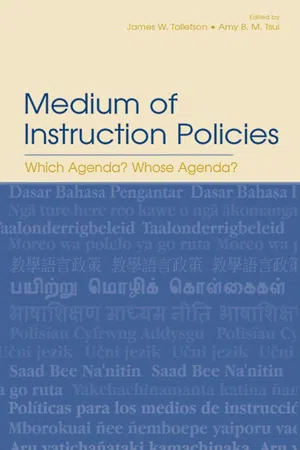
eBook - ePub
Medium of Instruction Policies
Which Agenda? Whose Agenda?
- 312 pages
- English
- ePUB (mobile friendly)
- Available on iOS & Android
eBook - ePub
Medium of Instruction Policies
Which Agenda? Whose Agenda?
About this book
Information
1
The Centrality of Medium-of-Instruction Policy in Sociopolitical Processes
Amy B. M. Tsui
The University of Hong Kong
James W. Tollefson
University of Washington
Most of the studies on medium of instruction, particularly in the 1970s and 1980s, were conducted in the field of bilingual education and focused on the effects of choices of medium of instruction at the micro level, including the classroom and the individual. The studies were motivated by educational concerns. Questions being addressed at the time pertained largely to the effectiveness and efficiency of different models of immersion in the acquisition of the first language and the second language, and in academic achievement in content subjects (for a critique of research on bilingual education, see Paulston, 1980). Although research on language policy sees language- policy issues as very much shaping—as well as being shaped by—the broader social and political issues, most of the earlier studies of medium of instruction had not been situated in the sociopolitical contexts in which they were implemented, and of which they were a part. The emergence in the 1990s of critical linguistics as a field of study focusing on linguistic human rights, and the role of language in power, control, dominance, and equality, has provided new insights and new foci for investigations of language-in-education policies (see, e.g., Fairclough, 1989; Pennycook, 1998; Phillipson, 1992, 2000a; Skutnabb-Kangas, 2000, 2002; Tollefson, 1995, 2002).
This volume makes a case for the centrality of medium-of-instruction policy in sociopolitical processes. The language of a nation, or an ethnic group, is often a symbol of its identity and allegiance, and an embodiment of its values, culture, and traditions. Medium of instruction is the most powerful means of maintaining and revitalizing a language and a culture; it is the most important form of intergenerational transmission (Fishman & Fishman, 2000). It is also the most direct agent of linguistic genocide (Skutnabb-Kangas, 2000, 2002). Medium-of-instruction policy determines which social and linguistic groups have access to political and economic opportunities, and which groups are disenfranchised. It is therefore a key means of power (re)distribution and social (re)construction, as well as a key arena in which political conflicts among countries and ethnolinguistic, social and political groups are realized. Because medium-of-instruction policy is an integral part of educational policy, debates surrounding it necessarily pertain to educational efficacy. All too often, policy makers put forward an educational agenda that justifies policy decisions regarding the use and/or the prohibition of a particular language or languages. Yet, behind the educational agenda are political, social, and economic agendas that serve to protect the interests of particular political and social groups. The tension between these agendas is difficult to resolve, and almost invariably leads to the triumph of the political, social, or economic agenda over the educational agenda. For this reason, we feel that it is important, when examining medium-of-instruction policy issues, to ask and address the questions, “Which Agenda? Whose Agenda?”—hence the title of this volume: Medium of Instruction Policies: Which Agenda? Whose Agenda?.
The chapters in this volume address the questions just mentioned in a range of sociopolitical contexts, including minority groups in English- dominant countries, post-colonial countries that have suffered long periods of political and linguistic domination, and countries where ethnolinguistic groups have succeeded in resisting linguistic domination and thereby gained political independence. Accordingly, this book is organized around these contexts. Part I consists of three chapters that focus on the efforts made by linguistic minorities in English-dominant countries to revitalize and maintain their languages, namely theMāori inNewZealand, the Welsh in Wales (United Kingdom), and the indigenous Indians in the United States. Part II consists of five chapters that focus on post-colonial countries and the different paths that they have taken toward nation building through their medium-of-instruction policies. They include Hong Kong, Singapore, Malaysia, India, the countries of sub-Saharan Africa, and the Philippines. Part III consists of three chapters that focus on the conflicts between ethnolinguistic groups, how they were managed, and the political consequences. They cover post-apartheid South Africa, Ecuador, Bolivia, and Yugoslavia. Four recurrent themes can be identified in this volume, and are discussed here under separate headings.
SITUATEDNESS OF MEDIUM-OF-INSTRUCTION POLICIES
All chapters in this volume contextualize the discussion of current medium- of-instruction policies and practices in the history of the development, formulation, and implementation of these policies. The shared understanding is that the interpretation of medium-of-instruction policies, and the debates surrounding them, must be situated in their sociopolitical contexts, which are inseparable from their historical contexts.
The historical reviews provided in the chapters show remarkable similarities in the functions of medium-of-instruction policies. In former colonial states, the colonial language was adopted as a medium of instruction by a small number of schools and made available to an exclusive group of indigenous people. This exclusive group joined the elite of the society who had access to power, wealth, and status, and acted as auxiliaries to the colonizers and as brokers between the colonizers and the colonized. As Pennycook (2002) observes, the spread of western knowledge and values was of equal, if not greater, importance to securing good will toward the colonizers and producing a loyal working force. Consequently, formal education was made available by colonial governments through the indigenous languages (to a greater or lesser extent), either as an alternative, or as a transitional medium of instruction. No matter whether the colonial language or the indigenous languages were used as the medium of instruction, the goal remained the same—to subjugate the colonized. Alidou’s account of sub-Saharan Africa, Annamalai’s account of India, and Tsui’s account of Hong Kong all tell the same story. In English-dominant countries, the history of medium of instruction is no different. The indigenous languages were treated as backward and uncivilized, and seen as something that must be eradicated in order for the country to become modernized. Indigenous people were made to feel ashamed of their own tongue and were penalized for speaking it. They were to be civilized through schooling and the acquisition of another language. This policy of linguistic assimilation, which was part of the machinery of political subjugation, not only deprived the indigenous minorities of the right to speak their mother tongue, but also made it impossible for the indigenous languages to develop into languages that could fully function in all domains. In some cases, it almost led to the demise of the language(s). The indigenous Indians in the United States, the Welsh in the United Kingdom, and the Māori in New Zealand all have undergone the same experience.
The historical background outlined in the chapters in this volume provides a sound basis for appreciating the difficulties faced by post-colonial countries and linguistic minorities in using the mother tongue as the medium of instruction. The lack of opportunity for indigenous languages to develop into languages that could function in all domains has made it necessary for these languages to be standardized and codified before they could be used in domains such as education, law, and government. It has also led to a paucity of teaching materials in the indigenous languages and the lack of a literacy environment for speakers of these languages. The long-standing low status that indigenous languages were accorded, the negative experience with which they were associated, and the prestige that the former colonial languages enjoyed, have together resulted in a lack of confidence in the indigenous languages as adequate working languages, and languages that are suitable for schooling. In many cases, these difficulties have been used as excuses by policy makers for their noncommittal stance toward mother-tongue education. For example, in India and sub-Saharan Africa, the need for codification and standardization of the indigenous languages has been used as the justification for not committing to a definite time frame for implementing mother-tongue education.
LINGUA FRANCA AND LINGUISTIC IMPERIALISM
Another recurrent theme in this volume is that the choice of official languages and the choice of medium of instruction are shaped by political, social and economic forces. In multi-ethnic and multilingual states, decisions regarding which languages should be established as official languages, and which as the medium of instruction, are political decisions that, if ill-managed, can lead to war and bloodshed. Ironically, in many cases the colonial language was chosen as one of the official languages and has often effectively functioned as the dominant working language and the lingua franca. The colonial language is also the dominant or preferred medium of instruction on the grounds that it is ethnically neutral and therefore, theoretically, also politically neutral. Although most post-colonial countries also established ethnic and indigenous languages as the official languages, these languages are often more symbolic than substantive (Fishman&Fishman, 2000). In India, although there are a dozen regional languages that are official languages at the state level in addition to English and Hindi, English continues to play a prominent role. It is used in all three forms of mass media—newspapers, radio, and television—and is the only language taught in all states and in the largest number of schools. In Singapore, English was not only recognized as one of the official languages, it was also selected as the official working language of the country. In Hong Kong and the Philippines, English was retained as an official language alongside the national languages, Chinese and Filipino respectively, and is clearly the preferredmediumof instruction. Similarly in sub-Saharan Africa, the colonial languages (English, French, Spanish, and Portuguese) continued to be the official languages after independence, and are used as media of instruction although they are spoken by a very small percentage of the population in these countries. In post-apartheid South Africa, although 11 languages were declared official languages, English is the preferred language of the media and education, and is used almost exclusively as the official language.
The adoption of a colonial language as the lingua franca may be seen as an ethnically neutral move, but it is by no means a politically neutral move. The term lingua franca, as Phillipson (2000b) points out, is deceptive: It hides the inequality that is inherent in a system that is supposed to serve both the native and nonnative speakers of the language equally well, but clearly serves some better than others. The asymmetrical power relationship among the official languages in these countries perpetuates social, economic, and political inequality, and favors speakers of the colonial languages, at national, sub-national, and supranational levels. As Phillipson (1992) points out, this kind of linguistic domination, which he terms linguistic imperialism, is analogous to economic and military imperialism, except that it is even more pervasive and penetrating because the domination is not just economical but also cultural and ideological. Linguistic imperialism, as Rasool (2000) observes, “continues to circumscribe cultural, economic and political possibilities in the developing world” (see page).
LINGUISTIC DIVERSITY: THE RHETORIC AND THE REALITY
The gap between the rhetoric of medium-of-instruction policy and the reality of its implementation is the third recurrent theme. The discourse surrounding language policies is full of phrases such as “respect for linguistic diversity,” “rights to mother-tongue education,” “promotion of multilingualism,” and so forth. As Skutnabb-Kangas (2002) points out, in the policy documents of transnational organizations such as UNESCO, United Nations, the World Bank and the Council of Europe, there is impressive rhetoric about the importance of maintaining all the world’s languages because they are part of the heritage of humanity. For example, in late 2001, UNESCO adopted the Universal Declaration on Cultural Diversity, which calls for action against the homogenization resulting from the disappearance of languages. However, behind the beautiful rhetoric there is little commitment to linguistic human rights in education (Skutnabb-Kangas & Phillipson, 1994), particularly the right to mother-tongue education (see also Mazrui, 1997). Articles relating to mother-tongue education are usually vague in their formulation, and contain many more qualified statements than other articles. The 1992UNDeclaration on the Rights of Persons Belonging to National or Ethnic, Religious, and Linguistic Minorities, for example, contains this clause:
4.3. States should take appropriate measures so that, wherever possible, persons belonging to minorities have adequate opportunities to learn their mother tongue or to have instruction in their mother tongue. (cited in Skutnabb- Kangas, 2002, emphases added)
Qualifications such as “appropriate,” “wherever possible” and “adequate opportunities” allow the state to adopt a minimalist approach to mother-tongue education but still be able to meet the requirements of the policies, which, as Skutnabb-Kangas observes, puts the minorities at the mercy of the state. Similar features can be found in the Council of Europe Framework Convention for the Protection of National Minorities and the European Charter for Regional or Minority Languages, both in force since 1998. It is therefore not surprising that there is no sign of linguistic homogenization abating.
Similarly, in the countries covered in this volume, the declared language policies claim to promote linguistic and cultural plurality, and to provide opportunities for mother-tongue education. However, the lack of commitment on the part of the policy makers is often seen in policy documents that contain exit clauses and qualified statements, the lack of a definite time frame for implementation, the lack of follow-up measures and clear guidance, and a reluctance to provide adequate resources for implementation. This noncommittal stance is motivated by the political agenda of avoiding ethnic conflicts, the economic agenda of exploiting the market of post-colonial countries, and the sociopolitical agenda of protecting the interests of the elite.
GLOBALIZATION, ASSIMILATION, AND ETHNOCULTURAL IDENTITY
The impact of globalization on medium-of-instruction policies is a recurrent concern voiced in this volume. The dominant role of English-speaking countries, particularly the United States, in international economy and politics, and the use of English as the lingua franca on the Internet, have aggravated the pull toward English as a much sought-after commodity, at national, subnational and supranational levels (Phillipson & Skutnabb- Kangas, 1999). In Europe, the move toward integration has made the learning of the major European languages a necessary condition for survival for many of the smaller European countries. The effect of globalization that lead to linguistic and cultural assimilation is particularly evident in smaller states, whose national languages are not among the major languages, and in developing countries, which are keen to remain competitive and play an active role in the international economy.
By equipping the nation with the language(s) of modernization and technological advancement, developing countries are better able to keep abreast of developments in developed countries, and smaller states are able to integrate better with bigger states. But this nevertheless raises the question: What effect does this kind of assimilation have on national and ethnocultural identity? In cases where English is appropriated as the language of the nation, the tension between retaining the culture and values associated with the mother tongue and the adoption of a national identity symbolized by a foreign language is not easy to reconcile. Although globalization can bring aboutmore collaboration amongst countries, it also brings about assimilation of the powerless toward the powerful. The effects of assimilation can be very harmful; it not only exacerbates the existing inequality in power, it may produce nationals who are ambivalent about their own identity, and nations that are stripped of their rich cultural heritage.
SUMMARY OF CHAPTERS
As mentioned earlier, this volume is organized according to the sociopolitical contexts in which medium-of-instruction policies are formulated and implemented. Part I addresses issues confronted by minority linguistic groups in English-dominant countries. The English-dominant countries discussed in this section all had the historical experience of having the languages of the indigenous minorities treated as obstacles to civilization and modernization. The indigenous people were to be civilized through schooling. To this end, they were forced to abandon their own tongue and acquire another, and to assimilate European culture and habits.
Stephen May outlines the history of colonization of the Pākehā (i.e.,New Zealanders of European origin) over the indigenous Māori in New Zealand, and provides a detailed account of the efforts made by theMāori to redress the disadvantages that they suffered as a consequence of colonization, and to halt the impending demise of the Māori language (which resulted from the assimilationist policy adopted by the Pākehā). Medium of instruction has been one of the key areas in which the redress is realized. TheMāori worked outside the state education system and started an independent movement to establish Māori-medium preschools in the early 1980s, with the aim of reviving traditionalMāori knowledge and cultural practices. The success of this movement led to the rapid emergence of Māori-medium education at other levels of education in order to maintain the language acquired in preschool. In 1987, the Māori Language Act was passed andMāori was recognized as an official language of New Zealand. TheMāori-medium education policy was motivated by the conviction that total immersion in Māori is the best way to achieve language reversal, to counter the dominance of English that is prevalent in all domains, and to ensure the transmission of cultural practices and behavior. The success of theMāori Language Act led to theMāori demanding significant structural reforms in the state education system, as well as greater autonomy for their people. In 1990, Māori-medium education was recognized as part of the state education system. May observes that Māori-medium education, and the transmission of Māori culture and philosophy through schooling, should not be seen as separatist, but rather as making available to theMāori the same opportunities—social, economic, and political—that have always been available to the Pākehā.
Dylan Jones and Marilyn Martin-Jones examine the development of Welsh-medium education and bilingual education inWales, where English is the dominant language. They trace the historical context of the educational provision through Welsh and the sociopolitical processes involved. In the late 19th and early 20th century, theWelsh language was considered an obstacle to progress inWales, and there weremovesto eradicate it fromthe educational system. English-medium education was introduced as a form of intervention to helpWalesmoveforward.Two major efforts weremadeto resist Anglicization and to maintain the Welsh language: They are to make Welsh the only official language ofWales, and to use it as medium of instruction at all levels of education. Both of these policy changes then led to the formulation of the broader political agenda of self-government for Wales. Welsh-medium education proved successful and attracted students not only fromWelsh speaking families, but also from English speaking families. The remarkably successful revitalization of the Welsh language in an English dominant environment was partly due to the good reputation that Welsh-medium schools had established. It was also due to the increased use ofWelsh in public institutions in the 1950s and 1960s, which opened up employment opportunities for Welsh speakers. Strong institutional support from local education authorities, the school inspectorate, teacher training institutions, and key educational bodies also played a very important role. The specification in the National Curriculum of Welsh as a Core subject in all Welsh-medium schools and a Foundation subject in all other schools, along with the use ofWelsh in public examinations, were important indicators of the currency ofWelsh. The passing of theWelsh Language Act in the 1990s ensured that Welsh was recognized as having the same status as English. Jones and Martin-Jones raise two major issues, however, that have yet to be addressed. First, the revitalization of theWelsh language has been achieved mainly throughWelsh-medium education at preschool and elementary levels. At secondary level, there has beenmoredemandfor English-medium education by native Welsh students, as English is the medium of higher education. This leads to increasing Anglicization, which seems to be inevitable. Second, asWelsh-medium schools have to teach both native and nonnative Welsh students through Welsh, teachers often resort to code switching and code mixing to help students understand the content. Jones and Martin- Jones present an interesting analysis of the patterns of code switching in a mathematics classroom, and highlight the need to conduct classroom-level research to gain a deeper understanding of policy issues.
Although bothNewZealand andWales seem to be moving forward in promoting linguistic diversity, the United States has apparently been moving in the direction of homogenization since the 1980s. Teresa McCarty provides a critical analysis of the history of medium-of-instruction policy in the United States—one of the most linguistically and culturally diverse countries in the world—that serves as a context for making sense of the apparent contradictions in U.S. medium-of-instruction policies. She observes that these contradictions were responses to the political and socioeconomic forces at different times in the history: When linguistic diversity was nonthreatening or even necessary, it was tolerated and even supported—as in the early days of U.S. history, when indigenous languages were instruments for religious conversion and land usurpation, as well as for “civilizing” the children of native Americans, and when the co-existence of multiple European languages helped to spread the ideals of the new government. ...
Table of contents
- Cover Page
- Title Page
- Copyright Page
- Preface
- Contributors
- 1 The Centrality of Medium-of-Instruction Policy in Sociopolitical Processes
- I Minority Languages in English-Dominant States
- II Language in Post-Colonial States
- III Managing and Exploiting Language Conflict
Trusted by 375,005 students
Access to over 1.5 million titles for a fair monthly price.
Study more efficiently using our study tools.
Frequently asked questions
Yes, you can cancel anytime from the Subscription tab in your account settings on the Perlego website. Your subscription will stay active until the end of your current billing period. Learn how to cancel your subscription
No, books cannot be downloaded as external files, such as PDFs, for use outside of Perlego. However, you can download books within the Perlego app for offline reading on mobile or tablet. Learn how to download books offline
Perlego offers two plans: Essential and Complete
- Essential is ideal for learners and professionals who enjoy exploring a wide range of subjects. Access the Essential Library with 800,000+ trusted titles and best-sellers across business, personal growth, and the humanities. Includes unlimited reading time and Standard Read Aloud voice.
- Complete: Perfect for advanced learners and researchers needing full, unrestricted access. Unlock 1.5M+ books across hundreds of subjects, including academic and specialized titles. The Complete Plan also includes advanced features like Premium Read Aloud and Research Assistant.
We are an online textbook subscription service, where you can get access to an entire online library for less than the price of a single book per month. With over 1.5 million books across 990+ topics, we’ve got you covered! Learn about our mission
Look out for the read-aloud symbol on your next book to see if you can listen to it. The read-aloud tool reads text aloud for you, highlighting the text as it is being read. You can pause it, speed it up and slow it down. Learn more about Read Aloud
Yes! You can use the Perlego app on both iOS and Android devices to read anytime, anywhere — even offline. Perfect for commutes or when you’re on the go.
Please note we cannot support devices running on iOS 13 and Android 7 or earlier. Learn more about using the app
Please note we cannot support devices running on iOS 13 and Android 7 or earlier. Learn more about using the app
Yes, you can access Medium of Instruction Policies by James W. Tollefson, Amy B.M. Tsui, James W. Tollefson,Amy B.M. Tsui in PDF and/or ePUB format, as well as other popular books in Bildung & Bildung Allgemein. We have over 1.5 million books available in our catalogue for you to explore.