- 280 pages
- English
- ePUB (mobile friendly)
- Available on iOS & Android
eBook - ePub
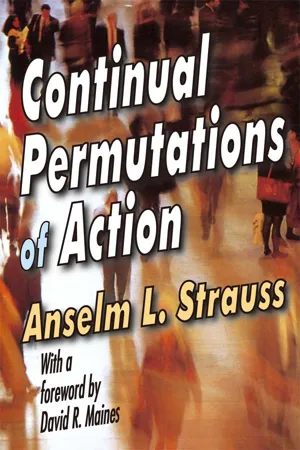
Continual Permutations of Action
About this book
Richard Bernstein expressed the view that pragmatism was ahead of its time; the same has been true of symbolic interactionism. These two closely related perspectives, one philosophical and the other sociological, place human action at the center of their explanatory schemes. It has not mattered what aspect of social or psychological behavior was under scrutiny. Whether selves, minds, or emotions, or institutions, social structures, or social change, all have been conceptualized as forms of human activity. This view is the simple genius of these perspectives. Anselm Strauss always took ideas pertaining to action and process seriously. Here he makes explicit the theory of action that implicitly guided his research for roughly forty years. It is understood that Strauss accepts the proposition that acting (or even better, interacting) causes social structure. He lays the basis for this idea in the nineteen assumptions he articulates early in the book--assumptions that elaborate and make clearer Herbert Blumer's famous premises of symbolic interactionism. The task Strauss put before himself is how to keep the complexity of human group life in front of the researcher/theorist and simultaneously articulate an analytical scheme that clarifies and reveals that complexity. With these two imperfectly related issues before him, Strauss outlines an analytical scheme of society in action. It is a scheme that rests not on logical necessity but on research and observation, and the concepts he uses are proposed because they do a certain amount of analytical work. One would be well advised to take Continual Permutations of Action very seriously.
Information
PART I
Chapter 1
Assumptions of a Theory of Action
[W]e are confronting a universe marked by tremendous fluidity; it won’t and can’t stand still. It is a universe where fragmentation, splintering, and disappearance are the mirror images of appearance, emergence, and coalescence. This is a universe where nothing is strictly determined. Its phenomena should be partly determinable via naturalistic analysis, including the phenomenon of men [and women] participating in the construction of the structures which shape their lives.—A. Strauss, “A Social World Perspective”
CONTRASTS
What kind of a theory of action might fit the nature of the universe assumed in the quotation above: a world that is complex, often ambiguous, evincing constant change as well as periods of permanence; where action itself although routine today may be problematic tomorrow; where answers become questionable and questions produce ultimately questioned answers?
First of all, such a theory of action calls for specificity about the dimensions of action that need to be included in the total gestalt of the conception of “action.” If we were psychologists or psychiatrists, our dimensions of action might be different. If we were a different kind of sociologist, making other kinds of assumptions, the chosen dimensions might be different also. Understand that whichever ones are chosen will have crucial implications for your sociology and mine.
As a striking illustration, consider the differences between how two influential thinkers, Talcott Parsons and George H. Mead, conceived of acts and action. For Talcott Parsons’s views I will quote the summary statement by Alfred Schuetz (1932; see Grathoff 1978, p. 12) in a paper titled “Parsons’ Theory of Social Action: A Critical Review.” I will follow each summary point with my own commentary. It is not necessary to assume that Schuetz has correctly interpreted Parsons, though I think he has; the point is rather to see the kinds of elements or dimensions that might go into thinking about a sociological scheme about action.
“(a) The act implies an Agent, an ‘actor.’”
“The”: one; single. “Act,” not action; connotation perhaps of brief duration, brief action. “An agent”: one person, or collectivity—group, organization?—who engages in the act. “An” actor: one; single. In sum: one bit of action, carried out by one individual or a collectivity.
“(b) The act must have an ‘end,’ a future state of affairs to which the process of action is oriented.”
“[M]ust have an end”: teleological. Also, “an” or one. Also, perhaps specific? But also, act as means: thus, a means-end scheme.
“[A] future state of affairs”: Act has temporal aspect. Faces forward over some unspecified stretch of time.
“[T]he process of action”: Act is a process. Does this mean stages, steps, changing over time, or just unfolding?
“[F]uture state of affairs to which … is oriented”: image or projection of the way things will be. Probably also means will be as a consequence of the act? Anyhow, an image/projection of future state and an act to reach it, or else cannot reach it. Act, as noted above then: a means to that future end.
“(c) The act must be initiated in a ‘situation’ which in turn is ‘analyzable’ into two elements: ‘conditions’ of action over which the actor has no control, and ‘means’ over which he has control.”
“[I]nitiated in a ‘situation’ which … is analyzable into two elements.” His definition of the situation seems limited to only one dimension: control or no control. Why does he so limit this?
“(d) The act involves a certain mode of relationships between these elements, a ‘normative’ orientation of action.”
I am uncertain exactly what is meant, except it seems clear that again he has restricted his definition of the act to “a certain mode of relationships between these elements.” It is important, then, to note this specificity and this restriction.
Contrast this Parsonsian view of action with that of G. H. Mead. We are in a different world entirely, breathing a different sociological atmosphere. Here is Mead at the very beginning of his lectures in Mind, Self and Society talking about action:
“Social psychology studies the activity or behavior of the individual as it lies within the social process: the behavior of an individual can be understood only in terms of the behavior of the whole social group of which he is a member, since his individual acts are involved in larger, social acts, which go beyond himself and which implicate the other members of the group.”(1934, pp. 6’3)
Even when studying individuals [Mead was talking about social psychology rather than society (sociology) in this part of his lectures], Mead does not talk of isolated, individual actions. An individual’s actions are, in Mead’s frequent terminology, thoroughly “social.” After birth, the infant begins to become socialized, its acts are a part of the flow of “group” activity. The latter precede the individual’s actions and will continue afterward. So both individual and collective activity have historical dimensions as well as future ones. Moreover, from his discussion we can also see that, along with its temporal features, this activity embodies moral, biographical, symbolic, and even perhaps aesthetic properties.
Actions are in effect interactions between and among group members, not simply an individual’s actions or acts. Mead uses the word conduct, implying meaning—given to it by everyone involved. Elsewhere, as we know, Mead emphasizes multiple meanings for the same actions that derive from the multiple perspectives of the interactants. (These include, along with the temporal, the moral, biographical, and aesthetic.) We also know that he elsewhere emphasizes how individuals engage in self-reflection (thinking) before, during, and after their overt action.
BASIC ASSUMPTIONS OF A THEORY OF ACTION
What would be the basic assumptions of a sociological theory of action? The Pragmatist philosophers, including Florian Znaniecki in his early philosophic treatise, Cultural Reality ([1919] 1983), certainly did not develop their common theory of action as a service to sociology. Rather, it was designed to combat competing philosophic positions like idealism, realism, and materialism; to attack dualisms, including a separation of mind and body, and of individual and society; to address the nature of reality and human relationships to it; to elucidate the characteristics and functions of reflective thought; and to better understand the creative processes happily granted to humans as a favored species. These are specifically philosophical issues, not immediately sociological ones, albeit the stands taken on them most assuredly affect the kinds of sociologists that we become.1 Philosophic tasks, however, are not identical with sociological ones.
In the next pages, a number of assumptions on which an effective sociological action theory will rest are suggested and discussed. This list of assumptions is based both on my interpretation of the Dewey-Mead perspectives, and development of this interpretation through a series of research projects. As mentioned earlier, my research projects were not guided by any explicitly formulated theory of action. However, now it is clear that a list of assumptions about action and interaction obviously derived from Pragmatism have run like a red thread through my research. In different studies, particular assumptions are more leaned upon than others, but the total list seems to be what I have assumed generally.
Few of them will appear strange or novel to interactionists, and some are so much part of sociological tradition that the commentary on specific ones can be scanned with no loss of understanding of the overall presentation. Interactionists operate with many of these assumptions when carrying out research, but have not necessarily adopted all. The list is offered not as dogma but as a set of suggestions designed to enhance sensitivity toward sociological phenomena and to increase the sociological awareness that I myself treasure. Of course, all of the assumptions are not necessary for carrying out particular research studies, but the entire list makes for a more powerful theory of action. Although these assumptions are designed to capture the nature and details of the social universe described at the outset of this chapter, you need not be an interactionist to find such a conceptualization of action useful. Usefulness is the operative criterion here, not truth.
DEFINITIONS
Working definitions of action, interaction, and an act are needed first.
Action: though expressed in the English language as a noun, is actually a verb—“to act.” It has two dimensions. Acting overtly is the dimension most frequently taken as synonymous with action. Overt action can be observed by other people. However, acting covertly, or reflectively, is also an aspect of action. It cannot be observed by others (although body cues may suggest it), but of course it can be reported by the actor.
Interaction: is acting, by an individual or collectivity, toward others who are not necessarily aware of this action. The others may not be present, may be dead, may be imaginary, or in some way may be cultural others (heroes, celebrities, models for the actor, etc.). If alive, the others may in turn act toward, or respond to, the actions of the first actor. There can be no interaction without persons, groups, or organizations acting; just as there is virtually no acting, at least after very early infancy, where action is divorced from interaction.
Reflexive interaction: is the interplay of an actor (person, group, organization) acting toward some aspect of the actor’s self. Mainly, we social scientists conceive of this as internal, and when done by persons as covert action. It can, however, be expressed visibly in actions, say, by hitting one’s head angrily when missing an easy tennis shot or preening before a bedroom mirror. Reflexive action by organizations is, of course, observable at least by its own members.
An act and to act: will be used in this book (although only rarely) as the common English equivalent of any of the above—of acting, interacting, or reflexive interacting. Thus, “it was an unjust act” is a judgment made of some interaction, including an act by oneself as in “I (we) acted unjustly.”
An actor: will be the agent of an action—a person, a group, an organization, or other social unit.
A LIST OF ASSUMPTIONS
Now for the list of assumptions of this interactionist theory of interaction. Some of them overlap, but for the sake of clarity they will be noted and discussed separately. The well-recognized and accepted ones will receive scant attention; fuller commentary will be reserved for the less obvious.
Assumption 1. No action is possible without a body: That is, the body is a necessary condition for action; but as a concept “body” can be a very rich one, embracing multifaceted actions toward body and bodies as object including complex body processes. This multifacetedness is only deceptively a matter of individuals with bodies, for collectivity is intrinsic to this individuality. (See Chapter 4.)
Martha Graham, the celebrated dancer and choreographer, when asked in her eighties how she felt about no longer being able to dance, answered that at first it was very difficult and her self-regard suffered, but that now she views her beautiful young dancers as extensions of herself, dancing her dances for her.
The first phrase of this assumption, about body as a condition for action, is so patently banal that social scientists implicitly assume it, but few follow through very far on its implications. Since a number of those implications for interaction will be discussed in Chapter 4, this first assumption will only be touched on here summarily. Keep in mind, however, that it is not the body itself that is central but aspects of the body in their relationships with interaction. Everything about the body, sociologically conceived, turns around those relationships including both the suffering and conversely the joy they may bring.
The body is a condition for means of interaction since none can occur without a body or bodies. With these, actors can perform, present themselves, and their interactions can be judged with respect to performance and appearance, during and after the interactions. These three modes are central to interaction and the body is necessary to them.
Bodies can also be acted toward as objects. However, it is not the body as such that acts toward itself or others’ bodies (or a part of itself or the others), but actors with selves and identities who direct actions toward bodies as objects. When actions affect someone’s body, change some aspect of it physically (or “mentally”), then this altered body part or system will constitute a new condition affecting further actions.
If the dualism of distinguishing between mind and body is rejected, then one can see that mental activity is also a bodily function, and in addition that every action involves mental/body activity. It is only an artifact that body and mind get separated, whether in common speech or social science discourse. (Dualism is “A system or theory which asserts a radical duality or twofoldness of nature, being or operation.” (Funk and Wagnalls 1935).)
Willed, or voluntary, action arises as a possibility because of self-reference. Actors with selves initiate the interaction, at the same time giving commands to the bodies that will be and are agents in the interaction. Even routine interaction represents willed action. Although these may be automatically carried out, done without self-consciousness, they are still self-referential and willed.
A variety of “body processes” serves to enhance, promote, denigrate, destroy, maintain, or alter performances, appearances or presentations. It is through these processes that much of the shaping of selves, identities, biographies, and even changes of body occur. The body processes include protecting the body, abusing the body, training the body, shaping the body, presenting the body, symbolizing the body. This concept of body processes underlines the multifaceted aspects of the otherwise deceptively singular noun body, which deceptively masks collectivity even in acts by individuals.
Assumption 2. Actions are embedded in interactions—past, present, and imagined future. Thus, actions also carry meanings and are locatable within systems of meanings. Actions may generate further meanings, both with regard to further actions and the interactions in which they are embedded.
Mirrors and Masks began with a discussion about the crucial relevance of classifying objects for action: “[T]he direction of activity depends upon the particular way that objects are classified” ([1959] 1969, p. 21). Classifications are components of language, and while individuals can invent classifications, of course they do this through the instrumentality of language itself. (Classification really means to class(y—an act itself.) This theoretical approach to action links action to meaning, but does so in conjunction with the linking of actions to interactions. Acts are not bits of uninhabited activities, even those of a Robinson Crusoe alone on his isolated isle or a hermit in his desert cave. Acts are directed at oneself, persons, organizations, at societal rules and legal regulations, at valued goals, and so on. Th...
Table of contents
- Cover
- Half Title
- Title Page
- Copyright Page
- Table of Contents
- Acknowledgments
- Foreword
- Introduction
- Part I
- Part II
- References
- Index
Trusted by 375,005 students
Access to over 1.5 million titles for a fair monthly price.
Study more efficiently using our study tools.
Frequently asked questions
Yes, you can cancel anytime from the Subscription tab in your account settings on the Perlego website. Your subscription will stay active until the end of your current billing period. Learn how to cancel your subscription
No, books cannot be downloaded as external files, such as PDFs, for use outside of Perlego. However, you can download books within the Perlego app for offline reading on mobile or tablet. Learn how to download books offline
Perlego offers two plans: Essential and Complete
- Essential is ideal for learners and professionals who enjoy exploring a wide range of subjects. Access the Essential Library with 800,000+ trusted titles and best-sellers across business, personal growth, and the humanities. Includes unlimited reading time and Standard Read Aloud voice.
- Complete: Perfect for advanced learners and researchers needing full, unrestricted access. Unlock 1.5M+ books across hundreds of subjects, including academic and specialized titles. The Complete Plan also includes advanced features like Premium Read Aloud and Research Assistant.
We are an online textbook subscription service, where you can get access to an entire online library for less than the price of a single book per month. With over 1.5 million books across 990+ topics, we’ve got you covered! Learn about our mission
Look out for the read-aloud symbol on your next book to see if you can listen to it. The read-aloud tool reads text aloud for you, highlighting the text as it is being read. You can pause it, speed it up and slow it down. Learn more about Read Aloud
Yes! You can use the Perlego app on both iOS and Android devices to read anytime, anywhere — even offline. Perfect for commutes or when you’re on the go.
Please note we cannot support devices running on iOS 13 and Android 7 or earlier. Learn more about using the app
Please note we cannot support devices running on iOS 13 and Android 7 or earlier. Learn more about using the app
Yes, you can access Continual Permutations of Action by Anselm L. Strauss in PDF and/or ePUB format, as well as other popular books in Psychology & History & Theory in Psychology. We have over 1.5 million books available in our catalogue for you to explore.