- 340 pages
- English
- ePUB (mobile friendly)
- Available on iOS & Android
eBook - ePub
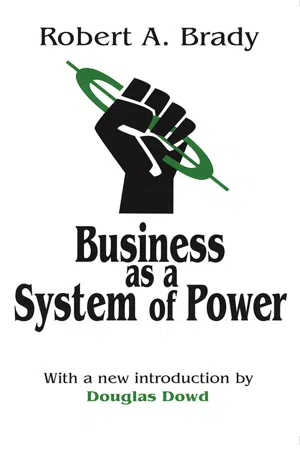
Business as a System of Power
About this book
Business as a System of Power was the direct product of extensive and continuing study of the rise of bureaucratic centralism. The project was begun in 1934, and resulted a decade later in this volume, arguably the most important work in comparative and historical economics to emerge in the World War Two period. Indeed, Brady's theorems such as the bureaucratic authoritarian model of development, became a touchstone for the study of Third World economies.Brady saw the direction of business moving in a variety of directions: from the totalitarian model set by fascism with its highly centralized approach to special interests, profit making and policy made in the interests of those who rule; and the alternative democratic model set by the democracies of the West, which expound the latitude of direct public participation in decision-making and social organization of the economy as a whole. Brady does not indulge in cheap conspiracy theory. Rather he sees the business classes worldwide as possessing a collective mind, but not a collective will. In this setting the business civilization itself is at stake.The volume offers a fascinating study of German Nazism, Italian fascism and Japanese militarism as a series of policies rather than historical inevitabilities. But the work is also a foreboding and a warning to democratic varieties of capitalism. As business becomes increasingly global in character, unbound by national interests or democratic aims, it also becomes more rational in its own terms. Its drive for maximizing profits with scant regard to what may be less cost effective, but more open to popular control or participation, becomes transparent. Brady provides a remarkably prescient, albeit controversial, study of trends in Western democracy and big business. Robert S. Lynd, in his Preface, writes, "Brady cuts through to the central problem disrupting our worldàa world-wide counter-revolution against democracy." More than a half century later, in his outstanding review of the life and career of Robert Brady, Douglas Dowd points to the same lessons: economic inequities, economic globalization and political concentration of power. "In such a world, the counsel of a Brady never loses its vitality."Robert A. Brady was professor of economics at Columbia University, and author of The Rationalization Movement in German Industry; The Spirit and Structure of German Fascism; and The Scientific Revolution in Industry. Douglas F. Dowd was professor of economics at Johns Hopkins University and author of a number of important books on economics, including Modern Economic Problems in Historic Perspective.
Information
Part I
THE EVOLUTION OF MANUFACTURING PEAK ASSOCIATIONS IN THE TOTALITARIAN BLOC
Chapter I
THE NEW ORDER FOR GERMAN INDUSTRY
THE BATTLES of Poland, France, the Balkans, and Russia have been object lessons in the techniques of ‘‘lightning war.” Complete mechanization on the one hand and full coordination of air, land, and naval forces on the other have proven an irresistible combination against allied military strategists whose tactics have been still largely grounded in the obsolete methods of “fixed position” combat. But equally irresistible in a closely related field has been another Nazi innovation—that of the fullest possible coordination of propaganda, diplomacy, and economic power. To date, this latter coordination has developed a striking power equal in paralyzing effect to that of the military forces; its actual conquests have reaped material gains for the Third Reich which extend far beyond anything the latter has had to offer, even in the major theater of war.
The separate elements in both cases are in no important Sense of the term new. What is new is the fact that each element has been rationally exploited to the fullest possible extent, and at the same time all elements have been combined into a program which has been not only centrally directed but also dominated by a limited series of internally coherent objectives. While synchronization amongst the military branches is grounded in the works of Scharnhorst, von Moltke, von Schlieffen, von Hoffman and their compatriots, the new synthesis is more boldly conceived, action is deployed on a far greater scale, and the services are coordinated on an infinitely more meticulous and finely detailed basis. Similarly, synchronization of the nonmilitary machinery traces back to such as von Treitschke, Bismarck, the elder Krupp, Stinnes, von Moellendorf and Walther Rathenau. But, in order to be properly understood, the new synthesis must be compared simultaneously with the spiritual imperialism of the Catholic Church, the political imperialism of the Roman Empire, the psychoanalytic imperialism suggested by Le Bon, and the economic imperialism of the greatest of all British empire builders, Cecil Rhodes.
In a sense, the objectives of the Nazi program for a “new order in Europe” are self-evident. Clearly military and nonmilitary programs are now but different facets of a dynamically expansionist imperial state which has effected a third line of coordination, that of domestic and foreign policy. And so, as a program for imperial coordination of European (and possibly both African and other) peoples on a continental basis, it represents a logical unfolding from earlier Germanic models for fusing the Germanies into a compact and militarily omnicompetent state. The Hohenstaufens, Frederick the Great, Friedrich List, Bismarck, the late Kaiser would all have understood the driving forces that lie behind the Hitlerian juggernaut.
Whether world domination be the eventual aim or not, there can now be no question that the Nazi conquerors are thinking of at least something like a modern European equivalent of the old Roman Empire. In this picture, a nucleus of compact, more or less “racially” and culturally homogeneous peoples stand at the center of an imperial system which is surrounded on every side by subject nations which, powerless to resist, may yet be simultaneously “enslaved” and allowed some degree of “provincial” self-government. On the outer fringes of these provincial areas, the expanding lines of conquest—always seeking but never finding “natural frontiers” —soon force division of the world into great competing, hostile, and continent-wide imperial systems. Within each such major system every effort will be made, step by step with the advance of conquest, to weave the whole ever more closely together by construction of the most modern transportation, communications, power, industrial, trade, and military networks. And the pattern of control fitted over “great-space economy” will necessarily be that of a militarized hierarchy of imperial command and subordination.
If so much may be predicted from analysis of past trends and present developments, what then becomes of the capitalistic system? Will it disappear? Is it even now on its way out? Or is the transmutation of form and content one which is also in line with past developments in the structure, organization, functioning, and larger objectives of monopoly-oriented German business enterprise?
Genesis of German Imperial Capitalism
Taproots for all the immensely elaborated organizational networks that characterize twentieth century Germany are found in Bismarck’s imperial system. Under his capable hands, industrial capitalism underwent a sort of forced-draft growth within the confines of a modernized cameralism, in its turn greatly modified in many respects by important feudal carry-overs. The whole of the elaborate and amazingly efficient bureaucracy, inherited directly from the days of Frederick the Great and the systems of Kammern, was placed at the disposal of plans which visualized a swift catching-up and rapid overreaching of the industrial rivals of Imperial Germany. To this end the recalcitrant landed aristocracy were bribed, beaten into line, or deliberately fused with favored industrial, shipping, and commercial circles, with the inevitable result that the stigmata of special privilege were transferred wholesale to the new fields of upper class interest. And, on the other extreme the radicalized proletariat were numbed into submission by a combination of social security concessions—Bismarck’s adaptation of Realpolitik to the “social question” which succeeded in robbing Lassalle of all independent initiative—and superpatriotic romanticism which appeared to gear labor’s fortunes inescapably to those of the expanding state apparatus.1
Coming onto the industrial stage comparatively late,2 under such auspices, and with England as the principal rival,3 there was little tendency to comply with the tenets of competition or laissez faire. Some speculation on, followed by half-hearted experimentation with, the advantages of the Manchestrian system had, of course, taken place. For a short period of time during the sixties and the seventies ideas imported from England seemed to be gaining ground. But this Blütezeit of laissez faire was brought to a close with the famous Bismarck tariff of 1879. Germany thus returned to more familiar ways. These ways—from the romanticism of an Adam Mueller and the rationalized protectionism of a Friedrich List—her theoreticians had assured Germany were fitting and proper in the face of economic conditions and in the perspectives of future need.4
All the important institutional seeds5 of contemporary Germany were sown in this final rejection of Manchester. And, amongst these, an almost completely free field was opened to every conceivable type of monopoly, quasi-monopoly, or monopoly-oriented device which did not clearly militate against the felt needs of the state. No important bars were placed against combinations in general or in any field. Not until 1923, with the passage of the famous law against “the abuse of economic power”6 was any legislation placed on the statute books which could effectively check the more obvious abuses of collusive action on the part of the cartels. In the main, the state laid a premium on fusion, organization, compacts, agreements, communities of interest. If at any point the state stepped into the picture, it was primarily to protect one collusively organized section of the business world against the overwhelming power of another collusively organized section, or to act as an ally, a promoter, a guardian, or a partner of some particular type of central economic control apparatus. The result has been a proliferation of organizational activity without parallel in modern times. A few data will illustrate the point and show how far concentration of control had gone by the time the Nazis took over.
Combinations and Monopoly Groupings.7
Coal
(a) Ten companies produced 68.98 percent of total output and employed 67.88 percent of all labor. Three companies produced 37.93 percent of total output, and employed 37.22 percent of all labor.
(b) Under law the coal industry was divided into ten producing districts, each of which was governed by a special coal syndicate, and made subordinate to a national coal association and the federal coal council.8
Steel and Iron
(a) Three concerns produced 68.8 percent of all pig iron; one concern produced 50 percent.
Four concerns produced 68.3 percent of all crude steel; one concern produced 43 percent.9
(b) One concern, the United Steel Works, held the following cartel quotas: pig iron, 38.445; crude steel, 38.298; “A”-Products, 40.023; bar iron, 30.724; band iron, inland and foreign, 38.955; thick sheet, 39.742; rolled wire, 29.161; wire, 22.224; pipe, 50.613.
Electro-technical (manufacture of electrical machinery and goods) 1.9 percent of all firms employed 66.1 percent of all persons. Two firms, AEG and Siemens-Halske-Siemens-Schuckert, completely dominated both “heavy” and “light” current fields.
Electric power
“Two-thirds of the current production and delivery of all German public electrical enterprises (concerns producing power for sale to third parties) are concentrated in the hands of seven concerns.” Two companies delivered over 40 percent of the total power consumed in 1929–30.10
Chemicals
One company, the vast I.G. Farbenindustrie A.G., owned 35 percent of all invested capital and employed over one-third of all employees.11
Potash
A closed syndicate (“forced cartel“) governed the entire industry, as in coal. Four of the leading 9 concerns were organized in the Kalibleck, controlling about 77 percent of the industry’s quotas.12
Shipping
Two companies, the Hamburg-Amerika and the North German Lloyd, almost completely dominated all overseas shipping.13
Industrial cartels.—According to estimates made by different experts, there were four cartels in Germany in 1865. Thereafter occurred the following spectacular growth in numbers: 1875, 8; 1887, 70; 1890, 117; 1900, 300; 1911, 600; 1922, 1,000; 1925, 1,500;14 1930, 2100.15 Data collected by the Cartel Bureau of the National Federation of German Industry for the year 1926 listed 1,543 cartels to which its various subsidiary special trade and industry groups belonged. They were distributed as follows:16
| Milling | 15 |
| Iron making | 73 |
| Smelting and semi-manufactures | 17 |
| Machine industry | 147 |
| Iron, steam boiler, and apparatus | 48 |
| Railway car construction | 1 |
| Motor vehicles and wheels | 8 |
| Iron and steel ware | 234 |
| Electric manufacturers, fine optics | 56 |
| Metalware | 78 |
| Wood | 44 |
| Leather | 46 |
| Stone and earth | 30 |
| Building industry | 36 |
| Ceramics | 10 |
| Glass industries | 20 |
| Chemical industries | 91 |
| Oil and fats | 36 |
| Paper | 107 |
| Textiles | 201 |
| Clothing | 71 |
| Brewing, malting, and milling | 97 |
| Sugar and foodstuffs | 24 |
| Food and luxuries | 49 |
| Shipping and forwarding | 4 |
| Total | 1543 |
According to an estimate of the German Business Cycle Institute all raw and semimanufactured goods produced within Germany and about half of all finished industrial goods were in 1938 bound by monopoly or by cartel agreements. See Neumann, op. cit., p. 291.
Trade associations, federations, and business coordinating groups.17—So numerous and so varied in details of organization and functions are the pre-Nazi trade and industrial associations that statistical summary is next to impossible. Some idea of the level of development may be had by reference to the membership rolls of the Central Committee of German Employers’ Associations. This body was made up of industrial, trade, and financial associations, organized on a national, regional, and local basis. Counting all these together, there were 2,272 associations within 14 central business associations,18 in turn divided into 8 groups.19 Even this listing is incomplete, and the web of business organization not included under the Central Committee seems at some points to have bee...
Table of contents
- Cover
- Half Title
- Title Page
- Copyright Page
- Dedication
- Table of Contents
- Introduction to the Transaction Edition
- Foreword
- Acknowledgments
- Introduction Efforts to Organize Business for Political Action
- Part I The Evolution of Manufacturing Peak Associations in the Totalitarian Bloc
- Part II Manufacturing Peak Associations within the Liberal-Capitalist Scheme
- Part III Comparison and Contrast of Trends in Business Policy Formations
- Bibliography
- Index
Trusted by 375,005 students
Access to over 1.5 million titles for a fair monthly price.
Study more efficiently using our study tools.
Frequently asked questions
Yes, you can cancel anytime from the Subscription tab in your account settings on the Perlego website. Your subscription will stay active until the end of your current billing period. Learn how to cancel your subscription
No, books cannot be downloaded as external files, such as PDFs, for use outside of Perlego. However, you can download books within the Perlego app for offline reading on mobile or tablet. Learn how to download books offline
Perlego offers two plans: Essential and Complete
- Essential is ideal for learners and professionals who enjoy exploring a wide range of subjects. Access the Essential Library with 800,000+ trusted titles and best-sellers across business, personal growth, and the humanities. Includes unlimited reading time and Standard Read Aloud voice.
- Complete: Perfect for advanced learners and researchers needing full, unrestricted access. Unlock 1.5M+ books across hundreds of subjects, including academic and specialized titles. The Complete Plan also includes advanced features like Premium Read Aloud and Research Assistant.
We are an online textbook subscription service, where you can get access to an entire online library for less than the price of a single book per month. With over 1.5 million books across 990+ topics, we’ve got you covered! Learn about our mission
Look out for the read-aloud symbol on your next book to see if you can listen to it. The read-aloud tool reads text aloud for you, highlighting the text as it is being read. You can pause it, speed it up and slow it down. Learn more about Read Aloud
Yes! You can use the Perlego app on both iOS and Android devices to read anytime, anywhere — even offline. Perfect for commutes or when you’re on the go.
Please note we cannot support devices running on iOS 13 and Android 7 or earlier. Learn more about using the app
Please note we cannot support devices running on iOS 13 and Android 7 or earlier. Learn more about using the app
Yes, you can access Business as a System of Power by Robert Brady in PDF and/or ePUB format, as well as other popular books in Économie & Commerce Général. We have over 1.5 million books available in our catalogue for you to explore.