![]()
1 What constitutes a “good” screenplay?
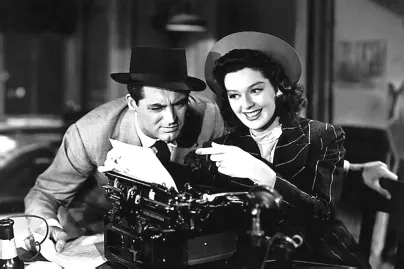
Figure 1.1 His Girl Friday (1940)
As a matter of fact, screenplays are not written to be read but to be shot. However, to be shot, they need to be read.
(Rosen, 1982, p. 75)
To answer this “obvious” if not mundane, yet highly essential and complex question, one must first ask, what is the function of a screenplay and what exactly is it? A screenplay is not only a document whose format has become standardized over the years, it holds a critical and market value for the industry. It is the first stage in producing a film. A screenplay is usually the reason why a film is or isn’t made. It is by reading the script that national funding institutions, peer committees, production and distribution companies and film-makers will decide to back a film or not upon reading the screenplay. There are numerous issues regarding the project, be they economic, aesthetic, dramatic, political, local or international regarding both the artistic film-making process and the project’s feasibility. And the script plays a central role in all of these.
A screenplay is read many times throughout its development by a wide range of readers who often skim through it in order to answer a few simple questions: Who is attached to the project? How much will it cost to produce? Does the part interest me? Will the film be a hit? What is it about? Unfortunately too many screenplays never become movies, not for want of good ideas, but because they haven’t been formulated properly and because they do not take full advantage of the medium for which they were written. Indeed, an incredible number of screenplays are but a story with dialogue. A screenplay, as we will explore in this book, is, and should be, much more than that. And so, some screenwriters completely miss the obvious: What makes a movie a movie? A film is an audio-visual piece – another oft-forgotten “fact”.
Forms of screenplays
At the very least, screenplays should include a description of every scene that sets the tone, both visually and auditorily, for the audio-visual piece that will hold both a sound and a visual track. It is by splicing together sound and visual tracks that the content and aesthetic of the film – the story, subject, direction and editing – will or will not be received, perceived, felt, understood or enjoyed by viewers. Screenplays are to be written with future viewers in mind. These viewers to come, must be present all the time – before, during and in-between the lines of the script. We write to please their senses. We put pen to paper anticipating their reactions.
Here are the first pages of a screenplay from which you will surely quickly recognize the sound and visual track (sound descriptions are in italics):
Aubervilliers. Fifteen years after the disaster.
Ext. Night
An old four-story building in the middle of a vast no man’s land.
Against the leaden skies stands the silhouette of a slumbering city.
There’s a delicatessen on the building’s ground floor. The metallic blinds are drawn. An old sign marked “Delicatessen” squeaks as it sways in the wind. On an upper floor, a light shines at a window. Shots are fired in the night.
Int. Night. Mr. Houy’s apartment
Houy, his ear against the air vent, listens with fear. A fly disrupts him. He nervously swats it away.
He wraps one of his legs in newspaper, tears garbage bags and straps his chest with tape.
He suddenly hears a noise.
A garbage truck with full headlights appears in the distance.
Houy puts on a garbage-bag hood and heads for the door. Each footstep produces a plastic rustle. He stops and stares at his feet.
HOUY
Shit.
The door slowly opens. A foot appears; a pillow taped underneath it. He slides across the corridor, commando-style. The fly continues to buzz around him. He goes down the flight of stairs.
The Butcher continues to sharpen his knives, inspecting every sharp edge.
The garbage truck approaches.
(Delicatessen, written by Gilles Adrien, Jean-Pierre Jeunet and Marc Caro, 1989, screenplay published in 2010, pp. 7–8, our translation)
This example demonstrates how much a screenplay can and should provide the reader with a sound (italicized above) and visual experience. We will see in the next chapter how the mise en scène is also integral to the script development (Raynauld, 1990). One should always picture the future film in order to carefully choose every word in the screenplay. In fact, in good screenplays, words “jump off the page” and materialize as light, gestures, ambiance, lines, emotion, action, landscape, movements, content, continuity between points in time and … the story, although not all scripts are story-driven. Writers can have a non-narrative film in mind. But I will come back to this later.
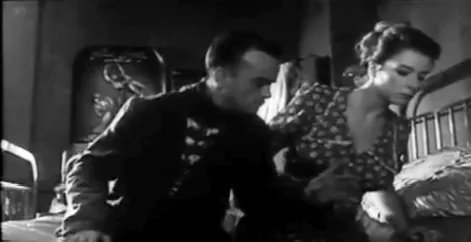
Figure 1.2 Delicatessen (1991)
Since early cinema, screenplays have been written in a wide variety of formats, from a three-line blurb describing the film’s general intent – the desired film – to the standard feature-length fiction film’s 100- to 120-page script, to impossible-to-shoot wording that is essential to some directors – such as the 200 scribbled pages Cassavetes1 purportedly used to shoot Faces, his “most improvised” film, to Children of Paradise’s2 wonderful screenplay full of pastel drawings, As Gilles Mouëllic brilliantly put it in his book on jazz, cinema and improvisation:
Even the filmmakers who are the most open to improvisation rely on a written screenplay by necessity rather than for production reasons (as future backers aren’t often inclined to venture into a project on the sole basis of a few lines and the director’s word). Writing isn’t only and necessarily designing, organizing, planning and mastering, but also thinking and setting the creative process in motion, which will in turn enrich the range of choices that will need to be made during production.
(Mouëllic, 2011, p. 23)
In this book (except in Chapters 10 and 11), I mostly discuss and analyse short and feature-length fiction screenplays written in a standard fashion. By “standard screenplay” I do not imply standard content, treatment or narrative. It is standard in its presentation, professionalism and layout, as well as in its length/page number ratio. Incidentally, despite its non-linear narrative, Mulholland Drive (written by David Lynch and Joyce Alison, 1999) was written in a standard way. It is standardized to fit the expectations of the industry, for funding and other production purposes. Of course, a director can go out and shoot a film without a script if he/she is not dependent on institutionalized funding.
However, you shouldn’t judge a screenplay by its cover. I invite everyone to be vigilant when reading a submitted screenplay and really focus on the content coming to life. It works both ways. For example, when a script does not fit the standard format – 12 pages long comprised of evocative photos and drawings and a few lines of dialogue may be seductively striking, but it will not necessarily lead to an original or innovative film.
Published screenplays
It is crucial for anyone wanting to understand, write, read or teach screenwriting to read the scripts for what they are, instead of only analysing the plot of an actual movie (as is often the case in classrooms or writing workshops). It is essential to use the original manuscript versions rather than the published one. A transcription of a film written after its completion is not a screenplay. It is worth noting that there are several types of published screenplays. Reading the preface is important as they usually identify which version it is. While some publishers have the professionalism to release complete pre-production screenplays, others opt for novelized versions or scene-by-scene transcriptions of the finished motion picture. Though the latter bear a resemblance with well-known films and can be great reference guides, these by-products are not screenplays and should never been analysed as such. There are huge differences between the various versions of one screenplay and a transcription of a film that does not allow us to delve into the author’s writing process (for instance, the magazine L’Avant-scène du cinéma only publishes transcriptions).
All the quotes in this book were taken from actual screenplays written before the films were shot. Original scanned screenplays found on the Internet with the “Final Draft” date on its front page, scripts in film archives and libraries, the personal collection of directors, some published screenplays (except for errors and omissions of the publisher), are all pre-production screenplays.
Words and their consequences
Why does one write a screenplay? For whom is it intended? The screenplay is constituted of two layers of text: the didascalic text (scene descriptions) and the dialogical text (dialogue and voice). The scene descriptions describe what will be seen but also heard (wind, music, noises, etc.). They include visual and auditory instructions, but are separate from the lines that are part of the dialogue and voice (off/over) section.
In a screenplay, every word leads to something, has a consequence if you will, and should be carefully chosen for its capability to become something on-screen. Writing, “The whole village goes up in flames” has a different economic impact on the film’s budget than “A young boy, squatting on the side of a dirt road by a field, plays with matches. Mesmerized, he watches as the flame engulfs dry twigs. In the distance lies the village.” The economic consequences of words might be the easiest one to spot, like choosing the right actor for a part. So producers tend to focus on this too much, too early in the development, often to the detriment of the story, mise en scène and global treatment. Production companies might find these first cursory readings useful in order to spot impossible or excessively expensive projects, but this can prevent readers from discovering the dramatic, aesthetic, narrative and stylistic heart of the entire screenplay and, therefore, of the future film. Judge for yourselves. Here is an excerpt from one of Orson Welles’ most powerful opuses, The Trial ([1962] 1970, pp. 203–204):
INT. COURTROOM. DAY
The accused people stare at K [Anthony Perkins] and his lawyer [Orson Welles].
INT. SPIRAL STAIRCASE. DAY
He turns away from them, leaves the courtroom and enters a small passage. A small door shuts violently behind him as he immediately discovers that he is not alone… The place is damp, dimly lit and he can sense furtive movements around him … little noises, scratchings, gnashing of rodents … and these terrible cluckings … the little girls … He is suddenly surrounded by them.
He screams …
Suddenly taken over by a paroxysmal excitement he furiously fights to free himself from them. He hits blindly to get rid of their insect like fingers … The whole passage now feels like a long chimney … He escapes but he is going down, always deeper down …
The chimney-like passage fills with a thick fog and now he starts to feel he has freed himself from them or at least distanced himself … he runs.
Like furies the young girls chase him, we hear the screams …
What are the scene descriptions telling us? Who is speaking? Who sees what? What do we understand when reading them? What are we picturing in our mind’s eye? What are we feeling? What scenes or moments will these descriptions allow the director to create? Will the viewers be moved or shocked? We should be thinking of all of this when reading a screenplay, as it is because of these emotions, perceptions and stylistic decisions that the film becomes – or fails at becoming – unique, unforgettable, moving, disturbing, different … and good.
The importance of detail
What is a detail in a screenplay? In the previous example from Welles’ script, the girls are the disturbing detail. The girls terrorize the hunted man. In the film, the scene takes place in a dark staircase whose walls are covered in slats of wood through which light casts shadows on to the actor, covering him in black and white stripes (Figure 1.3). The girls peer through the interstices, spying on the man and their shrieks drive him mad as he runs down the stairs leading him nowhere.
A detail needn’t be small and there doesn’t necessarily have to be many in a screenplay. But they must always be significant. This is what turns a mundane scene into something strange, powerful, ...