- 242 pages
- English
- ePUB (mobile friendly)
- Available on iOS & Android
eBook - ePub
About this book
This book is an essential resource for facilitators seeking to help students develop their knowledge of management practice in Italy. It presents a collection of the best case studies and accompanying teaching notes from the Italian Association for Management Development (ASFOR) competition in 2014. The cases are written by teachers across many of the members of ASFOR in Italy, leading business schools, corporate universities and academia. Knowledge gained by professionals often remains implicit and is rarely shared. By grouping together the award-winning case studies in this volume, readers can gain an important insight into how management is conducted in Italy. This collection shines a light on management practices across several industries. The Italian economy differs from others in that it is one in which small and family-run businesses dominate, and the relationship between the private sector and public life is unique. As a result, The Italian Model of Management provides the opportunity for students to enlarge the Anglo-Saxon model and perspective of management, and to offer cross-cultural learning experiences, based on the distinction of a "Made in Italy" competitive advantage. Each case provides an engaging story, plots the strategic development of the organization in question, and is supported by online teaching guidance and teaching notes.
1
The heart of business in an Italian family firm
The Hotel Stella case*
University of Padova, Italy
University of Padova and CUOA Business School, Italy
The case is about an Italian entrepreneurial family and its second generation family hotel. The protagonist is Rosa, who is torn between letting her daughter work in the family business and selling it. The historical background, values and rules of the family and the modes by which the family team was able to exploit environmental entrepreneurial opportunities are explained in detail. Hotel Stella is an organization which functioned according to informal family logics and dynamics. The firm’s management and organization have been based on the family members’ roles and connections. This was particularly important during the economic downturn in recent years. Hotel bookings are decreasing and it is time for innovation. The composition of the family has also changed over time. The Hotel Stella case triggers family business issues such as succession, innovation, strategy, and human resources and it is a comprehensive and stimulating real life example about a family and a business: these two strictly intertwined spheres can be the secret behind proactive and innovative entrepreneurial acts, but they can also hide risk-avoiding fears.
It’s 14 June 2010. Rosa, an elegant and charming 50-year-old woman, and her 25-year-old daughter, Giulia, are having dinner together at home. Rosa looks very tired. She is recovering after the surgery she’s just had, even so she never comes home from work before 9 pm. Rosa has been working at Hotel Stella –her family’s hotel –since 1983.
All of a sudden, Giulia asks, “Mom, do you think I could work at the hotel with you some time?” Rosa looks at her like she has been expecting this question for a long time, but she’s never really been sure how to answer it. Her daughter’s choice could be either the worst mistake of her life or their business salvation. Of course, she could give her the straight answer, “no”, but she wonders what would be better: “The hotel is very stressful: can’t you just keep doing what you are doing now and help me in your free time?” she manages finally. Giulia nods. The conversation apparently ends here.
1.1 Hotel Stella
1.1.1 Organization
Hotel Stella –a four-star hotel –is an enterprise with about 36 staff members (seven cooks and cooks’ assistants, six waiters, two bartenders, two washerwomen, four chambermaids, two receptionists, two secretaries, one hairdresser and aesthetician, three masseurs, two mud therapists, two maintenance men, Rosa, her brother and her husband).
1.1.2 Building and facilities
The hotel has 30 single rooms and 58 double rooms, one indoor swimming pool and one outdoor one, a large hall with a bar, two meeting rooms (for 35 and 15 people), an attractive garden with a big terrace, a tennis court and bowls court, one restaurant, a kitchen and a wine cellar. On the first floor is the beauty, massage and inhalation therapy department; on the fourth and fifth floors are the thermal therapy departments. The whole hotel is accessible to clients, except for a laundry, three offices and the mud pond which have restricted access. Finally, an old swimming pool and an old tavern are used as warehouses.
1.1.3 History and location
The hotel is located in the centre of Abano Terme, in the north-eastern part of Italy. The town is quite well known for hotels with spas. Stella is one of the historic hotels in the town, founded in 1975 by a wealthy local family. Rosa’s family bought it in 1983. In 1984 her daughter was born. After repaying the initial debt, the family has always financed the hotel with its own capital, without incurring other debts. Some additional financial data are reported in Table 1.1.
Rosa’s father’s family has a long entrepreneurial history, which still has a bearing on business conduct today.
Table 1.1 Hotel Stella financial data

1.2 The family background
Rosa’s grandmother was Maria. “Mamma Maria”, her husband, two daughters, and three little sons, Giuseppe, Salvo and Matteo: that’s how it all started (Fig. 1.1).
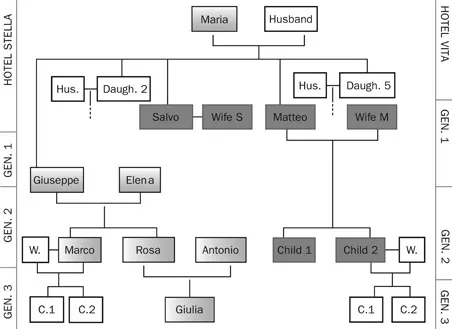
Figure 1.1 Simplified genogram of Rosa’s family and businesses
Notes: C.1 and 2 are less than 14 years old. W. do not feature in the case, but are present in real life. Light grey boxes indicate Hotel Stella; dark grey, Hotel Vita.
1.2.1 Traditional values and local roots
The Fontana family was a typical Catholic Italian middle-class family of the period after World War II. Everyone was used to working hard in the rural area where they lived. During the day, women stayed at home and cared for the children and the house, while their husbands worked in the fields and came back home at night for dinner. Men and older people were always served first, as a sign of respect.
The family was fairly well known in town, especially for their kindness and helpfulness. They were also considered wealthy, because they owned some fields. All the money they had was invested either in fields or in food. For them, work was a means of survival, and also something that could enhance their social status. They also loved nature; horses, fields and rivers were free amusement parks, where they could have fun and be carefree.
Mamma Maria was very important for everyone; she wanted her children to come together at night to feel part of one big united family.
1.2.2 The beginning of the entrepreneurial family
The Fontana family began its entrepreneurial adventure in the 1950s, when family members bought a grocery store in the town centre. It was soon after the war, a time of renaissance, growth and wellbeing. The business was going rather well. In the meantime, Maria’s daughters got married and decided to start some new businesses with their husbands.
The three sons grew and got married and with their wives they decided to “get bigger”. Therefore, they sold the grocery store and promptly bought a restaurant in town.
Giuseppe and Matteo both had two children. When the children grew up, they also had to help their parents with the business after school. It was a normal routine for them. Rosa says: “this was my everyday programme…come back from school, do my homework and then help mom and dad with the dishes.”
The restaurant became quite famous and even had a picture of a well-known actor, who had lunch there, hanging on the wall!
The women made and served the food, did the dishes and the cleaning, while the men were in charge of the bar and of the food procurement. After work, the three men sat at the table and the women had to serve them. This was just the normal routine; no one ever complained.
When Rosa was little she was quite afraid of her dad, a big man who was always very strict. He never said “good job!” and never gave her attention, while her mother was always very busy working, but would have loved to. Since everyone was very busy, Rosa spent a lot of time with her grandmother, Maria. Work was hard for everyone, but they made good money, as Rosa says, “Nine adult hands and eight little hands were enough for being successful! Maybe, even too many for such a small business…”
1.3 Environmental changes and entrepreneurial opportunities
In the 1960s, the family’s home town, Abano Terme, was becoming quite well developed thanks to the numerous hot water springs found there. Hotels were being established all over the town. The Italian public healthcare department was providing financial support to citizens for thermal treatments, as was German health care insurance. Thanks to this support, many hotels were built in the area. Here, the main form of treatment is still mud and inhalation therapy, which are recommended respectively for rheumatic illnesses and respiratory problems.
In a few years, there was a hotel in every corner of the town. Clients came mainly from Germany, along with visitors from Austria, Switzerland and France. The tourist season for foreigners ran from February until June and from September until November, while Italians came mainly in the summer. The average stay of each client was around 12–15 days, and clients used to come back year after year. The German mark was strong over the lira, which also helped to increase tourist traffic.
What still makes this area unique is that almost every hotel was founded by different owners, mainly local families, who built hotels as if they were their own houses. As a matter of fact, every hotel included not only rooms, a bar, a restaurant and a kitchen, but also its own thermal department and facilities (e.g. laundry). To offer a good service, everything had to be made “in house”. This was a fairly common local belief that came from the rural culture, when the best things were “made by mom’s hands”. The associated costs could be afforded because there was no lack of income.
1.3.1 Hotel Romano
The Fontanas could not miss such an opportunity! In 1973 Salvo, the middle son, decided to buy a hotel –Hotel Romano –with his brothers. They took out a loan from the bank which they repaid in less than three years. In the 1970s the hotel was so full that some clients even had to sleep in the chambermaids’ rooms. Meanwhile, barons, ministers and many other famous people started to come to Abano. It became a very attractive, elegant and luxurious town.
Rosa finished her studies when she was 16, in 1976. In that year, she started working full-time at the hotel, first in the front office and later in the back office. At school she was always a good student; she travelled in Switzerland and Germany to learn French and German, but she hated maths. Rosa remembers:
I didn’t like maths! I didn’t like the back office work either. I always made a lot of mistakes with numbers, receipts, accounts… I had to do it, but I would have rather stayed talking or writing to clients for the bookings or information.
1.3.2 Hotel Vita and Rosa’s love life
As there were enough family members to do the work, in less than three years another important decision was made. Salvo and his brothers decided to build another hotel on their own. In the meantime, their father passed away and Mamma Maria gave them her blessing.
In 1977, the new hotel was finished. They named it “Hotel Vita”: a short name, which would have been cheap to light at night. Clients started to come and it was always full, just like Hotel Romano.
A young, proud and brilliant receptionist was hired; his name was Antonio. Rosa also went to work there. Antonio had been a hotel restaurant director before, but since he could speak other languages and was born in Abano, he thought he could also be a good receptionist. Antonio was so overconfident that he made a bet with another employee, “I bet that I will be able to date Rosa, the owner’s daughter. If I win you owe me 20,000 lira”.
Eventually, he did date Rosa! Of course, her father did not know anything about the relationship and Rosa didn’t know about the bet. Giuseppe would have never let his daughter go out with that young man, who was so arrogant, and Rosa would have never agreed to go out with someone who just wanted to win a bet. In 1981 they got married and in 1984 their daughter, Giulia, was born.
1.3.3 Hotel Stella
In 1983, the hotel right in front of Hotel Romano was one of the most luxurious in town. The owners decided to put Hotel Romano up for sale, because they wanted to buy a bigger one. The three brothers didn’t miss the opportunity. They sold Romano and bought the exclusive Hotel Stella. They were not afraid of having to pay off the loan they got from the bank again. They knew they were going to be successful if they worked hard, as they had always done. They felt like a winning team. They had a lot of energy, but also enough experience to accomplish their goals. They felt confident that the economy was growing and they felt they had the chance to be the winners again and again.
1.4 Hotel network and family relationships
1.4.1 The organization: family and business division
Giuseppe, the o...
Table of contents
- Cover
- Half Title
- Title
- Copyright
- Contents
- Foreword
- Introduction
- 1 The heart of business in an Italian family firm: the Hotel Stella case
- 2 Performance appraisal at Telespazio: aligning strategic goals to people development
- 3 UniQuest at UniManagement: Driving innovation through executive development
- 4 Designing a PPP beyond legal procedures: the case of Fahrenheit Resort
- 5 Social business plan simulation: the case of Dynamo Camp
- 6 Strategy execution at Mediolanum Bank: a role play case study
- 7 Ametista
- 8 Implementing a co-branding decision: the Magneti Marelli and Mopar case
- 9 iGuzzini Illuminazione and the challenge of LEDs on the global market
- 10 After all the music… the repositioning of MTV Italia
- Afterword
- About the authors
- About the editors
Trusted by 375,005 students
Access to over 1.5 million titles for a fair monthly price.
Study more efficiently using our study tools.
Frequently asked questions
Yes, you can cancel anytime from the Subscription tab in your account settings on the Perlego website. Your subscription will stay active until the end of your current billing period. Learn how to cancel your subscription
No, books cannot be downloaded as external files, such as PDFs, for use outside of Perlego. However, you can download books within the Perlego app for offline reading on mobile or tablet. Learn how to download books offline
Perlego offers two plans: Essential and Complete
- Essential is ideal for learners and professionals who enjoy exploring a wide range of subjects. Access the Essential Library with 800,000+ trusted titles and best-sellers across business, personal growth, and the humanities. Includes unlimited reading time and Standard Read Aloud voice.
- Complete: Perfect for advanced learners and researchers needing full, unrestricted access. Unlock 1.5M+ books across hundreds of subjects, including academic and specialized titles. The Complete Plan also includes advanced features like Premium Read Aloud and Research Assistant.
We are an online textbook subscription service, where you can get access to an entire online library for less than the price of a single book per month. With over 1.5 million books across 990+ topics, we’ve got you covered! Learn about our mission
Look out for the read-aloud symbol on your next book to see if you can listen to it. The read-aloud tool reads text aloud for you, highlighting the text as it is being read. You can pause it, speed it up and slow it down. Learn more about Read Aloud
Yes! You can use the Perlego app on both iOS and Android devices to read anytime, anywhere — even offline. Perfect for commutes or when you’re on the go.
Please note we cannot support devices running on iOS 13 and Android 7 or earlier. Learn more about using the app
Please note we cannot support devices running on iOS 13 and Android 7 or earlier. Learn more about using the app
Yes, you can access The Italian Model of Management by Luigi Serio in PDF and/or ePUB format, as well as other popular books in Business & Business General. We have over 1.5 million books available in our catalogue for you to explore.