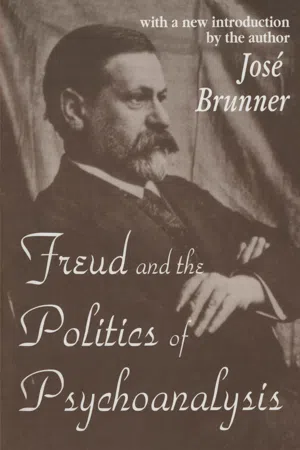
Freud and the Politics of Psychoanalysis is a sympathetic critique of Freud's work, tracing its political content and context from his early writings on hysteria to his late essays on civilization and religion. Brunner's central claim is that politics is a pervasive and essential component of all of Freud's discourse, since Freud viewed both the psyche and society primarily as constellations of power and domination. Brunner shows that when read politically, Freud's discourse can be seen to unite mechanics and meaning into a plausible, fruitful and internally consistent theory of the mind, therapy, family and society.Part one deals with the medical and political background of Freud's work. It explains how Freud postulated mental principles that were the same for all races and nations. The second part is concerned with the logic and language of Freud's theory of the mind. Brunner also details how Freud introduced dynamics of dominance and subjugation into the very core of the psyche. Part three addresses dynamics of power in the clinical setting, which Freud forged out of a curious blend of authoritarian and liberal elements. Brunner focuses on how this setting creates an arena for verbal politics. He also examines various social factors that influenced the therapeutic practice of psychoanalysis, such as class, gender and education. Part four explores Freud's analysis of the family and large-scale social institutions. Though Brunner is critical of the authoritarian bias in Freud's social theory, he suggests that it provides a useful vocabulary to unmask hidden psychological aspects of domination and subjection. This is an essential book for those interested in the history of ideas and psychoanalysis.Josu Brunner is Senior Lecturer at the Buchmann Faculty of Law and the Cohn Institute for the History and Philosophy of Science and Ideas, both at Tel Aviv University. Born in Zorich, Switzerland, he has been living in Israel for most of the last three decades. He is author of numerous publications on the history and politics of psychoanalysis and contemporary political theory.
- 238 pages
- English
- ePUB (mobile friendly)
- Available on iOS & Android
eBook - ePub
Freud and the Politics of Psychoanalysis
About this book
Information
Table of contents
- Cover
- Half Title
- Title Page
- Copyright Page
- Table of Contents
- Introduction to the Transaction Edition
- Preface
- I Nervousness and Nationalism
- II A State of Mind
- III Between Two Consenting Adults
- IV Empires of Passion: Oedipal Politics in Freud’s Writings on Social Relations
- Conclusions
- Notes
- References
- Index
Trusted by 375,005 students
Access to over 1.5 million titles for a fair monthly price.
Study more efficiently using our study tools.
Frequently asked questions
Yes, you can cancel anytime from the Subscription tab in your account settings on the Perlego website. Your subscription will stay active until the end of your current billing period. Learn how to cancel your subscription
No, books cannot be downloaded as external files, such as PDFs, for use outside of Perlego. However, you can download books within the Perlego app for offline reading on mobile or tablet. Learn how to download books offline
Perlego offers two plans: Essential and Complete
- Essential is ideal for learners and professionals who enjoy exploring a wide range of subjects. Access the Essential Library with 800,000+ trusted titles and best-sellers across business, personal growth, and the humanities. Includes unlimited reading time and Standard Read Aloud voice.
- Complete: Perfect for advanced learners and researchers needing full, unrestricted access. Unlock 1.5M+ books across hundreds of subjects, including academic and specialized titles. The Complete Plan also includes advanced features like Premium Read Aloud and Research Assistant.
We are an online textbook subscription service, where you can get access to an entire online library for less than the price of a single book per month. With over 1.5 million books across 990+ topics, we’ve got you covered! Learn about our mission
Look out for the read-aloud symbol on your next book to see if you can listen to it. The read-aloud tool reads text aloud for you, highlighting the text as it is being read. You can pause it, speed it up and slow it down. Learn more about Read Aloud
Yes! You can use the Perlego app on both iOS and Android devices to read anytime, anywhere — even offline. Perfect for commutes or when you’re on the go.
Please note we cannot support devices running on iOS 13 and Android 7 or earlier. Learn more about using the app
Please note we cannot support devices running on iOS 13 and Android 7 or earlier. Learn more about using the app
Yes, you can access Freud and the Politics of Psychoanalysis by Jose Brunner in PDF and/or ePUB format, as well as other popular books in Psychology & History & Theory in Psychology. We have over 1.5 million books available in our catalogue for you to explore.