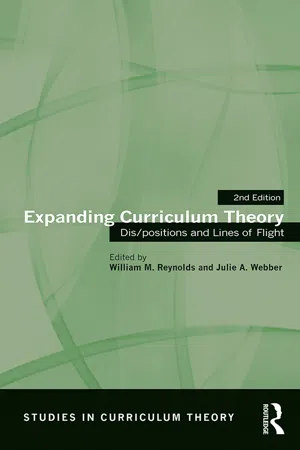
Expanding Curriculum Theory, Second Edition carries through the major focus of the original volume—to reflect on the influence of Deleuze and Guattari's concept of "lines of flight" and its application to curriculum theorizing. What is different is that the lines of flight have since shifted and produced expanded understandings of this concept for curriculum theory and for education in general. This edition reflects the impact of events that have contributed to this shift, in particular the (il)logic of school policy changes and reforms in the past decade, and the continued explosion of social media and its effect on the collective understanding of how both "knowledge" and "education" work as forms of repression. The introduction updates the text and puts it into current debates in the field and in the larger socio-economic milieu. New dis/positions are presented that explore central questions circulating within and outside curriculum studies. Exciting scholarship on a range of topics includes notions of desire and commodities, youth culture and violence, new directions in curriculum theory, Eco-Ethical consciousness, new Deleuzian views of normality, the diffusion of technology and lines of flight in transnational curriculum inquiry.
eBook - ePub
Expanding Curriculum Theory
Dis/positions and Lines of Flight
- 166 pages
- English
- ePUB (mobile friendly)
- Available on iOS & Android
eBook - ePub
About this book
Information
1 Introduction
Curriculum Dis/positions
DOI: 10.4324/9781315882109-1
We have as many entangled lines in our lives as there are in the palm of a hand. But we are complicated in a different way. The pursuits we call by various names—schizo-analysis, micro-politics, pragmatism, diagrammatics, rhizomatics, cartography—have no other goal than the study of these lines, in groups or in individuals.Deleuze and Guattari 1983, pp. 71–72
The first edition of this text (2004) was written during the years of the George W. Bush administration. Bush was re-elected in 2004 and his legacy of fear, surveillance, perpetual war and religiosity continued for another four years, and that legacy can still be felt in the Obama administration’s use of drone warfare. The Obama administration’s focus is the continuation of the militarization of everything, particularly the schools. The disastrous economic plummet in 2008 affected everyone or at least the 99 percent. Now in 2015 we have a new type of presidential campaign. The campaign has become a reality show, with those who spew forth the most vile, racist, sexist, and nativist comments receiving the most media attention. We now face a time of cruelty, greed, and insensitivity.
Evil is not confined to war or totalitarian ideologies. Today it more frequently reveals itself in failing to react to someone else’s suffering, in refusing to understand others, in insensitivity and in the eyes turned away from a silent ethical gaze.Bauman and Donskis 2013, p. 9
It is a time to reemphasize the need for the political orientations and conceptualizations of Deleuze and Guattari. In the first edition we also emphasized the political ramifications of the work of Deleuze and Guattari. This book expands our earlier conceptual efforts to encourage the use of Deleuze and Guattari’s seminal works Anti-Oedipus: Capitalism and Schizophrenia (1983) and A Thousand Plateaus: Capitalism and Schizophrenia (2002) by scholars and teachers to continue to reconceptualize curriculum theory in the twenty-first century. Legislation like No Child Left Behind (NCLB) and Race to the Top, the increasing corporatization of public education, and the politics surrounding the training of new teachers as administrative workers make this intervention critical. This volume revisits our original argument, responds to critics, and reimagines the use of Deleuze and Guattari’s work a decade later.
In 2004, in the Afterword of the first edition, we speculated that the further the United States went into administering NCLB as a means of reforming public education, the worse educational outcomes would become. This has happened. We also argued that the continued response to public education crises that model themselves on market policies would ultimately fail. Again, this has happened. Finally, we noted and explained how part of the crisis was facilitated by the poor curriculum theory and philosophy that most universities and colleges replicate. As Henry Giroux wrote nearly three decades ago,In our volume, we stressed that time would become a significant barrier to teachers’ and activists’ ability to challenge the growing corporatization and administrative orientation of public schooling. As the decade wore on, and more and more tests were mandated, there was simply no time left in the school day to teach the arts and humanities. Schools across the country eliminated music, art, and physical education from the school day. Teacher burnout was at an all-time high, and many highly controversial scandals erupted, showing that teachers were cheating the testing system itself.
Teachers and administrators must be seen as more than technicians. The technocratic, sterile rationality that dominates the wider culture, as well as teacher education, pays little attention to theoretical and ideological issues. Teachers are trained to use forty-seven different models of teaching, administration or evaluation. Yet, they are not taught to be critical of these models. In short, they are taught a form of conceptual and political illiteracy.Giroux 1988, p. 8
“The widespread cheating and test score manipulation problem,” said Robert Schaeffer, the public education director of FairTest, the National Center for Fair and Open Testing, “is one more example of the ways politicians’ fixation on high-stakes testing is damaging education quality and equity” (quoted in Rich 2013). The critical intervention we proposed comes out of an earlier movement in curriculum theory called the Reconceptualization, which was an attempt to forestall the effects of what was seen as a growing business orientation in teacher education and in public schools through the organization and conceptualization of the curriculum itself. It was also a challenge to exclusively viewing curriculum as simply curriculum development.
Two major splinter groups formed at the inception of this movement were not antithetical; they took different, yet largely complementary directions. First, the radical pedagogy approach proposed by Giroux, Aronowitz, Kincheloe, McLaren, Macedo, and others drew upon and theorized a radical educational philosophy from Paulo Freire, a Brazilian critical educator. They were inspired by the radical democracy they saw implied in the work of the early twentieth-century American pragmatist John Dewey. Through radical, critical pedagogy their goal has been to promote critical literacy for teachers, especially through education and support, but also to transform the educational system by imagining it as a laboratory for radical democracy rather than for the administration of mass schooling. The second group, known as the Reconceptualization, aimed to theorize the curriculum of education and schooling in ways that promoted critical intellectual inquiry by students and graduate students in education. The Reconceptualization focused on epistemology (e.g. how we know what we know and do we know it?) is an important political and educational intervention because it criticizes and often undermines the excesses of traditionalist and positivist approaches in mainstream education thought that allows standardized testing such undisputed authority when measuring educational outcomes. Expanding Curriculum Theory represents the second view with its advocacy of Deleuze and Guattari’s work and specifically focuses on their goal of “lines of flight” from traditional educational politics, even from the parameters of the debates in education. Yet, it also has ties to those radical democratic conceptualizations as well. So, for example, Diane Ravitch is a prominent education scholar and policymaker who for decades promoted standardized testing as a means of measuring educational outcomes. Although she no longer supports NCLB, she still supports the role of standardized testing, which is underwritten by philosophies of education and curriculum that reaffirm the centrality of the instrumentalist, rationalist, positivist paradigm in social science. This means that critical interventions from the humanities, such as literature, philosophy, foreign languages and the arts, will continue to be excluded from the national conversation about educational reform. They will also face exclusion from the curriculum of new teachers in schools of education, except where students are allowed to take electives. This research is significant to all university and college teachers who wish to continue to see intellectual integrity and respect promoted in public schooling.
As an edited volume, this second edition is comprised of many new chapters that reflect on the relevance of Deleuze and Guattari’s work for curriculum theorizing and radical pedagogy given the events of the past decade. In many ways, the past decade, while characterized as one of both reform and openness (of schools, markets, etc.) is in reality one of stifling repression. Schools are closing throughout the country, books are banned, and state legislatures pass bills that ban books, rewrite history, and promote further inequality among American citizens. Some scholars confused the openness of Deleuze and Guattari’s line of flight with the openness of the market. It is often quoted that Michel Foucault called the twentieth century “Deleuzian,” but then critics concluded that their work is no longer relevant in or even potentially dangerous to the twenty-first century. These kinds of criticisms have generated debate, not only in curriculum (Wallin 2012, jagodzinski 2010) but also in political and social theory. Contemporary proponents of Deleuze and Guattari’s work (Hardt and Negri 2000, 2004) have demonstrated how global capitalism itself is Deleuzian through its de-territorial operations. Žižek has called Hardt and Negri’s Empire (2000) “the communist manifesto for the twenty-first century” (quoted in Nail 2012, p. x). Others have pointed out that the Israeli Defense Forces (IDF) have used Deleuzian concepts like “smooth space” to enhance its military training in Gaza, enabling soldiers to envision “walking through walls” (Weizman 2007, p. 1), while still others characterize Deleuze and Guattari’s entire oeuvre as politically “open source,” meaning anyone can adopt it for their political projects without damaging the poetic and epistemological relevance it nonetheless poses to rigid, authoritarian systems of thought (Galloway 2012, p. 50). Some even point out that the tendency to confuse Deleuzo-Guattarian thought with contemporary politics is the result of poor study habits, as John Protevi remarks of Deleuze: “Although that was forty years ago now, and already in the early ’90s when he wrote the ‘control society’ essay near the end of his life, he was perhaps realizing that power had already co-opted his rhizomatic relational ontology in new ways. And in fact today it’s not that difficult to show how Deleuzian ontology is quite compatible with capitalism (i.e. how Google or Facebook valorizes multiplicity and distributed networks, etc.)” (Protevi 2012). However, Protevi points out that Deleuze and Guattari stressed in A Thousand Plateaus (2002) that this rhizomatic ontology was meant to be understood and analyzed alongside other factors, such as stratification (Protevi 2012). This means that the “smooth space” that the IDF borrows from them in order to imagine Gaza and walk through walls must also be seen as a space of stratification that interacts with that rhizomatic being: the IDF soldier. Some argue that the overemphasis on Deleuze’s philosophy and under-emphasis on Guattari’s politics have left the duo vulnerable to these unfair charges (Wallin 2012). These debates are lively and critical. Paul Patton (2008) discusses the notion that there is in one line in Deleuze and Guattari’s What Is Philosophy (1994) that is a reference to “becoming democratic.”
Moreover, the political and epistemological questions raised by these new debates have encouraged us to invite essays on topics concerning the role of social media, technology, and the diverse communities they comprise in education. More recently, one response to the crisis of NCLB has been to argue for open source educational content, alongside the application and use of technology in the classroom to enhance learning. We present the nuances posed by the comparison between what Deleuze and Guattari theorized about global capitalism and the braided and complex conclusions observers have drawn from them.
One conclusion in particular is that education is an enterprise centered on false notions of equality of access and profitability. Critics see this emphasis on liberal notions of equality and profitability as evidence that education has itself become “Deleuzian” in that it seeks to free itself from the repressive structures of authority imposed by teachers as knowledgeable agents, and tax dollars as penalties to free citizens. However, citing Protevi’s important argument that the rhizomatic operates alongside stratification, we see the liberal legacy of NCLB itself as the repressive structure, in that it has only served to produce inequality, social and economic stratification, and political deprivation. We propose to understand even the popular criticism of NCLB as a new concept of repression to explain the ongoing chain of events posed by neoliberal education reform. Second, the continued explosion of social media and its effect on our collective understanding of both “knowledge” and “education” is another form of repression. While proponents see such media as a “sharpening” of students’ critical skills, many contributors to this volume see such media and their iterations (technologies, new social formations like flash mobs), at least in their current use, as regressive.
So the focus in this second edition remains on the work of Deleuze and Guattari; however, the lines of flight have shifted and produced expanded understandings of their work for curriculum theory and education in general. The essays in this second edition differ from the first edition in that there is an effort to have all of the essays focus specifically on the works of Deleuze and Guattari and related thinkers. Following the wisdom of the reviewers of the first edition, this concentrated focus is one of the major changes in the volume, resulting in new and exciting scholarship. Issues discussed include, but are not limited to, notions of desire and commodities, youth culture and violence, new directions in curriculum theory, Žižek, Deleuze and curriculum, eco-ethical consciousness, new Deleuzian views of normality, new notions of the diffusion of technology, and lines of flight in transnational curriculum inquiry. These contributions will all be assessed in terms of the framework presented in the Introduction.
The second edition, while carrying through with the major orientation of the first edition, will present students and scholars new lines of flight to consider as possibilities as the work of Deleuze and Guattari and other major intellectuals are applied to curriculum studies.
Dis/positioning
Control is not only the ghost in the clock of curriculum—to use the predominant modernist, mechanistic, metaphor—it is the ghost which actually runs the clock. It is time to put this ghost to rest, let it retire peacefully to the land of no return and to liberate curriculum to live a life of its own.Doll and Gough 2002
In this section, the curriculum studies field is used as an example of the type of thinking that can dis/position in general. This line of flight scholarship is connected by its shared concern for viewing educational phenomena from alternative perspectives that are not method driven, but instead derived from the insights of a disposition that seeks to disentangle scholarship from its traditional dependence on formalities. Ever since reconceptualization, formal curriculum theorizing as well as educational research have dominated the field as scholars have attempted to gain acceptance for alternative methodologies such as textual analysis, discourse theory, hermeneutics, cultural studies, psychoanalysis, and poststructuralism while triangulating them with the important perspectives of race, class, gender, and sexual orientation. Although the enormity of this reconceiving process has produced innovative and challenging work, the place from which the author speaks has been, for the most part, ignored to the benefit of professionalism as an ideology in the academy. That is, although the research topics and methods that have recast curriculum orientations have made the field a much stronger contender within the larger field of education, they have not yet touched on the crucial role th...
Table of contents
- Cover Page
- Half-Title Page
- Title Page
- Copyright Page
- Table of Contents
- Preface
- Acknowledgments
- 1 Introduction: Curriculum Dis/positions
- 2 Commodification and Desire: Lines of Flight in the Distractions of Consumer Capitalism and Corporate Education
- 3 The Damned Soul: Pleasure and Meaning in American Life
- 4 To Die Well: The Death of Death in Curriculum
- 5 Education for Eco-Ethical Becoming: Reading Bateson and Deleuze on Difference
- 6 Cracking the Dish: Micropolitical Possibilities for Bodies without Organs
- 7 Changing Planes: Lines of Flight in Transnational Curriculum Inquiry
- 8 Wild Honey: Toward a Curriculum of Be(e)comings
- 9 Teaching-Assemblages: Negotiating Learning and Practice in the First Year of Teaching
- Contributors
- Index
Trusted by 375,005 students
Access to over 1.5 million titles for a fair monthly price.
Study more efficiently using our study tools.
Frequently asked questions
Yes, you can cancel anytime from the Subscription tab in your account settings on the Perlego website. Your subscription will stay active until the end of your current billing period. Learn how to cancel your subscription
No, books cannot be downloaded as external files, such as PDFs, for use outside of Perlego. However, you can download books within the Perlego app for offline reading on mobile or tablet. Learn how to download books offline
Perlego offers two plans: Essential and Complete
- Essential is ideal for learners and professionals who enjoy exploring a wide range of subjects. Access the Essential Library with 800,000+ trusted titles and best-sellers across business, personal growth, and the humanities. Includes unlimited reading time and Standard Read Aloud voice.
- Complete: Perfect for advanced learners and researchers needing full, unrestricted access. Unlock 1.5M+ books across hundreds of subjects, including academic and specialized titles. The Complete Plan also includes advanced features like Premium Read Aloud and Research Assistant.
We are an online textbook subscription service, where you can get access to an entire online library for less than the price of a single book per month. With over 1.5 million books across 990+ topics, we’ve got you covered! Learn about our mission
Look out for the read-aloud symbol on your next book to see if you can listen to it. The read-aloud tool reads text aloud for you, highlighting the text as it is being read. You can pause it, speed it up and slow it down. Learn more about Read Aloud
Yes! You can use the Perlego app on both iOS and Android devices to read anytime, anywhere — even offline. Perfect for commutes or when you’re on the go.
Please note we cannot support devices running on iOS 13 and Android 7 or earlier. Learn more about using the app
Please note we cannot support devices running on iOS 13 and Android 7 or earlier. Learn more about using the app
Yes, you can access Expanding Curriculum Theory by William M. Reynolds,Julie A. Webber in PDF and/or ePUB format, as well as other popular books in Education & Education General. We have over 1.5 million books available in our catalogue for you to explore.