![]()
1.1 HISTORICAL BACKGROUND
Historically, there are two branches of science that underpin the physics behind electromagnetic fields – electrostatics and magnetism. Both of these have been well known for centuries. The ancient Greeks were familiar with electrostatics from their studies of amber and magnetism was known to the Chinese who invented the magnetic compass. The science of electroconduction was developed around 1800 with the invention of the battery; however, it was Michael Faraday (1791–1867) who made the link between electrostatics and electroconduction – they were the same thing. Now there were two sciences – electric current and magnetism.
It wasn’t until 1820 that Hans Christian Oersted demonstrated a link between a magnetic field and a constant current (only direct current [dc] at the time). This was the first indication that electroconduction and magnetism were linked. In 1831, Faraday demonstrated that a changing magnetic field could induce a changing current in a wire. So, we now have a changing magnetic field causing a changing current in a wire and a changing current causing a changing magnetic field. It was James Clerk Maxwell who, in 1865, formalised the work of Faraday and unified electricity and magnetism. This laid the foundation of, among other things, special relativity. A fortunate result of this work was the prediction of electromagnetic waves and that light was an electromagnetic wave.
Oliver Heaviside (1893) adapted the theory presented by Maxwell into the four equations we know today as Maxwell’s equations. Heaviside also worked on the telegraph system, predicting that performance can be improved by using loading coils. Following on from Maxwell’s prediction, there were several attempts to demonstrate radio wave transmission. However, these were considered to be transmission due to inductive coupling and not to be electromagnetic waves themselves. Credit for using electromagnetic waves goes to Heinrich Rudolf Hertz who, in 1888, demonstrated conclusively that the waves existed. It was Marconi, in 1894, who started work on a commercial radio system and in 1897 he started a radio station on the Isle of Wight in the United Kingdom. He was awarded the Nobel Prize in Physics in 1909. This was the start of commercial broadcasting as we know it.
As a society, we now have radio broadcasting, numerous TV channels, the Internet, voice over Internet protocol (IP), video on demand, text messaging, etc. We are a “wired” or even “wireless” society. It is instructive to see how long this has taken: Maxwell formulated his ideas in 1865 and we are now some 150 years later; the optical fibre that is widely used to carry the Internet and data was developed in 1970; broadcast by satellite started in earnest in 1990; we also have digital radio and TV (1998). The pace of change is very fast and it is a very brave person indeed who would predict what the next 20 years will bring. One thing is certain, the fundamentals will not change and that forms the first part of this chapter.
1.2 REASONS FOR ELECTROMAGNETIC COMMUNICATION
Communications, in the form of electromagnetic waves, are literally all around us – radio, TV, mobile phones, Wi-Fi, satellite, etc. These systems are so common that we often take them for granted. But why do we use electromagnetic waves and why do the signals sometimes drop out so that we lose the telephone link or there is no TV signal?
Let us first look at how we communicate in our everyday lives. As a species, we are equipped with the means to communicate – we talk using our mouths and we hear using our ears. This system of communication is very efficient and is replicated throughout the animal world. So, why have we developed an alternative that uses man-made signals?
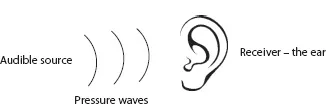
One of the problems associated with our innate communication system is that it relies on pressure waves carried by the molecules that make up the air (Figure 1.1). If we are in space, where there is no air, sound does not carry since there are no molecules present. Another problem is one of power. If we talk face to face, not much audio power is required to carry on a conversation. However, in a noisy environment, we have to increase our audio power by raising our voices. Eventually, we have to shout and this places a strain on our vocal chords. This is where electronic amplification comes in.
FIGURE 1.1 An audible transmission system.
In order to increase audio power, a microphone can be used to convert sounds into an electrical signal and an amplifier is used to boost the signal (Figure 1.2). A loudspeaker is then used to convert the signal back into a pressure wave. In this way, we can overcome the problem of limited audio power by simply increasing the amplification. There is a major difficulty though. If we wish to broadcast to a large audience, a city for example, we would require a very large amount of audio power. If the power level is adequate for those far from the loudspeaker, the level for those close to the loudspeaker would be so high that permanent damage to the ear would result. So, there is an obvious limitation if this system ...