Advances in Building Energy Research (ABER) offers state-of-the-art information on the environmental science and performance of buildings, linking new technologies and methodologies with the latest research on systems, simulations and standards. As stringently reviewed as a journal but with the breadth of a book, this annual volume brings together invited contributions from the foremost international experts on energy efficiency and environmental quality of buildings. Spanning a broad range of technical subjects, this is a 'must have' reference on global developments in the field, suitable for architects and building engineers, environmental engineers, industry professionals, students, teachers and researchers in building science, technical libraries and laboratories.
- 324 pages
- English
- ePUB (mobile friendly)
- Available on iOS & Android
eBook - ePub
About this book
Information
1
Research on heating and cooling requirements of buildings with solar louvre devices
Ana I. Palmero-Marrero and Armando C. Oliveira
Abstract
External louvres have been increasingly used to provide solar protection for a building’s glazed surfaces. In this work, a general study of the effect of louvre shading devices applied to different façades of a building is carried out for different locations (latitudes). Building energy requirements for a building in the cooling and heating seasons are quantified for different window and louvre areas, under different climatic conditions (Europe, Africa and America). Shading geometry is studied with EES software, while indoor air and operative temperatures are calculated through simulations with TRNSYS. Both horizontal and vertical louvre layouts are considered. The results show that the use of louvre shading devices in the building leads to indoor comfortable thermal conditions and may lead to significant energy savings, in comparison with a building without shading devices. The potential of integrating solar thermal collectors into horizontal solar louvres is also addressed, by considering possible active solar heating and cooling systems.
■ Keywords – building simulation; EES; energy requirements; solar louvres; TRNSYS
INTRODUCTION
Glazed areas and shading devices have an important role in a building’s energy consumption. Highly glazed façades have been increasingly used in new buildings, allowing access to daylight and an external view. However, the risk of a high cooling and heating demand in the building must be considered (Hien et al, 2005; Poirazis et al, 2008).
The most effective way to reduce the solar load on fenestration is to intercept direct radiation from the sun before it reaches the glass. The energy performance of buildings using different shading designs, such as overhangs (Lee and Tavil, 2007), external roller shades (Tzempelikos and Athienitis, 2007) and venetian blinds (Simmler and Binder, 2008), has been studied. Glazed areas that are fully shaded from the outside reduce solar heat gain by as much as 80 per cent (ASHRAE, 1997). In all exterior shading structures, the air must move freely to carry away heat absorbed by the shading and glazing materials. This is the case with external louvres.
Louvres are currently widely used, providing solar protection for glazed spaces and reducing loads during the cooling season. Some studies on the effect of louvres on a building’s thermal performance (Datta, 2001) and daylighting performance (Freewan et al, 2009) have been carried out. The integration of a solar thermal collector into an existing louvre design, using horizontal louvres (overhang type), was assessed (Palmero-Marrero and Oliveira, 2006). In all these cases, only south-oriented windows and horizontal layout louvres were studied. However, louvres have been applied to other façade orientations, and also with vertical layouts. Applications extend to a variety of vertical glazed façades, atria roofs, windows and conservatories – see Figure 1.1.
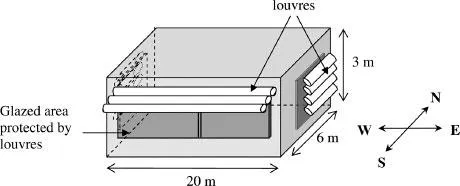
In the Northern Hemisphere, due to solar incidence angles, horizontal layouts can considerably reduce the solar heat gain on south, southeast and southwest exposures, during late spring, summer and early autumn. On east and west exposures, during the entire year, solar altitude is generally so low that, to be effective, horizontal layouts would have to be excessively long (ASHRAE, 1997). In these cases, a good solution could be the use of adjustable vertical mechanisms to control direct solar radiation (Ciemat, 2001).
Since a building may have glazed façades that are not south-oriented, the effect of shading devices in other orientations must be studied. In this work, the performance of louvre shading devices applied to the east, west and south façades was evaluated for different latitudes. Both horizontal and vertical layouts were considered. The energy required in the building for space coolin...
Table of contents
- Cover
- Half Title
- Title Page
- Copyright Page
- Table of Contents
- List of Acronyms and Abbreviations
- 1 Research on heating and cooling requirements of buildings with solar louvre devices
- 2 On the evaluation of heating, ventilating and air conditioning systems
- 3 Climatic change and the built environment
- 4 Chromogenic technologies: Towards the realization of smart electrochromic glazing for energy-saving applications in buildings
- 5 Overview of natural cross-ventilation studies and the latest simulation design tools used in building ventilation-related research
- 6 Comfort models and cooling of buildings in the Mediterranean zone
- 7 Cool materials and cool roofs: Potentialities in Mediterranean buildings
- 8 Artificial intelligence for energy conservation in buildings
- Index
Trusted by 375,005 students
Access to over 1.5 million titles for a fair monthly price.
Study more efficiently using our study tools.
Frequently asked questions
Yes, you can cancel anytime from the Subscription tab in your account settings on the Perlego website. Your subscription will stay active until the end of your current billing period. Learn how to cancel your subscription
No, books cannot be downloaded as external files, such as PDFs, for use outside of Perlego. However, you can download books within the Perlego app for offline reading on mobile or tablet. Learn how to download books offline
Perlego offers two plans: Essential and Complete
- Essential is ideal for learners and professionals who enjoy exploring a wide range of subjects. Access the Essential Library with 800,000+ trusted titles and best-sellers across business, personal growth, and the humanities. Includes unlimited reading time and Standard Read Aloud voice.
- Complete: Perfect for advanced learners and researchers needing full, unrestricted access. Unlock 1.5M+ books across hundreds of subjects, including academic and specialized titles. The Complete Plan also includes advanced features like Premium Read Aloud and Research Assistant.
We are an online textbook subscription service, where you can get access to an entire online library for less than the price of a single book per month. With over 1.5 million books across 990+ topics, we’ve got you covered! Learn about our mission
Look out for the read-aloud symbol on your next book to see if you can listen to it. The read-aloud tool reads text aloud for you, highlighting the text as it is being read. You can pause it, speed it up and slow it down. Learn more about Read Aloud
Yes! You can use the Perlego app on both iOS and Android devices to read anytime, anywhere — even offline. Perfect for commutes or when you’re on the go.
Please note we cannot support devices running on iOS 13 and Android 7 or earlier. Learn more about using the app
Please note we cannot support devices running on iOS 13 and Android 7 or earlier. Learn more about using the app
Yes, you can access Advances in Building Energy Research by Mat Santamouris in PDF and/or ePUB format, as well as other popular books in Arquitectura & Sostenibilidad en la arquitectura. We have over 1.5 million books available in our catalogue for you to explore.