eBook - ePub
How to Account for Sustainability
A Simple Guide to Measuring and Managing
- 119 pages
- English
- ePUB (mobile friendly)
- Available on iOS & Android
eBook - ePub
About this book
Learn how to measure, manage and account for sustainability in your business in clear, simple and feasible steps.This book takes you from concept to innovation and back to action items for all aspects of sustainability. Each chapter has four sections: (1) a specific description of sustainability challenges, (2) an example of a business making a profit by sustainability problem, (3) an exercise challenging the reader to identify business solutions and (4) clear, simple takeaways.The book is structured around the world's most accepted guidelines for sustainability reporting, the Global Reporting Initiative.
Chapter 1
Introduction: Occam’s Razor and Sustainability Reporting
THE PRINCIPLE OF OCCAM’S RAZOR states that the simplest explanation is the best as long as it captures all the relevant points. In the words of Einstein, ‘If you can’t explain it simply, you don’t understand it well enough.’
This book explains, in the simplest terms possible, how to account for sustainability. It does this by providing you with an understanding of the landscape of sustainability with entry points for each area and aspect of sustainability. It is written so you can enhance your company’s bottom line through the ‘triple bottom line’.
If you are reading this book, you probably have an idea that your company is doing a lot when it comes to sustainability, but are not sure exactly how it all fits together. This book gives you an easy entry point into sustainability reporting for your business. It can also be used to create a foundation for your company’s sustainability strategy.
This entry point is found indicators. Once you know what to account for, and what your company is already measuring, and so managing, in the sustainability landscape, it is just a series of simple steps to issue your first sustainability report. One of the benefits of creating a sustainability report is you will have a firm understanding of what sustainability means for your business, where you are doing well, and where your gaps are. With this foundation, you will be in a position to take advantage of the opportunities that sustainability presents for your business, form a strategy, and increase profits while helping the planet.
So, what is sustainability?
These days, the simplest way to measure sustainability is the Global Reporting Initiative’s framework, known as the ‘GRI’. The GRI emerged in reaction to the 1989 Exxon Valdez oil spill. A group of socially responsible investors and environmentalists formed the first set of indicators for managing environmental, social, and economic performance. They thought that if business managers had the means to measure the full range of business impacts, disasters like the Valdez oil spill could be averted.
The GRI is a set of guidelines created by businesses, governments, advocacy groups, universities, and research organizations. It is a collaborative effort designed to give business managers the measures to manage sustainability. The GRI encompasses six areas: Environment, Economic, Social, Product Responsibility, Human Rights, and Labor Practices & Decent Work (Figure 1).
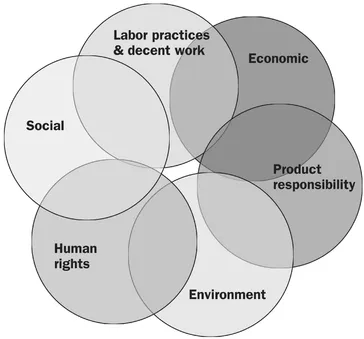
FIGURE 1. The six areas of sustainability
The GRI’s six areas fit within the convention of the three systems of the ‘triple bottom line’ – economy, environment, and society. Other areas – labor practices & decent work, human rights, and product responsibility – overlap within environmental, social, and economic systems.
Areas and aspects of sustainability
The ‘topography’ of the GRI’s indicators consists of the areas and the aspects (Figure 2), which can be thought of as the map and the path for business performance, respectively. They are the areas for measuring and for managing.
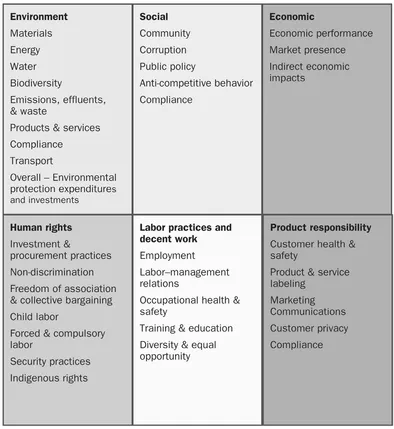
Figure 2. GRI’s areas and aspects of sustainability.
How to use this book
The following chapters give examples of sustainability challenges and opportunities for businesses within the six areas defined by the GRI. Together, we will look at each specific aspect of sustainability and highlight ways we are not sustainable. For each aspect there is an example of a company that is making good by doing good and an exercise to help business managers identify opportunities within the challenge for enhancing profits and practicing sustainability. At the end of each exercise are learning points the exercise is intended to bring to mind.
A bit about best practices
Best practices are the most efficient and effective way to reach a goal. The businesses I highlight are blazing a new path. Some are doing this intentionally. Others found a niche that emerged out of the lack of sustainability in that industry or market. I use these businesses as examples to inspire. We all understand there are a lot of factors that make for the success, or failure, of a business when it comes to sustainability. Thus, what may work well for one business could end in failure for another. My intent is for the reader to use these examples as launching places to forge their own best practices.
As our environment, society, and economies become sustainable, the best practices for any business will be very different from those of today. Part of our job is creating best practices for doing business that bring about sustainability today and in our future. And then doing it again.
It’s that simple, and just like we got what we aimed for at the dawn of the industrial era – profit – we can get what we aim for now by employing simple frameworks, setting simple goals, and creating the best practices that will get us there.
How not to use this book
This book is not prescriptive. It defines sustainability through the GRI, but this does not mean this is the only way to define sustainability for your company. I believe the GRI is a good place to start, but the list of areas and aspects may not cover all the areas where your business is active. The exercises in each area are designed to give you a better perspective on your own business’s sustainability performance, and they are also designed to help you identify areas where your business is already working towards sustainability that may not be included in the GRI. In other words, in reading the following chapters think outside the box.
This book is not intended to help you form a sustainability strategy. While strategy is traditionally thought of as necessary before taking action, in some cases, it is not the best first step. A strategy is usually composed of your mission, objectives, tactics, action plans, and resources. You use indicators to manage and measure strategic performance. In this book, I turn this approach on its head. We start with the indicators – the measures. First, you determine what you are already measuring in the sustainability landscape, and then what you can easily measure. From there you have a solid ground to create a strategy.
The purpose of the chapters between this one and the conclusion is to give you the knowledge and framework so you can account for your own sustainability performance. In the conclusion, I ask you to identify all the areas and aspects where you are already measuring performance, and the indicators you are using. By reading the next chapters, you will gain insights and knowledge about your own business’s sustainability performance.
Chapter 2
The Environment: Challenges, Examples, and Opportunities
IN THIS CHAPTER, YOU WILL FIND PROBLEM STATEMENTS, examples of how a company has profited from the problem, and a short exercise for each aspect of the environment followed by tips. These aspects are materials, energy, water, biodiversity, emissions, effluents & waste, products & services, compliance, transport, and overall environmental protection expenditures and investments.
Materials
What happens when nature’s resources, which we rely on, become scarce commodities? The combination of population growth, increased demand for goods by developing nations, and natural resource decline presents a compelling problem, to say the least. Globally, we use over 119 pounds (54 kilograms) of paper products per person a year worldwide.1 Americans use nearly 661 pounds (300 kilos) of paper per year, where the Nepalese use only about 2.2 pounds (1 kilo) each year. Overall consumption has doubled over the last 40 years. About half of the world’s original forests are gone, and within the next 40 years, we could lose the rest.
Bamboo is known as ‘poor man’s wood’. Over one billion people live in bamboo-framed houses.2 Bamboo can also be used to produce paper, clothing, and traditional housing materials. Unlike most wood, a bamboo forest can grow in three years. Ann and David Knight saw an opportunity to do the world good and make good in 1994, when they started their bamboo flooring business, Teragren. They kept the company small, wove environmental stewardship into the profit motive, and saw strong growth. They have not yet achieved their goal of being a carbon negative company, but have won recognition for their environmental performance along the way. Today, they have a stronghold in the specialty flooring market, with annual revenues in the double digit millions.
A materials-bases strategy
You run an online catalogue firm, selling high-end outdoor gear to retailers and customers. You’ve converted virtually all your company’s paperwork to electronic files, cut back on as much procurement as you could, and adopted a policy you call ‘considered decisions’ for your procurement and packaging, meaning your managers look at the lifecycle of packaging before contracting with a supplier. Last month you were featured in a national magazine for your forward-thinking packaging. The article was placed next to another covering the law in Germany requiring tech firms to take back their packaging. Now you are getting calls from advocacy groups asking you what you are doing to preserve the forests your customers used to enjoy. What’s your plan?
What to think about:
- Connect the dots between your office practices and your product and packaging. Let how you reduce and recycle paper in the office have a ripple effect on your packaging, and for the inputs for your service or product.
- Increase customer retention through recycle, reuse, take back, or renewal programs for your products and packaging.
- Connect your company’s well-being to that of the environment: is there a way for your company to use natural and man-made resources that enhances nature or does no harm?
Energy
Most of the world’s energy comes from fossil fuels. The United States, where 5% of the world’s population resides, consumes 25% of the world’s energy.3 Energy consumption is tied to the gross national product, which is a measure of how much a nation produces per year.4 If the rest of the world were to require as much energy as the United States, the energy demands would increase by 500%.
Microsoft hired Rob Bernard as their Chief Environmental Strategist when they decided to tackle sustainability. Rob took a three-fold approach, first with the low hanging fruit by reducing energy on their campus. Next, he guided the company to re-engineer their software products for energy efficiency. Last, they developed products for entrepreneurs in the renewable energy market, energy companies seeking to reduce energy use along the supply chain, and data centers seeking higher energy efficiency.
Energetic response
Your online resale company is going gangbusters. It allows the public to freely post items for sale, thereby providing a solution for the ‘reuse’ part of the mantra ‘reduce, reuse, recycle’. You provide a forum for local sales, so that people can zoom into radiuses in five-mile increments when they put in an address, which helps with energy consumption from transportation. Your popularity, and your firm’s growth alongside it, has been phenomenal. Last week, potential partners from the EU and from China contacted you. You realize that your business is entirely dependent upo...
Table of contents
- Cover
- Title
- Copyright
- Abstract
- Contents
- 1 Introduction: Occam's Razor and Sustainability Reporting
- 2 The Environment: Challenges, Examples, and Opportunities
- The Economy: Challenges, Examples, and Opportunities
- 4 Our Society: Challenges, Examples, and Opportunities
- 5 Products: Challenges, Examples, and Opportunities
- 6 Human Rights: Challenges, Examples, and Opportunities
- 7 Labor Practices and Decent Work: Challenges, Examples, and Opportunities
- 8 Conclusion: You Get What You Measure
- References
Trusted by 375,005 students
Access to over 1.5 million titles for a fair monthly price.
Study more efficiently using our study tools.
Frequently asked questions
Yes, you can cancel anytime from the Subscription tab in your account settings on the Perlego website. Your subscription will stay active until the end of your current billing period. Learn how to cancel your subscription
No, books cannot be downloaded as external files, such as PDFs, for use outside of Perlego. However, you can download books within the Perlego app for offline reading on mobile or tablet. Learn how to download books offline
Perlego offers two plans: Essential and Complete
- Essential is ideal for learners and professionals who enjoy exploring a wide range of subjects. Access the Essential Library with 800,000+ trusted titles and best-sellers across business, personal growth, and the humanities. Includes unlimited reading time and Standard Read Aloud voice.
- Complete: Perfect for advanced learners and researchers needing full, unrestricted access. Unlock 1.5M+ books across hundreds of subjects, including academic and specialized titles. The Complete Plan also includes advanced features like Premium Read Aloud and Research Assistant.
We are an online textbook subscription service, where you can get access to an entire online library for less than the price of a single book per month. With over 1.5 million books across 990+ topics, we’ve got you covered! Learn about our mission
Look out for the read-aloud symbol on your next book to see if you can listen to it. The read-aloud tool reads text aloud for you, highlighting the text as it is being read. You can pause it, speed it up and slow it down. Learn more about Read Aloud
Yes! You can use the Perlego app on both iOS and Android devices to read anytime, anywhere — even offline. Perfect for commutes or when you’re on the go.
Please note we cannot support devices running on iOS 13 and Android 7 or earlier. Learn more about using the app
Please note we cannot support devices running on iOS 13 and Android 7 or earlier. Learn more about using the app
Yes, you can access How to Account for Sustainability by Laura Musikanski in PDF and/or ePUB format, as well as other popular books in Business & Accounting. We have over 1.5 million books available in our catalogue for you to explore.