- 128 pages
- English
- ePUB (mobile friendly)
- Available on iOS & Android
eBook - ePub
Immigrant Women
About this book
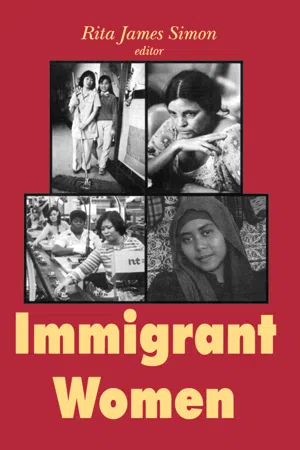
The obstacles to assimilation and treatment of immigrant women are major issues confronting the leading immigrant-receiving nations today-the United States, Canada, and Australia. This volume provides a range of perspectives on the concerns, the sources of problems, how issues might be addressed, and the future of immigrant women. It is based upon a two-part issue of the journal Gender Issues, and contains a new introduction by the editor. The first section focuses on labor force experiences of women who have immigrated to the United States and Australia from Mexico and Latin America, Eastern Europe, Korea, the Philippines, India and other parts of Asia. Nancy Foner assesses the complex and contradictory ways that migration changes women's status. Cynthia Crawford focuses on Mexican and Salvadoran women who have recently moved into janitorial work in Los Angeles. M.D.R. Evans and Tatjiana Lucik analyze labor force participation of immigrants in Australia and family strategies of women migrants from the former Yugoslavia against the experiences of woman migrants from the Mediterranean world and other parts of the Slavic world. Economist Harriet Duleep reviews what is known as the family investment model. Monica Boyd tackles the controversial issue of the leading immigrant-receiving nations' unwillingness to declare gender an explicit ground for persecution and thus for gaining -refugee status. The second section deals with social class and English language acquisition, the obstacles women have had to overcome in gaining refugee status in the United States and Canada, and a comparison of movement patterns between different commentaries in Mexico and the United States on the part of Mexican male and female immigrants. Contributors include Suzanne M. Sinke, Katharine Donato, and Nina Toren. Immigrant Women will be valuable to researchers in women's studies, population demographics, as well as those teaching courses in sociology, history, and immigration. Rita James Simon is university professor in the School of Public Affairs at the Washington College of Law at American University. She is editor of Gender Issues and author of The American Jury, The Insanity Defense: A Critical Assessment of Law and Policy in the Post-Hinckley Era (with David Aaronson), Adoption, Race, and Identity (with Howard Altstein), In the Golden Land: A Century of Russian and Soviet Jewish Immigration, Social Science Data and Supreme Court Decisions (with -Rosemary Erickson), and Abortion: Statutes, Policies, and Public Attitudes the World Over.
Information
1
Benefits and Burdens: Immigrant Women and Work in New York City
Nancy Foner
Abstract: This article analyzes the complex and contradictory ways that migration changes women’s status in New York City—both for better and for worse. The focus is on the impact of women’s incorporation into the labor force. On the positive side, migrant women’s regular access to wages—and to higher wages— frequently improves their position in the household, broadens their social horizons, and enhances their sense of independence. Less happily, many migrant women work in dead-end positions that pay less than men’s jobs. Immigrant working wives also experience a heavy double burden since the household division of labor remains far from equal.
There is an underlying tension in much of the work on immigrant women. On the one hand, a growing number of studies show that women experience marked improvements in their status as women as a result of migration. These range from increased control over decision making in the household to greater personal autonomy and access to resources in the community at large (e.g., Foner, 1986; Grasmuck and Pessar, 1991; Hondagneu-Sotelo, 1994; Lamphere, 1987; Pedraza, 1991; Pessar, 1998; Simon, 1992; Brettell and Simon, 1986). On the other hand, the literature also emphasizes migrant women’s continued oppression—what some call a triple burden or oppression, as gender inequalities are compounded by discrimination on the basis of class and race or ethnicity. Increasingly, recent research seeks to reconcile these two perspectives. As Patricia Pessar (1998) notes in a recent review of the literature, to ask whether migration is emancipating or subjugating for women is to couch their experiences in stark—and misleading—either/or terms. Feminist scholars now caution that migration often leads to losses as well as gains for women, and that, despite improvements, patriarchal codes and practices may continue to have an impact (see, for example, Espiritu, 1997; Morakvasic, 1984; Pessar, 1998).
In the spirit of the new feminist scholarship, this article offers an analysis of the complex and often contradictory ways that migration changes women’s status— both for better and for worse. The focus is on the impact of women’s incorporation into the labor force. This issue has been in the forefront of research on migrant women since it is wage work that so often empowers migrant women at the same time as it places severe burdens and constraints on them. The article is based on my larger comparative project on immigrants in New York City.1 It draws on my own first-hand research on Jamaican women (see Foner, 1983, 1986, 1994)2 as well as on available sociological and anthropological accounts for other immigrant populations. New York City continues to be a preeminent destination for the nation’s immigrants: in 1996, about a third of its population was foreign born (Moss, Townsend, and Tobier, 1997). The city’s immigrants include a wide variety of Asian, Latin American, and Caribbean groups; in 1990, the top five were Dominicans, Chinese, Jamaicans, Russians, and Guyanese, in that order. While the analysis presented here is sensitive to different patterns of labor-market incorporation and cultural background among the various groups, the emphasis is on common themes, experiences, and processes that emerge.
Female Immigrants: The Background
To set the stage for the analysis of the impact of wage work on New York City’s migrant women, some basic background information is necessary on their numbers, migration patterns, and labor force and occupational profile.
Women migrants now outnumber men in virtually all of the major groups coming to New York. In large part, this is because United States immigration law favors the admission of spouses and children as a way to reunite families and has made it possible for certain kinds of workers, like nurses, to get immigrant visas (Donato, 1992; Houston, Kramer, and Barrett, 1984). In the early 1990s, there were ninety-two male immigrants for every one hundred female immigrants entering New York City, up from ninety-eight males per one hundred females in the 1980s (Lobo, Salvo, and Virgin, 1996).
It is not just that women predominate. Many women come on their own rather than follow in men’s footsteps. The structure of U.S. immigration law, changing gender roles, and economic opportunities for women are all responsible for this trend. Immigrant women’s concentration in specific high-demand occupations—like private household work and nursing—has also enabled many to play a pivotal role as pioneer immigrants, establishing beachheads for further immigration (Salvo and Ortiz, 1992). This has been especially true for certain groups like Filipinos, with large numbers of nurses, and West Indians, with substantial numbers of private household workers.
Once in New York, the majority of immigrant women go out to work. At the time of the 1990 census, 60 percent of foreign-born female New Yorkers of working age were in the labor force. The percentages are much higher for certain groups. Filipino women, who often came specifically to work in health-care jobs, stand out as having the highest labor force participation rate at over 85 percent. West Indian women are not far behind, with labor force participation rates in the 70–80 percent range. Dominicans come out near the bottom, with 52 percent in the work force, and they have a relatively large proportion unemployed as well (Kasinitz and Vickerman, 1995). In trying to explain these different rates, Sherri Grasmuck and Ramon Grosfoguel (1997) argue that Dominican women’s lower levels of education and limited English language skills have made it more difficult for them to find jobs, especially jobs that pay enough to cover the costs of child care. Because Jamaican women arrive with English and, on average, higher educational levels, they have better employment prospects. They are also more disposed to go out to work because they come from a society with a strong tradition of female employment: almost 70 percent of women in Jamaica were in the work force in 1990 compared to only 15 percent in the Dominican Republic.3
In New York, there is an enormous variety in the kinds of jobs occupied by female immigrants; a good many have professional and managerial positions while others end up in low-level service and factory work. Census data for 1990 on immigrant women in the labor force who arrived in the 1980s show this variation. Twenty-seven percent of Asian women, 13 percent from the Caribbean, and 10 percent from Central and South America were classified as professionals and manager; at the same time, 21 percent of Asian women, 14 percent from the Caribbean, and 23 percent from South and Central America were operators (Mollenkopf, Kasinitz, and Lindholm, 1995).
That many immigrant women are able to obtain professional and managerial jobs is not surprising given the human capital they bring with them. Immigration and Naturalization Service (INS) data, although limited, show that a fifth of the working age women intending to live in New York City who reported an occupation to the INS when admitted for permanent residence between 1982 and 1989 were in professional/technical and administrative/managerial positions; in the early 1990s, the share in these categories went up to 36 percent. In both the 1980s and early 1990s, about one in every six immigrant women were in administrative support occupations such as secretaries, typists, and general office clerks (Lobo, Salvo, and Virgin, 1996).4
Of course, many immigrant women who had professional or white-collar jobs in their home society experience downward occupational mobility when they arrive in New York. Without American-recognized training, English proficiency, or green cards, highly qualified women are often consigned, at least temporarily, to relatively low-level positions when they arrive. Many Jamaican private household workers I interviewed in my research, for example, had been teachers and clerical workers back home, some experiencing what Maxine Margolis has called the transition from “mistress to servant” (Margolis, 1994; see also Colen, 1990). A number of Haitian and Hispanic aides in the New York nursing home I studied in the 1980s were full-fledged nurses before they emigrated, but their qualifications were not recognized here and language problems stood in the way of passing the requisite licensing exams to practice nursing in New York (see Foner, 1994).
In a time-worn pattern, women in each immigrant group gravitate in large numbers to particular occupations. As among men, English language ability and work skills help women in some groups gain a foothold in certain jobs; lack of English and specific job skills limit the employment possibilities of others. Once a beachhead is established, co-ethnics are likely to follow through a process of network hiring and referrals as well as employer preferences. Thus, for example, West Indian women are heavily concentrated in health care. Indeed, in 1990, close to a third of employed Jamaican women in New York were nurse’s aides, orderlies, and attendants and registered or practical nurses (Kasinitz and Vickerman, 1995; see also Waldinger, 1996). Garment work has drawn in Dominican and Chinese women because it requires no English language ability, is quickly learned, and is often close at hand, in factories owned and managed by their compatriots. In the early days of the migration, Dominicans’ entry into garment factories was also facilitated by the fact that the industry had already adjusted itself to Puerto Ricans, using bilingual supervisors and employee mediators (Grasmuck and Grosfoguel, 1997). Although the proportion of Dominican women in manufacturing has dramatically declined since 1980, substantial numbers still work in this sector. Chinese women remain the garment workers par excellence. Over half of all immigrant Chinese women workers in New York City are in the needle trades, virtually all as sewing machine operators. In recent years, new groups of immigrant women have also been drawn to the garment trades. The growing number of Korean-owned sewing shops—about 200 opened in midtown Manhattan in the late 1980s and early 1990s—are filled with Mexican and Ecuadoran workers, who are primarily women. Korean owners have had to look beyond the ethnic labor market for a source of cheap labor because Korean women are relatively well educated and have better opportunities elsewhere (Chin, 1997).
Wage Work: The Benefits
Wage work has, in many ways, improved the position of substantial numbers of migrant women in New York. This is not just the perception of the women themselves. From the outside looking in, it is clear that migrant women often gain greater independence, personal autonomy, and influence as a result of earning a regular wage for the first time, earning a higher wage than in the sending society, or making a larger contribution to the family economy than previously. How much improvement women experience depends to a large degree on their role in production and their social status in the home country as well as their economic role in New York. What is important is that, for the vast majority, the move to New York—and their involvement in work here—lead to gains in some domains of their lives, particularly in the household.
In cases where women did not earn an income, or earned only a small supplementary income, prior to migration, the gains in New York that come with a shift to regular wage work are especially striking. The much-cited case of Dominican immigrant women fits this pattern. Now that so many Dominicans work for wages— often for the first time—and contribute a larger share of the family income, they have more authority in the household and greater self-esteem. They use their wages, anthropologist Patricia Pessar observes, “to assert their rights to greater autonomy and equality within the household” (1995).5
In New York, Dominican women begin to expect to be co-partners in “heading” the household, a clear change from more patriarchal arrangements in the Dominican Republic. “We are both heads,” said one woman, echoing the sentiments of many other Dominican women in New York. “If both the husband and wife are earning salaries then they should equally rule the household. In the Dominican Republic it is always the husband who gives the orders in the household. But here when the two are working, the woman feels herself the equal of the man in ruling the home” (Pessar, 1987: 121). In a telling comment, a Dominican migrant visiting her home village told her cousin about New York: “Wait till you get there. You’ll have your own paycheck, and I tell you, he [your husband] won’t be pushing you around there the way he is here” (Grasmuck and Pessar, 1991: 147).
The organization of the household budget is in fact more equal in New York. In the Dominican Republic, men generally controlled the household budget even when wives and daughters put in income on a regular or semi-regular basis. Commonly, men doled out an allowance to their wives, who were responsible for managing the funds to cover basic household expenses. The men had the last word when it came to decisions about long-term and costly outlays. When women contributed income, it was used for “luxuries” rather than staples, reinforcing the notion that the man was the breadwinner. In New York, Pessar found that husbands, wives, and working children usually pool their income; they each put a specific amount of their wages or profits into a common fund for shared household expenses. Often, they also pool the rest of what they earned for savings and special purchases. With this kind of arrangement, women’s contributions are no longer seen as “supplementary” and men’s as “essential.” As men become more involved in developing strategies for stretching the food budget, they begin to more fully appreciate the skills women bring to these tasks. How critical women’s wage work is to these new arrangements is brought out by what happens when women significantly reduce their contributions to the household budget, either in New York or when they return to the Dominican Republic. The man usually asserts his dominance once again by allocating a household allowance to his wife and reducing her authority over budgetary decisions.
No wonder that Dominican women are eager to postpone or avoid returning to the Dominican Republic where social pressures and an unfavorable job market would probably mean their retirement from work and a loss of new-found gains. One reason women spend large amounts of money on expensive durable goods like new appliances and home furnishings is to root their family securely in the United States and deplete the funds needed to return to the Dominican Republic.
Of course, many immigrant women, including some Dominicans, had regular salaries before emigration. Even these women often feel a new kind of independence in New York because jobs in this country pay more than most could ever earn at home and increase women’s contribution to the family economy. For example, many Jamaican women I interviewed had white-collar jobs as secretaries, clerks, nurses, or teachers before they emigrated. Still, they said they had more financial control and more say in family affairs in New York where their incomes are so much larger. “We were brought up to think we have to depend on a man, do this for a man, listen to a man,” said a New York secretary. “But here you can be on your own, more independent.” Many told me that in Jamaica women usually have to depend on their husbands, whereas in New York they can “work their own money.” Also, for those with training, there is a wider range of good jobs available. And there are better opportunities for additional training and education than in Jamaica, something that holds true for those from other Latin American and Caribbean countries as well (see Foner, 1986).
The sense of empowerment that comes from earning a regular wage—or a higher wage—and having greater control over what they earn comes out in studies of many different groups. Paid work for Chinese garment workers, according to one report, not only contributes to their families’ economic well-being, but also has “created a sense of confidence and self-fulfillment which they may never have experienced in traditional Chinese society.” “My husband dares not look down on me,” one woman said. “He knows he can’t provide for the family by himself.” Or as another put it: “I do not have to ask my husband for money, I make my own” (Zhou and Nordquist, 1994: 201). For many Salvadoran women, the ability to earn wages and decide how they should be used is something new. As one woman explained: “Here [in the U.S.] women work just like the men. I like it a lot because managing my own money I feel independent. I don’t have to ask my husband for money but in El Salvador, yes, I would have to. Over there women live dependent on their husbands. You have to walk behind him” (Mahler, 1996). Or listen to a Trinidadian woman of East Indian descent: “Now that I have a job I am independent. I stand up here as a man” (Burgess and Gray, 1981).
The female-first migration pattern involving adult married women that is common in some groups reinforces the effects of wage-earning on women’s independence. Many women who initially lived and worked in New York without their husbands change, as one Dominican woman put it, “after so many years of being on my own, being my own boss” (P...
Table of contents
- Cover
- Half Title
- Title Page
- Copyright Page
- Table Of Contents
- Introduction
- 1 Benefits and Burdens: Immigrant Women and Work in New York City
- 2 Gender and Citizenship in the Restructuring of Janitorial Work in Los Angeles
- 3 The Impact of Resources and Family-Level Cultural Practices on Immigrant Women vs Workforce Participation
- 4 The Family Investment Model: A Formalization and Review of Evidence from Across Immigrant Groups
- 5 Gender, Refugee Status, and Permanent Settlement
- 6 Gender in Language and Life: A Dutch American Example
- 7 A Dynamic View of Mexican Migration to the United States
- 8 Women and Immigrants: Strangers in a Strange Land
- About the Contributors
Trusted by 375,005 students
Access to over 1.5 million titles for a fair monthly price.
Study more efficiently using our study tools.
Frequently asked questions
Yes, you can cancel anytime from the Subscription tab in your account settings on the Perlego website. Your subscription will stay active until the end of your current billing period. Learn how to cancel your subscription
No, books cannot be downloaded as external files, such as PDFs, for use outside of Perlego. However, you can download books within the Perlego app for offline reading on mobile or tablet. Learn how to download books offline
Perlego offers two plans: Essential and Complete
- Essential is ideal for learners and professionals who enjoy exploring a wide range of subjects. Access the Essential Library with 800,000+ trusted titles and best-sellers across business, personal growth, and the humanities. Includes unlimited reading time and Standard Read Aloud voice.
- Complete: Perfect for advanced learners and researchers needing full, unrestricted access. Unlock 1.5M+ books across hundreds of subjects, including academic and specialized titles. The Complete Plan also includes advanced features like Premium Read Aloud and Research Assistant.
We are an online textbook subscription service, where you can get access to an entire online library for less than the price of a single book per month. With over 1.5 million books across 990+ topics, we’ve got you covered! Learn about our mission
Look out for the read-aloud symbol on your next book to see if you can listen to it. The read-aloud tool reads text aloud for you, highlighting the text as it is being read. You can pause it, speed it up and slow it down. Learn more about Read Aloud
Yes! You can use the Perlego app on both iOS and Android devices to read anytime, anywhere — even offline. Perfect for commutes or when you’re on the go.
Please note we cannot support devices running on iOS 13 and Android 7 or earlier. Learn more about using the app
Please note we cannot support devices running on iOS 13 and Android 7 or earlier. Learn more about using the app
Yes, you can access Immigrant Women by Rita J. Simon in PDF and/or ePUB format, as well as other popular books in Social Sciences & Emigration & Immigration. We have over 1.5 million books available in our catalogue for you to explore.