- 288 pages
- English
- ePUB (mobile friendly)
- Available on iOS & Android
eBook - ePub
About this book
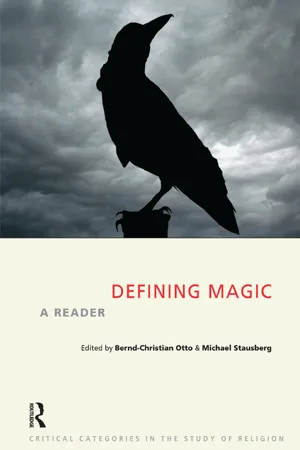
Magic has been an important term in Western history and continues to be an essential topic in the modern academic study of religion, anthropology, sociology, and cultural history. Defining Magic is the first volume to assemble key texts that aim at determining the nature of magic, establish its boundaries and key features, and explain its working. The reader brings together seminal writings from antiquity to today. The texts have been selected on the strength of their success in defining magic as a category, their impact on future scholarship, and their originality. The writings are divided into chronological sections and each essay is separately introduced for student readers. Together, these texts - from Philosophy, Theology, Religious Studies, and Anthropology - reveal the breadth of critical approaches and responses to defining what is magic. CONTRIBUTORS: Aquinas, Augustine, Helena Petrovna Blavatsky, Dennis Diderot, Emile Durkheim, Edward Evans-Pritchard, James Frazer, Susan Greenwood, Robin Horton, Edmund Leach, Gerardus van der Leeuw, Christopher Lehrich, Bronislaw Malinowski, Marcel Mauss, Agrippa von Nettesheim, Plato, Pliny, Plotin, Isidore of Sevilla, Jesper Sorensen, Kimberley Stratton, Randall Styers, Edward Tylor
Information

PART I
HISTORICAL SOURCES
INTRODUCTION
The conceptual history of “magic” spans around 2500 years and pervades a huge number of texts and different cultural-religious epochs (see Otto 2011). In order to understand the degree to which the academic debate inherited ideas and valuation patterns from former pre-academic discourses, in this part we present twelve key texts that illustrate main features of the conceptual history of “magic”. These texts have been selected because of their historical impact, their mainly theoretical and often encyclopaedic approach, and the variety of semantic patterns and connotations they exemplify. As we shall see, the pre-academic conceptual legacy of “magic” is characterized by some haziness and polyvalence that has not least contributed to the academic problem of “defining magic”.
Etymologically, the concept of “magic” goes back to the ancient Iranian appellative maguš, but the etymology of this word is unclear. Greek sources ascribe a variety of functions to the Iranian mágoi. According to Herodotus, who also refers to them as one of seven Median tribes, besides being in charge of religious rites such as sacrifices and the interpretation of dreams, the mágoi served as functionaries at the Persian (Achaemenian) court and advisers to the king (Histories, e.g., 1.101f; 3.30f; 7.19f, 37f, 113f, 191f).
During the late sixth and early fifth centuries BCE, the term maguš was picked up and Graecicized (into μάγoς, μαγεία) by ancient Greek authors and thereby developed a life of its own. The Greek adaptation of the concept implied some fundamental semantic transformations, which may be particularly due to the fact that the Greek city states faced serious military conflicts with the Persian Empire at that time. To the Greeks, the magós represented the religious specialist of a threatening foreign – “barbaric” – culture so that the concept quickly assimilated a variety of negative stereotypes. The mágos was regarded as a charlatan and “magic” (i.e., the ritual art of the mágos) a mere fraud (see, e.g., Sophocles, Oedipus Rex 387f; Hippocrates, De morbo sacro 1.10f). “Magical” rites were perceived as strange, unconventional and dangerous (see Hippocrates, De morbo sacro 1.39f; Gorgias, Encomium of Helen 9–10). The extraordinary, miraculous abilities allegedly possessed by mágoi were regarded as sacrilegious and suspicious (see Hippocrates, De morbo sacro 1.28f; Euripides, Orestes 1493f). In line with these notions, the Greek concept of “magic” came to signify all sorts of unsanctioned rites performed by private ritual entrepreneurs outside the institutionalized cults. The texts from Plato hosted here reflect this development in a twofold manner: in his Laws (see Chapter 1), Plato proposes harsh punishments for specialists of “magic” (he uses the synonym pharmakeía), which he classifies as a form of asebeía (“blasphemy”, “impiety”, “false religion”). On the other hand, in his Alcibiades I (see Chapter 1), (Pseudo-)Plato, reflecting the historical and etymological background of the term, claims that mageía refers to the “worship of the Gods” (i.e., “religion”) among the Persians. Some later authors would use this argument to elevate the concept of “magic” and question the negative stereotypes predominant in Western discourse.
In the first century BCE, the Greek concept was picked up and Latinized (into magus, magia) by Roman authors. The Roman reception of the term continued main features of the Greek usage, but with a greater emphasis on its judicial application, semantic scope and theoretical explanation. At least since the mid-first century CE, court cases were carried out against “magicians” or “magical rites” (see Tacitus, Annales, e.g., 2.27, 12.59; 16.31, etc.); the late ancient Codex Theodosianus points, in fact, to the increased elaboration of statues against “magic” in the Roman Empire (see Codex Theodosianus 9.16.3f). The trial against the philosopher Apuleius of Madaura is the most famous example of the ancient prosecution of “magic” (see his extant defence speech Apologia sive pro se de magia). To the Romans, “magic” signified a fraudulent ritual art that pervades a multiplicity of (foreign) cultures and goes back to a distant past. Our third text – an excerpt of Book 30 of Pliny’s Historia Naturalis – is a fine example of this already ancient pattern of generalization and historicization of “magic”. Eventually, ancient authors proposed theories of the possible mechanisms underlying the rites and thoughts associated with “magic”. Chapter 3 shows how the philosopher Plotinus accomplished this task by embedding the concept within his “Neoplatonic” philosophical framework.
In the first centuries CE, the concept of “magic” was picked up by Christian authors who incorporated it within Christian theology and also adopted former Jewish conceptual patterns (in particular, the opposition of “magic” and “miracle”). As a result, the negative stereotypes already implied in the Greek and Roman understanding of “magic” were enhanced: the texts in Chapter 4 by Augustine of Hippo show that, for Christian authors, “magic” not only refers to some fraudulent, superstitious, unsanctioned ritual practice, but to the very opposite of “religion”, as “magic” now exclusively relies on the working of demons, the henchmen of Satan. This radicalization – the idea of the “demon pact” – turned the “magician” into an enemy of God and, as a polemical weapon, made it possible to devaluate inner and outer enemies of Christendom (such as pagan religions), a pattern that was continuously applied throughout Christian history. The idea of the “demon pact” was handed on by Christian authors throughout the Middle Ages (see, e.g., Chapters 5 and 7), early modern and modern times, and can still be found in modern Christian polemics against Harry Potter (see, e.g., Arms 2000, 83).
Despite the predominantly derogatory usage of “magic” in Christian discourse, more affirmative conceptualizations were likewise pronounced in the course of Western history. While the conceptual background of the – surprisingly ambivalent – definition of “magic” in the Byzantine Suda (see Chapter 6) remains to be investigated, the early modern conception of magia naturalis is a striking example of affirmative interpretations of “magic” in pre-academic discourses. That concept was introduced in the late fifteenth century by two Italian humanists – Marsilio Ficino (b. 1433; d. 1499) and Giovanni Pico della Mirandola (b. 1453; d. 1494) – who, inspired by the rediscovery of the works of Plato and Plotinus (see Chapters 1 and 3), regarded “magic” as an elementary force pervading all sorts of natural processes. Accordingly, they promoted magia naturalis to the rank of a new philosophical discipline that ought to systematically investigate this natural force. With this novel concept, Ficino and Pico influenced fifteenth- and sixteenth-century scholars such as Johannes Reuchlin, Johannes Trithemius, Agrippa of Nettesheim, Theophrastus of Hohenheim (also known as Paracelsus), Giordano Bruno and others. We reprint one important example of this first scholarly discourse of “magic” in Western history – namely, an excerpt from Agrippa of Nettesheim’s extensive work De occulta philosophia (see Chapter 8).
The concept of “natural magic” remained influential in some scholarly milieus but could not fundamentally alter the negative perception of “magic” predominant in Western discourse. The increasing success of natural sciences and, in particular, the philosophical movement of Enlightenment contested the notion of magia naturalis, mostly by criticizing its alleged fallaciousness and charlatanry. We reprint one representative anti-magical text of the Enlightenment discourse in eighteenth-century France – namely, Diderot’s article “Magie” in his Encyclopédie, ou Dictionnaire raisonné des sciences, des arts et des métiers (see Chapter 9).
While the Enlightenment movement adopted traditional anti-magical rhetoric as part of its agenda of human rationality, there also existed anti-Enlightenment movements that retained a positive view of “magic”. The last text in this part, written by the Russian occultist Helena Petrovna Blavatsky during the late nineteenth century (see Chapter 10), illustrates this continuous stream of positive interpretations of “magic” in Western history. While the precise semantic meaning of “magic” in Blavatsky’s work remains fuzzy, our text brings home the point that the late nineteenth century founding fathers of the academic discourse could, in fact, have chosen very different contemporary models of defining “magic”. Yet, they adopted, for the most part, traditional Western stereotypes – in particular, the notions of irrationality (“magic” as false “science”) and of a-religiosity (“magic” as false “religion”). The texts presented in Part I show that these polemical notions are deeply rooted in the conceptual history of “magic”. Their “survival” in academic discourse has made the concept particularly vulnerable to criticism and been one of the main reasons why, in recent decades, some scholars have opted for abandoning the category.
1
PLATO
Alcibiades I 120e-122c, translation W. R. M. Lamb
Laws 933c–e, translation Marios Skempis
Although he neither wrote systematically nor extensively on the topic, Plato (b. 428/427 BCE;d. 348/47 BCE) played a formative role in shaping Western discourses of “magic”. The two statements presented here – Alcibiades I 120e–122c and Laws 933c–e – albeit contradictory, exerted a major influence on later writers.
The Alcibiades I, a work dubiously ascribed to Plato, discusses the traits and skills that a potential political leader such as the young aristocrat Alcibiades, Socrates’ interlocutor in the dialogue, ought to possess. In our passage, Socrates refers to the Persian kings and their manners of educating their sons; we learn that at the age of fourteen the Persian princes learn “magic” (Greek “μαγεία”, translated by Bury as “magian Lore”) from the “wisest” teacher in the Persian Empire. “Magic” is here defined as “worship of the gods” (θεῶν θεραπεία) – an apparently positive statement often quoted by later authors who intended to valorize the concept (see, e.g., Chapter 10 in this volume). Furthermore, the Alcibiades I is one of the first extant texts that links Zoroaster to the concept of “magic”, another idea that had substantial impact upon later authors who advanced Zoroaster to the rank of one of the founding fathers of “magic” (see Chapters 2 and 5; see in more detail Stausberg 1998 I: 503–69). However, Plato’s definition in the Alcibiades I hardly had any influence on modern academic definitions of “magic”, the more so since “worship of the gods” is typically subsumed under the concept of “religion”.
In the eleventh book of his Laws, Plato, on the other hand, puts forth a law against pharmakeía. In ancient texts, the term pharmakeía can be used as a rough synonym of mageía, but it has different etymological roots (pharmakon can mean “poison”, “medicine”, “herb”, “drug”, or “charm”) and thereby refers to different things. In our excerpt, pharmakeía refers to methods of harming someone by means of substances (“drinks, foods and unguents”) or verbal practices (“binding spells or conjurations or incantations”) – that is, by methods whose modus operandi is not perceptible (contrary to, for instance, injuring someone with a knife). Plato’s law against pharmakeía derives from his law against asebeía (“blasphemy”, “impiety”), which is described shortly before our passage, in the end of the tenth book (Laws 907d–910d). Accordingly, Plato claims that people offering pharmakeía to upright citizens of Athens act blasphemously as they believe that “the gods are easy to win over when bribed by offerings and prayers” (Laws 885b, trans. Bury 1926: 299). Plato systematically questions this belief (Laws 905d–907d), inasmuch as he regards these persons as “ravening beasts” that despise men and “try thus to wreck utterly not only individuals, but whole families and States for the sake of money” (Laws 909a–c; Bury 1926: 383). Hence, in the end of our text, Plato proposes harsh punishments for specialists of pharmakeía, while suggesting more moderate adjudgements for laymen. Note that Greek asebeía is the antonym to Greek eusebeía, a term often associated with the modern concept of “religion”. Thus, Plato provides us with the first opposition, at least in Classical Greece, between eusebeía and pharmakeía, an opposition equivalent, in some modern translations, to “religion” and “magic”.
Plato’s contribution to Western discourses of “magic” appears, therefore, as ambivalent. On the one hand, the Alcibiades I offered later authors the possibility to claim that “magic” is nothing else than “religion” – by arguing that this classification purely depends upon one’s perspective. The Roman philosopher Apuleius of Madaurus (b. ca. 125 CE;d. ca. 180 CE), who was accused of being a “magician” in a public court case around 158 CE, takes up this argument when he asks the court “what a magician really is. For, if what I read in most authors is correct, that ‘magician’ is the Persian word for our ‘priest’, what crime is involved in it? Can it be wrong to be a priest, to have the proper knowledge, competence, and experience of ceremonial rules, sacred rituals, and religious laws? This, at least, is how Plato interprets ‘magic’, when he examines the branches of study in which, among the Persians, a young heir to the throne is educated” (Apuleius, Apol. 25.9f, transl. Harrison and Hunink 2001: 50). On the other hand, Plato’s idea of “religion” (eusebeía), as sketched out in the tenth and eleventh books of the Laws, which is based on a devout, selfless belief in morally irreprehensible gods, prompted later polemics against “magic” that centred around the coercion and blasphemy argument. Plato’s desire to put forth a law against pharmakeía seems to anticipate various Roman statutes addressing “magic” (Lex Cornelia de sicariis et veneficis; Codex Theodosianus 9.16.3f), which also influenced mediaeval and early modern European juridical discussions of the crimen magiae. Turning to modern academic discourse, Plato’s opposition of eusebeía and pharmakeía could be held to anticipate James G. Frazer’s distinction of coercion (“magic”) and submission (“religion”) (see Chapter 12).
ALCIBIADES I 120e–122c
SOC. Then let ...
Table of contents
- Cover
- Half Title
- Title Page
- Copyright Page
- Table of Contents
- Preface
- Sources
- General Introduction
- Part I: Historical Sources
- Part II: Foundational Works of the Academic Debate
- Part III: Mid-Twentieth-Century Approaches to Magic
- Part IV: Contemporary Voices
- Bibliography
- Index
Trusted by 375,005 students
Access to over 1.5 million titles for a fair monthly price.
Study more efficiently using our study tools.
Frequently asked questions
Yes, you can cancel anytime from the Subscription tab in your account settings on the Perlego website. Your subscription will stay active until the end of your current billing period. Learn how to cancel your subscription
No, books cannot be downloaded as external files, such as PDFs, for use outside of Perlego. However, you can download books within the Perlego app for offline reading on mobile or tablet. Learn how to download books offline
Perlego offers two plans: Essential and Complete
- Essential is ideal for learners and professionals who enjoy exploring a wide range of subjects. Access the Essential Library with 800,000+ trusted titles and best-sellers across business, personal growth, and the humanities. Includes unlimited reading time and Standard Read Aloud voice.
- Complete: Perfect for advanced learners and researchers needing full, unrestricted access. Unlock 1.5M+ books across hundreds of subjects, including academic and specialized titles. The Complete Plan also includes advanced features like Premium Read Aloud and Research Assistant.
We are an online textbook subscription service, where you can get access to an entire online library for less than the price of a single book per month. With over 1.5 million books across 990+ topics, we’ve got you covered! Learn about our mission
Look out for the read-aloud symbol on your next book to see if you can listen to it. The read-aloud tool reads text aloud for you, highlighting the text as it is being read. You can pause it, speed it up and slow it down. Learn more about Read Aloud
Yes! You can use the Perlego app on both iOS and Android devices to read anytime, anywhere — even offline. Perfect for commutes or when you’re on the go.
Please note we cannot support devices running on iOS 13 and Android 7 or earlier. Learn more about using the app
Please note we cannot support devices running on iOS 13 and Android 7 or earlier. Learn more about using the app
Yes, you can access Defining Magic by Bernd-Christian Otto,Michael Stausberg in PDF and/or ePUB format, as well as other popular books in Theology & Religion & Comparative Religion. We have over 1.5 million books available in our catalogue for you to explore.