eBook - ePub
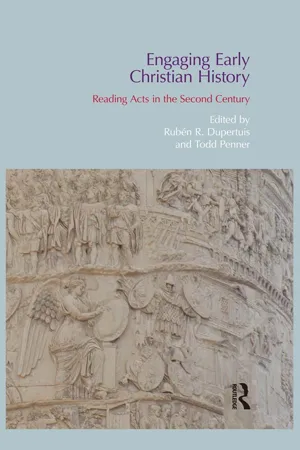
Engaging Early Christian History
Reading Acts in the Second Century
- 288 pages
- English
- ePUB (mobile friendly)
- Available on iOS & Android
eBook - ePub
About this book
This book extends scholarly debate beyond the analysis of pure historical debates and concerns to focus on the associations between Acts and the diverse contemporaneous texts, writers, and broader cultural phenomena in the second-century world of Christians, Romans, Greeks, and Jews.
Chapter 1
READING ACTS IN THE SECOND CENTURY: REFLECTIONS ON METHOD, HISTORY, AND DESIRE
Todd Penner
It is the tale, not he who tells it.
(Stephen King, “The Breathing Method”)
You have been chopped!
(Ted Allen)
In a chapter in his collection of essays entitled Pauline and Other Studies in Early Christianity, compiled over a hundred years ago, William M. Ramsay records and summarizes his reflections across the span of his scholarly career on the dating of Acts. The piece is both a methodological assessment and a personal meditation on how his mind changed from viewing Acts as a product of the mid-second century to claiming that it ought to be fully situated within a first-century early Christian milieu (Ramsay 1906: 199). Ramsay lays the foundation for the mid-second-century composition of the book of Acts at the feet of the European “critical” school (ibid.: 191–2), by which he means the German scholarly trajectory emerging out of the theoretical framework of Ferdinand Christian Baur (1792–1860) and his colleagues and students. Ramsay admits that, by the time he is writing his essay, the mid-second-century view has been in decline, and has certainly been modified in terms of some of its earlier exaggerations. For Ramsay, the chief problem with the New Testament “critical” European approach had been the lack of readily available information on Roman imperial history (ibid.: 192–4), particularly the work of Theodor Mommsen (1817–1903), which represented a sea-change in the study of the ancient Romans. Although Mommsen’s major work on Roman imperial institutions and the governance of the provinces emerged during the same time period that the “critical” school was gaining traction in Europe (mid-1800s), it was relatively ignored by German biblical scholarship until later.
Ramsay’s main point is that Mommsen’s work provided numerous details about Roman imperial structures and interaction throughout the first century that made it clear that Acts, as a narrative, fitted much better in that earlier period than in the second century. Ramsay notes in particular the importance that Asia Minor played in the first century, specifically with respect to the Roman focus on expansion in the province of Galatia (ibid.: 199). In comments that resonate with some strands of more recent empire-critical scholarship, Ramsay implies that the focus of Acts and Paul’s letters on the Asia minor region would appear to mimic a Roman imperial agenda of expansion, with the impulse being somewhat resistant to the empire: “Christianity was the fullest expression of the new spirit in the Roman Empire, the refusal of the provinces to accept tamely the tone of Rome” (ibid.: 194). It is precisely for this reason, then, that Roman imperial history and the Asia Minor region in particular are so critical for Ramsay in terms of the study of early Christianity. Ramsay goes on to note that Acts “plunges one into the atmosphere and the circumstances of the first century; it is out of harmony with the circumstances of the second century” (ibid.: 199).
Ramsay’s position offers an important insight into the traditional discussion among New Testament scholars about locating the book of Acts in the first century. Most importantly, his challenging of the “critical” view on the point of historical affinity and veracity represents quite well one of the enduring debates in the scholarly discussion of the temporal situating of Acts. This point of contention has lasted well into even recent deliberations over the contextualization of early Christian narratives, and in fact is utilized now in reverse, as proponents of a second-century point of composition argue for the historical affinities between Acts and a second-century context. In this latter instance, however, scholars generally rely less on Roman imperial history as a point of comparison and more on reconstructions of early Christian theological debates that would make sense of a later date for Acts in terms of its theological and ecclesial maturity.
Whatever the case, controversies in the study of Acts have not in small part rested on historical issues. And to be sure, discussions on social themes and theological tradents in the book of Acts often, in one way or another, relate back to the dating of the book as a critical prerequisite for considerations of content and scope. In some ways, the “linguistic turn” in historical study, particularly as that trajectory had an influence in the work of scholars of early Christianity in the late 1980s and early 1990s, and most certainly had an earlier influence on reader-response and other literary forms of criticism, shifted the conversation away from historical questions such as the date of composition, compilation, and/or redaction. Indeed, one might argue there was some welcome relief for scholars of early Christian history in taking a break, if you will, from the contentious historical issues surrounding Acts and getting back just to reading Acts as a narrative, even if now a more mul-tivalent and ideologically complex one. At the same time, the problems of history have not gone away—nor will they. And one cannot divorce here the theological and religious importance of Acts for modern Christian identity from the discussion of the historical issues that can at a quick glance appear to be of mere scholarly curiosity. Some years ago I referred to the “madness in the method” that was evident in almost all levels of methodological discussions in the study of Acts (Penner 2004b), and such methodological mayhem is largely a result of the substantive (often unacknowledged or even unconscious) investment that people have in particular historical, social, and theological constructions related to the book of Acts.
In point of fact, the book of Acts is considered to be our only “real” source for the history of early and possibly earliest Christianity. Even if one were to say that Paul, by which one would really mean Paul’s letters and his theology, is the central (or at least most serious) concern of the vast majority of early Christian scholarship in one way or another, the narrative of Acts is absolutely essential as it provides a social, historical, and theological context in which to embed Paul as a “founder” figure. And our entire construction of everything from early Christian history to social location to literary development to theological evolution all hinges in some respect on Acts providing us with a roadmap to those ends. One can consult just about any scholarly treatment on the history of early Christianity and witness first-hand how Acts operates in the background, even in the shadows, providing the superstructure to the larger construction of Christian origins built by scholars. One could refer to just about any study of early Christian history to demonstrate this point. I offer one example in my own earlier work on Stephen and the Hellenists in the book of Acts (Penner 2004a), where I demonstrate that almost every treatment of early Christian history, be it more conventional or more “critical” (in the sense that Ramsay used that term), is reliant on material in Acts that is considered to be a “bedrock” historical stratum, without which we cannot make sense of how the emergent Christians developed both socially and theologically. Indeed, it is quite clear that at stake is more than just our knowing about early Christian history—perhaps even more so, modern (particularly Protestant) investments in certain constructive theological projects are perceived to be essentially bound up with the historical realities and realia of the early Christians.
It is no surprise, then, that the dating of early Christian texts has mattered such a great deal. Indeed, the first-century vs second-century divide, as noted above, has been critical in this discussion precisely because, if Acts is a product of the first century, then it is assumed that we have a sure grounding for the superstructure of early Christian history and theology. And, conversely, if Acts is a product of the second century, then it is supposed to be a fictional and relatively unreliable account of Christian origins. Neither of these assumptions need be true, of course (e.g. we could have a first-century account that is pure fiction and a second-century one that bears the distinct mark of historicity). That said, both of these frameworks are generally operative in the critical discussion and therefore some reflection on this binary division is in order.
“FOR THE TIME BEING”: METHODOLOGICAL REFLECTIONS ON STABILITY AND INSTABILITY
I tremble at what exceeds my seeing and my knowing … although it concerns the innermost parts of me, right down to my soul, down to the bone, as we say.
(Derrida 1995: 54)
In his essay “What a Difference a Difference Makes,” Jonathan Z. Smith offers an extended discussion of and reflection on Christopher Columbus’s discovery of the Americas, which he takes as a critical point for helping us understand the concept of comparison in the study of religions. Smith’s primary emphasis relates to the attempt by Columbus to classify his observations of phenomena in the New World. The language that Columbus uses to describe and to delineate that which is newly encountered is, by necessity, the linguistic categories and conceptions of his native Spanish language. Smith aptly sums up the problem that Columbus confronts: “What we see in Columbus is primarily a failure of language, the inability to recognize the inadequacy of his inherited vocabulary and the consequent inability to project a new. At best there is a muddle. Things are either ‘like’ or ‘unlike’ Spain, but nothing is ‘other’” (J. Z. Smith 2004b: 267). Smith goes on to observe that “something ‘different’ has been sensed but that has as yet gained no distinctive voice. Rather, the old language has been stretched to accommodate it” (ibid.: 269). The colonial edge of this comparative discourse is not lost on Smith, as he notes that the colonizer casts the new world in his own language so as to make that space inhabitable—to make it “like home” (ibid.: 270). As a result, these new lands that Columbus discovers are not truly strange and foreign, even as they may be different compared to Spanish life and culture. The “other” is still understood in terms of the “self,” particularly in terms of the language deployed in the very process of naming and classifying that “other.”
Modern New Testament scholarship, with its interest and investment in particular temporal constructions of early Christian history, literature, and theology, is situated somewhat similarly to the figure of Columbus in Smith’s equation. In our exploration of the ancient landscape we cannot help but continually utilize our language to understand the new territories we encounter. Indeed, for post-Enlightenment creatures predictably wedded to being and time, and the complex intersections thereof, the ancient world becomes comprehended and apprehended in these very categories. Present at the juncture of being and time is the fundamental issue of stability vs instability.1 Though this might seem difficult to illustrate, modern developments in the quantum level of physics provides a relatively good access point, even if it is one that is remote from most historians’ minds as they interrogate their sources and rummage through the remains of history. The physicist and feminist scholar Karen Barad notes the immense contradiction that exists between our perception of touching a cup and the “reality” (from the standpoint of physics) involved in touching that same cup. From the basic vantage point of human perception and in many respects cognitive apprehension, when I lift up a cup and hold it in my hand I am literally in contact with that object. However, from the perspective of modern physics what is actually happening is that my hand and the cup are repelling each other through the electromagnetic force generated by the electrons that make up my hand and those that make up the cup. We are not actually touching—it is physically, in the “real world,” impossible for me to touch the cup. It is the repelling of electrons from each other that create the sensation of touch. One might say I feel touch precisely because of those very forces that keep me from touching (Barad 2012: 209). Quantum physics suggests a view of the world that in some sense is rather frightening, as this is a world full of contradictions and discontinuities, where randomness and blind chance are the order of things, where the more one learns about one facet of an element the less one knows about another, where disorder and chaos seem to reign supreme, where instability appears to be the ground of being and the measure of time.
Such discussions of “indeterminacy” are not new, of course, and have been going on in quantum physics for nearly a century. And while the uncertainties of the quantum level of being and time may seem somewhat remote from our overall concerns as historians, we should bear in mind that our lives are constantly caught up in the larger macro instabilities of a world that feigns stability at all costs. Whether it is a war on terror or the terrors of war, or collapsing economic markets, or the unease of the expanding global market (now, ironically, being used against the West), or the deployment of nuclear warheads by those “unknown” to us, the bailing out of an entire country as a result of national bankruptcy, or the countless personal and local uncertainties that shape our lives on a daily basis, we cannot deny that such forces configure how we think about the present and conceptualize the past, irrespective of whether we are conscious of these operative forces or not.
Mommsen’s work on Roman imperial history, which Ramsay cited as the height of intellectual achievement in the modern study of Rome, provides an excellent example. It is no wonder that Mommsen’s analysis of the great institutions of the Roman empire was so timely and “life-affirming,”2 given that his historical moment, among other things, was fraught with the anxieties generated by the growing pains of nationhood and the tumultuous birth pangs of industrial capitalism, overdetermined by the awareness of the ever fragile peace that was kept in check by the threat of state force, and shadowed by perceived threats to personal and communal identity with Jews and other outsiders now becoming “citizens.” This was a ripe moment to stabilize the present through a concrete reconstruction of a glorious, stable, not to mention useable, past. One is reminded here of Michel Foucault’s application of Nietzschean logic to the study of history. Foucault notes how historians have frequently sought to offer stability and comfort in certainty: “[w]e want historians to confirm our belief that the present rests upon profound intentions and immutable necessities. But the true historical sense confirms our existence among countless lost events, without a landmark or point of reference” (Foucault 1977: 155). In contrast to this striving for the naturalness and certainty of the past, Foucault notes that “nothing in man—not even his body—is sufficiently stable to serve as the basis for self-recognition or for understanding other men” (ibid.: 153).
It is within this larger schema that narratives such as that which we find in the book of Acts offer such an important resource for the modern world, as do, even more importantly, our own historical interventions in the rehabilitations and configurations of such ancient narratives. It is here, in this foreign territory, and our attempts to describe the encounters we have, that we see at play a fairly complex dialectic between stability and instability, uniformity and plurality, simplicity and complexity—on the level of the narrative itself as well as on the level of the modern scholarly engagements thereof. An interesting dimension of this dialectic is that the overdetermination of one aspect, say stability, increases the desire for instability, while the opposite is also the case, as an overfixation on instability generates a longing for stability. The history of scholarship on Acts can readily be traced out through the interrelationship and ongoing interaction between these two poles. It is not surprising, then, that we see scholars focusing so intently on dating Acts either in the first century or the second, since that kind of hypothesizing has much greater consequence than merely determining the timeline of a text. It is what is at stake in these dating enterprises that matters so much, especially in terms of what is lost and what is gained, not only for writing history and theology but also for inscribing ourselves into the equation.
A broader view such as this helps explain the conundrums that inevitably arise in all of this dating adventure (or perhaps misadventure): there is a tendency to conceptualize the second century in terms of its difference from our perceptions of the first, and to configure the two within the stability vs instability framework. As such, we are caught up in a continuous dialectical reasoning process that arises in mapping territory through canonical categories and language. The temporal and spatial measurements are self-perpetuating and self-confirming. The second century becomes identifiable only as we construct and delineate the first century as its opposite, the latter being a stable “ground zero” and historical context out of which early Christian literature arises. The first century provides something of the familiar, and perhaps in this sense is akin to Columbus’s Spain, his homeland. Here we map onto the landscape stability, coherence, uniformity, consistency, and naturalness. The second century, by contrast, becomes that foreign territory that we experience as both “like” and “unlike” the first. This is the foreign territory, inviting for some, the cause of reticence for others. For those scholars who find the second century appealing, this new, exotic territory becomes the unfamiliar land that provides an alternative from a “home” that can often be experienced as sterile, stale, and stifling. As such it is the territory where one can explore freely, ask “new” questions, inhabit a different space or a different identity, and experience a different community, for however long the “holiday” might last. For these “some,” then, the second century becomes everything that, in their view, the first is not. Here we find plurality (in texts, traditions, identities, communities, confessions) and unparalleled creativity, complexity, and heterogeneity. Many welcome and celebrate this difference. The exotic land of the second century therefore becomes a kind of Xanadu, where genuine creative scholarship can still find a home—where indisputably creative forms of Christianity exist, and in an irreducible way. Indeed, many attempts have then been made to read this animated literature back into the first century, to declare that the antecedents of this later creativity were already taking shape in the earliest Christian literature and communities, and traces of this are captured in our canonical texts. In this way, the dialectic between first and second century, between familiar and uncharted territory, between home and away, between stability and instability, can, somewhat ironically, actually manufacture the desire to stabilize instability.
Now, if we look more closely, we may observe that in some sense there is no second century to speak of when we are thinking historically about early Christian texts and contexts. It is not as if early Christians themselves would have been aware of living in sequentially delineated centuries (they lived under “emperors” or in “generations”), as if somehow after 100 CE or perhaps 110 ce there is some magical transformation as one moves out of a period of pristine origins into an era of chaotic diffusion, out of the period of the “New Testament” and the “Apostolic Fathers” into the manifold creativity and literary explosion that marks the second century. The “second century” as we designate it is contiguous with the first—for all intents and purposes, it is to be identified, alongside what we call the “first century,” as the formative period of Christian origins, development, self-identification, and so on. This is not to say that somehow Justin does not come later than, say, Ignatius, and they after Paul, but it is to suggest that we do ourselves a historical disservice to conceptualize this time period as somehow temporally distinct ...
Table of contents
- Cover
- Half Title
- BibleWorld
- Title Page
- Copyright Page
- Dedication
- Table of Contents
- Acknowledgments
- Contributors
- 1. Reading Acts in the second century: reflections on method, history, and desire
- 2. Jerusalem destroyed: the setting of Acts
- 3. Acts and the apostles: issues of leadership in the second century
- 4. Spec(tac)ular sights: mirroring in/of Acts
- 5. Acts of ascension: history, exaltation, and ideological legitimation
- 6. Time and space travel in Luke-Acts
- 7. The complexity of pairing: reading Acts 16 with Plutarch's Parallel Lives
- 8. Constructing Paul as a Christian in the Acts of the Apostles
- 9. Bold speech, opposition, and philosophical imagery in Acts
- 10. Among the apologists? Reading Acts with Justin Martyr
- 11. The Second Sophistic and the cultural idealization of Paul in Acts
- 12. Reading Luke-Acts in second-century Alexandria: from Clement to the Shadow of Apollos
- Bibliography
- Index of primary sources
- Index of authors
- Subject index
Trusted by 375,005 students
Access to over 1.5 million titles for a fair monthly price.
Study more efficiently using our study tools.
Frequently asked questions
Yes, you can cancel anytime from the Subscription tab in your account settings on the Perlego website. Your subscription will stay active until the end of your current billing period. Learn how to cancel your subscription
No, books cannot be downloaded as external files, such as PDFs, for use outside of Perlego. However, you can download books within the Perlego app for offline reading on mobile or tablet. Learn how to download books offline
Perlego offers two plans: Essential and Complete
- Essential is ideal for learners and professionals who enjoy exploring a wide range of subjects. Access the Essential Library with 800,000+ trusted titles and best-sellers across business, personal growth, and the humanities. Includes unlimited reading time and Standard Read Aloud voice.
- Complete: Perfect for advanced learners and researchers needing full, unrestricted access. Unlock 1.5M+ books across hundreds of subjects, including academic and specialized titles. The Complete Plan also includes advanced features like Premium Read Aloud and Research Assistant.
We are an online textbook subscription service, where you can get access to an entire online library for less than the price of a single book per month. With over 1.5 million books across 990+ topics, we’ve got you covered! Learn about our mission
Look out for the read-aloud symbol on your next book to see if you can listen to it. The read-aloud tool reads text aloud for you, highlighting the text as it is being read. You can pause it, speed it up and slow it down. Learn more about Read Aloud
Yes! You can use the Perlego app on both iOS and Android devices to read anytime, anywhere — even offline. Perfect for commutes or when you’re on the go.
Please note we cannot support devices running on iOS 13 and Android 7 or earlier. Learn more about using the app
Please note we cannot support devices running on iOS 13 and Android 7 or earlier. Learn more about using the app
Yes, you can access Engaging Early Christian History by Ruben R. Dupertuis,Todd Penner in PDF and/or ePUB format, as well as other popular books in History & Ancient History. We have over 1.5 million books available in our catalogue for you to explore.