Food, Animals, and the Environment: An Ethical Approach examines some of the main impacts that agriculture has on humans, nonhumans, and the environment, as well as some of the main questions that these impacts raise for the ethics of food production, consumption, and activism. Agriculture is having a lasting effect on this planet. Some forms of agriculture are especially harmful. For example, industrial animal agriculture kills 100+ billion animals per year; consumes vast amounts of land, water, and energy; and produces vast amounts of waste, pollution, and greenhouse gas emissions. Other forms, such as local, organic, and plant-based food, have many benefits, but they also have many costs, especially at scale. These impacts raise difficult ethical questions. What do we owe animals, plants, species, and ecosystems? What do we owe people in other nations and future generations? What are the ethics of risk, uncertainty, and collective harm? What is the meaning and value of natural food in a world reshaped by human activity? What are the ethics of supporting harmful industries when less harmful alternatives are available? What are the ethics of resisting harmful industries through activism, advocacy, and philanthropy? The discussion ranges over cutting-edge topics such as effective altruism, abolition and regulation, revolution and reform, individual and structural change, single-issue and multi-issue activism, and legal and illegal activism. This unique and accessible text is ideal for teachers, students, and anyone else interested in serious examination of one of the most complex and important moral problems of our time.
- 256 pages
- English
- ePUB (mobile friendly)
- Available on iOS & Android
eBook - ePub
About this book
Information
1 Introduction
1.1 What this book is about
At least since Upton Sinclair published The Jungle in 1906, people have been raising awareness about the public health and environmental risks of food production. Ruth Harrison’s Animal Machines in 1964 and Peter Singer’s Animal Liberation in 1975 built on this foundation by drawing attention to the animal welfare impacts as well.1 At that point many people still saw animal and environmental issues as separate, in part because the animal and environmental movements were still focusing on relatively separate issues. However, since then, people have started to see animal and environmental issues as connected, in part because these movements have started to develop a shared interest in animal agriculture. In 2006 the Food and Agriculture Organization of the United Nations (UN FAO) published Livestock’s Long Shadow, the first major report on the environmental impacts of animal agriculture. Over the past decade, the idea that animal agriculture harms animals and the environment alike has received increasingly widespread acceptance.
This book is set at the intersection of food, animals, and the environment. We will examine the impacts of industrial animal agriculture—as well as of alternative food systems—for humans, nonhumans, and the environment. We will also examine the questions that these impacts raise for the ethics of food production, consumption, activism, and advocacy.
There are many reasons why we are focusing on the intersection of food, animals, and the environment. These include but are not limited to the following:
➔ The number of terrestrial animals used for animal agriculture is staggering: There are about 1.5 billion cows, hundreds of millions of sheep and goats, hundreds of millions of pigs, and 50–60 billion individuals of other species, most of whom are poultry. The annual number of aquatic animals used for food is at least in the hundreds of billions, and probably in the trillions. All in all, we use and kill an estimated 100+ billion domesticated animals annually for food.2
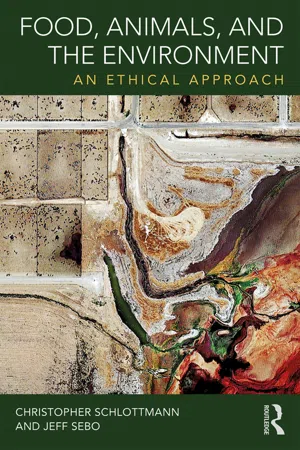
➔ Animal agriculture contributes to local waste and pollution. Animals on industrial farms produce too much waste to be disposed of properly, and deregulation makes improper disposal easy. As a result, animal waste seeps into the land and water of surrounding communities. We selected the cover art for this book in part because it captures the scale and local impact of animal agriculture—in this case a waste lagoon on a feedlot.
➔ About 70% of the world’s freshwater3 and 80–90%4 of the U.S.’s consumed water use is for agriculture, especially for farmed animals,5 making it a much larger user of water than industry and end-consumers (those who use water at home) combined.
➔ Of land used for agriculture, 75% is used for raising animals.6 Because we produce so much food to feed to humans and nonhumans, it requires over a third of all land.7 (By contrast, urban settlements make up only about 4% of global arable land.8) On a global scale, about 60% of crops are used to feed humans directly; one third is fed to nonhumans.9 Grazing land accounts for a large percentage of global land use,10 and the clearing of land for grazing emits significant CO2 and—when land is cleared by burning—black soot and other particulate matter pollution. Because so much land is used for animal agriculture and feed production, “plant-based agriculture grows 512% more pounds of food than animal-based agriculture on 69% of the mass of land that animal-based agriculture uses.”11
➔ Farmed animals who eat feed (accounting for the vast majority of farmed animals in industrialized countries) convert these calories inefficiently. It takes 4,000 calories of fossil fuel to eventually produce 1,000 calories of protein in a chicken raised for human consumption.12 In part due to conversion, “ruminant meat has impacts ~100 times those of plant-based foods.”13
➔ A large percentage of global arable land is also used to grow crops that are used for feed. This further contributes to CO2 and nitrous oxide emissions.
➔ Animal agriculture is responsible for an estimated 14.5% of all anthropogenic greenhouse gas (GHG) emissions on a 100-year time scale. This percentage increases substantially on a 20-year time scale, since methane (CH4) and nitrous oxide (N2O) proportionately trap much more heat on a 20-year time scale.14
◆ Animal agriculture is responsible for an estimated 9% of global carbon emissions.15
◆ When ruminant animals (mammals who can ferment plants in specialized digestive systems) digest, enteric fermentation occurs—resulting in methane emissions. All in all, animal agriculture is responsible for an estimated 37% of all anthropogenic (human-induced) methane, and methane traps heat an estimated 23 times as effectively as carbon dioxide over 100 years.16
◆ The management of manure emits nitrous oxide and methane. All in all, animal agriculture is responsible for an estimated 65% of all anthropogenic nitrous oxide, and nitrous oxide traps heat an estimated 296 times as effectively as carbon dioxide over 100 years.17
➔ If we want to increase our chances of meeting the greenhouse gas targets from Paris’ COP21 conference, animal product consumption needs to be considered, as just the projected increase in animal product consumption could account for much or all of the “carbon budget” keeping the increase in global temperature to 2 degrees Celsius (about 3.6 degrees Fahrenheit).18
Animals are also central to the framing of this book because the impact that modern agriculture has on them is morally important in and of itself. Most of the 100+ billion domesticated animals killed annually for food live very short lives relative to how long they could live otherwise. In industrialized settings, they are subject to inhumane conditions that lead to disease, suffering, and eventually slaughter. In non-industrialized settings, they still live short lives, but often have more freedom and space, and lower rates of diseases.
Agriculture also impacts animals not raised for food. When we clear land, we alter or destroy animal habitats. When we create grazing land we threaten animals such as prairie dogs and coyotes.19 When we harvest wheat with combines we kill mice, and when we spray (organic and synthetic) pesticides on crops we kill insects. Our industrial practice of extracting aquatic animals from their habitats (in addition to farming aquatic animals) captures billions of animals who are not intended to be eaten. These animals are subsequently thrown back into the ocean, often no longer alive. Many industrial fishing practices, such as bottom trawling, destroy habitat for aquatic animals.
Numerous ethical questions arise in light of this situation. How do we feed people while minimizing animal and environmental harms? Should cultural values override animal welfare and environmental impacts? Is it better for animals on free-range farms to live short lives they otherwise would not have lived, or to never have existed in the first place? How much should individuals shoulder these dilemmas, given that large companies and governments control how food is produced? As the human population rises and food production industrializes, these questions are more urgent than ever.
These ethical questions do not have easy answers. All agriculture harms animals and the environment at least to a degree. As we transform nature, we change habitats, convert energy, release pollution, and otherwise alter the environment. In an industrialized world of over 7 billion people, we cannot help but transform nature radically in food production. However, there are more and less harmful ways to transform nature, and determining which food systems are best, and which ways of bringing these food systems about are best, is a necessarily messy, complex, and multifaceted matter.
1.2 How this book is organized
Food, Animals, and the Environment: An Ethical Approach introduces readers to the major concepts and values at the intersection of food and the environment, emphasizing the unique place of animals. We will proceed as follows.
In Chapter 2, we will discuss key concepts related to food, animals, and the environment, including the distinction between—and relationships among—descriptive concepts (concerning facts) and prescriptive concepts (concerning values).
In Chapter 3, we will discuss key concepts related to moral theory. This will include discussion of moral methodology as well as of some of the main moral theories that people accept, and how these theories relate to each other both in theory and in practice.
In Chapter 4, we will discuss key concepts related to moral status. This will include discussion of the moral value of humans, nonhumans, plants, species, and ecosystems. We will also discuss collective responsibility and duties to people in other nations and future generations.
In Chapter 5, we will discuss the empirical dimensions of food, animals, and the environment that apply to all agriculture, including a discussion of the scale of animal, environmental, and human impacts.
In Chapter 6, we will discuss the empirical ...
Table of contents
- Cover Page
- Praise
- Food, Animals, and the Environment
- Title
- Copyright
- Contents
- 1 Introduction
- 2 Facts, Values, and Naturalness
- 3 Moral Theory
- 4 Moral Status
- 5 Agriculture and The Environment
- 6 Industrial Agriculture
- 7 Alternatives to Industrial Agriculture
- 8 The Ethics of Food Production
- 9 The Ethics of Food Consumption
- 10 The Ethics of Legal Food Activism
- 11 The Ethics of Illegal Food Activism
- 12 Conclusion
- Index
Trusted by 375,005 students
Access to over 1.5 million titles for a fair monthly price.
Study more efficiently using our study tools.
Frequently asked questions
Yes, you can cancel anytime from the Subscription tab in your account settings on the Perlego website. Your subscription will stay active until the end of your current billing period. Learn how to cancel your subscription
No, books cannot be downloaded as external files, such as PDFs, for use outside of Perlego. However, you can download books within the Perlego app for offline reading on mobile or tablet. Learn how to download books offline
Perlego offers two plans: Essential and Complete
- Essential is ideal for learners and professionals who enjoy exploring a wide range of subjects. Access the Essential Library with 800,000+ trusted titles and best-sellers across business, personal growth, and the humanities. Includes unlimited reading time and Standard Read Aloud voice.
- Complete: Perfect for advanced learners and researchers needing full, unrestricted access. Unlock 1.5M+ books across hundreds of subjects, including academic and specialized titles. The Complete Plan also includes advanced features like Premium Read Aloud and Research Assistant.
We are an online textbook subscription service, where you can get access to an entire online library for less than the price of a single book per month. With over 1.5 million books across 990+ topics, we’ve got you covered! Learn about our mission
Look out for the read-aloud symbol on your next book to see if you can listen to it. The read-aloud tool reads text aloud for you, highlighting the text as it is being read. You can pause it, speed it up and slow it down. Learn more about Read Aloud
Yes! You can use the Perlego app on both iOS and Android devices to read anytime, anywhere — even offline. Perfect for commutes or when you’re on the go.
Please note we cannot support devices running on iOS 13 and Android 7 or earlier. Learn more about using the app
Please note we cannot support devices running on iOS 13 and Android 7 or earlier. Learn more about using the app
Yes, you can access Food, Animals, and the Environment by Christopher Schlottmann,Jeff Sebo in PDF and/or ePUB format, as well as other popular books in Philosophy & Ecology. We have over 1.5 million books available in our catalogue for you to explore.