Wisdom of the Psyche
eBook - ePub

Wisdom of the Psyche

Beyond neuroscience

  1. 232 pages
  2. English
  3. ePUB (mobile friendly)
  4. Available on iOS & Android
eBook - ePub

Wisdom of the Psyche

Beyond neuroscience

About this book

The first edition of Wisdom of the Psyche engaged with one of the main dilemmas of contemporary psychology and psychotherapy: how to integrate findings and insights from neuroscience and medicine into an approach to healing founded upon activation of the imagination. In this revised edition, Ginette Paris re-focuses her attention on the modern lack of desire to become adult and updates the book with brand new neuroscientific research.

Paris uses cogent and passionate argument, as well as stories from patients, to demonstrate that the human psyche seeks to destroy relationships and lives as well as to sustain them. She makes clear that the way out of those destructive states does not start with an upward, positive, wilful effort of the ego, but with an opening of the imagination, and aims to foster the dialogue between psychotherapists and neuroscientists. In clear and accessible language, Paris describes how depth psychology can be seen as a subject of the humanities rather than the sciences, and explains how gaining an understanding of neuroscience will not necessarily make us psychologically wiser.

A unique and powerful book, Wisdom of the Psyche will be fascinating reading for Jungian and depth psychologists, psychotherapists, analysts and others in the helping professions, as well as students and those in training, and readers with an interest in psychology and neuroscience who want to create an inner life worth living.

Frequently asked questions

Yes, you can cancel anytime from the Subscription tab in your account settings on the Perlego website. Your subscription will stay active until the end of your current billing period. Learn how to cancel your subscription.
No, books cannot be downloaded as external files, such as PDFs, for use outside of Perlego. However, you can download books within the Perlego app for offline reading on mobile or tablet. Learn more here.
Perlego offers two plans: Essential and Complete
  • Essential is ideal for learners and professionals who enjoy exploring a wide range of subjects. Access the Essential Library with 800,000+ trusted titles and best-sellers across business, personal growth, and the humanities. Includes unlimited reading time and Standard Read Aloud voice.
  • Complete: Perfect for advanced learners and researchers needing full, unrestricted access. Unlock 1.4M+ books across hundreds of subjects, including academic and specialized titles. The Complete Plan also includes advanced features like Premium Read Aloud and Research Assistant.
Both plans are available with monthly, semester, or annual billing cycles.
We are an online textbook subscription service, where you can get access to an entire online library for less than the price of a single book per month. With over 1 million books across 1000+ topics, we’ve got you covered! Learn more here.
Look out for the read-aloud symbol on your next book to see if you can listen to it. The read-aloud tool reads text aloud for you, highlighting the text as it is being read. You can pause it, speed it up and slow it down. Learn more here.
Yes! You can use the Perlego app on both iOS or Android devices to read anytime, anywhere — even offline. Perfect for commutes or when you’re on the go.
Please note we cannot support devices running on iOS 13 and Android 7 or earlier. Learn more about using the app.
Yes, you can access Wisdom of the Psyche by Ginette Paris in PDF and/or ePUB format, as well as other popular books in Psychology & Mental Health in Psychology. We have over one million books available in our catalogue for you to explore.

Information

Chapter 1
A fable

Mom, dad, and me, me, me

Wisdom can be learned

When I returned from my dip in the Styx, I found I had only one central thought scribbled on the envelope containing the release form from the hospital. It was a kind of memo to myself and it said: wisdom can be learned.
Pain penetrates the outer shell of our persona and forces a plunge deep into the core of our being. There resides a simple truth: psychological health does not exist in the absolute, yet we all have the possibility of becoming wiser. There are many forms of wisdom, and one of these is psychological. It does not appear as wisdom in full bloom, but as a seed, ready to germinate. Pain and joy are the fertilizers. Were our society attuned to the potential and value of this kernel, we would nurture the psyche’s wisdom from a very early age. I truly believe we should ask children questions that would help them develop their psychological skills, such as: ā€œwhy do you think X is angry at Y? What do you think might help A and B get better grades? Do you think the sadness that was in your house last week is still hanging around? How do you understand the emotion of anger when it grips you?ā€ Wisdom is not a given, not some thing. It is more like an orientation. Just as the seed that is germinating grows toward the light, psychological wisdom is that compass within each of us, pointing in what seems like the most fruitful direction. Wisdom is a destination rather than a destiny, a goal rather than a state. Nobody is wise all the time and nobody reaches absolute adulthood; nevertheless, the more we walk in the direction of wisdom, the more peaceful we feel.
All forms of wisdom and all schools of spiritual discipline agree on one principle: we all start our journey as a needy, vulnerable, impotent child. If the needs of the child are not addressed properly the first time, the adult self must eventually address them. The basic task of psychotherapy is to go back and give the inner child what he or she needs to grow up. What many theories about the ā€œinner childā€ seem to have missed is that adulthood begins when one is willing to leave behind the developmental model of helpless child, which means taking responsibility for one’s needs. As long as one waits for others to take charge, the psychic compass remains defective.
There is a junction where Buddhism most obviously meets psycho therapy in proclaiming: yes, compassion allows the inner child to stop whimpering. Yes, paying attention to our own needs supports the life force that naturally grows toward maturity. Prophets, healers and sages all show aspects of the Great Mother; they let us drink of what folk wisdom appropriately calls the ā€œmilk of compassion.ā€ As an adult patient in an intensive care unit, I have drunk of this sweet milk; without this gift, I would now be dead.
Nevertheless, the archetype of Great Mother also personifies the vigilance of the mother who expects the child to grow up— otherwise the child turns into a tyrant and the adult remains infantile, a puffed up, pompous tyrannical big baby in whom the seed of wisdom is lost. A wise psychotherapist addresses not only the unmet need for mothering, but also the unmet need for separation. Re-mothering or re-parenting consists of giving both the nurturing and the weaning.
Beginning with the basic cast of Mother-Father-Child, every school of psychology has offered theoretical variations, some bizarre and far-fetched, but all point at a core that is the same through thousands of years of philosophical and spiritual teachings. It is that core, that consensus, that basic archetypal story that will be the starting point of my theoretical revision. I am asking here, in this chapter, what is the basic plot for the child to evolve into an adult, what is the nut in the shell, where is the beginning of wisdom, or the wrong turns that provoke failure.
When a discipline develops as quickly and in as many directions as did psychology, there comes a point where we lose sight of the basics. The non-specialist can’t see the foundations of the huge theoretical building; the solid anchors that are the places of agreement detach from the mother ship. It is time to remind ourselves that all humans (not just the wise psychologists) have perennial values, archetypal principles, spiritual and theoretical corner stones that sustain the whole edifice.
The following fable is my attempt at summarizing the consensus among philosophers, psychologists and spiritual leaders of different periods, cultures and places. Instead of the genre of theory, with abstract concepts and theories, I am presenting these ideas in the genre of the fable. It is an invitation to compare my imagining with your own subjective version of the same basic narrative.

The cast of characters

The casting involves three characters.

Archetypal Child

The archetypal child is the symbol for the universal state of vulnerability and neediness of the infant. The Jungians, who like the sophistication of Latin, refer to this archetype as the puer (puer = child), or puer aeternus (eternal child). It is an archetype that remains active all our life and contains both the vulnerability and the vitality of youth. We regress back to its vulnerability each time life wounds us. We feel the joy of the Child each time we experience enthusiasm to learn, discover, experiment. The Child archetype (let’s give him a capital C) is activated when the soldier can’t sleep because of terrifying nightmares, when the worker is professionally burned out and starts crying on the job, when the lovesick person can’t get out of bed to face the day’s work. Archetypal Child screams: ā€œTake care of me, I can’t. Love me, give me joy, otherwise I’ll die.ā€

Archetypal Mother

The Great Mother is the archetype of compassion, the essence of mothering. Mothering and compassion are universally understood as synonymous, because the human newborn is so fragile that without the compassion of caregivers the human race would not have survived. Compassion and mothering can be offered by a male or a female, a sister or an uncle, a friend, lover, cellmate, or, if one has luck, one’s own biological mother. When the child is a baby, even the biological father has to play the role of Great Mother, because a baby does not yet need disciplining. An archetypal role is distinct from the social or biological function; what is crucial is the experience of the archetype itself, in whatever form it is given. One absolutely needs to have been touched by the caressing hand of a Great Mother, to have been held in a tender gaze that does not condemn us for our weakness. By ā€œGreat Motherā€ I mean that experience of unconditional love, without which nothing small, nothing vulnerable, nothing in its infancy can survive, not even the ā€œbabyā€ ideas, the tentative impotent style of the first sentences that are in a student’s first draft of a dissertation. No writer in his or her right mind would risk showing a first draft to a critical mind, not until the text ā€œgrows upā€ to stand on its own and sustain some measure of criticism. Everything new, young, fragile—even the first shoot of what will become a mighty oak tree––first appears as a vulnerable sprout needing protection and nurturance; otherwise, it is crushed and dies.
Great Mother has many appellations: the maternal principle or instinct; the capacity for compassion; the tender-loving-care principle; or the chicken-soup-healing factor. I prefer not to call it the feminine principle, because that has led to many misunder standings. To think that the female gender is more gifted with maternal qualities is a philosophical mistake filled with tragic consequences for both genders. Compassion is a human quality and ā€œMotherā€ with a capital ā€œMā€ symbolizes it. If mothers were not motherly, human babies, the most vulnerable creatures in the animal kingdom, would die. Nevertheless, the archetypal quality exists in every one of us, with the same possibility of development or non-development.
The Mother’s message is essentially one of compassion: ā€œI love you, little one, simply because you exist. Don’t cry. I’m here. I will take care of you, feed you, heal you, and give you a taste of the nectar of tenderness.ā€ When Great Mother refuses to give of Herself (which means when the little mother is impatient and says, ā€œget out of my way and take care of yourselfā€), the archetypal Child experiences pure panic. That abandonment anxiety is the very essence and source of all adult panic.

Archetypal Father

This powerful authority figure, Cosmic Father, Great Father or God the Father, is the third and last character in our fable. He informs the child that there is such a thing as conditional love, and that law and order, although they may vary in their applications, are universal. The archetypal Father is represented in mythology with that thundering voice and authoritatively raised eyebrows that the Romans represented as Jupiter, the Greeks as Zeus and Christians as God the Father. These Father divinities personify authority and responsibility. The Child draws a sense of power and protection from a powerful father, expressed by all kids when they boast ā€œmy father is stronger than yoursā€ (or richer, taller, braver, has a bigger car, bigger gun, bigger fist or my dad has the most powerful computer in the neighborhood). The projection is carried over to any person who holds authority (king, general, president, boss, chief, captain, sheriff etc.). In politics, it is still the Father archetype that draws the votes: ā€œThe president of my country is more powerful than yours, has more money, more arms, more soldiers, more allies … and I want the protection it offers me.ā€
The Father archetype is present in the teacher who flunks you at the exam but also can help you prepare for it; he (or she) may be the bank officer who informs you that you are overdrawn, but who will also help you start your business with a loan; he is the policeman who writes you a ticket, but also protects you from thieves and thugs; he is the IRS agent who disallows a tax deduction because he serves the principle of redistribution of wealth; he is the referee who sends you to the bench, thus keeping the game within the limits of fair play. The terrifying news for the Child is that this figure of authority will impose his rules and regulations, has strict codes of rewards and also of punishments, and holds on to principles of order. Archetypal Child rages: ā€œWhat are you telling me? I, the Little King of the House, have to obey rules? If not, smack, whap? I really don’t like it.ā€
Now that we have the cast of characters, I am offering my version of this eternal drama. Of course, this basic narrative can be re-interpreted in multitude of ways, and it has been since humans tell stories.
First trial: born needy
Child: I am so small, Great Mother. I implore you to take care of me. I just came into this world. I don’t even know how to distinguish between hunger and cold, between hurt and fear. My consciousness is undeveloped. I have no culture and no language. All I have is this body, this bundle of tyrannical needs. ā€œItā€ feels pleasure or pain. It is not ā€œIā€ because I don’t have an ā€œIā€ yet. To be honest, I don’t have the slightest idea of who ā€œIā€ is, or who ā€œIā€ can be. I beg you to put sweet words in my ears to stir the desire to learn language. And once you have given me the words, I will want stories. I want them rich and complicated. I want the stories to make me feel the presence of a humanity that is dense, with many protective layers made of all the generations of wise humans. I need to feel a part of a large, knowledgeable, extended tribe, compassionate enough to contain my life and protect me from harm. Most of all, Great Mother, I want you to define me. Look at me with eyes of adoration. Become the mirror that reveals Me as your Sun King, the source of all light, the center of all joy in your life.
Great Mother: Don’t worry, little one. I’ll give you all that. My task is to convince you to incarnate, to take pleasure in living in a body and for that you need pleasure and joy.
Child: Caresses, songs, cuddling, cooing and kisses, will you give me all those?
Great Mother: You need them as much as you need food, warmth, language and a clan. Without joy, you may not want to incarnate fully, you may fail to thrive. So, you shall get the whole package. But listen! You must begin right now to transform and start maturing to become a full human being.
Child: What if I don’t?
Great Mother: I’ll drop you, baby! And if I drop you, you die.
Child: Okay, I get it! What do I have to do?
Great Mother: There are many trials, each one interesting and difficult.
Child: If it’s hard, I want you to do it for me.
Great Mother: If I do it for you, you will never be able to say ā€œIā€. No ego, no competence; no ego, no freedom.
Child: I want an ego. I want freedom. I want the world and I want it now. What’s the first trial? Bring it on then.
Great Mother: Here’s the first trial: separate! Starting now, begin differentiating the discomfort of hunger from the discomfort of cold. Toilet train, because your shit stinks, even for Mommy. Discover that ā€œyouā€ and ā€œIā€ equal two, not one. Understand that I am less and less at your beck and call. As you grow, you’ll have to abdicate the throne.
Child: I don’t want to.
Great Mother: Of course you don’t. Your resistance is precisely the first step in your education. I’ll be careful not...
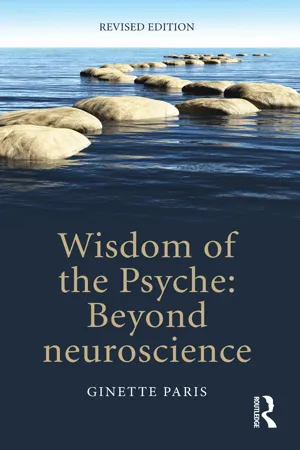
Table of contents

  1. Cover
  2. Title
  3. Copyright
  4. Dedication
  5. Contents
  6. Preface
  7. Introduction
  8. 1 A fable: mom, dad, and me, me, me
  9. 2 Mother as archetype
  10. 3 Father as archetype
  11. 4 Ideas and emotions
  12. 5 Brother philosophy, sister psychology
  13. 6 Psyche is invisible
  14. 7 The night vision
  15. 8 The virtual reality of the psyche
  16. 9 Modeling the soul
  17. 10 Looking for a savior
  18. 11 How sick am I doctor?
  19. 12 Is therapy an investment?
  20. 13 The legal model of psychotherapy
  21. 14 Joy is the best teacher
  22. 15 Schools of thought are families; bibliographies their family trees
  23. Notes
  24. Bibliography
  25. Index