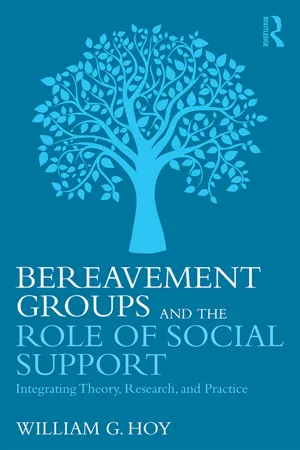
All too frequently, clinical practice consists of repeating year after year the methods learned in graduate training, occasionally seasoned by a technique learned in a continuing-education workshop. Bereavement Groups and the Role of Social Support gives clinicians what they've been missing in other volumes: practical techniques that have a solid contemporary empirical basis. Deftly weaving together theory, research, and practice, this volume is a compendium of the latest practical thinking about bereavement support groups. Readers will learn when well-loved practices make sense and are supported by sound evidence, as well as which practices should possibly be discontinued. The book also contains the results of a qualitative study bringing together the best practices of experienced bereavement group leaders from around the world.
eBook - ePub
Bereavement Groups and the Role of Social Support
Integrating Theory, Research, and Practice
- 224 pages
- English
- ePUB (mobile friendly)
- Available on iOS & Android
eBook - ePub
Bereavement Groups and the Role of Social Support
Integrating Theory, Research, and Practice
About this book
Information
Chapter 1 Making Sense of Grief
DOI: 10.4324/9781315686844-2
Joan was not the first widow to wonder if she could possibly survive the overwhelming sense of “being lost” that followed her husband’s death. Just after their 30th wedding anniversary, Rick had died suddenly at work of a heart attack. He was 52. The autopsy report explained his cause of death as a “proximal lesion of the left anterior descending artery”; their family doctor explained to Joan that her husband had died almost instantly in a cardiac episode known widely as “the Widow Maker.” To Joan, more frightening words had never been spoken, and she did not like the term. In one decisive moment, a malfunction in her beloved husband’s heart had made her into something she had never wanted to be: a widow.
Now at the urging of a friend from work, she was here: the first evening of a seven-week group called “Exploring Your Grief” in a conference room at a local hospital. When the facilitator greeted Joan at the door, the new widow could already feel the tears welling up in her eyes. It had been almost four months, and she seemed only to get worse, not better. Her anxiety mounted a few weeks earlier when her well-meaning sister-in-law, herself widowed a few years earlier, remarked, “Well, Joan, if you think it’s bad now, just wait. The second year is even worse than the first.” Somehow, Joan hoped this group of people whom she had never met would help her “explore” her grief. But, in reality, what she hoped more than anything was that in “exploring her grief,” she would learn how to get past the overwhelming sense of “lostness” she had felt for the last four months.
Ironically, the quick death of Joan’s husband at an early age would have been common rather than unusual in much of the world and throughout much of history. Among early humans, archaeological evidence implies deaths generally came quickly and without warning rather than after the protracted dying so often seen in the Western world today. While we do not know how early humans dealt with grief, we can readily surmise that they did experience it.
Whatever they did with their grief, however, these humans dealt with their dead as a way to deal with their loss. One British scholar writes, “At 10,000 years ago, we have good evidence of elaborate food and decorations inside graves, of the dead being dressed in elaborate ways, of differential burials based on status, or even possibly the elicited grief” (Kellehear, 2007, p. 23, emphasis added).
Humans have developed an amazing capacity to adapt to loss. Music in virtually every genre includes references to loss. The words of poets, playwrights, and novelists throughouthistory have heralded the sentiment of aching human hearts and the solace and hope they found in the face of great sorrow. Novelists in every era have chosen the vagaries of grief to enliven their characters and to draw readers into the sentiment of the story. Perhaps no experience plays on the heartstrings of readers quite like sorrow, if for no other reason than that grief is such a universal human experience.
Perhaps the world’s oldest story is that of Gilgamesh, a historical king who reigned in Urek, a Mesopotamian city, around 2750 BCE. The portrayal of inconsolable grief in the life of Gilgamesh is familiar, even if the story’s details are unknown to many living in the 21st century. After the death of his friend Enkidu, with whom he had “slain monsters,” Gilgamesh, the mythic king-hero of the story, was inconsolable. In the words of the story’s narrator, Gilgamesh’s grief was beyond understanding, his pain impenetrable, and his sorrow unbearable (Mitchell, 2004).
In similar ways, the poetry of the anci ent Hebrews also wrestled with the vagaries of death and the difficult experiences of bereavement. The accounts of the death of the Hebrew patriarch Abraham’s wife, Sarah (Genesis 23), and of Jacob, father of famous Hebrew-born Egyptian prime minister, Joseph (Genesis 49–50), portrayed grief and its rituals with poignant words. Perhaps the oldest writing in the Hebrew Bible told the story of Job, a man who lost everything—wife, children, home, possessions, and livelihood. The story is his quest to make meaning of the loss in the context of faith, and in the end, his faith is rebuilt as he found a way to live in a world radically reshaped by his encounter. Incidentally, a large part of the narrative explains the very poor care Job received from his advice-giving, theologically inaccurate friends. Religious literature is replete with references to grief and hope, including perhaps the most quoted text of all time from the Hebrew Bible: “Yea, though I walk through the valley of the shadow of death, I will fear no evil, for Thou art with me; Thy rod and Thy staff, they comfort me” (Psalm 23:4, Jewish Publication Society, 1917).
The Christian New Testament frequently references the experiences of death and loss, in spite of some contemporary Christians insisting that real faith makes grief unnecessary. When Stephen, the first known Christian martyr, died, the response of the community was stated with simplicity: “Godly men buried Stephen and mourned deeply for him” (Acts 8:2, New International Version). In reflecting on the life-threatening illness of his colleague Epaphroditus, Paul, the famous first-century Christian missionary, explained his theological understanding of his friend’s recovery: “Indeed he was ill, and almost died. But God had mercy on him, and not on him only but also on me, to spare me sorrow upon sorrow” (Philippians 2:27, New International Version).
Perhaps unlike any group of writers, the Victorians raised “literature of sorrow” to a refined art form. Christ (1995) suggested: “Literature, particularly poetry, was often used to perform a kind of mourning work. Much as the Victorians created material objects that were effigies for the dead, Victorian writers often sought to substitute the literary work for the dead body” (p. 392).
Carman Bliss (1904) dedicated an entire volume of his nine-volume W orld’s Best Poetry to the topic of Sorrow and Consolation. Among more than 125 poems on death and consolation, he includes 19th-century poet Elizabeth Barrett Browning’s appreciation of hopefulness in the light of loss in the words of her sonnet, “Tears.” She concluded the work simply:
Ye who weep only! If, as some have done,Ye grope tear-blinded in a desert place,And touch but tombs,—look up! Those tears will runSoon in long rivers down the lifted face,And leave the vision clear for stars and sun.(Bliss, 1904, p. 126)
In his tragedy Macbeth, William Shakespeare placed words into the mouth of his character Malcolm as he informs and then provides support to Macduff in the aftermath of the murder of Macduff’s wife and children: “Merciful heaven! What, man! Ne’er pull your hat upon your brows. Give sorrow words. The grief that does not speak whispers the o’er fraught heart and bids it break” (Macbeth, Act 4, Scene 3, lines 210–214).
Paintings, sculpture, and architecture provide a glimpse into the subjective world of how people have experienced loss in history, as well. Eppel (2009) suggests, “Art reveals much of our inner life, the tru th about human nature,” and then asks rhetorically, “but what is art and why does it resonate so much with us?” He quotes Laplanche and Pontalis’ notion of art as “a half-way house between the subjective and objective,” suggesting that it is the place where elements of inner emotional life get combined with material elements. While the study of art, Eppel suggests, helps the student better understand the artist’s inner life, it likely resonates because of our own identification with that which “strikes a chord with us, because they constitute elements which are universal in human nature” (p. 48).
If classical literature, visual art, and drama all provide windows to the sorrowing soul, these renderings likely describe the subjective inner world of the artists and, by extension, the experienced world of bereaved masses. Nevertheless, developing sociological and psychoanalytical theory desired a more objective description of the bereavement experience, so by the early 20th century, theorists such as Max Weber and Sigmund Freud were examining the experiences of bereavement from an intellectual perspective. Freud’s 1917 paper “Mourning and Melancholia” set the stage for the 2 0th century’s voluminous exploration of the bereavement process. Likely responding to a growing desire in his day to pathologize grief, he wrote,
although mourning involves grave departures from the normal attitude toward life, it never occurs to us to regard it as a pathological condition and to refer it to a medical treatment. We rely on its being overcome after a certain lapse of time, and we look upon any interference with it as useless or even harmful. (Freud, 1957/1917, p. 243)
Models: Describing the Process of Adapting to Loss
In the third decade after Freud’s “Mourning and Melancholia” and while the deadliest conflict in history raged in Europe, Asia, the Pacific islands, and North Africa, interest in the role of bereavement intensified. Estimates of total fatalities in World War II range from 50 million to more than 80 million, a number that represents 3% to 5% of the 1939 global population (Duff, 2015; Ferguson, 2006; Rummel, 1994). American psychiatrist Eric Li ndemann had been interested in the bereavement experiences of families whose loved ones were military personnel killed in war. However, it was his work with survivors of the deadly Boston Cocoanut Grove nightclub fire that propelled him to the forefront of conversations about the immediate and long-term effects of grief (Cobb & Lindemann, 1943; Lindemann, 1944).
On Saturday evening, November 28, 1942, fire raced thr ough the famous club; the eight-minute fire would eventually claim 492 lives, including the four Fitzgerald brothers. Like many of the young patrons at the club that night, they and their dates all died at the Grove celebrating the homecoming of Henry, a private in the Army Air Corps (Esposito, 2005). Ironically, this early work of Lindemann’s on bereaveme nt represented very complicated stories of loss in that so many of the victims were young people. Many of the victims of the fire that night were celebrating College of the Holy Cross’s upset victory in football against cross-town rival Boston College. Like the Fitzgerald brothers, many other young people in the club that night were reveling in the safe return of family members and friends from military service, ironically dying in the celebration marking that their loved ones had survived combat.
As one of the first to systematize the grief process and the ways it can go awry, Lindemann concluded that grief is a “definite syndrome” that might appear immediately after a crisis or after some delay. Through using appropriate techniques, Lindemann (1944) asserted, the “distorted pictures (of bereavement) can be successfully transformed into a normal grief reaction with resolution” (p. 141). Presaging much of the thinking in grief over the next half-century, Lindemann concluded,
The duration of a grief reaction seems to depend upon the success with which a person does the grief work, namely, emancipation from the bondage to the deceased, readjustment to the environment in which the deceased is missing, and the formation of new relationships. One of the big obstacles to this work seems to be the fact that many patients try to avoid the intense distress connected with the grief experience and to avoid the expression of emotion necessary for it. (p. 143)
During World War II and the early postwar years, British psychiatrist John Bowlby was at work trying to understand the influence on young children of an absent mother, studies that gave rise to the attachment theory for which Bowlby is most famous. His research included psychological examination of children accused of theft as well as children hospitalized for various illnesses and injury, the latter project in the late 1940s, in which work the first “phases” of loss were labeled. Along with James Robertson, a filmmaker Bowlby hired to chronicle the hospitalization experience of children, Bowlby described three phases in this separation process: protest, despair, and denial (Bowlby, 1969; Robertson & Bowlby, 1952). Incidentally, these phases were eventually elab orated intofour in Bowlby’s collaboration with Collin Murray Parkes, the stage model that predated the now famous work of Elisabeth Kübler-Ross (Bretherton, 1992).
The growing interest in bereavement as a field of inquiry during the mid-20th century gave rise to a need to define terms. Like with most specialized languages, there does not seem to be a “moment in time” when the core terms of bereavement were defined. Rather, there has been a gradual evolution of terminology as the 20th century progressed. Bereavement came to be the label assigned to the actual experience of loss, and as interest in non-death losses has grown, the term bereavement seems now to be primarily used in the literature to denote the loss experienced in response to a human death. We can speak of a person as “being bereaved,” meaning he or she has suffered this significant death loss. Grief, on the other hand, has come to mean the bereaved person’s emotional, social, spiritual, cognitive, and physical response to loss, while mourning is the term used for the expressive acts or practices of grief that are part of experiencing loss in a particular society or culture (Jakoby, 2012; Stroebe, Hansson, Stroebe, & Schut, 2001).
By the late 1960s, and perhaps in fluenced by the mounting “body count” in the Vietnam War being played out on the battlefields of the Far East and the televisions of the industrialized West, Europeans and North Americans became intensely interested in death and grief issues. At least across the American landscape, this interest had likely been intensified by the death of the United States’ young, idealistic president, John F. Kennedy, in 1963. Less than five years later, civil rights leader Martin Luther King, Jr., was gunned down on a Memphis hotel balcony, to be followed only eight weeks after that by the assassination of another member of the politically iconic clan, presidential hopeful Robert Kennedy.
It is little wonder that when Swiss psychiatrist Elisabeth Kübler-Ross published her book On Death and Dying in 1969, it rocketed to the top of bestseller lists, becoming a near-instant cult classic. Within a few years, the popular press, accompanied by many nonspecialists in grief work, applied her seemingly common sense theory to every conceivable loss, and her “five stages” gained prominence in the popular cultural lexicon. Kessler and Kübler-Ross (2005) applied her original five stages of the dying process to post-death grief in a book published after Kübler-Ross’ death.
The labels for the five stages made common sense. “Denial,” after all, seemed to be the first logical response to bad news, while “acceptance” suggested equanimity, a sighing recognition that all would turn out alright in the end. Whatever “stages” came in between, whether they be Kübler-Ross’s “anger,” “bargaining,” and “depression” or some other scholar’s list of five, seven, or nine stages, was really quite beside the point. The picture of grief was one of pathway and journey. If the bereaved person began the “journey of grief,” the implied thinking went, there must be a destination. So if “denial” was “Ground Zero,” the starting gate and the opening salvo, then “acceptance” must be the destination, the finish line, the fait accompli. As bereavement support group leaders know well, the experiences of grief are not so easily compartmentalized.
Kübler-Ross most certainly deserves credit for freeing death from its closet in the urbanized West. Her work became an invaluable gif...
Table of contents
- Cover Page
- Halftitle Page
- Title Page
- Copyright Page
- Dedication
- Table Of Contents
- Preface
- Acknowledgments
- Introduction
- CHAPTER 1 Making Sense of Grief
- CHAPTER 2 Social Groups and the Support of Bereaved Individuals
- CHAPTER 3 Recruiting and Training Group Leadership
- CHAPTER 4 What Goes On Here? Developing Content for Adult Groups
- CHAPTER 5 Meeting Challenges in Support Groups
- CHAPTER 6 Supporting Children and Teens Through Grief Groups
- CHAPTER 7 Dealing With Complicated Grief in the Support Group
- Epilogue
- References
- Appendix
- Index
Trusted by 375,005 students
Access to over 1.5 million titles for a fair monthly price.
Study more efficiently using our study tools.
Frequently asked questions
Yes, you can cancel anytime from the Subscription tab in your account settings on the Perlego website. Your subscription will stay active until the end of your current billing period. Learn how to cancel your subscription
No, books cannot be downloaded as external files, such as PDFs, for use outside of Perlego. However, you can download books within the Perlego app for offline reading on mobile or tablet. Learn how to download books offline
Perlego offers two plans: Essential and Complete
- Essential is ideal for learners and professionals who enjoy exploring a wide range of subjects. Access the Essential Library with 800,000+ trusted titles and best-sellers across business, personal growth, and the humanities. Includes unlimited reading time and Standard Read Aloud voice.
- Complete: Perfect for advanced learners and researchers needing full, unrestricted access. Unlock 1.5M+ books across hundreds of subjects, including academic and specialized titles. The Complete Plan also includes advanced features like Premium Read Aloud and Research Assistant.
We are an online textbook subscription service, where you can get access to an entire online library for less than the price of a single book per month. With over 1.5 million books across 990+ topics, we’ve got you covered! Learn about our mission
Look out for the read-aloud symbol on your next book to see if you can listen to it. The read-aloud tool reads text aloud for you, highlighting the text as it is being read. You can pause it, speed it up and slow it down. Learn more about Read Aloud
Yes! You can use the Perlego app on both iOS and Android devices to read anytime, anywhere — even offline. Perfect for commutes or when you’re on the go.
Please note we cannot support devices running on iOS 13 and Android 7 or earlier. Learn more about using the app
Please note we cannot support devices running on iOS 13 and Android 7 or earlier. Learn more about using the app
Yes, you can access Bereavement Groups and the Role of Social Support by William G. Hoy in PDF and/or ePUB format, as well as other popular books in Psychology & Education in Psychology. We have over 1.5 million books available in our catalogue for you to explore.