![]() Part I
Part I
The Socratic Method![]()
Chapter 1
Two Models of Teaching
If Good Teaching is a Dialogue, Why Does the Monologue Continue to Dominate?
Robert Benchley once remarked that: “There are two kinds of people— those who classify things and those who don’t.” Since I belong to the first group, I tend to classify teachers according to those who still employ the lecture model of learning and those who daily engage their students in active learning. I do so not only because most of my former teachers assumed that they were the most important part of the learning process but also because the lecture method continues to dominate in too many classrooms even today. In contrast, the Socratic teacher knows that the student is the most important part of the learning process.
Take my high school American literature teacher, Marc Prosser. He began most lessons by stating the objective: “By the end of this class you will be able to identify the characteristics of the ‘code hero’ in Hemingway”—and then, anticipating the so-what looks on our faces, explained the relevance or importance of this knowledge: “Hemingway’s concept of the ‘code hero’ will give you standards by which to judge your own ideas of heroism.” The class proceeded as a lecture. Mr. Prosser knew what a code hero was and he was going to tell us, tell us that he told us, and then ask us to tell him what he had told us. Our job as students was to “pay attention,” that is, to be receptive and passive and to take careful, detailed notes. We were not to interrupt his lecture with comments; however, we were allowed to ask questions for elementary clarification. For example, “What do you mean by pragmatic?” or “Who is James L. Roberts?” or “Why do you call this stuff ‘literary criticism’?” His authority was supreme, his answers all we needed to know on those subjects. After all, he had a Master’s degree.
His lessons concluded with an objective test. “I am the tester, and you are the testees,” he would say, and never would we break from those roles. However, “to be fair”—another of his pet phrases—he “entertained” questions before the test. If we had none, Mr. Prosser judged his lesson a success. In the end, we were to trust that Mr. Prosser knew best even when we did not know what he was talking about. “Someday you will understand, and all will be clear,” he would reassure us.
What I eventually came to understand, thanks to my college contemporary literature professor, Kenelm Basil, was that there was a better way to teach. Mr. Basil was a Socratic teacher if ever there was one. He began each lesson not by telling us what we were going to learn (he was not certain that we would learn anything although that was, of course, his fondest hope) but by posing a major problem about the meaning of the day’s assigned text (a work of art whether written, created, or performed). He began always with a basic question of interpretation, wrote it on the board, and then asked each of us to write down our own initial answers on scrap paper. For example, “According to Vonnegut’s story, ‘Harrison Bergeron,’ is the desire to excel as strong as the tendency to be mediocre?” Because he kept his own opinions to himself—he was not a participant but a leader—and he asked only follow-up questions on our comments, Mr. Basil convinced us over time that he really did not have a single correct answer in mind. Indeed, the class soon realized that more than one correct answer was possible because evidence from the story supported differing views. In short, our teacher began the discussion with a real question, the answer to which he himself was uncertain or even had no answer at all.
As students, we had to be active: clarifying our answers, testing others’ answers for supporting evidence, resolving conflicting answers with evidence, and listening for more opinions. Learning in Mr. Basil’s classroom was not about receiving ideas but about wrestling with them. The test of truth was reason and evidence, not teacher authority. The lesson concluded with a resolution activity since, after all, questions are quests for answers. We were asked to review our original responses and then to write a paragraph or a brief essay stating our comprehensive answer to the basic question. Most importantly, Mr. Basil strove not for group consensus or truth by vote, but rather for individual understandings: “Given the answers that you have just heard in discussion, what now is your solution?”
Liberation at last! I no longer had to sit dutifully silent while someone told me what I could just as easily have read for myself, found in a library, or researched on the Internet. I no longer had to parrot the teacher’s interpretations. More important, Mr. Basil challenged me to think independently and to become responsible for my own ideas. The responsibility for learning had been placed in my hands and along with it, the joy and personal satisfaction of arriving at my own insights. I had learned to live with doubt and to uncover questions that answers hide. In short, I had learned how to learn.
Do not misunderstand. Most so-called Socratic teachers do not conduct discussions the way Mr. Basil did. Many have not mastered the art of fostering reflective, independent thinking. Such teachers confuse the right to express an opinion with the notion that any opinion can be right. Toleration of any and all ideas becomes the goal, and brain storming—that pathetic analogy—gets enthroned as the method. As one mindless person put it, “Don’t we all know that everything is relative and that there are no absolutes?” Except, of course, his opinion.
Others, the pseudo-Socratic teachers, offer little more than a disguised lecture. These teachers pretend to conduct open discussions but have specific answers in mind. They tip their hands in several ways: by asking leading questions (“How can you honestly think Vonnegut would agree with you?”), by allowing opinions that they agree with go unchallenged or unsubstantiated, by developing a single line of argument on but one side of an issue, by injecting their own opinion into the discussion (“I believe that you have all overlooked important information on page six”), by commenting on student answers (“That’s very good, James. I’m so proud of you” or, “Maria, I think you had better reconsider your answer. You are missing something”), and finally, by attempting to arrive at group consensus (“I would like to see a show of hands. How many think the desire to excel is as strong as the tendency to be mediocre?”). If what I have said about these would-be Socratic teachers is not true, how else are we to explain these examples of common student and teacher behaviors?
| Teacher: | Whenever I try to have a discussion, my students clam up. Only one or two contribute. They just don’t get the point. I have to tell them. |
| Student: | My answer is correct, isn’t it Mrs. Jones? |
| Teacher: | Discussion is a waste of time. I have to cover the curriculum. |
| Student: | But Mrs. Jones, what is the right answer? |
| Teacher: | My students’ test scores have to improve. I don’t have time for the luxury of endless discussions. I have 130 students. Get real. |
| Student: | Why do you keep asking questions when you know the answers? |
| Teacher: | Students don’t know how to ask good questions and anyway, discussions are just too messy. |
| Student: | Just let me alone and give me my C. I don’t mess up your class. |
| Teacher: | My students cannot be trusted to think for themselves. They keep coming up with silly answers. |
But isn’t that just the point? The lecturing teacher fails to understand that wrong answers are a necessary part of the learning process when real thinking takes place. In contrast, the authentic Socratic teacher recognizes and accepts false turns and “silly” answers as inevitable when students have the freedom to be wrong— and right. After all, thinking is difficult and students resist it like the plague. Any teacher will recognize immediately the common cop-outs: “I don’t know,” or “Why did you call on me?” or “I wasn’t doing anything,” or “Who cares?” or “What difference does it make?” and “Ask somebody else.” In the end, if thinking were easy, there would be more of it.
The fundamental difference between Mr. Prosser and Mr. Basil comes down to who is finally responsible for learning. Mr. Prosser’s approach implies that the teacher is, while Mr. Basil’s suggests that students should be. Can anyone convince students they are responsible for their own learning other than students themselves? And is it not usually through discussion, dialogue, and problem solving—not through lecture—that students come to realize what they have and have not learned?
Not long ago, I heard James Howard of the Council for Basic Education state on National Public Radio say: “Education is what you have left after you have forgotten everything you learned in school.” I wonder what Mr. Prosser would make of that statement. I know what Mr. Basil would do with it.
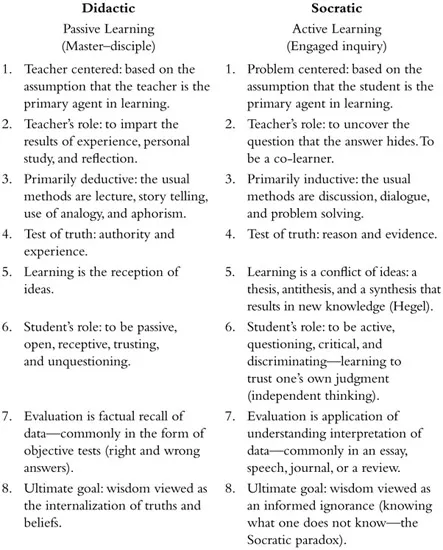
Two Models of Teaching and Learning
While the article illustrates the importance of the Socratic method for active learning, the didactic model still has a necessary but ancillary role since teachers must sometimes provide orga...