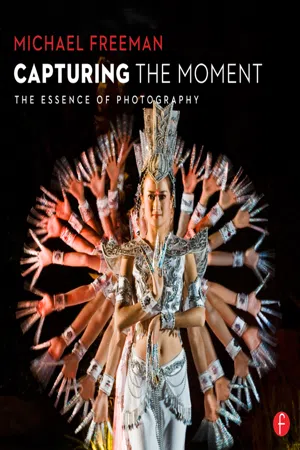
This is not a book about the fundamentals of shutter speed or how your camera works; it is a book that will teach photographers of all levels how to work with their cameras to capture moments whether they are occurring quickly or unfolding over many hours. Capturing the Moment is about a gesture, an expression, a ball in the net, a whale breaching, like Marilyn Monroe's skirt flying up or Alfred Eisenstaedt's image of a kiss between a soldier and nurse in Times Square. Moments in all forms are the true core of photography, and this book will explain how to anticipate them, recognise them, choose them, and capture them, through the eyes and wisdom of award-winning photographer and celebrated author Michael Freeman.
- 256 pages
- English
- ePUB (mobile friendly)
- Available on iOS & Android
eBook - ePub
About this book
Trusted by 375,005 students
Access to over 1.5 million titles for a fair monthly price.
Study more efficiently using our study tools.
Information

1
CAMERAWORK
Despite the technical-sounding title, this chapter is as much about ideas as about operating the camera. Rather more so, in fact, because well before the mechanical issues of shutter speed, the choice of single or continuous triggering, and other settings, there’s the basic matter of what kind of moment will be the best one. The difference between the continuous flow of action that we see and experience in life, and a still slice taken out of it, is a major jump, and not a completely natural one, either. We probably take it for granted more than we should, that the camera is going to efficiently deliver a still version of what we’re looking at. Some of the time, with a more-or-less static subject like a building, a still life, or a landscape, it indeed turns out like that—a still frame from a scene in which nothing much is happening and where movement plays no part.
Much more of the time, however, life and activity of some sort is going on in front of the camera, and the choice of when to shoot becomes the main one. Some actions follow a trajectory, such as a ball being thrown, a vehicle driving down a lane, a bird taking flight, and the good thing about trajectories is that you know what comes next, and can prepare for it. Other actions happen suddenly, with little or no warning, like a smile on a face in the street, or something hidden bursting into view. These need reaction rather than anticipation, and a different kind of preparedness. In either case, what difference, visually and emotionally, is that action going to make to the scene? And is it, or should it be, small enough in the frame to be just one element, or would it work better closed in on with a tight framing? Which would be more interesting? Which would be more effective?
All of these decisions—and there are more—affect the way the camera needs to be used. Camerawork is wrapped up in all the reasons why you are shooting the moment, and so the techniques go much deeper than simply knowing what shutter speed is appropriate. One important range of technique that we explore in this chapter is between selective shooting and collecting a mass of images quickly. There is more to this than just a question of quantity, because it reflects both personality in the photographer and the needs and possibilities of the situation. I divide this into three main groups of technique, which I call Fireman, Builder, and Marksman, for reasons explained later on. We’ll also look in more detail at the kinds of moment to expect from photography’s most frequent subject—people. Posture, gesture, and expression all contribute in different ways to how we appear in front of the camera, and the range is huge. Finally, camerawork surely extends to the editing process, not only because this is where photographers re-live their decisions, but also because when you shoot it’s wise to anticipate how you will treat the images later.
A HISTORY OF MOMENT

Spain, Madrid, 1933, Henri Cartier-Bresson
Cartier-Bresson’s most widely reproduced images, like this one—and many would say his best work—are in fact fully in the tradition of early photographic surrealism, despite Robert Capa’s later advice to move away from this into more mainstream reportage. This is surrealism as a way of saying “see how interesting and strange the ordinary world can be when you look at it my way,” and usually, with Cartier-Bresson, it involves a precise and strange moment of capture.
Key Points
Legacy of “decisive”
One among many
Casual moments
With the idea of moment so central to photography, it’s little surprise that it has been the focus of so much opinion and theorizing. Every commentator and writer who wants to be taken seriously in the field has something to say about it. Henri Cartier-Bresson cornered the market in the idea of there being an independently special moment to be captured with his phrase “the decisive moment”—actually borrowed from the 17th-century Cardinal de Retz, very much a non-photographer, who wrote, “There is nothing in this world that does not have a decisive moment.” Applied to photography, as Cartier-Bresson did in his 1952 book Images à la Sauvette, it seems entirely appropriate, a view bathed in commonsense. “The decisive moment” is hard to avoid and argue against, to the point where it is in danger of being considered a cliché (the fate of all good expressions).
This has not, of course, prevented many from trying, and the cheap journalistic tag “the indecisive moment” is almost as common as the original, and a lot more tiresome. In fact, the trail that the famous phrase initiated is the hunt for the specialness of a camera-captured moment, and not surprisingly, it’s all to do with success and failure. A successful photograph (at least of the kind that depend on timing) is one in which the photographer has managed to catch an uncommon moment that pleases him or her, and which strikes a chord with enough other people to form an audience. The writer and critic John Berger put it like this in a 1972 essay titled Understanding a Photograph: “A photograph is a result of the photographer’s decision that it is worth recording that this particular event or this particular object has been seen. If everything that existed were continually being photographed, every photograph would become meaningless. A photograph celebrates neither the event itself nor the faculty of sight in itself. A photograph is already a message about the event it records. The urgency of this message is not entirely dependent on the urgency of the event but neither can it be entirely independent from it. At its simplest the message, decoded, means: I have decided that seeing this is worth recording.”
The other part of the equation that describes success is that an audience agrees, and finds that moment in the photograph worth looking at. In between you shooting the picture and it being displayed online, in a gallery, or in a publication, there is an important gap, during which other people are doing the looking and making their minds up. And with the booming wider interest in photography, the audiences are getting bigger—and more opinionated. The moment you chose needs approbation. “Hang on,” you might think. “I go to all this trouble perfecting my skills and my observation so that I capture exquisite moments, and then it’s up to some casual observer to say whether or not they really are significant?” Well, increasingly yes is the answer, and there always will be disagreement as to what makes the good moment.
The writings of photographers themselves are all concerned with defining their own ideas of moment, and understandably self-serving. For example, what Arnold Newman thought photographers should be looking for “is photographs, not the decisive moment. When they decide that the photograph is ready for them, that’s a decisive moment. If it takes an hour, two hours, a week, or two seconds, or one-twentieth of a second—there’s no such thing as only one right time. There are many moments. Sometimes, one person will take a photograph one moment; another person will take a photograph the other moment. One may not be better, they’ll just be different.” Garry Winogrand, championed by the 1970s New York art establishment as a kind of maverick street photographer, said, “No one moment is most important. Any moment can be something,” which is no more enlightening than most of his comments. A certain “what the hell, why are you even asking these kinds of question?” attitude prevailed in that particular period, and a contemporary of Winogrand, William Eggleston (also on the Museum of Modern Art’s A-list), came up with a response that sounded as if he’d never considered the matter before. Asked in a television interview what he looked for when out shooting, he replied, “What I’m photographing, it is a hard question to answer. And the best I’ve come up with is ‘life today.’ I don’t know whether they believe me or not, or what that [referring to a particular print] means. I don’t know what to say about that, but it is today.” Eggleston, it should be noted, polarizes opinion more than most famous photographers, and has many ardent supporters who enjoy the way he has found beauty in the mundane. What’s interesting for this book is that Eggleston’s definition of moment is “today,” and specifically the today of Memphis, Tennessee, a fairly dull city that he has chronicled exquisitely for decades. Eggleston’s moments are slow moments, a crucial topic that I’ll deal with here.
All of this is the photographers’ view of moment, but the philosophical possibilities caught the attention of some writers (though surprisingly few). By the 1920s, film and lenses were sensitive enough for cameras to handle moments efficiently, and Walter Benjamin in 1931 expressed the fascination many felt at being able to see beyond normal human vision: “…we have no idea at all what happens during the fraction of a second when a person actually takes a step. Photography […] reveals the secret. It is through photography that we first discover the existence of this optical unconscious.”
Mining the philosophical depths ...
Table of contents
- COVER
- HALF TITLE
- TITLE PAGE
- COPYRIGHT PAGE
- TABLE OF CONTENTS
- INTRODUCTION
- 1 CAMERAWORK
- 2 IN-CAMERA MOMENTS
- 3 FAST MOMENTS
- 4 SLOW MOMENTS
- INDEX & PICTURE CREDITS
Frequently asked questions
Yes, you can cancel anytime from the Subscription tab in your account settings on the Perlego website. Your subscription will stay active until the end of your current billing period. Learn how to cancel your subscription
No, books cannot be downloaded as external files, such as PDFs, for use outside of Perlego. However, you can download books within the Perlego app for offline reading on mobile or tablet. Learn how to download books offline
Perlego offers two plans: Essential and Complete
- Essential is ideal for learners and professionals who enjoy exploring a wide range of subjects. Access the Essential Library with 800,000+ trusted titles and best-sellers across business, personal growth, and the humanities. Includes unlimited reading time and Standard Read Aloud voice.
- Complete: Perfect for advanced learners and researchers needing full, unrestricted access. Unlock 1.5M+ books across hundreds of subjects, including academic and specialized titles. The Complete Plan also includes advanced features like Premium Read Aloud and Research Assistant.
We are an online textbook subscription service, where you can get access to an entire online library for less than the price of a single book per month. With over 1.5 million books across 990+ topics, we’ve got you covered! Learn about our mission
Look out for the read-aloud symbol on your next book to see if you can listen to it. The read-aloud tool reads text aloud for you, highlighting the text as it is being read. You can pause it, speed it up and slow it down. Learn more about Read Aloud
Yes! You can use the Perlego app on both iOS and Android devices to read anytime, anywhere — even offline. Perfect for commutes or when you’re on the go.
Please note we cannot support devices running on iOS 13 and Android 7 or earlier. Learn more about using the app
Please note we cannot support devices running on iOS 13 and Android 7 or earlier. Learn more about using the app
Yes, you can access Capturing The Moment by Michael Freeman in PDF and/or ePUB format, as well as other popular books in Art & Digital Media. We have over 1.5 million books available in our catalogue for you to explore.