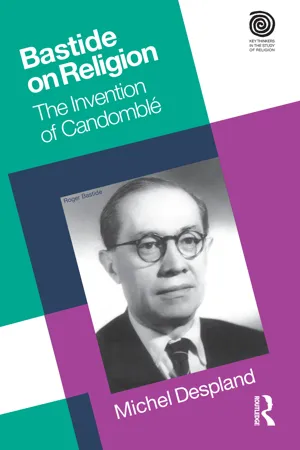
- 224 pages
- English
- ePUB (mobile friendly)
- Available on iOS & Android
eBook - ePub
About this book
Roger Bastide developed the theory of acculturation which provides a framework for understanding contact between different cultures and beliefs. 'Bastide on Religion' offers a clear introduction to the life and work of this influential scholar. The volume focuses on Bastide's study of Afro-Brazilian religions, in particular his study of Candomble, a religion born from the contact between African and Brazilian cultures. The book outlines Bastide's work on acculturation, his concept of the relationship between religion and culture, and his challenge to many dominant approaches to economic development.
Information
Chapter 1
An intellectual biography
Roger Bastide (Nîmes, 1898–Paris, 1974) accepted the labels of sociologist, anthropologist and ethnologist. All are appropriate, but only in part. First because Bastide was trained as a philosopher and never lost sight of the large questions philosophers try to handle. A second point is that his sensitivity to human beings nearly always shone through any label that he wore or received. Thus Bastide was also a writer—and one who reflected on the work that writers and other artists do. But scholars are necessarily localized—we do our jobs in a modern specialized world—so a sociologist he shall be, adding however that sociology, for him, included anthropology and ethnology.
His Ph.D. equivalent was an aggrégation en philosophie obtained in Bordeaux in 1920, where he followed the teaching of Gaston Richard, who was a pupil of Émile Durkheim (and his successor in the philosophy chair of Bordeaux). His early intellectual context places him in the second generation of Durkheimian sociology. He reached his intellectual maturity in Brazil, during his professorship in sociology at the University of São Paulo, from 1938 to 1954. He showed there the scope of his interests and pursued his now classical work on Afro-Brazilian religions. From 1954 to the year of his death, his outreach was international, centered in Paris. His scholarship flowered in the era of the cold war and the rise of the civil rights movement in the United States. But the general context in his own life was rather the era of post-colonialism. Post-modernism was not yet in the air; although it can be argued that the ground was being laid for it.
Bastide was raised in a protestant family and was educated in the schools of the Third Republic, which were laïques, meaning that religious affiliations and ideas were ignored. It will be necessary to pay some attention to the characteristically French approach to the study of religion, as it was shaped by the institutions of a State that practiced strict separation between itself and the Church.
The plan of this book is simple: it follows a chronological sequence, with three thematic final chapters. There is a reason for such a plan. To build the edifice of science is a cumulative affair and young minds learn by becoming acquainted with what their predecessors did. But no architect ever drew the plan for the overall edifice and scholars, even beginners, do more than follow specifications when they cut their stones. It is hard to imagine a building in which the foundations keep being remade and the ground floor plan revised—and in which odd-shaped bricks are made to fit. Yet this is in fact what happens. Scholars in the field of religion are historical beings who think and write about other historical beings. No fresh mind merely takes up the task where others left it. Each, in some sense, starts all over again. To draw attention to this reality I attempt in this book the intellectual biography of a man who started all over again.
This book is, in the end, a case study in the invention of a religion. Candomblé existed before Bastide wrote about it, just like America existed before Columbus discovered it. But Bastide and Columbus put what they
Morale laïque
In 1882 the government of the newly established Third Republic abolished the compulsory teaching of Catholic catechism in public schools and replaced it by a course in “secular morality.” But to translate “laïc” with “secular” is misleading. The morale laïque was based on rational considerations and excluded evidences from any revelation, but it had, at first, a theistic basis. The idea that God was the source of the moral law was very much part of it. (The programme was elaborated by a group of civil servants among whom Protestants of Kantian allegiance were over-represented.)
Laïcité in France is a public philosophy and a moral stance. Teachers are supposed to do the job of the nation, not of any community, and are expected to keep their religious opinions to themselves in the classroom. This ethos is strong and was accepted by all Protestants and Jews, a significant proportion of Catholics and of course all anti-clericals. Thus self-restraint is widely accepted. For instance teachers in the public schools ordinarily refrain from wearing jewellery indicating their religious allegiance when they exercise their official function in public spaces. (The recent legislation against pupils wearing ostentatious religious symbols, such as Muslim headscarves, was in line with custom).
In 1905 a similar political coalition passed laws imposing a strict separation between Church and State. This law in 1918 went as far as prohibiting any religious symbolism on public monuments to the war dead. (Yet at the beginning of the Great War, a chaplaincy corps—Catholic, Protestant, Jewish—was instituted in the army for ministries of individual succour and consolation). To sum up, laïcité is a philosophy of the State, not a social process.
found on the map. The peoples of the Americas knew the land existed before 1492, but those who did not (or not yet) live on this Continent found out about America only after the work of what we may call, using a somewhat archaic sense of the word, their inventors. Of Bastide’s three books on Candomblé, the first was published in Portuguese and the other two in French. All three became quickly available in both languages and the third and most weighty one was promptly translated into English.1
© Equinox Publishing Ltd. 2008, Unit 6, The Village, 101 Amies Street, London SW11 2JW
Chapter 2
Breaking the glass and striking the rock
The early career of Roger Bastide was the predictable one of a graduate of the aggrégation de philosophie: he taught in the senior years of a sequence of provincial colleges. One of his earliest available texts is an address to the award-winning 1926 graduates in Lorient (Britanny). His topic was regionalism and tradition and this leads him, as the genre requires, to direct exhortation.
His choice of topic, we can see now, and what he did say are indicative of life-long concerns. It was also rooted in crucial debates of the decade in France. It has been noted that from the end of the nineteenth century, memory became a central topic for a whole range of authors: psychologists, historians, philosophers—and novelists. Suffice to mention two monumental works: Matter and Memory (1896) in which Henri Bergson developed a contrast fundamental to his whole subsequent work, and Remembrance of Things Past by Marcel Proust (1913–1927).1 The issue of memory became socially and politically important because of the notion of tradition. Solidarity and tradition were at the core of the agenda of early sociology on France. That the individual is born into a pre-existing social whole and subsequently shaped by it was the basic premise that led to fertile inquiries. Traditionalism however, quickly became the rallying point of political anti-modernity movements (first led by persistent royalists and staunch Catholics). In the 1920s the defence of tradition and regionalism became monopolized by newly energized, post-war, right-wing bellicose movements that extolled rural wisdom and the memory of the soil from which the dead speak. (Maurice Barrés had orchestrated this theme in his novels).2
Bastide approaches the issue of regionalism from the other end of the political spectrum, from a firmly republican outlook. But he does not name it so—and generally avoids loaded ideological terms. He simply affirms that the simple joys of maintaining tradition are exhausted. The young, he adds, do not expect anything from warmed over, left over remains of the past, and dusty regional museums.3 He draws his examples from the region of his birth, the Cévennes and Languedoc, and from that of his students, Britanny. These are two contrasting parts of France, each with strong regional folklore and identity: South and Northwest, sheep and cows, olive oil and butter. Both are also heartlands of durable, contrasted confessional identification, protestant and catholic.4 He stresses that before they were placed on clothes-horses behind showcases in museums, the folkloric dresses and bonnets of Arles and of Brittany were not petrified. When worn by living women, they were varied and they changed. Strong winds, he concludes, come from the past and fill our sails, but we steer our boats—at least we want to, and rightly so. It is a crime against the “durability of provincial feeling” to protect it from the future in apparent safety behind a window, and with a little dish of repellent to keep the insects away. So Bastide calls for a new aesthetics.5 What is beautiful is much more than just what is classical and lasts.
Forty-seven years later, in 1973, on another formal occasion, Bastide delivers an address in Geneva, “Le sacré sauvage,” in which he affirms at the outset that “the instituted gods” are dead. After decades of ethnographic studies of, and proximity with, “archaic” societies, he multiplies examples of “savage trances” from distant continents and notes the appearance of similar phenomena in the Europe of the 1960s. And he concludes with a metaphor from the Bible, a text he knew from childhood. The old man invites his listeners to see in the unskilled experiences of the youthful discoverers of festive communions and alternative lifestyles, nothing less than imitations of Moses. The Hebrew leader, he reminds his listeners, struck the rock of Horeb with his rod, to make water stream from it so that the people in the desert could drink.6 The psychoanalytic echo is explicitly acknowledged but is not allowed to exhaust the intended meaning. When individuals are offered numerous pale substitutes to religion by consumerism and therapies, fresh and live meanings are born in countercultural movements, and fling an important challenge to all organized religions. This was to be his last major speech.
© Equinox Publishing Ltd. 2008, Unit 6, The Village, 101 Amies Street, London SW11 2JW
Chapter 3
Symbols, memory and anticipation: Sociology from Durkheim to Gurvitch
The uncontested leader of the sociological school in France in 1900 was Émile Durkheim. Three aspects of his work are of concern to us here.
Durkheim was first of all determined to make sociology a science. His models of science were, like those of his generation, drawn from the natural sciences; hence his slogan about treating social facts as things, the search for “elementary forms” of religious life, and the recourse to stable morphologies. Durkheim also maintained a sharp differentiation between his sociology and psychology, a discipline recently admitted to the holy shrine of approved methodical sciences.1 This led naturally to his opposition to any of the nascent forms of psychology of religion, which all seemed to him to eschew the only possible rational explanation of religion, namely the sociological. The translation in 1906 of William James The Varieties of Religious Experience 2 did not receive much attention in the group of the Année sociologique.
Secondly, the societies he knew and which nourished his reflection were what we might call societies that considered themselves complete. France and Germany believed they had evolved into a classical form and seemed both determined and able to go on as they were, colonial expansion being the only ambition left for the future. Thus he was not inclined to study evolution and social change but rather the mechanisms of stability in societies that had evolved toward their apparent end-goal.
Thirdly, Durkheim thought that sociology held the key to a proper moral education for the public schools. We shall have to return later to his notion of the morale de la République and his understanding of the goals of the école laïque. For now let us turn to the first issue.
We saw that it was Gaston Richard who guided Roger Bastide in his study of sociology. Richard was a contemporary of Durkheim and can be
Émile Durkheim (1856-1917)
The son of a rabbi, Durkheim quickly ascended the steps of the French educational system and published two doctoral dissertations, one on The Division of Labour and one (in Latin) on the political thought of Montesquieu. He read the nineteenth century social thinkers with zeal. With a professorship in Bordeaux (in philosophy) he taught and published on social solidarity and education. His studies The Rules of the Sociological Method (1895) and Suicide (1897) established him as a strong voice in the nascent discipline of sociology. From 1898 he directed an annual publication, l’Année sociologique, which gathered the work of a number of authors, mainly his students, and included numerous book reviews. In 1902, he moved to Paris. In 1912 came The Elementary Forms of Religious Life: A Study in Religious Sociology (translated 1915).
Durkheim promoted a scientific approach determined to treat social facts as if they were things. He documented the impact on the individual of collective consciousness. By insisting on seeing social realities as external to the individual, he was criticized for being an anti-individualist. Yet in ethics, law and politics, he was a staunch defender of the rights of the individual.
counted among his disciples; he certainly enjoyed the support of the master to succeed him in Bordeaux, and he managed to get the designation of his chair changed from philosophy to social science.3 But Richard was to cut an independent path. He showed interest in gender studies, a then uncharacteristic interest among Durkheimians.4 But above all he criticized Durkheim on the issue of his interpretation of religion, which he considered dogmatic. As a matter of fact there are grounds to believe that he objected to the strongly self-assured manner of the teacher known as the boss in his circle. “Let us beware of sociological metaphors,” he wrote;5 he might have added a warning against making of “society” the subject of a sentence and thereby tending to make of it an agent. Thus he shared the general unease with Durkheim’s “social realism” that was found outside the circle of early sociologists. He flatly challenged the sociologist’s case for sociology being the only rational approach to religion and rejected the alternative “God or society.” 6 The short formula “God is society” was also unacceptable under the form “society is God.” The article “Dogmatic atheism in the sociology of religion” (published in 1923, six years after Durkheim’s death) reviews the founder’s books and discusses other interpretations of “primitive religion.” It strongly opposes the identification of religion with forms of constraint.7
The article critical of Durkheim was published in a Strasbourg journal, the Revue d’histoire et de philosophie religieuse. It is relevant to know that the journal had a Protestant affiliation. (In 1905, the date of the laws separating Church and State, Strasbourg was German and therefore unaffected; it keeps to this day two confessional university Faculties of Theology). It should also be known that Richard became a Protestant at age...
Table of contents
- Cover
- Half Title
- Title
- Copyright
- Contents
- Preface
- Acknowledgments
- Chapter 1 An intellectual biography
- Chapter 2 Breaking the glass and striking the rock
- Chapter 3 Symbols, memory and anticipation: Sociology from Durkheim to Gurvitch
- Chapter 4 Civilizations neither meet nor clash; people do
- Chapter 5 The three books on Afro-Brazilian religions
- Chapter 6 The Paris career: The world of French ethnologists
- Chapter 7 Leaving safe ground: Acknowledging the fluidity of human interaction
- Chapter 8 Candomblé as paradigm for translocal religion
- Chapter 9 O sagrado selvagem as corner stone of a theory of religion
- Chapter 10 Study of religion and sociology of knowledge
- Chapter 11 The aesthetic dimension, or the black hen lays white eggs
- Notes
- Bibliography
- Index
Trusted by 375,005 students
Access to over 1.5 million titles for a fair monthly price.
Study more efficiently using our study tools.
Frequently asked questions
Yes, you can cancel anytime from the Subscription tab in your account settings on the Perlego website. Your subscription will stay active until the end of your current billing period. Learn how to cancel your subscription
No, books cannot be downloaded as external files, such as PDFs, for use outside of Perlego. However, you can download books within the Perlego app for offline reading on mobile or tablet. Learn how to download books offline
Perlego offers two plans: Essential and Complete
- Essential is ideal for learners and professionals who enjoy exploring a wide range of subjects. Access the Essential Library with 800,000+ trusted titles and best-sellers across business, personal growth, and the humanities. Includes unlimited reading time and Standard Read Aloud voice.
- Complete: Perfect for advanced learners and researchers needing full, unrestricted access. Unlock 1.5M+ books across hundreds of subjects, including academic and specialized titles. The Complete Plan also includes advanced features like Premium Read Aloud and Research Assistant.
We are an online textbook subscription service, where you can get access to an entire online library for less than the price of a single book per month. With over 1.5 million books across 990+ topics, we’ve got you covered! Learn about our mission
Look out for the read-aloud symbol on your next book to see if you can listen to it. The read-aloud tool reads text aloud for you, highlighting the text as it is being read. You can pause it, speed it up and slow it down. Learn more about Read Aloud
Yes! You can use the Perlego app on both iOS and Android devices to read anytime, anywhere — even offline. Perfect for commutes or when you’re on the go.
Please note we cannot support devices running on iOS 13 and Android 7 or earlier. Learn more about using the app
Please note we cannot support devices running on iOS 13 and Android 7 or earlier. Learn more about using the app
Yes, you can access Bastide on Religion by Michel Despland in PDF and/or ePUB format, as well as other popular books in Theology & Religion & Religion. We have over 1.5 million books available in our catalogue for you to explore.