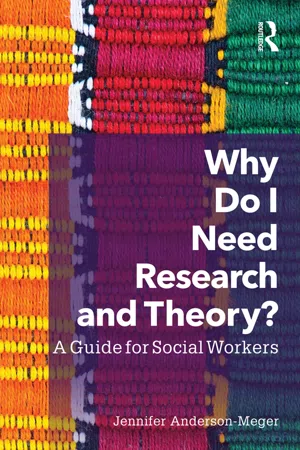
This book is based on the idea that social work as a profession can do better with advancing our mission if practitioners are knowledgeable, skilled, critical thinkers that use research to inform practice. This is a user-friendly, student directed book form to help students understand the connection between knowledge, social work research, and social work practice. This short text will support students in their research course by offering insights as to why research is important, how to help students understand how research affects their own future social work practice, how their beliefs impact successful learning, and practical tips for being successful in research.
- 140 pages
- English
- ePUB (mobile friendly)
- Available on iOS & Android
eBook - ePub
About this book
Information
1 The Importance of Research and Critical Thinking
DOI: 10.4324/9781315735498-1
This introduction presents an overview of the key concepts discussed in the subsequent chapters of this book. The book addresses why the social work profession needs to develop a greater intellectual tradition and ethos. Just because it is social work does not mean it is 'soft' or easy. Intellectual rigor is an important component of any profession. It introduces basic concept of learning theory; self-regulated learning, metacognition, and epistemology. The book explains in a user-friendly tone related to learning how to think as a social worker. It explores epistemology in more depth. The process of epistemological development is presented. The book addresses anxiety about research and knowledge development. Numerous ideas are presented from students and researchers that foster a classroom environment for critical thinking and epistemological development. The book focuses on years of teaching research methods, direct course evaluations, research on teaching and learning, and quotations from students.
The world is a complex place. We are bombarded with information on a daily basis. Our lives are so busy we fly from thing to thing without much thought. We live amidst countless distractions and believe multitasking is the only way to accomplish anything. Ask any social worker about the nature of his job and he will describe unpredictability, multiple demands, time constraints, funding and policy limitations, overwhelmed clients, and agencies that are stressed. You will also hear about the rewards of an intense helping career. Being a part of lives that are changing, witnessing strengths in people that are newly discovered, working to create changes in the broader system, and receiving a thank you for helping someone turn their life around are some of the many rewards of being a social worker.

Without a doubt, students are entering a demanding profession. Most go into social work because they hope to make a difference in the world and help others. Social workers want to see a better life for others and are dedicated to serving the marginalized in our world. Is there room in this passion for research and theory? Why is research and theory important anyway? Isn’t caring and working hard enough?
Social work is an evolving profession. We are generalist professionals who work with countless different agencies and population groups. Social work education will provide the foundational knowledge and skills to be an expert social worker but it cannot provide all you need to know. Being a social worker means lifelong learning and knowledge building. We are a profession that requires continuing education throughout our careers in order to stay competent (NASW, 2008). In addition, our Code of Ethics devotes an entire standard to research and evaluation (NASW, 2008, Standard 5). When you are in college it is difficult to think about continuing education beyond these years. However, our world is changing faster than anyone can predict. What we know today will be different in five to 10 years. How will you continue to stay abreast of all the knowledge you need to be a competent social worker?
Most students believe that experience is the best teacher (Anderson-Meger, 2014; Gambrill & Gibbs, 2009). However, research-based knowledge and theory can provide tools to help us “think” and perform as professional social workers. Personal experience teaches a lot. However, experience is not necessarily going to get a program funded, or a policy changed. We must provide accountability to the government and other funding entities that our programs work, people are being helped, and we are wise stewards of resources. If we cannot use research to inform practice, or do research to evaluate practice and build knowledge, then our profession will not survive.
Research is not just something that has to be done for funding. Clients have complex needs. Service to the client is a core value of the profession (NASW, 2008). How do we know what to do in certain situations? What are the best interventions? How can we reassure our client that the time and effort she puts forth to change her life will be a benefit? If we want to serve our clients well one of the best things we can do is research to determine if we are effective (Social Work Policy Institute, 2014). If you were struggling with a serious life issue the last thing you want to hear is, “Well, this worked for my friend, maybe you could try it …” Chances are you have already done that. What you need is someone who knows about other options. Not that you expect that person to know it all, or do the work, but you expect a competent professional with a store of knowledge based in that profession.
Why do so many social work students feel experience is the best way to learn? Would you want your medical doctor to practice medicine based only on her personal experiences and no knowledge of your disease or condition? Would you want a lawyer who represents you to practice based on his personal experience and no knowledge of law or policy? I know I do not want this, so why do we think it is okay for social work?
In essence it is not okay. Social workers are professionals and are required to obtain professional competency in numerous areas. This is not a profession of intuition and beliefs. Just think for a moment about how complex family issues are. We all know this – from our own experience, right? Now think about the dynamics behind the family issues. Might it be helpful in working with a family (that is not your own) to know something about family development, family communication, family violence, substance abuse, child development, etc.? What about the environment the family lives in? If you come from a rural Wisconsin farm family, how much do you know about life in Africa (where the refugee family that just arrived at the door of your agency is from)? Sure, you are a wonderfully caring person, but is this enough?
Very often we end up working with populations and individuals who have very different lives from our own. Our experience provides a limited perspective on our world. We see things through the bias of our own lives and background. How can we move beyond these biases? Now, everyone in social work is going to say, “oh, I am not biased, our Code of Ethics says it is important to be non-judgmental” (NASW, 2008). Everyone is biased. Period.
FOLLOWING YOUR GUT …
What are your thoughts as you read the following quotations from students?
- “If there is no right or wrong answer then I would really just go with my gut. What my heart tells me.”
- “I would still weigh the options but then I would want to know which one makes me feel happier.”
Where is the bias in these statements? What might be the outcome of this type of thinking in social work practice?
We need to be able to recognize the bias and learn ways to move beyond it in order to best serve others. Research and theory are processes that help us move beyond our biases.
Critical Thinking and Social Work
Due to reliance on personal experience, students often struggle with developing habits of critical thinking and using research evidence to make informed decisions in social work practice (Gambrill & Gibbs, 2009). As social workers we need to defend decisions throughout our career. It is imperative to develop an awareness of how we come to decisions and the knowledge used to make those decisions (Anastas, 2002). It is critical to examine complex philosophical questions around learning and knowledge in order to provide services to disenfranchised and disempowered individuals (Aymer & Okitikpi, 2000). Critical self-reflection about assumptions is necessary when making decisions on behalf of others. Without examining beliefs about knowledge we may base decisions on experiences and emotions that are inappropriate in meeting client needs (Gambrill & Gibbs, 2009). This does not mean that personal experience is not a good teacher, but it is only part of the equation. Relying on personal or emotional experiences alone can limit our ability to practice effectively (Gambrill & Gibbs, 2009).
According to the 2015 Educational and Policy Accreditation Standards, social work students must demonstrate competency in critical thinking and research skills (CSWE, 2015). Research methods courses are a primary mechanism for delivering instruction on critical thinking (Gambrill & Gibbs, 2009). The Council on Social Work Education also strengthened its standards regarding undergraduates’ research competencies in the Educational Policy and Accreditation Standards (CSWE, 2015). In addition to demonstrating how research informs practice and practice informs research, students must be able to critically evaluate research methodology (CSWE, 2015). One must understand the nuances of critical thinking in order to accomplish these competencies.
Critical thinking is difficult to define and even more difficult to measure (Abrami et al., 2008). Essentially critical thinking is a form of metacognition, among other things. Metacognition means thinking about your thinking. Critical thinking also includes the ability to analyze and evaluate one’s own thinking processes. Huff (2000) provides several definitions of critical thinking and emphasizes the relevance of critical thinking in social work education. His premise is that good critical thinking is not an innate or natural ability for most students, but that they can be taught through effective pedagogical methods to learn to think critically. Students need the ability to question, reason, and consider alternative perspectives, but also to evaluate their own biases, values, claims, and belief systems (Huff, 2000).
Mumm and Kersting (1997) identify more variations of critical thinking. Connections between critical thinking and social work practice include the ability to evaluate theory and interventions. Critical thinking is a necessary component when multiple options exist in problem solving and facts need to be evaluated. Understanding how theory informs practice is a function of critical thinking (Mumm & Kersting, 1997). Solving ethical dilemmas, evaluating research findings, developing arguments, clarifying definitions and directions, and organizing and creating new knowledge are functions of social work practice that require critical thinking.
Madoc-Jones and Parrott (2005) state that the importance of critical thinking cannot be underestimated due to the fact that critical and informed decision making is a requirement when making decisions that will affect others’ lives. Paul (2007) states that critical thinking helps expand the context of any discipline. It requires a person to think about thinking. “Critical thinking is thinking that analyzes thought, that assesses thought, and that transforms thought for the better” (Paul, 2007, para 3).
CRITICAL THINKING FOR SOCIAL WORKERS
- Has an ability to reject standardized formats for problem solving.
- Possesses interest in a wide range of diverse topics and fields with an ability to consider them together.
- Develops the ability to formulate multiple perspectives on a problem or issue.
- Develops a contextual and relativistic world view.
- Employs frequent use of trial and error.
- Operates from a future orientation without ignoring past or historical contexts.
- Develops a self-confidence and trust in personal judgment that can then be supported by outside information (Gibbons & Gray, 2004).
A critical thinker in social work practice will synthesize, compare, evaluate, and encourage the uprooting of deeply held assumptions, values, and beliefs. All of the above requires an evaluative view of situations and contexts that reach beyond the immediate situation at hand because critical thinking is more than just a problem-solving process (Gibbons & Gray, 2004). Central to the process is the ability to be creative and deal with ambiguities. Critical thinking is just as much about engaging with the world from an intuitive standpoint as it is about disciplined thought and evaluation processes (Gibbons & Gray, 2004).
In processing ethical dilemmas social workers use critical thinking to address values, underlying assumptions, and priorities (Barsky, 2010; Brookfield, 1987). An effective ethical decision requires a process to discern multiple levels of decisions including defining the issue(s), determining alternatives and strategies, evaluating consequences, and addressing implications for multiple constituencies (Dolgoff, Loewenberg, & Harrington, 2009).
A significant component of critical thinking and ethics instruction involves engagement with actual practice dilemmas. Social workers need to apply critical thinking and reason through the complexity. Stage models are common in processing ethical dilemmas (Barsky, 2010; Congress, 2000; Dolgoff et al., 2009). Some authors of critical thinking processes acknowledge that stage models of decision making have limit...
Table of contents
- Cover Page
- Half-Title Page
- Title Page
- Copyright Page
- Dedication
- Table of Contents
- List of Illustrations
- Preface
- Acknowledgments
- 1 The Importance of Research and Critical Thinking
- 2 Professionalism and Leadership for Social Work Practice
- 3 Learning Theory
- 4 Epistemology
- 5 Anxiety and Learning
- 6 For Faculty: Creating the Learning Environment for Critical Thinking and Epistemological Development
- Index
Trusted by 375,005 students
Access to over 1.5 million titles for a fair monthly price.
Study more efficiently using our study tools.
Frequently asked questions
Yes, you can cancel anytime from the Subscription tab in your account settings on the Perlego website. Your subscription will stay active until the end of your current billing period. Learn how to cancel your subscription
No, books cannot be downloaded as external files, such as PDFs, for use outside of Perlego. However, you can download books within the Perlego app for offline reading on mobile or tablet. Learn how to download books offline
We are an online textbook subscription service, where you can get access to an entire online library for less than the price of a single book per month. With over 1.5 million books across 990+ topics, we’ve got you covered! Learn about our mission
Look out for the read-aloud symbol on your next book to see if you can listen to it. The read-aloud tool reads text aloud for you, highlighting the text as it is being read. You can pause it, speed it up and slow it down. Learn more about Read Aloud
Yes! You can use the Perlego app on both iOS and Android devices to read anytime, anywhere — even offline. Perfect for commutes or when you’re on the go.
Please note we cannot support devices running on iOS 13 and Android 7 or earlier. Learn more about using the app
Please note we cannot support devices running on iOS 13 and Android 7 or earlier. Learn more about using the app
Yes, you can access Why Do I Need Research and Theory? by Jennifer Anderson-Meger in PDF and/or ePUB format, as well as other popular books in Sozialwissenschaften & Wissenschaftliche Forschung & Methodik. We have over 1.5 million books available in our catalogue for you to explore.