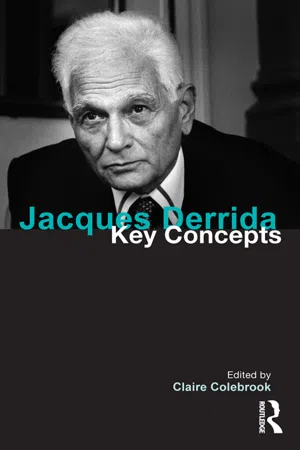
Jacques Derrida: Key Concepts presents a broad overview and engagement with the full range of Derrida's work - from the early phenomenological thinking to his preoccupations with key themes, such as technology, psychoanalysis, friendship, Marxism, racism and sexism, to his ethico-political writings and his deconstruction of democracy. Presenting both an examination of the key concepts central to his thinking and a broader study of how that thinking shifted over a lifetime, the book offers the reader a clear, systematic and fresh examination of the astounding breadth of Derrida's philosophy.
- 186 pages
- English
- ePUB (mobile friendly)
- Available on iOS & Android
eBook - ePub
About this book
Information
1 Jacques Derrida: A biographical note
DOI: 10.4324/9781315744612-1
Jacques Derrida was born on July 15, 1924, in El Biar, in the suburbs of Algiers, from a Jewish French family. His parents Haiim Aaron Prosper Charles and Georgette Sultana Esther Safar gave him the forename of Jackie. At this time, French Judaism in Algeria had undergone a progressive assimilation to the bourgeois Parisian life. Things changed from 1940, when, among other anti-Semitic measures, it was established that there would be a fixed number of Jewish children in primary and secondary education. Consequently, Jackie was excluded from the lycée he was attending in Ben Aknoun, nearby El Biar. He could go back to school only the following year. In 1947, he entered the Lycée Émile-Félix-Gautier, in the centre of Algiers. Later, he registered for the hypokhâgne class at the Lycée Bugeaud, a cycle of preparatory classes to take the exam for the École Normale Supérieure. He decided not take the exam in Algiers but, in 1949, moved to Paris where he gained a place at the Louis-le-Grand, the most prestigious of Parisian lycées.
In 1952, Jackie passed the exam for the École Normale Supérieure (ENS). There he had the first encounter with Louis Althusser who had been caïman in philosophy since 1948, namely, the teacher responsible for the preparatory classes for the agrégation. Over the summer spent in El Biar, he immersed himself in the reading of Husserl’s Ideas I (translated and commented upon by Paul Ricoeur). In November, he began work on the problem of genesis in Husserl’s philosophy as the subject of his diplôme d’études supérieures. Maurice de Gandillac, professor of philosophy at Sorbonne since 1946, was the supervisor of his work. Through his recommendation, Derrida visited Husserl’s archives in Louvain, where he discovered the text of the Origin of Geometry, which had been published in German by Eugen Fink. Back in Paris, he wrote his dissertation, which seemed not to provoke reactions in de Gandillac. However, Jean Hyppolite, at the time director at ENS, invited Derrida to prepare the text for publication (which happened only about forty years later, in 1990). Hyppolite also encouraged him to go on with the project of the translation of the Origin. Meanwhile, Derrida met Marguerite Aucouturier, his future wife, who was the elder sister of Michel, one of his best friends over the years of the Lycée and the École. In 1956, he was awarded a one-year bursary to pursue his research on Husserl at Harvard and left for the United States with Marguerite. A few days before returning to Europe, where he was expected to start military service, they got married in Cambridge. He spent his service in the small town of Koléa (nearby Algiers), mainly as a teacher in a school for the children of the soldiers.
Once back in Paris, in 1959, he took part in the Cerisy-la-Salle talk on “Genesis and Structure”, in which he presented the paper “‘Genesis and Structure’ and Phenomenology” (published later in Writing and Difference). He was also offered by Jean Hyppolite to publish the translation of Husserl’s Origin in the series Epimethée that the philosopher directed at the Presses Universitaires de France. On the occasion of the first public talk and the forthcoming publication, Derrida abandoned the forename “Jackie” for “Jacques”. After teaching a hypokhagné class in Le Mans, in October 1960 he returned to Paris where he was appointed as a lecturer in general philosophy at the Sorbonne. Among other things, he taught a course on “The Present”, that would later be developed into “Ousia and Grammé: Note on a Note from Being and Time” (first published in 1968). The appearance of Derrida’s introduction to Edmund Husserl’s Origin of Geometry, in 1962, did not pass unnoticed in French philosophical circles. Besides the appreciation of Hyppolite and Althusser, Georges Canguilhem and Michel Foucault congratulated Derrida, while Ricoeur invited him to present the text at his seminar for researchers at Sorbonne. Furthermore, the Origin was awarded the prestigious Cavaillès prize. In 1963–64, Derrida published “Cogito and History of Madness” (in Revue de métaphysique et morale; the text was read a few months earlier at the Collège philosophique, under the invitation of Jean Wahl), “Force and Signification”, on Jean Rousset, and “Edmond Jabès and the Question of the Book” (in Critique), “Violence and Metaphysics. An Essay on the Thought of Emmanuel Levinas” (again in Revue de métaphysique et morale). These texts were included later in the volume Writing and Difference (1978).
In 1963 his first son Pierre was born. In the same year, he was appointed as a maître de conference at ENS. When he definitively left his position at the Sorbonne in 1964 he passed to ENS to collaborate with Althusser. In his first year as caïman, he gave a series of lectures on “Heidegger and the Question of Being and History” (published posthumously in 2013). In 1965, responding to Philippe Sollers’ invitation, Derrida wrote an essay on Antonin Artaud “La Parole soufflé” for the review Tel Quel. In two issues across 1965 and 1966, Critique hosted the long essay “Writing before the Letter”, which appeared as a review of recent works on writing (among them, Gesture and Speech by André Leroi-Gourhan) and which was to become the germ of Of Grammatology. In 1966, he presented “Freud and the Scene of Writing” at the Institut de psychanalyse in Paris and “Structure, Sign and Play in human Sciences” at the Baltimore conference on “The Language of Criticism and the Sciences of Man”. Next year, when his second son, Jean, was born, Derrida published three of his early major works: the collection of essays, Writing and Difference (for Seuil, in the series “Tel Quel”), Of Grammatology (for Les Editions de Minuit, in a series related to Critique) and Speech and Phenomena (on the philosophy of Husserl, for Presses Universitaires de France).
In 1967, at the request of Paul de Man, whom he met at the Baltimore conference, Derrida gave a seminar in Paris for American students from Cornell and John Hopkins universities. De Man, who was teaching at Cornell, was interested in the reading of Rousseau that Derrida had developed in Of Grammatology. De Man wrote a first review of the work in the Annales Jean-Jacques Rousseau, followed by the longer article “Rhetoric of Blindness: Derrida Reader of Rousseau” published in Poétique in 1970.
In January 1968, Derrida presented “The Pit and the Pyramid: An Introduction to Hegel’s Semiology” in the context of Hyppolite’s seminar at the Collège de France and “Différance” to the Société Française de Philosophie at Sorbonne. Later, he was invited by Samuel Weber, a former student of Paul de Man, to give a lecture in a seminar on structuralist literary criticism organized at the Freie Universität in Berlin. On that occasion, Derrida met Peter Szondi, who was the founder of the Institute of Literary Theory and Comparative Literature and a close friend of Paul Celan, to whom Szondi introduced Derrida when he went to Paris. He was back in Berlin in 1969, where he met Rodolphe Gasché and Werner Hamacher. In 1968–9, he published “Plato’s Pharmacy” in Tel Quel and “Dissemination”, which was devoted to Sollers’ novel Numbers, in Critique. The two texts, together with “The Double Session”, that was read at the Tel Quel theoretical study group, were included later in Dissemination. In the same year, Derrida also taught for two months at John Hopkins University and in that period presented “The Ends of Man” at the New York conference on “Philosophy and Anthropology”.
At the beginning of 1970, he was invited by Philippe Lacoue-Labarthe and Jean-Luc Nancy, to take part in a seminar on rhetoric in Strasbourg, in which he read The White Mythology. It was the starting point of future collaborations.
Besides Dissemination in 1972 Derrida published also Margins of Philosophy and Positions. The first volume consists of a series of independent essays, including the paper given in Strasbourg (translated as “White Mythology”) and the one read in 1971 at the 15th congress of French speaking philosophical societies in Montréal, entitled “Signature, Event, Context” (which criticised the “speech act” theory of J.L. Austin). In 1972, in the context of the Cerisy conference on Artaud/Bataille, Derrida contributed to the session “Nietzsche Today”, in which he read “The Questions of Style”, later expanded into Spurs (published in 1978). It was also the year of the violent response to his early text “Cogito and History of Madness” that Foucault included in the two appendixes added to his History of Madness, on occasion of its republication.
In 1973 in France a special issue of the review L’Arc and a collective book edited by Jean Ristat were devoted to Derrida; in the same year the first translation of his work into English, Speech and Phenomena by David Allison, appeared in the United States. It was followed by Gayatri Spivak’s translation of Of Grammatology (1976) and Alan Bass’s translation of Writing and Difference (1978).
In 1974, Derrida published Glas with Galilée in the “Digraphes” series edited by Jean Ristat. The book, made of two columns, juxtaposed the reading of Hegel’s philosophical discourse (emerging from Derrida’s 1971–72 seminar on Hegel’s family) alongside the rewriting of Jean Genet’s literary text. In the same year, Derrida collaborated with the artist Valerio Adami in the production of silkscreens inspired by Glas.
After the success of Lacoue-Labarthe and Nancy’s study on Lacan, The Title of the Letter, published with Galilée in 1973, Derrida proposed to Lacoue-Labarthe, Nancy and Sarah Kofman that they might co-edit a series at this small and elite publishing house. The group also planned a collective volume, Mimesis, for which Derrida suggested Bernard Pautrat, a former student and fellow of Derrida at the ENS, and Sylvaine Agacinski, philosopher and former attendant of Derrida’s seminar at ENS. For this volume, Derrida wrote “Economimesis”, a reading of Kant’s Critique of Judgment. In 1974, Galilée began the publication of a new review, Digraphe, for which Derrida wrote another essay devoted to Kant’s third Critique, entitled “Parergon” (reprinted with Flammarion in The Truth in Painting, in 1978).
At the beginning of 1975, Derrida directed himself against the reform of secondary education planned by the Minister René Haby. A major role in this fight was played by the movement GREPH (Groupe de Recherches sur l’Enseignement Philosophique), that he set up in collaboration with some teachers and fellows (including Agacinski, Kofman, Pautrat). Ultimately the Haby reform was never implemented. In the same year, through the mediation of Paul de Man, Derrida was appointed as a short-term visiting professor at Yale for three years. In the same year, he presented Signeponge to the Cerisy colloquium on Francis Ponge. In the meanwhile, the series “La philosophie en effet” and the project of Mimesis moved from Galilée to the publishing house of Henri Flammarion. Derrida wrote long prefaces for books published by Aubier-Flammarion such as The Wolf Man’s Magic Word by Nicholas Abraham and Maria Torok and William Warburton’s Essay on Hieroglyphics. The first text provoked a response from Jacques Lacan, who in his seminar attacked Abraham, Torok and Derrida himself (the first response from Lacan since Derrida’s critique of Lacan’s reading of Poe’s “The Purloined Letter” entitled “The Factor of Truth” and published in Poétique in 1974). In 1977, he read a pseudo-improvised conversation with René Major about his previous work, at the seminar “Confrontations” organized by Major at the Institut de Psychanalyse. First appearing in the review Confrontation (with the title “Du tout”), the text would become the last part of The Postcard, that was published in 1980 and included a selection of his immense correspondence (“Envois”) as well as the texts “To Speculate – on ‘Freud’” (the third part of the seminar “Life Death” given at the ENS in 1974–75) and “The Purveyor of Truth”. Derrida would finally tell the history of his relationship with Lacan in the paper presented at the 1990 conference “Lacan with Philosophers”, entitled “For the Love of Lacan”.
In 1980, the first symposium on Derrida’s work, “The Ends of Man”, run by Lacoue-Labarthe and Nancy, took place in Cerisy-la-Salle. Among the speakers were Luce Irigaray, Barbara Johnson, Jean-Francois Lyotard, Sarah Kofman, Rodolphe Gasché and Werner Hamacher.
In 1981, as a member of the Jan Hus Educational Foundation in France, an association founded in Oxford and committed to supporting Czechoslovakian universities, Derrida went to Prague for a seminar on Descartes. At the end of the journey, he was arrested at the airport by the Czechoslovakian police and charged with drug trafficking. The following day he was released following a vociferous response from the French media and government. In the same year, Derrida was involved in the creation of the Collège International de Philosophie, which, according to the project of the Minister of Research and Technology Jean-Pierre Chevènement, aimed to be a center of excellence able to promote innovative research and to set up relationships with similar institutions in the world.
In 1983, he was elected director of studies on “philosophical institutions” at the École des Hautes Etudes. A few days later, Paul de Man died. In homage to his friend, the following year, Derrida gave the three lectures “Mnemosyne”, “The Art of Mémoires”, and “Acts: The Meaning of a Word given”, in Yale and in Irvine.
In 1986, he published with Galilée Parages (drawing together four texts on Maurice Blanchot, written and already published between 1975 and 1979) and Shibboleth: for Paul Celan (the text of a paper given in Seattle in 1984). He also accepted tenure for a part-time post of distinguished professor at the University of California Irvine, where, after the death of de Man, he was joined at Irvine by his friend J. Hillis Miller who moved from Yale. De Man and Miller (along with Geoffrey Hartman and Harold Bloom) had formed what came to be known as the ‘Yale School’ of deconstruction; this movement came to a virtual close with the subsequent “de Man affair” – the discovery of de Man’s anti-Semitic wartime journalism, to which Derrida later responded. In the meanwhile, the Swiss architect Bernard Tschumi, who had won the 1982 competition of the Parc de la Villette, invited Derrida to contribute to his project through a collaboration with the American architect Peter Eisenman. The volume Chora L Works, published in 1997, described the stages of this collaboration that was abandoned after two years.
In 1987, Derrida closed the conference organised by the Collège under the title “Heidegger’s Open Questions” with De L’Esprit which was published in the same year. Meanwhile, the appearance in France of Victor Farias’ book Heidegger and Nazism renewed a long-running debate within the French tradition of Heidegger. A memorable stage of this debate took place in Heidelberg, at the beginning of 1988, when Derrida and Lacoue-Labarthe were invited to discuss the subject with Hans-Georg Gadamer. In 1987, Derrida also published with Galilée Psyche: the Invention of the Other, the title of which came from one of the texts included in the volume (first presented at Cornell in 1984).
A year later, on the occasion of the French publication of Mémoires: pour Paul de Man (1988), in a long footnote added to the original, Derrida replied to the attacks directed at deconstruction by the German philosopher Jürgen Habermas in his The Philosophical Discourse of Modernity (published in 1985 and translated into French in 1988). Appearing the same year was Limited Inc, the text of the earlier polemic with John R. Searle following the reading of Austin developed in “Signature, Event, Context.” In the afterword of the text, “Towards an Ethics of Discussion”, Derrida responded again to Habermas.
In 1989 he gave a long opening address, entitled “Force of Law”, at the conference on “Deconstruction and the Possibility of Justice” organised at the Cardozo Law School in New York. In the same year he proposed to Geoffrey Bennington (a young British professor whom he first met during his visits in Oxford) to co-author a semi-biographical book on Derrida’s own work that would be published in the series “Les contemporaines” for Editions Seuil. The result of the collaboration was the volume Jacques Derrida (published in 1991) consisting of Bennington’s exposition of Derrida’s thought and the latter’s auto-biographical Circumfession. At the same time, Derrida wrote Mémoires d’aveugle, (or Memoires of the Blind) a reflection on drawing developed on the occasion of designing an exhibition for the Louvre. In 1991, he also publish...
Table of contents
- Cover
- Halftitle Page
- Key Concepts Page
- Title Page
- Copyright Page
- Contents
- Acknowledgement
- List of Abbreviations
- Notes on Contributors
- 1 Jacques Derrida: A biographical note
- 2 The Auto-bio-thanato-heterographical
- 3 Supplement
- 4 Suspension
- 5 Religion
- 6 Ecology
- 7 deconstruction and Ethics: An (ir)responsibility
- 8 Teletechnology
- 9 Friendship
- 10 Sexual Immunities and the Sexual Sovereign
- 11 Democracy and Sovereignty
- 12 On Time, and Temporisation; On temporalisation and history
- 13 When it comes to mourning
- 14 Race
- 15 Auto-Affection
- 16 Literature
- 17 Politics
- 18 Reading: Derrida and the Non-Future
- Bibliography
- Index
Trusted by 375,005 students
Access to over 1.5 million titles for a fair monthly price.
Study more efficiently using our study tools.
Frequently asked questions
Yes, you can cancel anytime from the Subscription tab in your account settings on the Perlego website. Your subscription will stay active until the end of your current billing period. Learn how to cancel your subscription
No, books cannot be downloaded as external files, such as PDFs, for use outside of Perlego. However, you can download books within the Perlego app for offline reading on mobile or tablet. Learn how to download books offline
Perlego offers two plans: Essential and Complete
- Essential is ideal for learners and professionals who enjoy exploring a wide range of subjects. Access the Essential Library with 800,000+ trusted titles and best-sellers across business, personal growth, and the humanities. Includes unlimited reading time and Standard Read Aloud voice.
- Complete: Perfect for advanced learners and researchers needing full, unrestricted access. Unlock 1.5M+ books across hundreds of subjects, including academic and specialized titles. The Complete Plan also includes advanced features like Premium Read Aloud and Research Assistant.
We are an online textbook subscription service, where you can get access to an entire online library for less than the price of a single book per month. With over 1.5 million books across 990+ topics, we’ve got you covered! Learn about our mission
Look out for the read-aloud symbol on your next book to see if you can listen to it. The read-aloud tool reads text aloud for you, highlighting the text as it is being read. You can pause it, speed it up and slow it down. Learn more about Read Aloud
Yes! You can use the Perlego app on both iOS and Android devices to read anytime, anywhere — even offline. Perfect for commutes or when you’re on the go.
Please note we cannot support devices running on iOS 13 and Android 7 or earlier. Learn more about using the app
Please note we cannot support devices running on iOS 13 and Android 7 or earlier. Learn more about using the app
Yes, you can access Jacques Derrida by Claire Colebrook in PDF and/or ePUB format, as well as other popular books in Philosophy & Deconstruction in Philosophy. We have over 1.5 million books available in our catalogue for you to explore.