eBook - ePub
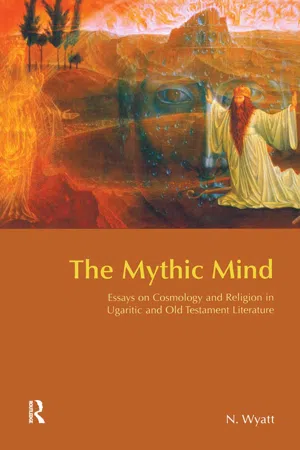
The Mythic Mind
Essays on Cosmology and Religion in Ugaritic and Old Testament Literature
- 320 pages
- English
- ePUB (mobile friendly)
- Available on iOS & Android
eBook - ePub
The Mythic Mind
Essays on Cosmology and Religion in Ugaritic and Old Testament Literature
About this book
The Mythic Mind follows the tradition of works which insist on the necessity for a comparative dimension in the study of ancient Israel. The Israelite world-view was essentially a West Semitic world-view in origin, with additional deeply embedded influences from Egypt and Mesopotamia, though it produced its own distinctive character by way of synthesis and reaction. The essays in this volume explore various aspects of this process, historically and cosmologically, commonly challenging received views developed in the treatment of Israel in isolation. The importance of the Ugaritic texts in particular, as reflecting the cultural context in which ancient Israel developed into two symbiotic kingdoms, heirs to a common 'Canaanite' tradition, emerges clearly from such studies as chapter 5: 'Sea and Desert', chapter 7: 'Of Calves and Kings', chapter 9: 'The Significance of Spn' and chapter 10: 'The Vocabulary and Neurology of Orientation.'
Chapter 1
THE PROBLEM OF THE ‘GOD OF THE FATHERS’*
The significance of the formula ‘the god of my father(s)’ and variants, which was the subject of A. Alt’s important monograph,1 has been discussed intermittently since, but without the problems involved having been resolved entirely satisfactorily. In what follows, I wish to offer a new explanation for the problems, which is consistent with current scholarly estimates of the other evidence in Genesis concerning ‘patriarchal religion’.
A. Alt was writing before the discovery of the Ugaritic texts had led to a complete reappraisal of the nature of the god El, and was able, in the fashion of the time, to dismiss the various El-forms found in Genesis as local numina.2 The ‘god of the fathers’, however, was felt to point to the distinctive feature in patriarchal religion, the cult of a god revealing himself to the cult-founder and being worshipped by subsequent generations conscious of their historical link with the founder.
J. Lewy suggested that the apparently anonymous ‘god of the fathers’ could be identified with El Shaddai, on the basis of Genesis 49.25, where ‘ēl ’abîkâ and šadday are parallel.3 However, his interpretation involved understanding the ’ēl in the former phrase as a generic in the construct (i.e. the equivalent of the prose form ’elōhê), and required the alteration of the ‘et preceding šadday into ’ēl.4 The former suggestion begs the question concerning the generic use of ’ēl, while the latter seems unnecessary. If the two particles m and ’et are understood to have an instrumental force, then the text of MT yields a perfectly good sense:
J. Lewy suggested
By (m) El your father, may he assist you!
and by (’et) Shaddai, may he bless you!5
There is no reason not to take ’ēl here as being the divine name El, and the two forms ’ēl and šadday seem to be a good example of a divided binomial form, such as is found in Job 15.25, 21.14–15 and so on.6 If this interpretation of Genesis 49.25 can be sustained there is no reference here after all to the ‘god of your fathers’, and the consequent identification of this deity with El Shaddai cannot be demonstrated on this evidence.
H.G. May drew attention to the distinction between the singular expression ‘the god of my (your etc.) father’ (’ābî-, ’abî-) and the plural ‘the god of my (your etc.) fathers’ (’abôtê).7 The latter expression was, he argued, a later formulation, and he pointed out that it was used predominantly in exilic or post-exilic passages (by the Deuteronomist, 11 times; by the Chronicler, 29 times; in Daniel, once). It is clear from the usage in these passages, where the name Yahweh is usually also present, that it is the ancestral faith of Israel that is in question: in 21 out of 28 cases it is a matter of faithfulness to or apostasy from the traditions of the covenant people. So there is no question of an allusion to the patriarchs. There are four passages which are apparently early where the formula is found – in Exodus 3.13 (E), 15 (E), 16 (J), and 4.5 (J). H.G. May suggested that there may be late editing here, and certainly the formula is suspicious.8 In the E passages it is a deliberate use, intended to indicate the continuity between past and present9 despite the change in the divine name. It reflects the theological presuppositions of the writer(s) of E, rather than those of Moses and his time. In the J tradition of course we already have the presupposed continuity in the use of the divine name, and here Yahweh comes to rescue ‘his’ people (Exodus 3.7, cf. ‘the sons of Israel’, 3.9 E), so that the ‘fathers’ of the formula need not be the three patriarchs Abraham, Isaac, and Jacob, but simply the ancestors in general of the enslaved Hebrews. The addition of the three patriarchal names in both passages is artificial and clearly secondary.10
It is the singular expression, ‘the god of your father’, which H.G. May argued is much more significant for our present purposes. It occurs only infrequently in passages normally ascribed to J. It is found at Genesis 26.24 and 28.13, where the name ‘Abraham’ has been added;11 31.53a is allocated by A. Alt to J,12 but in any case ’elōhê ’abîhem is patently a gloss designed to solve the problem of the implied polytheism; 43.23 presents a textual problem – two manuscripts, supported by Sam. and LXX, read ’abôtêkem for ’abîkem,13 and apart from the more awkward (plural) reading being preferable, the entire phrase should be treated as a gloss on the preceding ‘elōhêkem. The last example is in Genesis 49.25, taken by A. Alt to be J,14 but apart from the literary complexity of the chapter anyway, we have seen that the formula does not in fact occur here.
Contrasting with the rarity of its use in J, in each case not without suspicion, the formula occurs several times in E. Its use is straightforward in 31.5. 29 (’abîkem MT, ’abîkâ Sam., LXX). 31.42, 32.10 (bis), 46.1, 50.17, Exodus 3.6. In Genesis 31.53a (if E), we have seen it to be secondary, and in 31.53b it may be abbreviated or mutilated in the reading bepaḥad ’ābîw yiṣḥaq. We have seen that in 49.25, if the verse is to be assigned to E (see n. 14) there is in fact no case to be made. Now this passage does not stand alone and may give a clue to the significance of the curious usage to be found in 46.3, the clarification of which may provide an explanation for the whole construction. In 46.3 we read ’ānōkî hā’ēl ’elōhê ’ābîkā. This is an unusual expression, and it looks as though there may have been at some stage an expansion of the text. The term which E uses fairly consistently for God is ’elōhîm. There is an artificial, literary flavour to its use. Frequently it occurs where we would expect a divine name to appear. It is as though an editor of the tradition has at some stage deliberately tried to suppress all references to a particular divine name. Occasionally this leads to a rather forced situation. In the snatch of poetry quoted in Genesis 27.28, for example, we have the exhortation:
May Elohim give you dew from heaven…
A specific divine name would appear so much more natural here than the colourless ’elōhîm. Also, in 28.17, 22, where the narrative clearly locates Jacob at Bethel (cf. J, and 35.21ff., E) we have the curious expression bêt- ’elōhîm, where bêt-’ēl would have been so much more plausible, and I suspect was originally the term used.
This example gives us our clue – ’elōhîm has apparently, with a greater or lesser rigour, displaced ’ēl in the E source of Genesis. Further evidence can be adduced to support this conjecture. In 32.31, for example, we read that Jacob named the place Peniel (penî’ēl) ‘because I have seen God face to face’ (kî-rā’îtî ’elōhîm pānîm ’el-pānîm). Why has the writer not simply used ’ēl, as the whole explanation being offered for the name really demanded? Somehow or other, he appears to have a strong aversion to the term. At other times he is confronted with theophanies of the deity at Bethel, and here we have the formula hā’ēl bêt-’ēl (31.13, cf. 35.1, 3 lā’ēl – note the pointing). In view of the normal usage of E, we would expect ’elōhê (or hā’elōhîm if one wishes to take bêt-’ēl as a divine name). In any case, ’ēl is not a normal prose usage for the generic sense of the term. It seems possible, therefore, that the article has been added in an attempt to destroy the titular use of the term here, altering its sense from‘El’ to ‘the god (of)…’
If we now turn to 46.3 we find this use of the article again: ’ānōkî hā’ēl. This time however, because the context allows it, which it does not in the other cases, the writer has made quite sure that there will be no misunderstanding by adding ’elōhê ’ābîkā. Some comme...
Table of contents
- Cover
- Half Title
- Title Page
- Copyright Page
- Table of Contents
- Preface
- Acknowledgments
- Abbreviations
- Chapter 1 The Problem of the ‘God of the Fathers’
- Chapter 2 The Development of the Tradition in Exodus 3
- Chapter 3 The Significance of the Burning Bush
- Chapter 4 Who Killed the Dragon?
- Chapter 5 Sea and Desert: Symbolic Geography in West Semitic Religious Thought
- Chapter 6 Symbols of Exile
- Chapter 7 Of Calves and Kings: The Canaanite Dimension in the Religion of Israel
- Chapter 8 The Darkness of Genesis 1.2
- Chapter 9 The Significance of Ṣpn in West Semitic Thought: A Contribution to the History of a Mythological Motif
- Chapter 10 The Vocabulary and Neurology of Orientation: The Ugaritic and Hebrew Evidence
- Chapter 11 The Mythic Mind
- Chapter 12 ‘Water, water everywhere…’: Musings on the Aqueous Myths of the Near East
- Chapter 13 Androgyny in the Levantine World
- Bibliography
- Index of References
- Index of Names and Places
Trusted by 375,005 students
Access to over 1.5 million titles for a fair monthly price.
Study more efficiently using our study tools.
Frequently asked questions
Yes, you can cancel anytime from the Subscription tab in your account settings on the Perlego website. Your subscription will stay active until the end of your current billing period. Learn how to cancel your subscription
No, books cannot be downloaded as external files, such as PDFs, for use outside of Perlego. However, you can download books within the Perlego app for offline reading on mobile or tablet. Learn how to download books offline
Perlego offers two plans: Essential and Complete
- Essential is ideal for learners and professionals who enjoy exploring a wide range of subjects. Access the Essential Library with 800,000+ trusted titles and best-sellers across business, personal growth, and the humanities. Includes unlimited reading time and Standard Read Aloud voice.
- Complete: Perfect for advanced learners and researchers needing full, unrestricted access. Unlock 1.5M+ books across hundreds of subjects, including academic and specialized titles. The Complete Plan also includes advanced features like Premium Read Aloud and Research Assistant.
We are an online textbook subscription service, where you can get access to an entire online library for less than the price of a single book per month. With over 1.5 million books across 990+ topics, we’ve got you covered! Learn about our mission
Look out for the read-aloud symbol on your next book to see if you can listen to it. The read-aloud tool reads text aloud for you, highlighting the text as it is being read. You can pause it, speed it up and slow it down. Learn more about Read Aloud
Yes! You can use the Perlego app on both iOS and Android devices to read anytime, anywhere — even offline. Perfect for commutes or when you’re on the go.
Please note we cannot support devices running on iOS 13 and Android 7 or earlier. Learn more about using the app
Please note we cannot support devices running on iOS 13 and Android 7 or earlier. Learn more about using the app
Yes, you can access The Mythic Mind by Nicolas Wyatt in PDF and/or ePUB format, as well as other popular books in History & Ancient History. We have over 1.5 million books available in our catalogue for you to explore.