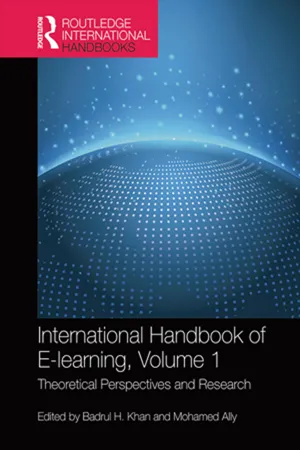
The International Handbook of e-Learning, Volume 1 provides a comprehensive compendium of research and theory in all aspects of e-learning, one of the most significant ongoing global developments in the entire field of education. Covering history, design models, instructional strategies, best practices, competencies, evaluation, assessment, and more, these twenty-seven contributions tackle the tremendous potential and flexibility inherent to this rapidly growing new paradigm. Past and present empirical research frames each chapter, while future research needs are discussed in relation to both confirmed practice and recent changes in the field. The book will be of interest to anyone seeking to create and sustain meaningful, supportive learning environments within today's anytime, anywhere framework, from teachers, administrators, and policy makers to corporate and government trainers.
eBook - ePub
International Handbook of E-Learning Volume 1
Theoretical Perspectives and Research
- 398 pages
- English
- ePUB (mobile friendly)
- Available on iOS & Android
eBook - ePub
International Handbook of E-Learning Volume 1
Theoretical Perspectives and Research
About this book
Information
1
Introduction to E-learning
Significant development in e-learning over the past decade has tremendous implications for educational and training practices in the information society (Khan, in press). With the advent of the Internet and online learning methodologies and emerging technologies, e-learning has become more and more accepted in the workplace. Academic institutions, corporations, and government agencies worldwide have been increasingly using the Internet and digital technologies to deliver instruction and training. Moreover, the need to address the training and learning requirements of a globally dispersed workforce is also driving the demand for e-learning programs. At all levels of these organizations, individuals are being encouraged to participate in e-learning activities. Since 1990, the field of e-learning has enjoyed exponential growth and recognition. According to a new report by Global Industry Analysts, Inc., “The global e-learning market is projected to reach $107.3 billion by the year 2015, driven by its benefits in the form of reduction in operational costs, flexibility in learning activities, and simplified training programs.”1 The e-learning market is one of the most rapidly growing sectors in the global education industry.2
The emerging field of e-learning has a tremendous impact on our educational and training systems and hence created a new paradigm of education and training. Participants in this new paradigm require rich learning environments supported by well-designed resources (Reigeluth & Khan, 1994). They expect on-demand, anytime/anywhere high-quality learning environments with good support services. In other words, they want increased flexibility in learning—they want to have more say in what they learn, when they learn, and where and how they learn.
They may choose a mix of traditional and new learning approaches and technology; they may want to study at their chosen time and location and at their own pace. To stay viable in this global competitive market, providers of education and training must develop efficient and effective learning systems to meet society’s needs. Therefore, there is a tremendous demand for affordable, efficient, easily accessible, open, flexible, well-designed, learner-centered, distributed and facilitated learning environments.
Can we do what learners want? Nunan (1996) stated,
Teaching and learning may be created through exploring different ways of delivering education. When ‘delivery’ or ‘learning’ is coupled with the word flexible, the intention to increase for learners both their access to, and their control over, particular teaching and learning environments is implied.
(Nunan, T. (1996). Flexible delivery - what is it and why is it a part of current educational debate?. Different Approaches: Theory and Practice in Higher Education.)
New developments in learning science and technology provide opportunities to develop learning environments that suit students’ needs and interests by offering them the choice of increased flexibility. A mix of traditional and new learning approaches and technologies is instrumental in creating innovative learning environments with increased flexibility.
However, many communities around the world are still in the process of implementing e-learning with varying results. Many instructors and trainers are being asked by their institutions to convert their traditional instructor-led face-to-face (f2f) classroom courses to e-learning. However, individuals involved in designing e-learning or converting f2f courses to online environments are faced with many challenges, which raises these questions: What is e-learning and how is it different from face-to-face (f2f) learning? What does and does not work for e-learning? How does one define and measure e-learning success?
In this section, e-learning is discussed from the perspective of an open and distributed learning environment; and how its various learning features can be designed to create meaningful e-learning environment. The following is an outline:
- What Is E-learning?
- Open and Distributed Learning Environment
- Traditional Instruction and E-learning
- Learner Focused E-learning System
- Components and Features of E-learning
What Is E-learning?
With the rapid growth of Internet and digital technologies, the Web has become a powerful, global, interactive, dynamic, economic, and democratic medium of learning and teaching at a distance (Khan, 1997; Taylor, 2014). The Internet provides an opportunity to develop learning-on-demand as well as learner-centered instruction and training. There are numerous names for online learning activities, including Massive Open Online Course (MOOC), Web-Based Learning (WBL), Web-Based Instruction (WBI), Web-Based Training (WBT), Internet-Based Training (IBT), Distributed Learning (DL), Advanced Distributed Learning (ADL), Distance Learning, Online Learning (OL), Mobile Learning (or m-Learning) or Nomadic Learning, Remote Learning, Offsite Learning, a-Learning (anytime, anyplace, anywhere learning), etc. In this book, the term e-learning is used to represent all open and distributed learning activities.
Designing and delivering instruction and training on the Internet requires thoughtful analysis and investigation, combined with an understanding of both the Internet’s capabilities and resources and the ways in which instructional design principles can be applied to tap the Internet potential (Ritchie & Hoffman, 1997). Designing e-learning for open and distributed learning environments is new to many of us. After reflection on the factors that must be weighed in creating effective open and distributed learning environments for learners worldwide, the following definition of e-learning is formulated in this book.
E-learning can be viewed as an innovative approach for delivering well-designed, learner-centered, interactive, and facilitated learning environments to anyone, anyplace, anytime by utilizing the attributes and resources of various digital technologies along with other forms of learning materials suited for the open and distributed learning environment.
The above definition of e-learning raises the question of how various attributes of e-learning methods and technologies can be utilized to create learning features appropriate for diverse learners in an open and distributed environment.
Open and Distributed Learning Environment
What is an open and distributed learning environment? A clear understanding of the open and distributed nature of the online learning environment will help us create meaningful flexible e-learning (Khan, 2012). According to Calder & McCollum (1998), “The common definition of open learning is learning at your own time, pace and place” (p. 13). Ellington (1995) notes that open and flexible learning allows learners to have some say in how, where, and when learning takes place. Saltzbert and Polyson (1995) noted that distributed learning is not synonymous with distance learning, but they stress its close relationship with the idea of distributed resources:
Distributed learning is an instructional model that allows instructor, students, and content to be located in different, non-centralized locations so that instruction and learning occur independent of time and place…. The distributed learning model can be used in combination with traditional classroom-based courses, with traditional distance learning courses, or it can be used to create wholly virtual classrooms.
(p. 10)
Janis Taylor of Clarke College in Iowa, who teaches students coming from different places in the Midwest, commented on open and distributed learning:
Consider a student user who described her online education as open because she can sit out on her back deck supervising her children in the swimming pool while doing her homework. Now that’s open-air and open learning. One of my preservice teachers works in a chemical lab in Cleveland, another is a court reporter three hours drive from me and another is a nurse in rural western Iowa. I, their teacher, am sitting in a small liberal arts college in eastern Iowa, a state badly needing to tap new people to come into the teaching profession. How could I get them all here to my campus if e-learning weren’t distributed? Thi...
Table of contents
- Cover
- Title
- Copyright
- Contents
- Preface
- Foreword
- Acknowledgments
- About the Editors
- Contributing Authors
- 1 Introduction to E-learning
- 2 Historical Perspectives on E-learning
- 3 E-learning: Past, Present, and Future
- 4 The Quality of Massive Open Online Courses
- 5 Instructional Theory and Technology for the New Paradigm of Education1
- 6 Pedagogical Development, E-learning and Teaching in Higher Education
- 7 Towards Effective and Less Stressful Online Collaborative Learning: Strategies to Promote Engagement While Minimizing Unnecessary Cognitive Load and Stress
- 8 Formulating Best Practices and Guidelines for Emerging E-learning Technologies
- 9 Revisiting the Need for Strategic Planning for E-learning in Higher Education
- 10 E-learning Design—From Instructional Events to Elements
- 11 Competences for Teaching and Learning in an E-learning Setting
- 12 Creating Online Courses Step-by-Step
- 13 The Role of the Online Learner: A Competential Model for Students When Learning Online
- 14 Collaborative Design Models for Blended, Online, and Traditional Courses: Five Approaches That Empower Students and Educators in the Twenty-first Century
- 15 Learner Interaction in E-learning
- 16 VISCAL: A Practical Guide for Adapting Face-to-Face Course Materials for Effective Online Delivery
- 17 Practical Strategies for Motivating and Retaining E-learners
- 18 Accessibility and Instructional Design in E-learning
- 19 An Overview of Accessible E-learning
- 20 E-learning Evaluation
- 21 Designing and Evaluating E-learning Interactions
- 22 A Theory of Mobile Learning
- 23 Developing Instructional Materials and Assessments for Mobile Learning
- 24 Emerging Learning Ecologies as a New Challenge and Essence for E-learning
- 25 The Leadership Imperative for Higher Education in the Twenty-first Century
- 26 Leadership Challenges in Online Distance Education
- 27 Beyond E-learning: Rethinking Purpose and Design
- Glossary
- Index
Trusted by 375,005 students
Access to over 1.5 million titles for a fair monthly price.
Study more efficiently using our study tools.
Frequently asked questions
Yes, you can cancel anytime from the Subscription tab in your account settings on the Perlego website. Your subscription will stay active until the end of your current billing period. Learn how to cancel your subscription
No, books cannot be downloaded as external files, such as PDFs, for use outside of Perlego. However, you can download books within the Perlego app for offline reading on mobile or tablet. Learn how to download books offline
Perlego offers two plans: Essential and Complete
- Essential is ideal for learners and professionals who enjoy exploring a wide range of subjects. Access the Essential Library with 800,000+ trusted titles and best-sellers across business, personal growth, and the humanities. Includes unlimited reading time and Standard Read Aloud voice.
- Complete: Perfect for advanced learners and researchers needing full, unrestricted access. Unlock 1.5M+ books across hundreds of subjects, including academic and specialized titles. The Complete Plan also includes advanced features like Premium Read Aloud and Research Assistant.
We are an online textbook subscription service, where you can get access to an entire online library for less than the price of a single book per month. With over 1.5 million books across 990+ topics, we’ve got you covered! Learn about our mission
Look out for the read-aloud symbol on your next book to see if you can listen to it. The read-aloud tool reads text aloud for you, highlighting the text as it is being read. You can pause it, speed it up and slow it down. Learn more about Read Aloud
Yes! You can use the Perlego app on both iOS and Android devices to read anytime, anywhere — even offline. Perfect for commutes or when you’re on the go.
Please note we cannot support devices running on iOS 13 and Android 7 or earlier. Learn more about using the app
Please note we cannot support devices running on iOS 13 and Android 7 or earlier. Learn more about using the app
Yes, you can access International Handbook of E-Learning Volume 1 by Badrul H. Khan,Mohamed Ally in PDF and/or ePUB format, as well as other popular books in Education & Education General. We have over 1.5 million books available in our catalogue for you to explore.