Step 1: Choose to Examine the Text or Context (or both)
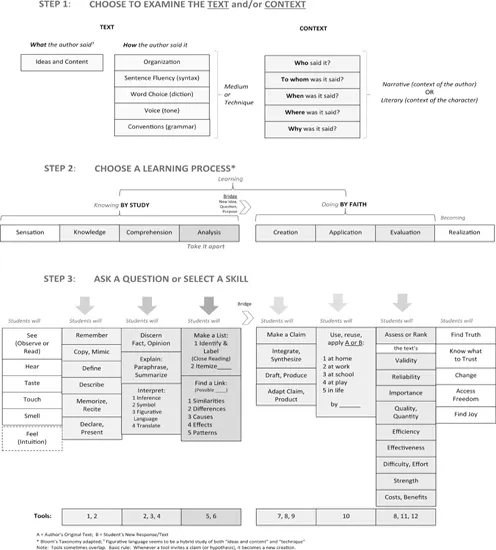
TEXT: If you choose to examine the text, you will have your students critically weigh what the author said (think ideas and content) or how the author said it (think medium or technique: organization, sentence fluency, word choice, voice, and conventions; or most literary devices). Figurative language seems to comprise a hybrid exploration examining the relationship between content and technique. Regarding what are called the six traits, many fine resources have been published by the Northwest Regional Educational Laboratory (NWREL), now Education Northwest, and developed to discuss these areas, precluding a need here to do anything but recommend their use. Other areas of the country or parts of the world use different nomenclature as indicated by popular, synonymous subscripts in parentheses in the expanded version (see Figure 7.10, p. 149). While designed as an orientation tool for teachers or administrators who want to design questions, benchmarks, assignments, or assessments more carefully, teachers may project a digital version on the board to explain the combination(s) or pathway(s) your students will be taking as you examine a text.
CONTEXT: If you choose to examine the context, you will have your students critically think about who said it, to whom, when it was said, where it was said, and why it was said (or the author’s motivation). An important distinction will surface in a later chapter as we teach students how to introduce a quotation from the text. What I am calling narrative context (after narrator) is the context of the author; what I am calling literary or dialogic context (after dialogue) is the context of the character.
Step 2: Choose a Learning Process
Learning may be understood as knowing something and doing something with that knowledge. For my purposes here, I mean to define knowing as the learning one obtains through study and doing as an act of faith, the learning one obtains through the literary equivalent of the scientific method or evidence-based inquiry. As we often do not know if our theory or creation or test (in this case, our literary analysis or other reader response) will prove true or actually work, we move forward anyway. It is that act of responding to a text without knowing if we are entirely right that enables learning. Faith as reader response, then, means to step into the unknown, the potentially flawed or problematic, and with limitations still make the attempt.
When selecting a cognitive or learning process, it usually means first establishing a foundational awareness of something—knowing it: in simple terms, to define it, to explain it, to take it apart. The most common order of approach is from left to right, but different assignments naturally vary. For example, by disassembling something first, it can help a person understand something afterward. A teacher might have a student analyze a song and then listen to it, providing both an alternative sensation as well and increased comprehension. Generally teachers have an awareness of Bloom’s taxonomy and its iterations. If not, a starting point is to ask questions or design activities that first foster students’ basic knowledge and comprehension of the text; the map (and the accompanying “Question Starters”) illustrate their basic differences. Next, to analyze something is to take it apart, to identify its pieces and relationships.
Figure 1.1 Thinking about Text: A Critical Thinking Map
Figure 1.2 Knowing (by Study)
Figure 1.3 Doing (by Faith)
Crossing the Bridge from Knowing to Doing
If a student can define something, explain it, and articulate its parts, structure, and relationships, then the student is ready to do something with that information. They are ready to create, apply, or evaluate. These learning processes are also non-linear. A learner may select any of the three and move around as needed. Usually a question or purpose (like to solve an authentic problem) invites our learners to cross the bridge from the study side of knowing to the faith side of doing. We create a claim.
Indeed, when we ask “creation” questions (like Why?), we invite our students to propose a hypothesis, for which they then gather evidence from a single source or integrate evidence from multiple sources (including their own lives), allowing their theses to change accordingly. They produce a response or solution to answer the teacher’s question or solve an observable problem or gap. Exemplary teachers help students understand how they can apply their knowledge or creation in their own lives (at home, work, school, or play) and evaluate what they create, so as to make improvements or clarify understanding.
To explain “learning processes” to younger students, perhaps the following example as it relates to car mechanics will simplify it for them:
| Knowledge: | A student at this stage knows the parts of the engine. He or she can look at pictures and match car parts with their names or uses. |
| Comprehension: | A student at this stage can explain how the engine functions. For example, the student can explain how the fuel, mechanical, or electrical systems work independently or together. |
| Analysis: | A student is here when he or she can take apart an engine, list or classify those parts in various groupings. If a car has problems, this student can trouble-shoot by listing possible causes of the problem and what affects it might have on performance. (The moment he or she develops a theory of the problem, that student has crossed the bridge into creation because he/she has formed a hypothesis.) |
| Now the student has a choice to make (crossing the bridge): |
| Creation: | The student may want to build an engine (by fixing or replicating an old one); rebuild one, possibly with parts or designs from other cars (“integration” or “inter-synthesis”); or invent an entirely new engine. (Innovation may represent the highest form of creation.) |
| Application: | The student may apply his prior knowledge by getting a job as a mechanic, or by working on his or her own car. |
| Evaluation: | The student can evaluate the old engine (from which he/ she learned) or new engine (he/she built), testing either to see if it works correctly (validity) and consistently (reliability). Maybe there’s a way to make the car more fuel efficient or cost effective. If the student-mechanic then offers a recommendation based on this evaluation, then he or she organically returns to "creation" because a claim has been made. |
Sensation and Realization indicated on the map are mentioned only briefly in this book, though a teacher may explain how listening to an engine (a sensation) can prove a helpful diagnostic, or the joy of becoming a mechanic (realization) a meaningful endeavor. Once a ...